
Expert review
Tata Sierra Review: More Than a Nostalgia Trip?

Automotive Writer · 16 October 2026 at 3:54 pm
Few Indian car launches have carried as many emotions as the new Sierra. Basically, Tata Motors has revived a nameplate that many generations associate with - an SUV that became the country's first proper lifestyle SUV has finally been reincarnated in a modern avatar. Its ARGOS platform, which sits between the ATLAS platform (used for the Curvv) and the JLR-derived OmegaArc platform (used for the Harrier and Safari), is expected to underpin the a wave of new products, right down to a Jeep built for export. The segment it has stepped into hasn't exactly been standing still either. The Hyundai Creta and Kia Seltos remain the names to beat on volume; Maruti has been a force to reckon with due to the success of the Grand Vitara and the recently launched Victoris, and even Renault and Nissan have walked back into this fight with the Duster and Tekton. Having spent proper time with the new Sierra on real Indian roads, here's my take on whether it deserves all the hype.
KEY HIGHLIGHTS
- The Sierra revives a nameplate Indian buyers have romanticised for more than three decades, built on an all-new platform.
- A segment-first triple-screen cabin, a 622-litre boot and the longest wheelbase in its class give it a footprint that nudges into territory usually reserved for a size class above.
- Three engines give the Sierra one of the broadest powertrain choices in the segment, though I found the NA Petrol can feel lethargic on highways, and the diesel's refinement still trails the segment's Korean benchmarks.
- The Sierra offers a plush ride quality even at highway speeds, while body roll is also well curtailed for an SUV this high.
SCORE BREAKDOWN
| Category | Score |
| Exterior Design | 4.5 |
| Interior & Comfort | 4 |
| Infotainment | 4.5 |
| Performance | 3.5 |
| Ride & Handling | 4 |
| Fuel Efficiency | 3.5 |
| Safety | 4.5 |
| Ownership Cost | 4 |
EXTERIOR DESIGN - 4.5 / 5
Tata's designers have successfully paid homage to the OG Sierra. The upright, boxy stance is the first giveaway, and the references to the 1991 original pile up fast, including a wide, blacked-out panel across the nose echoing the old rectangular grille, squared-off wheel arches, a high-set bonnet, and roof rails back for effect rather than actual use.
The signature touch is the side profile. The original's curved, single-piece rear glass can't pass modern crash norms anymore, so Tata's workaround uses a thick B pillar with a kink built into its window line, glossy black paint along the roof and C pillar, and a panoramic sunroof stretching nearly to the boot. From most angles, it reads as one continuous sheet of glass, recreating the spirit of the old Alpine window without literally rebuilding it, while even making the new avatar a lot more practical than its predecessor.
Then there's the size. At 4,340mm long, 1,841mm wide and 1,715mm tall on a 2,730mm wheelbase, the Sierra is among the tallest and widest SUVs in its segment, with its long wheelbase a mere 11mm shorter than the pricier Tata Harrier's. Even though the new Seltos has grown in size, the Sierra is pretty close. Top variants get 19-inch wheels, the largest offered here.
Where the design cools off is around the back, a plain, minimalist tailgate next to all that drama up front. The car rides on Tata's new ARGOS platform, an undertaking serious enough that Stellantis has confirmed it will use a Tata platform for a new Jeep SUV targeted for 2028, with industry reports identifying it as ARGOS.
INTERIOR & COMFORT - 4/5
Step inside and Tata has clearly moved away from the tight, cockpit-like layouts of its recent past towards something closer to a lounge-like experience. The cabin uses a mix of textures including cross-hatched dashboard plastic, a leatherette-wrapped mid pad, and fabric inserts. Most surfaces you'll actually touch feel padded and properly finished, and this is the most premium-feeling cabin the brand has ever put out. The light, coffee and off-white colour scheme lifts the mood further, though anyone with young kids or muddy shoes should brace for frequent cleaning. That said, certain bits, like the handrests on the door pads, feel flimsy. Also, some plastics in the lower sections of the cabin feel hard and scratchy - certainly not a deal-breaker, but a far cry from the overall upmarket ambience the cabin tries to project.
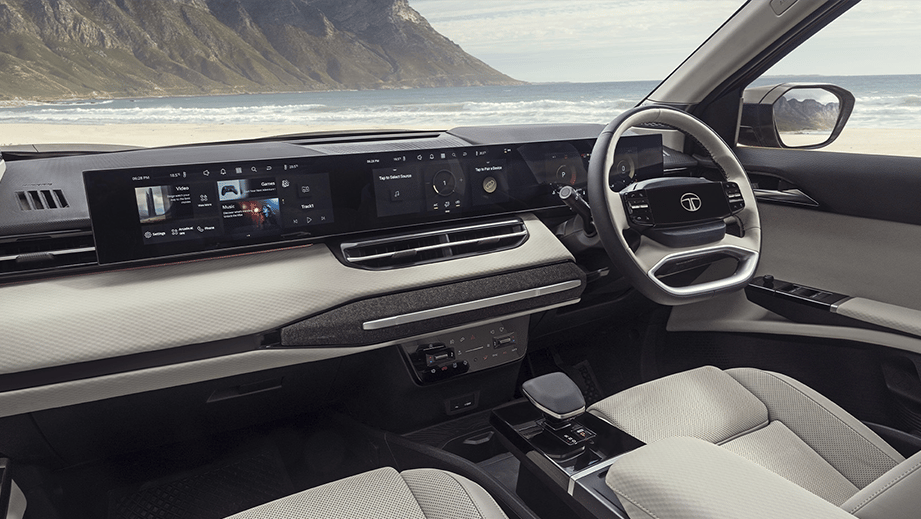
Space is where the Sierra's wheelbase advantage really shows up. Rear knee room is fairly good; one of our team members over six feet tall has reported a fist's worth of spare room behind their own driving position, and headroom stays generous thanks to that tall roofline. The rear bench takes three adults without serious complaint, and the flat floor helps the middle passenger too. Front seat comfort is good, with firm, well-shaped cushioning and, on the top trim, an extendable under-thigh support that longer drives will make you grateful for. One neat, thoughtful touch is boss mode: a lever on the front passenger seat that lets whoever's sitting behind push it forward for a proper limousine-style stretch, available from the Adventure+ trim upward.
Infotainment and Technology
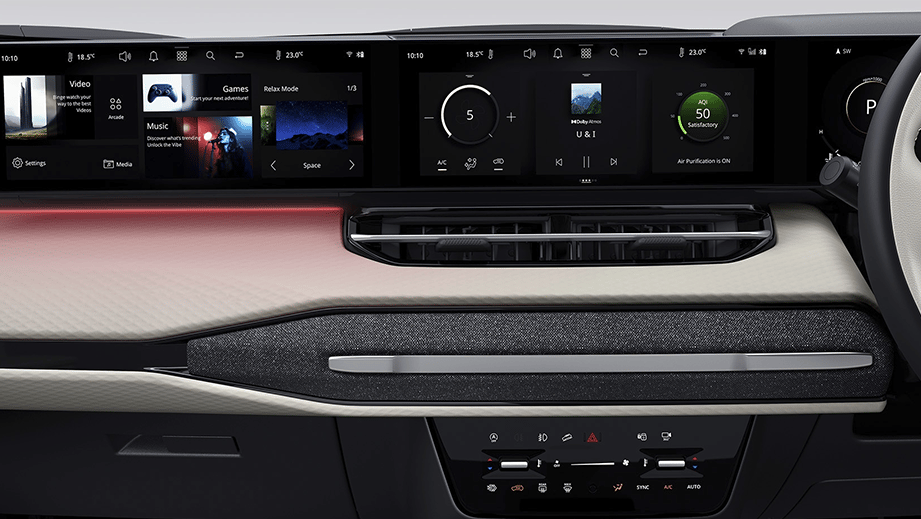
The top Accomplished+ trim gets a triple screen layout that Tata calls Horizon View: a 10.25-inch driver display, a 12.3-inch central touchscreen, and a separate 12.3-inch screen for the front passenger. All screens are crisp, quick to respond and built around an interface that doesn't need a manual to figure out. The passenger screen can stream video or music through paired wireless headphones, though the passenger screen has no privacy filter, so its content is still visible from the driver's seat at certain angles.
Elsewhere, the equipment sheet reads well, including a 12-speaker JBL system with Dolby Atmos and a dashboard-mounted soundbar, wireless Android Auto and CarPlay, a 360-degree camera with a helpful frontal view mode for blind junctions.
NVH Levels
Cabin insulation on the whole has taken a step forward for Tata, with wind and road noise kept reasonably in check at cruising speeds. The diesel is where things get vocal again, but even the petrols pick up a faint drone once you're past highway pace, something the 19-inch wheels on higher variants likely contribute to as much as the engines do.
ONE THING BUYERS SHOULD KNOW
For all the premium touches on the dashboard, the climate control panel is a touch-sensitive unit lifted straight from cheaper Tata models like the Nexon and Punch, finished in the same gloss black that shows every fingerprint within a day of ownership. Also, its usage demands you to take your eyes off the road - something a set of physical buttons would never warrant.
ENGINE & PERFORMANCE - 3.5 / 5
1.5 Naturally Aspirated Petrol- Best For: City Use and First-Time SUV Buyers
- Power: 106 PS
- Torque: 145 Nm
- Transmission Options: 6-Speed Manual, 7-Speed DCT
This is the entry point most Sierra buyers are likely to choose, if the sales pattern of the Creta and Seltos, both of which lean heavily on their own naturally aspirated variants for volume, is anything to go by. This engine runs an Atkinson cycle, which is known to make the engine operation thermally more efficient, helping in real-world fuel efficiency. However, because of the nature of these engines, they are typically offered alongside electric hybrid assistance, none of which exists in the Sierra as of now. Hence, the Sierra NA petrol feels best for city duties, usually with part-throttle inputs. The engine also feels smooth under these conditions, and the decent bottom-end torque helps with the on-tap responses at low city speeds. However, a sudden demand for power is met with a rather pronounced struggle as power delivery post 2,500 rpm is pretty much flat. Therefore, it isn't the engine I'd recommend for frequent highway use, particularly with a full load. Positively, the light clutch paired with the slick 6-speed manual further helps the case for urban dwelling. The DCT, on the other hand, is also surprisingly smooth, even if it’s not the quickest.
1.5 Diesel- Best For: High-Mileage Highway Drivers
- Power: 116-118 PS
- Torque: 260 Nm (Manual) / 280 Nm (Automatic)
- Transmission Options: 6-Speed Manual, 6-Speed Torque Converter Automatic
This is the same 1.5-litre diesel found under the Nexon and Curvv; however, Tata says the unit has been given a new state of tune along with hardware changes such as low-friction piston rings, and interestingly, the automatic gearbox gets 20Nm more torque. Power builds in a smooth, linear wave rather than any dramatic surge, which suits the relaxed, touring character the Sierra is clearly going for.
Credit where it's due, Tata is the only non-Korean brand still bothering to offer a proper diesel in this segment. That matters because diesel still accounts for a meaningful chunk of sales among the Creta and Seltos crowd, and the Sierra is positioned to catch some of that same buyer. The other benefit here for the general diesel buyers is that this variant uses a Lean NOx Trap rather than an SCR system, so it doesn't require AdBlue top-ups.
Refinement, however, is the weak point. NVH is noticeably higher than what the Hyundai Creta and Kia Seltos manage with their highly refined diesels, with the engine sounding gruffier both inside the cabin and from outside the car.
1.5 Turbo Petrol - Best For: Enthusiastic Driving and Effortless Highway Performance
- Power: 160 PS
- Torque: 255 Nm
- Transmission Options: 6-Speed Torque Converter Automatic only
Simply put, this is the pick of the range. Turbo lag is minimal, the power delivery stays linear rather than arriving in one lump, and the whole unit feels tuned with real-world drivability in mind. The 0- 100 kph run can be completed in roughly 10 seconds, and the six-speed torque converter, while not the fastest shifting unit around, is well matched to the engine's character.
What tells you Tata has actually invested serious effort here is that this same 1.5-litre Hyperion turbo petrol now also powers the pricier Harrier and Safari, albeit in a higher state of tune (168 PS and 280 Nm). Fuel efficiency hovers around 8 to 10kmpl in heavy city traffic and climbs to 14 to 16kmpl on the highway, and Tata has oddly chosen to cap the trip computer's minimum readout at 8kmpl, something that could lead to serious miscalculations.
RIDE & HANDLING - 4 / 5
Tata's SUVs have generally been strong in this department, and the Sierra mostly continues that streak. Top variants get Frequency Dependent Dampers, branded Superglide by Tata's marketing team, which use a hydraulic valve rather than any motor or sensor to automatically stiffen or soften depending on the frequency of bumps coming through. In practice, it works well: broken roads and larger potholes get absorbed with real composure, though there's some firmness at low speed on the 19-inch wheel variants that softer, taller sidewall options lower in the range likely won't suffer from as much. Braking, aided by all-wheel disc brakes as standard, feels strong and dependable across the range.
Highway Stability
At sustained highway speeds, the Sierra stays composed and doesn't feel unsettled by lane changes or sudden inputs, helped by that long wheelbase keeping things planted. Push it into a fast sweeping bend, and there's body roll, as you'd expect from something this tall, but it's controlled rather than alarming, and the chassis never feels like it's running out of grip before you do.
Handling
The steering is light, predictable, and not particularly communicative about what's happening under the front tyres, a fairly common trait across the Tata range these days. Three terrain modes, Normal, Wet and Rough, are included from the Adventure+ trim upward, and combined with 205mm of ground clearance, the Sierra handled a light off-road trail without much drama. What's missing entirely, at least for now, is All Wheel Drive. Despite the original Sierra's rugged reputation, this new one is strictly Front Wheel Drive at launch, though Tata's leadership has confirmed an AWD version planned for the ICE lineup by 2027. The ARGOS platform is engineered to accept it whenever that call gets made.
FUEL EFFICIENCY - 3.5 / 5
| Engine Options | Fuel Type | Transmission | ARAI Claimed Efficiency |
| 1.5L NA Petrol (1498cc) | Petrol | 6-Speed Manual | 17.4 kmpl |
| 1.5L NA Petrol (1498cc) | Petrol | 7-Speed DCT | 16.9 kmpl |
| 1.5L Turbo Petrol (1498cc) | Petrol | 6-Speed Automatic | 15.3 kmpl |
| 1.5L Turbo Diesel (1497cc) | Diesel | 6-Speed Manual | 21.26 kmpl |
| 1.5L Turbo Diesel (1497cc) | Diesel | 6-Speed Automatic | 19.22 kmpl |
Tata's own claimed range across the lineup spans roughly 16.9 to 21.26kmpl, with the manual diesel sitting at the top of that scale and the automatic turbo petrol anchoring the bottom. None of the three engines currently come with a hybrid or CNG option, both of which the ARGOS platform is technically built to support down the line.
SAFETY - 4.5 / 5
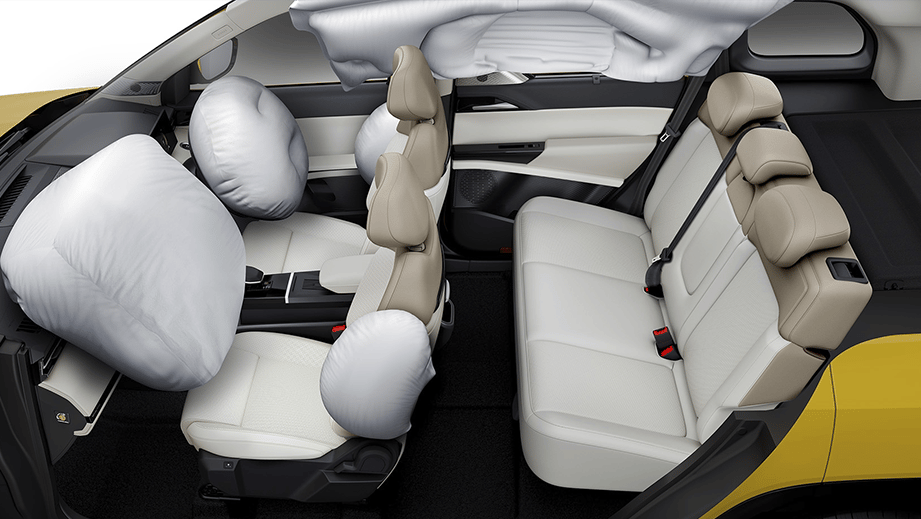
The Tata Sierra has earned a full 5-star rating from Bharat NCAP in both adult and child occupant protection categories. It scored 31.14 out of 32 points for adult occupant protection and 44.73 out of 49 for child occupant protection, with most critical body regions rated Good and only a handful, like chest and tibia protection, coming in at the slightly lower Adequate band. Standard safety kit across the entire range includes:
- 6 airbags
- Electronic Stability Programme
- Hill descent control
- All-wheel disc brakes
- Electronic parking brake with auto hold, standard from the base variant
Higher variants add a Level 2 ADAS suite with adaptive cruise control, automatic emergency braking, lane keep assist and blind spot monitoring. ADAS features start from the Accomplished trim (13 features), while Accomplished+ gets additional ADAS functions (22 features).
WHICH TATA SIERRA SHOULD YOU BUY?
| Engine Option | Transmission | Base-Level Trim | Mid-Level Trims | High-End Trims | Best Suited For |
| 1.5L NA Petrol | 6-Speed Manual | Smart+ | Pure, Pure+, Adventure, Adventure+ | Accomplished, Accomplished+ | Budget buyers |
| 1.5L NA Petrol | 7-Speed DCT | Not Available | Pure, Pure+, Adventure | Not Available | City commuters |
| 1.5L Turbo Diesel | 6-Speed Manual | Smart+ Diesel | Pure Diesel, Pure+ Diesel, Adventure Diesel, Adventure+ Diesel | Accomplished Diesel, Accomplished+ Diesel | Buyers with high mileage usage |
| 1.5L Turbo Diesel | 6-Speed Automatic | Not Available | Pure Diesel AT, Pure+ Diesel AT, Adventure+ Diesel AT | Accomplished Diesel AT, Accomplished+ Diesel AT | Diesel buyers wanting effortless cruising |
| 1.5L Turbo Petrol | 6-Speed Automatic | Not Available | Adventure+ Turbo | Accomplished Turbo, Accomplished+ Turbo | Drivers looking for performance or drive frequently on highways |
CARS24 EXPERT PICK
Adventure+ Turbo
This is the variant we'd point most buyers toward. What you get:
- An engine that's actually fun to drive
- Frequency Dependent Dampers and boss mode, both usually reserved for pricier trims
- 18-inch wheels, a 12.3-inch touchscreen and three terrain modes
- All this without paying Accomplished-grade money for a third screen you may rarely use
It skips the top trim's triple screen and Level 2 ADAS, but for most families, this is where the Sierra's price and its actual everyday usefulness line up best.
RIVALS
Hyundai Creta
The segment's long-standing benchmark, with a wide service network and a stronger resale track record than a brand new nameplate can claim yet. It concedes real ground to the Sierra on cabin space and outright boot volume, though.
Kia Seltos
Bolder to look at and every bit as feature-loaded, with a properly sporty turbo petrol DCT combination of its own. It costs a touch more for comparable equipment.
Maruti Grand Vitara and Victoris
Both bring a strong hybrid option to the table that neither the Sierra nor most rivals can currently match on fuel bills, backed by Maruti and Toyota's shared reputation for painless ownership. Neither feels as spacious or as premium and loaded as the Sierra does.
Toyota Urban Cruiser Hyryder
Shares its hybrid hardware with the Grand Vitara and adds Toyota's own after-sales reputation into the mix, a real consideration for buyers who rank peace of mind above anything else, though it suffers from the same shortcomings as the Maruti unit.
FINAL VERDICT - 4.2 / 5
The compact SUV segment in India is highly crowded, arguably the country's most competitive, and cars here have a knack for offering performance and premium features that, until a few years ago, were reserved for higher segments. The Sierra fits that mould well. It offers real presence, proper space, and a features list that reads as if it belongs on something costing considerably more. In fact, it strikes a clever balance between size, aesthetics, features and price that even Tata's larger SUVs can't quite match.
Where does that leave the rest of the segment? Japanese rivals have generally leaned on class-leading reliability and running cost advantages like CNG and hybrids, and German entrants have built their case around driving dynamics. But the cars that have actually made this segment aspirational to thousands of Indian car buyers wear Korean badges. The Sierra, meanwhile, brings that same aspirational quality to the table, wrapped around a nameplate with real emotional pull behind it. In my belief, ironing out the fit and finish niggles, improving the NA Petrol’s performance, and working on its after-sales experience is all that Tata Motors needs to give the Koreans and the Japanese rivals a serious run for their money.
- Exterior
- 4.5 / 5
- Interior
- 4.0 / 5
- Infotainment
- 4.5 / 5
- Safety
- 4.5 / 5
What works
- Best for buyers looking for the biggest cabin, tonnes of features, 5-star safety reassurance and among the strongest road presence in the compact SUV bracket.
- Buy if you want an SUV that feels a tad unique on the outside, and practical and feature-laden on the inside. It’s even a good option for buyers that are typically eyeing a turbo-petrol vehicle.
Worth knowing
- Skip if you are particularly looking at the base NA petrol engine for highway duties or a diesel SUV with good NVH levels. Also, fit-and-finish and after-sales are far from segment-leading.