
Expert review
Tata Tiago EV Expert Review: Refreshed and Energized!

Automotive Writer · 20 October 2026 at 3:02 pm
India's cheapest route into a proper five-door electric hatchback has worn the Tiago EV badge since September 2022, and for most of that stretch it did so without a single direct rival worth cross-shopping. That changed once the MG Comet EV and Citroen eC3 arrived, and it is changing again now that Tata's own Punch EV now starts just below the Tiago EV's range-topping variant while offering a larger battery while packing a noticeably bigger battery.
Key Highlights
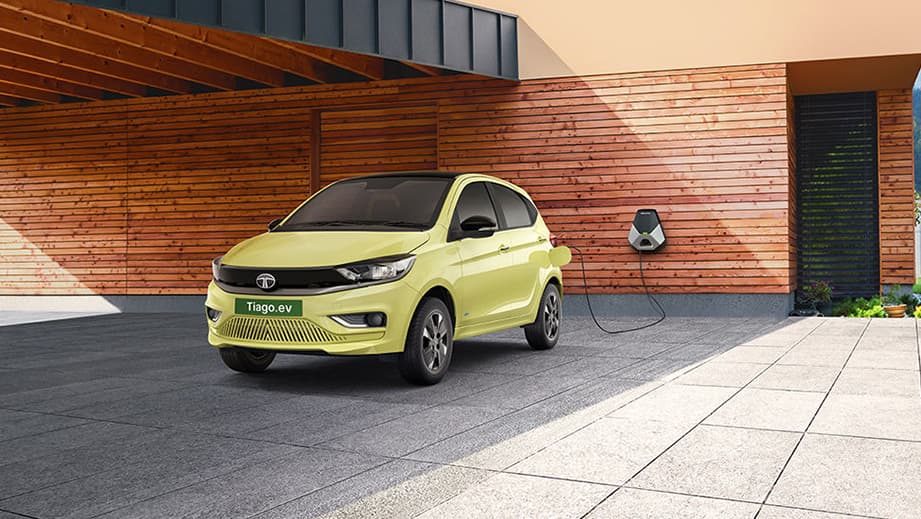
- This mid-life refresh trades the old car's chrome and gloss-black trim for a cleaner, more purpose-built EV face, though the blanked-off nose won't suit every taste and the 14-inch wheels still look a size too small under the newly clad arches.
- Tata actually cut prices with this update by as much as roughly Rs 1.15 lakh, making it cheaper at the lower end compared to the MG Comet EV, though the basic variant is more fleet-focused.
- DC fast charging climbs from 25kW to 30kW, though the 19.2kWh and 24kWh battery packs underneath carry over from the outgoing car untouched, so driving range has barely moved.
- Cabin fit and finish remains the Achilles' heel on an otherwise likeable package.
Tata rolled out a comprehensive facelift in May 2026, one that updated most of the visual appeal, screen and safety package on the car while retaining the existing 19.2kWh and 24kWh battery options and front-mounted motor setup.. Having spent considerable time around small EVs in this segment, we recently got to explore the updated Tiago EV to understand if its core appeal, as an unintimidating first step into electric motoring for buyers who mostly stay within city limits, remains intact or not.
Score Breakdown
| Category | Score |
| Exterior Design | 3.5 |
| Interior & Comfort | 3.2 |
| Infotainment & Technology | 4 |
| Performance | 3.3 |
| Ride & Handling | 4 |
| Range & Charging | 3.4 |
| Safety | 4 |
| Ownership Cost | 4.2 |
Exterior Design - 3.5 / 5
The new face is where this facelift makes its loudest statement. Where the outgoing Tiago EV differed from its petrol sibling mostly in badging, this one gets a body-coloured, closed-off grille that reads as properly its own design rather than a petrol car wearing an EV costume. Slim LED headlamps with brow-shaped daytime running lights flank the nose, while the fog lamps have been deleted.
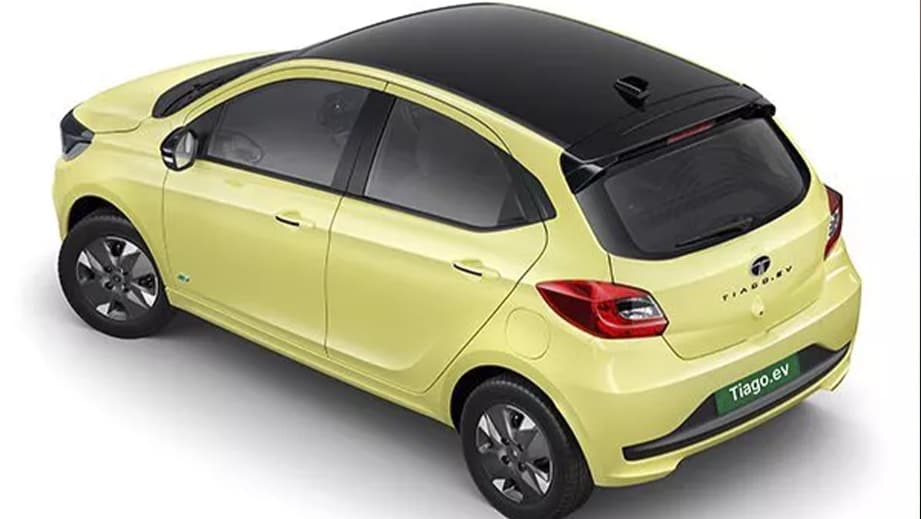
Along the sides, the wheel-arch cladding does a fair job of freshening up the profile. Less convincing are the 14-inch wheels, which now look a touch undersized inside those newly bulked-out arches. Even the range-topping Creative Plus trim makes do with dressed-up steel wheels rather than true alloys. Blacked-out ORVMs, a contrasting roof colour, chrome door handles and a shark-fin antenna round out the side treatment nicely.
The rear is arguably the more successful half of this redesign. New tail-lamp internals create a horizontal light bar flanked by two vertical elements, and while the centre section gives an impression of the lights being connected, it does not glow as one unified strip the way Tata's Punch EV manages. Dimensionally, the car measures 3,825mm long, 1,684mm wide and 1,562mm tall on a 2,400mm wheelbase.
Interior & Comfort - 3.2 / 5
Step inside and the cabin feels like it belongs to a different generation of car altogether. Grey fabric now runs across the dashboard and door pads above a black lower half.
The centre console now gets two rubberised phone holders in place of the outgoing car’s wireless charging pad., one of which sits near a 65W USB-C port capable of fast-charging a compatible phone. The rotary drive selector feels a shade quicker to respond than before, though its backlighting stays faint enough that confirming your selection at a glance, especially after dark, takes a moment longer than it should. Regenerative braking level and camera controls sit as physical buttons below the touchscreen, which at least means you are not hunting through menus mid-drive.
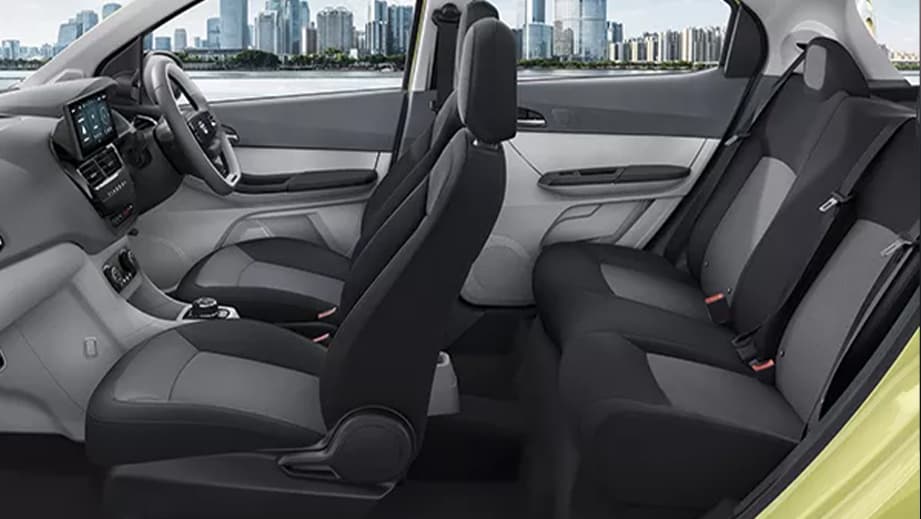
Seat comfort has improved through revised cushioning, better bolstering and stronger under-thigh support, and most average-sized occupants will find the front seats agreeable enough for a long day. Adjustable headrests are conspicuously absent though, which is an odd omission on a car launched in 2026. The rear bench suits four adults comfortably, and the rear air-conditioning vents are a welcome and overdue addition.
Boot space is rated at 240 litres, identical to the petrol Tiago, and swallows a handful of small trolley bags without complaint. There is no front boot the way Tata's newer, ground-up EVs like the Punch EV offer, and no spare wheel either, just a puncture repair kit and an electric tyre inflator tucked under the boot floor.
Fit and finish is where this cabin lets itself down. Loose panels, uneven gaps and rough edges are not hard to spot even on a fresh car straight off the line, and they take some shine off what is otherwise a thoughtfully designed interior.
Infotainment and Technology
The Creative Plus gets a 10.25-inch touchscreen while the Pure Plus makes do with an 8-inch unit, both running wireless Android Auto and Apple CarPlay. The digital instrument cluster is essentially a small monochrome panel at the centre flanked by coloured strips showing regeneration level and remaining charge, and while the centre section stays legible in most conditions, those coloured side strips wash out badly under direct sunlight.
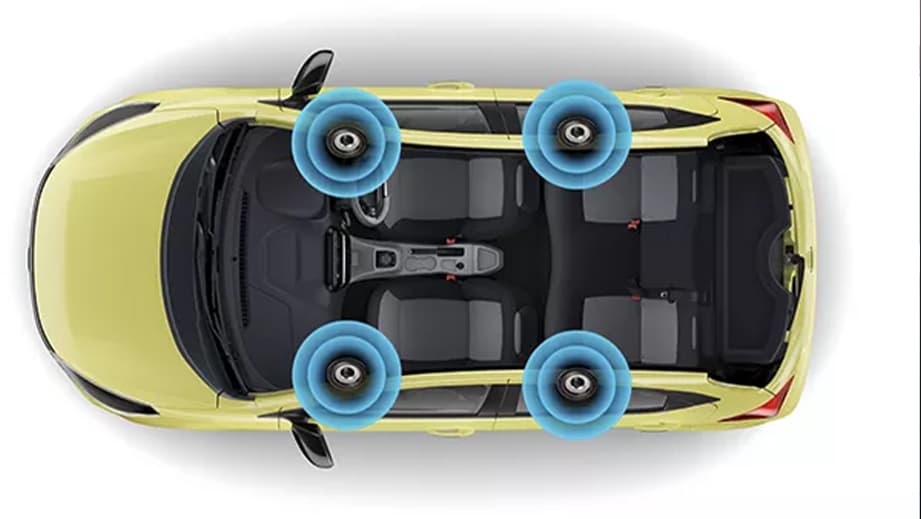
Tata's iRA.ev connected car suite bundles more than 40 features, from remote commands to charging status and geofencing to smartwatch pairing. The 360-degree camera with blind-spot monitor is a first for this car and adds real everyday value, though it takes over the entire touchscreen when active, which can be distracting if you happen to be relying on the map at the same time. One casualty of this update is the old Harman sound system, replaced by a plain four-speaker setup with the tweeters gone, a downgrade anyone who cared about in-car audio will notice within the first song.
NVH Levels
With no engine to speak of, the cabin stays properly quiet around town. Push on toward highway speeds and road and wind noise begin to creep in more than you would like, not overwhelming, but enough that this remains a car happiest inside city limits rather than eating up long, fast stretches of tarmac.
One Thing Buyers Should Know
Several features sit on the range-topping petrol Tiago yet are deliberately left off the EV to protect its pricing, among them wireless phone charging, fog lamps, a rear USB-C port and 15-inch alloy wheels. Rear wiper and washer, along with ESP and traction control, are also reserved solely for the Tiago EV’s Creative Plus trim.
Motor & Performance 3.3 / 5
19.2 kWh (Medium Range) Best For: City buyers watching the budget
- Power: 60 hp (45kW)
- Torque: 110 Nm
- Transmission: Single-speed reduction gear
This is the entry point into Tiago EV ownership, and it does the job around town without much fuss. ARAI's claimed range sits at 226km, though everyday use, especially with the air conditioning working overtime and a full complement of passengers, will likely land somewhere between 150 and 170km on a full charge. Acceleration feels adequate for weaving through traffic but noticeably less eager than the bigger battery's motor once speeds climb past 60 km/h.
24 kWh (Long Range) Best For: Buyers who have longer commutes with open stretches of road
- Power: 75 hp (55kW)
- Torque: 114 Nm
- Transmission: Single-speed reduction gear
Tata claims a 0-60kph sprint of 5.7 seconds for this version, and in practice the motor delivers its torque smoothly enough. Two drive modes are on offer: City, which caps output for a gentler, more predictable rollout, and Sport, which frees up the rest for a noticeably livelier feel, particularly useful for quick overtakes. Power builds with confidence up to around 105 to 110 km/h before tapering off. Four levels of regenerative braking, including a Level 0 setting that switches regeneration off entirely, let you tailor how much the car slows itself when you lift off the accelerator, though true one-pedal driving is not on offer here.
Ride & Handling 4 / 5
The suspension of the Tiago EV has been retuned for this generation and shrugs off potholes and rough patches with composure. What remains a fact, though, is that the added mass of the battery pack means this car still rides a shade firmer than the standard petrol Tiago.
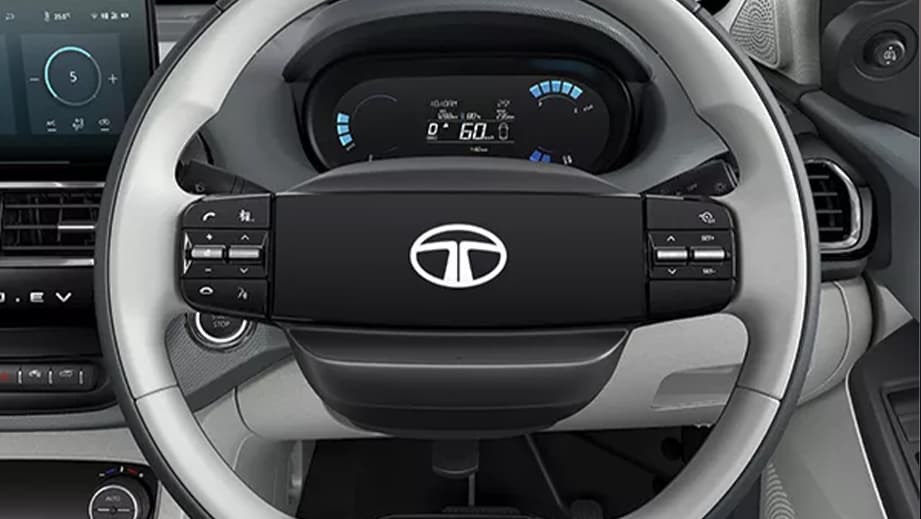
Steering stays light in both drive modes, making the car a pleasure to thread through traffic and slot into tight parking spots. Braking has a progressive pedal that inspires confidence in everyday driving, though the low-rolling-resistance tyres fitted to stretch range can feel out of their depth under hard braking from real speed.
Highway Stability
The car stays settled and composed at the sort of 80 to 100 km/h cruising speeds most Indian highway trips actually involve. Push beyond that and wind and road noise build noticeably, while the range gauge starts dropping quickly.
Handling
Light, easy steering makes tight streets and parking manoeuvres a non-event. Body control stays predictable with contained lean through corners for a car of this height, and nothing about the way it changes direction feels unsettled at sensible speeds, even if outright steering feedback remains in short supply.
Range & Charging 3.3 / 5
| Battery | ARAI Claimed Range | Estimated Real-World Range | Motor Output |
| 19.2 kWh | 226 km | approx. 150-170 km | 60 hp / 110 Nm |
| 24 kWh | 285 km | approx. 185-200 km | 75 hp / 114 Nm |
The Tiago EV’s smaller pack's ARAI figure crept up only slightly over the outgoing car, and the bigger pack's number moved even less. Tata's own internal C75 real-world figures for the 24kWh version are somewhere around 205 to 215km, while our independent test loops have returned closer to 185 to 200 km. For a typical 40–50km daily commute, either battery should require only two or three charging sessions a week.
On the charging side, the standard 3.3kW charger takes a 10 to 100 per cent top-up to roughly 6.9 hours on the smaller pack and 8.7 hours on the larger one. Step up to the optional 7.2kW AC wall box, and those figures drop to about 2.6 and 3.6 hours, respectively.
The bigger news sits with DC fast charging, which grows from 25kW to 30kW, bringing a 20 to 80 per cent charge down to around 30 minutes for either pack.
Safety 4 / 5
Six airbags now come standard across the entire range. ABS with EBD, ISOFIX child-seat anchors and a tyre pressure monitoring system, which flags a drop rather than showing a live reading, round out the standard fitment.
A reversing camera arrives from the Pure Plus trim upward, while the 360-degree camera, blind-spot monitor, electronic stability programme and traction control are all held back exclusively for the Creative Plus.
On crash-test credentials, the Tiago EV shares its underlying structure with the petrol Tiago, which holds a 4-star Global NCAP (pre-facelift model) rating for adult occupant protection and 3 stars for child occupant protection. The EV version itself has not been independently crash-tested by either Global NCAP or Bharat NCAP as things stand.
Which Tata Tiago EV Should You Buy
| Variant | Battery | Ex-showroom Price | Best Suited For |
| Smart | 19.2 kWh | Rs 6.99 lakh | Budget-conscious, safety-first city buyers |
| Pure Plus | 19.2 kWh | Rs 8.49 lakh | Touchscreen convenience without the bigger battery |
| Pure Plus | 24 kWh | Rs 9.49 lakh | A longer-legged battery plus everyday convenience |
| Creative Plus | 24 kWh | Rs 9.99 lakh | The full features list |
Expert Pick: Pure Plus 19.2 kWh / Creative Plus 24 kWh
Our pick of the range is the Pure Plus with the 19.2 kWh battery if you are very tight on budget and have a pre-determined, short city commute. It brings together all the must-have features at around Rs 8.5 lakh.
However, if you can extend, the Creative Plus 24 kWh is the overall most VFM variant. It brings the larger battery as standard (including lifetime battery warranty), and for a mere Rs 50,000 upgrade over the comparable Pure Plus Variant, it brings in a tonne of useful features.
Rivals
MG Comet EV
The smallest and quirkiest option at this price point, a true 2-door, 4-seat micro EV rather than a proper five-door hatchback. Its 17.3kWh battery and roughly 230km claimed range trail well behind the Tiago EV's bigger pack, though its tiny footprint, under 3 metres long, makes it easier to park in the tightest of spots. That comes at the cost of usable boot space and rear-door practicality.
Citroen eC3X
Styled more like a micro SUV and priced meaningfully higher, starting near Rs 11.99 lakh. Its 29.2kWh battery and claimed range in the mid-300km bracket give it an edge, at least on paper. It is also noteworthy that Tata's dealer network stretches considerably further than Citroen's across most of the country.
Tata Punch EV
Arguably the Tiago EV's toughest rival is parked in the very same showroom. Punch EV pricing starts just a little less than the Tiago EV's range-topping variant at Rs 9.69 lakh, yet it brings a bigger 30kWh or 40kWh battery, noticeably more real-world range, a proper front boot (frunk), and the added road presence and headroom that comes with a small SUV shape. Anyone whose budget can stretch that far owes it to themselves to cross-shop before signing on the Tiago.
Final Verdict
3.9 / 5
The Tata Tiago EV’s value proposition as an affordable sub-10 lakh electric car with respectable safety, equipment, and space for four is solid. The recent facelift adds to that with a sharper, more purpose-built face, a noticeably nicer cabin, six airbags as standard, quicker DC charging, and, most importantly for anyone nervous about EV ownership, a lifetime warranty on the bigger battery.
Yes, fit and finish could have been better, and anyone with the budget to stretch toward the showroom-mate Punch EV should think it through before committing here instead.
However, judged as what it actually set out to be, the easiest and cheapest way for a city-bound Indian household to go electric without changing how they live, the Tiago EV facelift does that job better than the car it replaces, and at its current price, the case for it is hard to argue against.
- Exterior
- 3.5 / 5
- Interior
- 3.2 / 5
- Performance
- 3.3 / 5
- Range
- 3.4 / 5
- Safety
- 4.0 / 5
What works
- Best for first-time EV buyers with dependable home or workplace charging and a daily one-way radius under 50km.
- Best if you want the lowest all-in cost of owning a proper five-door EV, backed by Tata's lifetime battery warranty on the bigger battery.
Worth knowing
- Skip if you regularly cover 200km-plus days and have the budget to extend to the Punch EV.