
Expert review
Tata Sierra EV Review: Old-School Cool, New-School Current

Automotive Writer · 20 October 2026 at 3:20 pm
About two decades ago, it would have been easier to predict flying cars than the Sierra nameplate returning with an electric powertrain. Yet here we are, with Tata not only reviving the iconic nameplate but also giving it an all-electric avatar. The Sierra EV is easily among Tata’s most ambitious mass-market electric SUVs yet, blending the familiar silhouette with a modern electric drivetrain and a far more premium cabin. The hype around its return is understandable, but does the Sierra EV actually live up to the promise? After spending time with it, here’s where Tata’s latest EV impresses and where it still leaves room for improvement.
KEY HIGHLIGHTS
- Tata resurrects its cult SUV nameplate for the second time in twelve months, this time as a battery-electric SUV that keeps the boxy, upright shape people associate with the badge.
- A dual-motor, all-wheel-drive (QWD in Tata speak) undercuts almost every rival's 0 to 100 km/h time at a claimed 5.8 seconds.
- Space and equipment are among the strongest in the segment, but Tata hasn't fully shaken off its reputation for inconsistent cabin quality, and there's no spare wheel anywhere in the lineup.
- The larger battery pack can realistically cover around 500 kilometres between charges, and the battery itself carries a 15-year, unlimited-kilometre warranty for the first owner.
SCORE BREAKDOWN
| Category | Score |
| Exterior Design | 4.3 / 10 |
| Interior & Comfort | 4.3 / 5 |
| Infotainment & Technology | 4.5 / 5 |
| Performance | 4.3 / 5 |
| Ride & Handling | 4 / 5 |
| Range & Charging Efficiency | 4 / 5 |
| Safety | 4.5 / 5 |
| Ownership Cost | 3.2 / 5 |
EXTERIOR DESIGN - 4.3 / 5
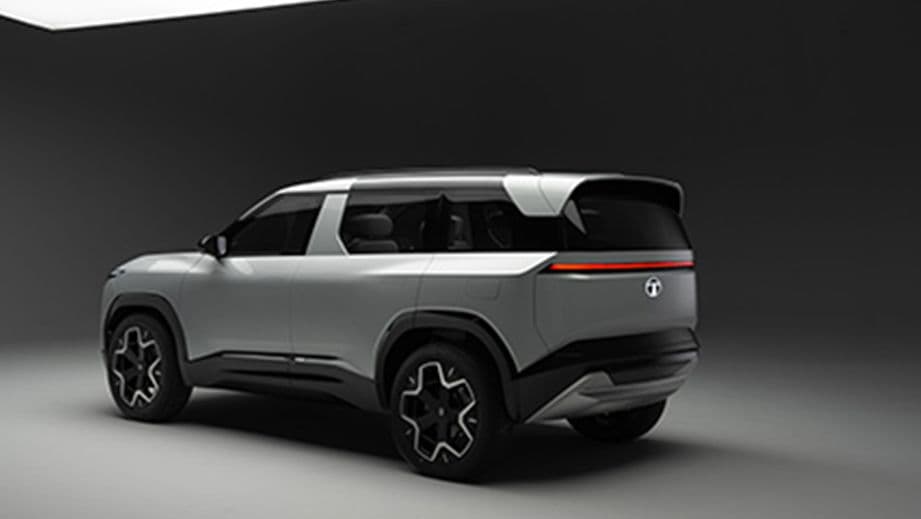
Squint at a Sierra EV in traffic and you could easily mistake it for its combustion sibling, and that is very much intentional. Rather than reshaping the body into the softer, pebble-like form so many EVs adopt to shave off a bit of drag, Tata left the boxy roofline, the towering glasshouse and the upright nose almost exactly as they were on the ICE car. The clearest giveaway sits at the nose: the metal grille has disappeared behind a flush, body-coloured panel, and the gloss-black treatment that once wrapped around the headlamps now appears on the lower bumper instead.
Numbers on paper put the Sierra EV at 4,340mm end to end, 1,841mm across and 1,750mm tall, riding on a 2,730mm wheelbase.
If there's one styling detail worth tweaking, it's the lighting; both headlamps and tail lamps read as a touch undersized against such broad, flat surfacing, and a chunkier light signature at the rear especially would balance out that wide tailgate more convincingly.
INTERIOR & COMFORT - 4.3 / 5
The first impression climbing aboard is of how much Tata has carried over unchanged from the combustion Sierra. Cream-toned leatherette wraps the dash, a fabric panel dresses up the soundbar, and the whole effect reads more upmarket than most cabins wearing a Tata badge have managed before.

Front occupants sit in generously bolstered seats, and rear-seat passengers fare just as well. A dead-flat floor lets three adults sit shoulder to shoulder without anyone's feet fighting for space, and the sheer amount of glass overhead keeps the cabin feeling airy. A panoramic sunroof and a backrest with a touch of recline round out a rear bench built with long family road trips in mind.
A few ergonomic decisions haven't aged as well as the overall design. The pedestal-style gear selector, for instance, sits at a natural height for your hand, but everything stashed beneath it suffers as a result, since the resulting cubby is too narrow and set too deep to swallow much beyond a phone and a set of keys. The cupholders, oddly, sit right down at the base of the dashboard rather than somewhere more reachable. Also, the umbrella holders on each door pad have no drain hole. Quality control is also where the cabin's ambitions run into Tata's oldest, most stubborn weakness.
Infotainment and Technology
Tech is where the cabin earns back most of its goodwill. Three screens make up the Horizon View setup: a 10.25-inch instrument cluster, a 12.3-inch touchscreen for infotainment, and from the Empowered trim upward, a second 12.3-inch display for the front passenger, who can stream a show or run a game on it. A 12-speaker JBL Black system handles sound, complete with Dolby Atmos and a fabric-covered SonicShaft soundbar built into the dash.
Perhaps the cleverest bit of software here ties navigation to your battery status: plug in a destination and the system works out what charge you'll arrive with, flagging a charging stop early enough that you're never caught planning one in a panic.
Menu navigation on all three screens is quick, and the graphics render cleanly, though the driver's cluster tries to pack in a touch too much information at a glance.
NVH Levels
Silence is the Sierra EV's biggest party trick at low speed. However, that silence turns into a mixed blessing as your speed climbs past 90 or so, since there's nothing left to drown out the faint whistle of wind working its way around the tall A-pillars and glasshouse. It is not loud enough to wear you down on a long stint, but you'll notice it because everything else about the cabin is so hushed.
ONE THING BUYERS SHOULD KNOW
Every Sierra EV, regardless of trim or battery size, comes without a spare wheel of any description. In its place sits a puncture repair kit, and there isn't even a recess carved into the boot floor for owners determined to travel with a spare of their own.
PERFORMANCE & POWERTRAIN - 4.3 / 5
63 kWh RWD Best For: First-time Sierra EV buyers chasing the lowest entry price into the range
- Power: 238 PS
- Torque: 315 Nm
Drive Type: Single motor, rear-wheel drive
This is the logical entry point for buyers looking to get into the Sierra EV at the lowest price. The single motor on the rear axle has enough muscle for brisk city overtakes and effortless highway merges, even if it can't match the flagship's theatrics. Anyone whose daily commute rarely exceeds a hundred kilometres won't find themselves wanting more, and the lower asking price makes this the logical entry point into the range.
75 kWh RWD Best For: Highway regulars who want the longest range without paying for AWD hardware they'll rarely use
- Power: 209 PS
- Torque: 315 Nm
- Drive Type: Single motor, rear-wheel drive
Curiously, the bigger 75kWh battery doesn't come with any extra motor output; it's, in fact, lower at 209 PS (vs 238 PS). The torque, though, stays unchanged at 315 Nm. What you're really paying for here is the longer distance between charges, and a claimed MIDC figure of 665 kilometres is properly hard to beat at this price. Pick this over the base car if range matters more to you. Also, there's little reason to stretch further to the QWD unless all-wheel drive is on your checklist.
75 kWh QWD (AWD) Best For: Buyers who want the quickest, most capable Sierra EV and the reassurance of all-wheel traction
Power: 306 PS combined (Individual motor peak outputs: 209 PS rear motor paired with a 140 PS front unit)
Torque: 504 Nm
Drive Type: Dual motor, Tata's QWD all-wheel-drive system
Bolt a second motor onto the front axle and the numbers shift up to a combined 306 PS and 504 Nm, enough for Tata to claim 5.8 seconds to 100 km/h with Boost mode selected. It feels every bit as quick in the real world, without ever becoming wild or unruly, which suits a family-oriented SUV rather well.
Ease off the line gently, though: there's a noticeable gap right at the very start of the accelerator's travel before power arrives. Push hard from a standstill, and a faint tug comes through the steering wheel too, since routing over 500Nm through the front tyres isn't entirely without consequence.
Four selectable modes: City, Eco, Sport and Boost, change how eager the throttle feels how eager the throttle feels, and there’s a Drift mode as well that dials back the electronic safety net and biases power to the rear wheels.
RIDE & HANDLING 4 / 5
Ride quality has long been one of Tata's strong suits, and that reputation survives the switch to electric power, even if the Sierra EV doesn't glide over bad roads with quite the same ease as its combustion twin. Underneath sits what Tata brands Ultra Glide suspension, essentially dampers that read road speed and surface texture and adjust their stiffness on the fly, and the setup absorbs potholes and cracked tarmac with composure.
Carrying a heavier battery low in the floor has firmed up the overall tune compared with the ICE car, so pottering around town over broken patches feels stiffer than it used to, though it never crosses into the harshness some rival EVs are guilty of. Wind the speed up toward highway cruising territory, though, and that firmer setup feels more composed as speeds rise
Highway Stability
Speed is where this chassis feels most convincing. Broken expansion joints and mid-corner ripples barely register through the cabin.
Handling
Steering weight is tuned for city driving above all else: light enough at parking speeds to need barely any effort, and it builds a sensible amount of heft as velocity increases.
The QWD adds six terrain modes, Normal, Snow or Grass, Mud and Ruts, Sand, Rock Crawl and a Custom setting.
Stopping power itself is strong, though the brake pedal's initial bite feels softer and spongier underfoot than the car's outright pace would suggest. Carrying north of two tonnes in QWD guise does introduce some body roll through a set of corners, but it stays predictable and never tips into anything alarming.
RANGE & EFFICIENCY 4 / 5
| Variant | MIDC Range (Claimed) | C75 Range (Real-World) | 7.2 kW AC Charging (10–100%) |
| 63 kWh RWD | 535 km | 440 – 460 km | 8.9 hours |
| 75 kWh RWD | 665 km | 510 – 530 km | 10.5 hours |
| 75 kWh AWD | 624 km | 480 – 500 km | 10.5 hours |
The 63kWh RWD is certified at 535 kilometres on the MIDC cycle, the bigger 75kWh RWD stretches that to 665 kilometres, and the QWD, despite the extra motor and hardware, still manages 624 kilometres.
Fast charging numbers are respectable, with both battery sizes accepting DC power at up to roughly 120kW, enough to go from 20 to 80 per cent charge in about 26 minutes at a compatible station. As far as home charging goes, the charger bundled as standard manages just 3.3kW, and getting to a more usable 7.2kW means paying additional.
SAFETY 4 / 5
Bharat NCAP hasn't put the Sierra EV itself through a crash test yet. What we do know is that the combustion version it's built on earned a 5-star rating, scoring 31.14 out of 32 for adult occupant protection and 44.73 out of 49 on the child protection front.
Every Sierra EV, regardless of trim, comes with six airbags, stability control system, hill descent control, tyre pressure monitoring, and a low-speed pedestrian alert system, since an EV creeping along in near silence can easily catch someone off guard. Move up to Empowered A and the list expands to:
- Level 2+ ADAS with 23 key features
- 540-degree surround camera setup, including a transparent view of what's under the car
- Self-parking assist that can also summon the car remotely
- A digital rearview mirror that doubles up as a dashcam
WHICH TATA SIERRA EV SHOULD YOU BUY?
| Variant | Battery | Ex-showroom Price |
| Pure 63 | 63 kWh | Rs 18.79 lakh |
| Pure S 63 | 63 kWh | Rs 19.99 lakh |
| Adventure 63 | 63 kWh | Rs 20.99 lakh |
| Adventure 75 | 75 kWh | Rs 22.19 lakh |
| Empowered 63 | 63 kWh | Rs 22.79 lakh |
| Empowered 75 | 75 kWh | Rs 23.79 lakh |
| Empowered A 75 | 75 kWh | Rs 24.79 lakh |
| Empowered A 75 QWD | 75 kWh | Rs 25.99 lakh |
CARS24 EXPERT PICK
Empowered 75 kWh RWD
This is the sweet spot of the range. What you get:
- The longest claimed configuration in the lineup at 665 kilometres MIDC
- The full Horizon View triple-screen setup and JBL Dolby Atmos sound system
- Powered, ventilated front seats with a memory function and dual-zone climate control
- A panoramic sunroof and ambient lighting that lift cabin ambience noticeably
- A price that sits comfortably below the QWD flagship
Skip this for the QWD only if all-wheel drive or a taste for light off-roading actually factors into how you'll use the car. Otherwise, this trim covers nearly everything the range-topping QWD offers, for meaningfully less money and without giving up on range, tech or comfort.
RIVALS
Mahindra BE 6
Mahindra's answer leans harder into unconventional styling and offers a slightly larger battery option, and it's priced closely enough to compete head-on. What it doesn't offer is all-wheel drive at any price point.
Hyundai Creta Electric
The Creta Electric starts at a similar price and leans on Hyundai's more established sales and service quality. It comes up short against the Sierra EV on battery size, range and outright cabin space, though its more conservative styling may suit buyers who'd rather not stand out quite so much.
Maruti Suzuki e-Vitara
Smaller, considerably cheaper, and easier to live with for someone taking their first step into EV ownership, the e-Vitara trades outright space and performance for a lower asking price and Maruti's reputation for reliability and after-sales.
Tata's Own Curvv EV and Harrier EV
The Sierra EV doesn't just compete with outside rivals; it has to justify its place between two siblings. The Curvv EV undercuts it substantially on price with a smaller footprint and battery, while the Harrier EV sits a notch above with a larger footprint. Anyone cross-shopping within Tata's own EV lineup should treat the Sierra EV as the size and price sweet spot between the two.
FINAL VERDICT 4 / 5
The Sierra EV is the most well-rounded electric vehicle that Tata Motors has built to date. It backs up a shape that refuses to blend in, with a features list that shames cars well above its price, and range figures that extend up to 500 km in the real world.
Getting in the way of an outright recommendation are issues familiar to anyone who has bought a Tata before: fit and finish that don't quite match the ambition on display elsewhere, a missing spare wheel that will inconvenience more than a few buyers, and after-sales support for EVs that still varies by city rather than being consistently dependable.
- Exterior
- 4.3 / 5
- Interior
- 4.3 / 5
- Performance
- 4.5 / 5
- Range
- 4.0 / 5
- Safety
- 4.5 / 5
What works
- Best for families who want an electric SUV that actually looks different from the wave of similarly shaped crossovers, and who value space, kit or AWD.
- Buy if you want one of the most spacious, tech-loaded electric SUVs at this price, and a 15-year, unlimited-kilometre battery warranty is enough to ease any nerves about going electric.
Worth knowing
- Skip if you are on a stricter budget and want a mid-size SUV, or consistent cabin plastics and tight panel gaps matter more to you than looks and space.