These 12 States Account for 80% of India’s Traffic Challans in 2025. Is Yours on the List?
- 112 states contribute 80% of total challans in India
- 2Uttar Pradesh alone accounts for nearly 21% of challans
- 3Tier 1 states drive most challan payments and dues
- The Big Picture: 80 Percent of Challans in 2025 Come From 12 States
- Uttar Pradesh Leads by a Wide Margin
- Delhi and Tamil Nadu Follow Closely
- Where Are Challans Still Pending?
- Total Challan Amount: Where the Money Is?
- Paid vs Pending: Compliance Trends
- Digital Payment Trends: Role of Cars24
- Tier 1 vs Tier 2 States: What Is the Difference?
- What This Means for Vehicle Owners
- Why This Data Matters?
- Final Thoughts
Traffic challans are a common part of vehicle ownership in India. But what if we told you that just 12 states account for nearly 80 percent of all traffic challans in the country?
As per Cars24 data, traffic violations are highly concentrated in a handful of large states. This means enforcement, compliance gaps, and payment opportunities are not evenly spread across India.
In this article, we break down:
- The 12 states that dominate challan volumes
- What does this mean for drivers?
- Which states have the highest pending cases?
- Where is digital payment adoption growing?
What should vehicle owners do next?
If you own a vehicle in one of these states, this data matters to you.
The Big Picture: 80 Percent of Challans in 2025 Come From 12 States
As per Cars24 2025 data, the following 12 states together contribute nearly 80 percent of total traffic challans in India:
| Rank | State | % Contribution to Total Challans |
| 1 | Uttar Pradesh | 21.04% |
| 2 | Delhi | 11.51% |
| 3 | Tamil Nadu | 10.90% |
| 4 | Haryana | 9.02% |
| 5 | Kerala | 7.03% |
| 6 | Gujarat | 6.70% |
| 7 | West Bengal | 5.38% |
| 8 | Maharashtra | 4.00% |
| 9 | Rajasthan | 3.35% |
| 10 | Karnataka | 2.47% |
| 11 | Bihar | 2.12% |
| 12 | Andhra Pradesh | 1.99% |
Together, these states account for roughly 80 percent of all challans issued across the country.
This concentration tells us something important. Traffic enforcement and violations are not evenly distributed. A few high-population and high vehicle density states drive most of the numbers.
Uttar Pradesh Leads by a Wide Margin
Traffic challans in Uttar Pradesh alone contribute 21.04% of India’s total traffic violations in 2025. As per Cars24 data, UP also leads in:
- Total challan amount collected
- Total pending challans
- Total paid challans
Paid challans through Cars24
This makes Uttar Pradesh the single largest driver of traffic enforcement activity in India.
Why Is UP So High?
Several factors may explain this:
- Large population and vehicle base
- Expanding urban centers
- Increased use of e-challan systems
Higher enforcement coverage
For vehicle owners in UP, this means the probability of receiving a challan is significantly higher compared to many other states.
Delhi and Tamil Nadu Follow Closely
Delhi contributes 11.51 percent of total challans, while Tamil Nadu contributes 10.90 percent.
Both states have:
- High urban density
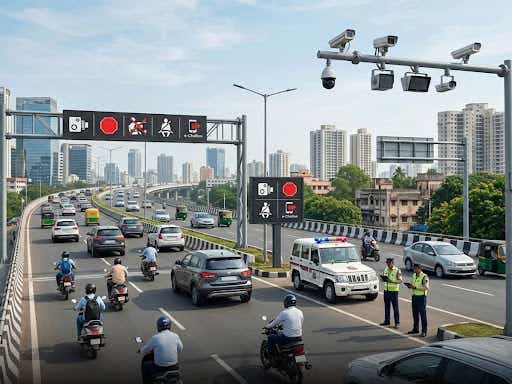
- Extensive CCTV surveillance
- Active e-challan systems
- Strong traffic enforcement policies
In metropolitan regions like the Delhi NCR and Chennai, even minor violations, such as signal jumping or lane discipline issues, can trigger automated challans.
If you drive frequently in these states, it is important to check your challan status regularly.
Where Are Challans Still Pending?
Total challan volume is only part of the story. The bigger concern is pending challans. As per Cars24 data, several Tier 1 states show large pending volumes. This suggests:
- Drivers may not be aware of issued challans
- Notification systems may not always reach vehicle owners
Some users delay payment intentionally
High pending volumes create risk for vehicle owners. Unpaid challans can lead to:
- Court summons
- Vehicle blacklisting
- RC transfer issues
Problems during resale
If you plan to sell your car, clearing pending challans is critical.
Total Challan Amount: Where the Money Is?
When we look at the total challan amount, the same Tier 1 states dominate. Uttar Pradesh leads in total challan amount as well. This indicates not just high volume, but also significant monetary penalties.
States with high challan amounts typically have:
- Higher enforcement frequency
- Strict penalty structures
Large vehicle density
For drivers, this means violations are not just common; they are expensive.
Paid vs Pending: Compliance Trends
One useful way to understand driver behaviour is to compare paid and pending challans.
In many Tier 1 states:
- Paid volumes are high because total volume is high
Pending backlog is still significant
This shows that awareness and digital payment adoption still have room to grow.
Some states show better compliance rates than others. High compliance often correlates with:
- Better digital infrastructure
- Strong awareness campaigns
Easier payment systems
Digital Payment Trends: Role of Cars24
Another important insight from the data is digital adoption. As per Cars24 data, several Tier 1 states show meaningful payment activity through the Cars24 platform.
This indicates:
- Growing trust in digital payment platforms
- Convenience-driven behaviour
Increased awareness of online challan checking
For drivers, digital platforms simplify the process:
- Instant challan check
- Easy payment
Clear history tracking
This reduces legal and resale risk.
Tier 1 vs Tier 2 States: What Is the Difference?
Tier 1 States
The top 12 states contribute around 80 percent of total challans.
These states typically have:
- Large urban populations
- High vehicle registrations
- Strong enforcement
Advanced e-challan systems
Tier 2 States
The remaining states together contribute only around 20 percent.
These often include:
- Smaller states
- Union territories
Lower vehicle density regions
For drivers in Tier 2 states, enforcement may be less frequent, but that does not mean compliance should be ignored.
What This Means for Vehicle Owners
If you live in one of the top 12 states, your likelihood of receiving a challan is much higher.
Here is what you should do:
1. Check Your Challan Status Regularly
Many drivers are unaware of issued e-challans.
2. Clear Pending Dues Early
Unpaid challans can create legal trouble and delay RC transfers.
3. Maintain Good Driving Discipline
Most common violations include:
- Overspeeding
- Signal jumping
- Helmet and seatbelt violations
Parking violations
4. Keep Contact Details Updated
Ensure your vehicle registration has updated mobile and address details.
Why This Data Matters?
As per Cars24 data, traffic enforcement in India is becoming more structured and digitised.
The concentration of 80 percent of challans in just 12 states shows:
- Enforcement is highly active in major states
- Compliance gaps still exist
- Digital payment adoption is rising
Awareness remains uneven
This is not just about fines. It is about responsible vehicle ownership.
Final Thoughts
Traffic challans in India are not evenly distributed. A small group of 12 states accounts for nearly 80 percent of total violations.
If you live in Uttar Pradesh, Delhi, Tamil Nadu, Haryana, Kerala, Gujarat, West Bengal, Maharashtra, Rajasthan, Karnataka, Bihar, or Andhra Pradesh, staying alert about your challan status is essential.
As per Cars24 data, enforcement is strong, digital systems are expanding, and compliance is improving. But pending cases still remain high in several states.
The smart move is simple. Check your challan status regularly. Clear dues early. Drive responsibly. Your vehicle record is part of your financial and legal footprint. Treat it that way.
Frequently Asked Questions
Expand all