How Cars24 Eliminates Middlemen Markups When You Sell Your Car
- 1Traditional car sales involve many middlemen reducing your final price
- 2Cars24 links sellers to 20,000+ dealers in a competitive live auction
- 3Buyer competition, not one-on-one negotiation, boosts your price
When most people sell a used car in India, they do not sell it directly to the person who will eventually drive it. Their car passes through one, two, or sometimes three sets of hands before it reaches a retail buyer. Each of those hands takes something out of the transaction. By the time the car reaches its final owner, the difference between what the original seller received and what the final buyer paid can be significant.
This gap is not a market secret. It is simply how traditional used car sales work when intermediaries are involved. Cars24 is built on the premise that the seller should capture as much of that gap as possible, rather than leaving it with people who had no stake in the car. This article explains exactly how the traditional chain extracts value from sellers, and what Cars24 does differently to put more of that value back.
How the Traditional Middleman Chain Works
When a private individual tries to sell their car through conventional channels, the typical sequence looks something like this.
The Local Dealer or Broker
The most common first point of contact for most sellers is the local used car dealer or an informal broker. This person is not buying the car for themselves. They are buying it to resell it, either to a retail customer off their lot or to another dealer in a different city. Their business model requires them to buy below market value to create a margin that covers their costs, risk, and profit.
A dealer quoting you a price for your car has already factored in what they believe they can sell it for, subtracted their target margin, subtracted an estimate for any rectification or refurbishment cost, and arrived at the number they offer you. That number is not what the market thinks your car is worth. It is what the dealer is willing to pay after protecting their own interests. The seller has no way of knowing how much of the gap represents legitimate dealer margin and how much is simply opportunistic undercutting.
The Broker Who ‘Finds a Buyer’
Some sellers prefer to go through a broker rather than a dealer, believing they will get a better price. A broker claims to find a direct buyer and charges a commission for doing so, typically 1 to 2 per cent of the sale value on each side. The problem is that this commission comes directly out of what the seller receives, and the broker’s incentive is to close the deal quickly, not to find the highest possible price. A broker who can close a deal at a lower price with less effort has no strong financial reason to push for more.
The Car Exchange Middleman
Some sellers take their car to an exchange or swap deal at a dealership when buying a new car. The dealership offers a trade-in value for the old car and adjusts the price of the new one accordingly. Trade-in valuations are almost always significantly below open market value, because the dealership needs to resell the used car and has every incentive to undervalue the trade-in to protect their margin on the new car sale. The seller gets a notionally convenient transaction but loses a material amount on the old car.
The Classified Listing Intermediary
Listing on a classified platform looks like a direct-to-buyer route, but in practice most serious buyers on these platforms are dealers or agents, not genuine retail buyers. Retail buyers browsing classifieds tend to negotiate aggressively or do not follow through. The people who do complete transactions are often re-sellers who apply the same logic as local dealers: buy below market value, resell at a margin. The classified platform itself also charges a listing or lead fee, adding another layer of cost.
Where the Value Goes in a Traditional Sale
To make this concrete, consider a car that a retail buyer would pay ₹6 lakh for in the open market. In a typical multi-step chain, what reaches the original seller can look like this:
| Who Gets It | Approx. Amount | What It Represents |
| Retail buyer pays | ₹6,00,000 | True market value |
| Dealer 2 / retail seller margin | ₹50,000–80,000 | Resale margin |
| Dealer 1 / middle buyer margin | ₹30,000–50,000 | Holding and resale margin |
| Broker or agent commission | ₹10,000–20,000 | Deal facilitation fee |
| Original seller receives | ₹4,50,000–5,10,000 | What lands in the seller’s bank |
Note: Figures are illustrative. Actual amounts vary by car, location, and intermediary.
The seller in this example has potentially left ₹90,000 to ₹1.5 lakh on the table, not because the market did not value the car at ₹6 lakh, but because each intermediary between the seller and the buyer extracted a share. None of these people added value to the car itself. They simply occupied positions in the chain.
What Cars24 Does Differently
Cars24’s model is structurally different from the traditional chain in one fundamental way: it connects the seller directly to the end buyers, the dealers who will resell the car to a retail customer, without inserting intermediaries between them.
The Live Auction Replaces Negotiation with Competition
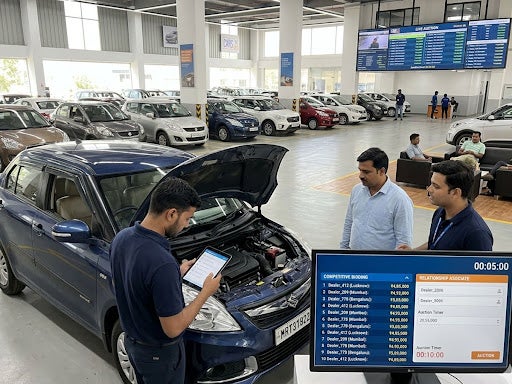
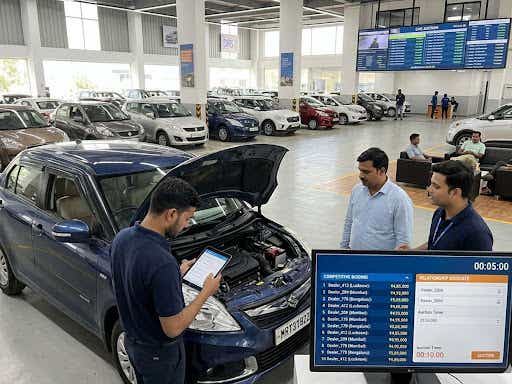
When your car is listed on Cars24 after inspection, it enters a live auction platform where over 20,000 verified dealers across 1,500+ cities bid against each other simultaneously. Every dealer who bids is bidding to win the car from the seller. Their bids drive the price up, not down. The seller does not negotiate with one dealer who has every reason to offer as little as possible. The seller receives the highest bid from a market of thousands of buyers who are competing with each other.
This is the core structural difference. In a traditional sale, one buyer negotiates with one seller and the power is asymmetric, the buyer knows more about the market than the seller does. In the Cars24 auction, thousands of buyers compete, and competition itself does the work of extracting the best price. The seller does not need to be an expert negotiator. The market negotiates on their behalf.
Data Removes the Information Gap
A large part of why middlemen can extract value from sellers is that sellers do not know what their car is actually worth in the current market. The local dealer does know, or at least has a much better estimate, and that asymmetry in information is what allows them to offer less than market value without the seller being able to challenge it effectively.
Cars24’s free online valuation tool, powered by AI and trained on over 10 lakh verified transactions since 2015, gives sellers an accurate, data-backed estimate of their car’s market value before the auction even begins. This removes the information gap. A seller who knows what their car is worth cannot be talked into accepting a lowball offer by a dealer who is the only buyer in the room.
National Reach Removes Geographic Pricing Constraints
A seller dealing with local dealers is constrained by what the local market will pay. If there are only three dealers in their area who buy that type of car, those three dealers informally set the ceiling on what the seller can receive. Cars24’s national auction removes this constraint entirely. A car listed in Lucknow can attract bids from dealers in Bengaluru, Hyderabad, Surat, or Jaipur, cities where demand for that specific car may be stronger and where dealers are willing to pay more. The seller benefits from the best price available across the entire national market, not just their postcode.
Transparent Charges Instead of Hidden Margins
Cars24 charges a service fee for the selling service it provides: the free home inspection, auction listing, live bidding facilitation, documentation handling, instant payment processing, and Seller Kavach post-sale protection. This charge is disclosed explicitly by the Relationship Associate before the deal is confirmed. The seller knows exactly what is being deducted and why.
In the traditional chain, none of the margins taken by intermediaries are ever disclosed to the seller. The dealer simply offers a number. The seller has no visibility into how much of the gap between that number and true market value represents legitimate service cost versus pure extraction. Cars24 replaces hidden margins with a declared fee, which is a fundamentally more honest structure for the seller.
Traditional Sale vs Cars24: Side by Side
| Factor | Traditional Sale | Cars24 |
| Price-setting mechanism | One dealer negotiates down | 20,000+ dealers bid up |
| Seller’s market knowledge | Limited; dealer has the advantage | AI valuation gives accurate estimate upfront |
| Number of buyers | One to three, typically local | 20,000+ across 1,500+ cities |
| Intermediary margins | Hidden, multiple layers | Declared service charge only |
| Geographic reach | Local market only | National; best price from any city |
| Payment timing | Varies; often delayed | Instant, before car leaves |
| Post-sale liability | Seller remains liable until RC transfer | Covered by Seller Kavach from handover |
Conclusion
Middlemen in the used car chain are not malicious actors. They are rational participants who extract value because the structure of traditional car sales allows them to. The seller does not know the market price. The seller has access to only a small number of buyers. The seller negotiates from a position of information disadvantage against a professional buyer. Every one of these conditions works against the seller getting a fair price.
Cars24 changes each of these conditions. It gives the seller market data before the auction. It replaces a single negotiation with competition among thousands of buyers. It extends reach from the local market to the national one. And it replaces undisclosed margins with a transparent declared charge. The result is not that Cars24 charges nothing, it does charge for the service it provides. But the price the seller receives from the auction, after that charge, is structurally better positioned than what the traditional chain would deliver, because competition among buyers is a more powerful price discovery mechanism than negotiation with one.
Frequently Asked Questions
Expand all