Are Drivers in Your State Paying Their Traffic Fines? State-Wise Payment Trends Revealed
- 1Goa tops India's challan payment rate at an impressive 87.30%
- 2Telangana has 97.01% of its challans unpaid, the highest in India
- 3UP leads in total challans and also carries the largest pending stock
- The National Picture: How Much of India Actually Pays?
- States With the Highest Challan Payment Rates
- States With the Lowest Challan Payment Rates
- State-Wise Challan Payment and Pendency at a Glance
- The Uttar Pradesh Paradox
- Why Do Payment Rates Differ So Much Across States?
- What This Means for You as a Driver
- The Bigger Picture: What Poor Payment Rates Cost Everyone
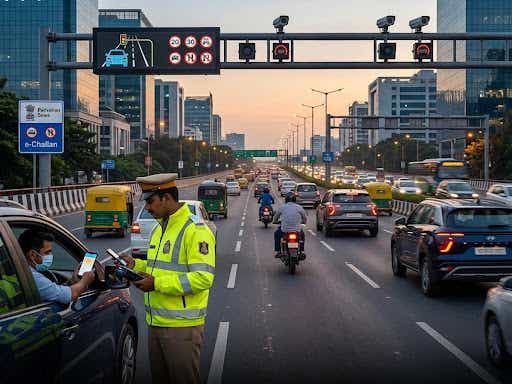
Every day, thousands of traffic challans are issued across India. Speed cameras click, traffic officers wave down violators, and e-challan notices land on mobile phones. But here is the question most people never ask: how many of those challans actually get paid?
The answer depends entirely on which state you are in. Traffic challan payment rates across India vary so dramatically that a driver who ignores a fine in Telangana faces almost no statistical consequence, while a driver in Goa is part of a system where nearly nine out of ten challans are cleared. Whether you drive in Delhi, have a vehicle registered in Kerala, or are curious about traffic challan trends in Karnataka, this data tells a very revealing story about how seriously different states take road compliance.
The National Picture: How Much of India Actually Pays?
As per Cars24 data, traffic challan payment rates across India are deeply uneven. Some states have built systems where payment is the norm. Others have large backlogs of unpaid fines stretching back years, with no real mechanism to recover them.
The overall pendency problem in India is significant. When a majority of challans go unpaid, it does two damaging things. First, it reduces the deterrent effect of traffic enforcement. Second, it creates a hidden liability for vehicle owners who may not even know they have outstanding fines against their registration number.
States With the Highest Challan Payment Rates
Let us start with the good news. Some states are doing exceptionally well at ensuring that challans issued are actually paid.
Goa: The Clear Leader at 87.30%
As per Cars24 data, Goa has the highest traffic challan payment rate in India at 87.30%. That means nearly 9 out of every 10 challans issued in Goa are settled by the driver. This is a remarkable number in a country where the norm is far lower.
What drives this? Goa is a small state with a relatively high per-capita income, strong tourism-linked vehicle movement, and a traffic enforcement system that is more contained and therefore easier to follow up on. The smaller geography means fewer challans can slip through the cracks.
What High Payment Rates Tell Us
A high payment rate does not necessarily mean fewer violations. It means the system is working: challans are being issued, drivers are being notified, payment options are accessible, and there are real consequences for ignoring a fine. States with high payment rates tend to have better digital infrastructure for challan notification and payment, more consistent follow-up from traffic authorities, and a tighter link between unpaid challans and vehicle documentation renewals.
States With the Lowest Challan Payment Rates
Now for the data that should concern both policymakers and drivers alike.
Telangana: 97.01% Challans Unpaid
As per Cars24 data, Challan payment in Telangana has a rate of just 2.99%. This means that out of every 100 challans issued in the state, 97 remain unpaid. This is the starkest compliance gap in the country.
This does not mean Telangana drivers are uniquely irresponsible. It more likely reflects a systemic issue: either challans are being issued without an effective follow-up mechanism, digital payment options are not well integrated with how enforcement works on the ground, or drivers are simply not aware they have outstanding fines. Whatever the cause, a 97% pendency rate means the deterrent effect of traffic enforcement in Telangana is effectively near zero.
Karnataka: 83.58% Challans Still Pending
Karnataka is another large, economically significant state with a serious pendency problem. As per Cars24 data, 83.58% of challans in Karnataka remain unpaid. Given that Karnataka includes a major metro like Bengaluru, one of India's most vehicle-dense cities, the volume of unpaid challans here is substantial in absolute terms.
Bengaluru's traffic is notoriously complex. High volumes of challans issued through cameras combined with a population that may not always receive or act on SMS notifications contributes to this backlog.
State-Wise Challan Payment and Pendency at a Glance
Here is a consolidated view of how key states compare on traffic challan compliance, as per Cars24 data.
| State | Payment Rate | Pendency Rate | Compliance Level |
| Goa | 87.30% | 12.70% | Excellent |
| Uttar Pradesh | Moderate | High absolute volume | Mixed |
| Delhi | Moderate-High | Moderate | Average |
| Tamil Nadu | Moderate | Moderate | Average |
| Haryana | Moderate | Moderate | Average |
| Karnataka | ~16.42% | 83.58% | Poor |
| Telangana | 2.99% | 97.01% | Critical |
| Lakshadweep | Negligible volume | Negligible volume | N/A |
The Uttar Pradesh Paradox
Uttar Pradesh deserves its own section because it sits at the top of every major metric. As per Cars24 data, UP accounts for 21.04% of all challans issued in India and 24.94% of the total challan amount. It also has the highest number of both paid and pending challans in absolute terms.
This is the UP paradox: it leads in payments made, but it also leads in payments pending. The sheer volume of challans issued in UP means that even a moderate payment rate produces the largest absolute number of cleared challans in the country. At the same time, the leftover unpaid pile is also the country's largest.
For drivers with vehicles registered in UP or for used car buyers considering a UP-registered vehicle, this is a critical point. The probability of finding an outstanding challan on a UP vehicle is statistically higher than in most other states. Always check before you buy.
Why Do Payment Rates Differ So Much Across States?
The gap between Goa at 87.30% and Telangana at 2.99% is not random. Several structural factors drive these differences.
1. Notification Systems
When a traffic camera issues an e-challan, a notice is sent via SMS to the registered mobile number of the vehicle owner. If that number is outdated, the driver may never know about the challan. States with higher rates of updated vehicle records tend to have better notification reach and, therefore, higher payment rates.
2. Ease of Payment
If paying a challan requires visiting a traffic police office in person during working hours, many drivers will simply not bother. States and cities that have made online payment genuinely easy, through Parivahan integration, UPI apps, and third-party platforms, see better payment rates meaningfully. Paying a traffic challan online in a few taps removes the single biggest barrier: inconvenience.
3. Consequences for Non-Payment
In states where unpaid challans are linked to vehicle fitness certificate renewals, insurance renewals, or RC transfers, the incentive to clear dues is much stronger. Where no such linkage exists, drivers rationally conclude that ignoring the challan costs them nothing in the short term.
4. Awareness and Literacy
A significant number of drivers in India are not aware that they have pending challans, especially for camera-based violations. Traffic awareness campaigns and proactive challan status checks through platforms like Cars24 or the Parivahan portal can change this significantly.
What This Means for You as a Driver
Whether you are a daily commuter, an occasional long-distance driver, or someone looking to buy or sell a used car, the state-wise payment trend data has direct implications for you.
Check Your Challan Status Right Now
You can check pending traffic challans on the Parivahan portal at echallan.parivahan.gov.in or through platforms like Cars24 using your vehicle registration number. This takes less than two minutes and could reveal outstanding fines you did not even know existed.
Do Not Assume No News Means No Challan
As the Telangana and Karnataka data shows, a system can issue challans without effectively notifying the driver or following up on payment. The absence of a notice does not mean you have a clean record. Proactive checking is the only reliable way to know.
Before Buying a Used Car, Run a Challan Check
As per Cars24 data, states like UP and Delhi are the largest contributors to total challans in India. A used car from these states carries a statistically higher chance of having an unpaid challan attached to it. Once you complete the RC transfer, those challans can become your liability. Always verify challan status before finalising any used car purchase.
Pay Online for Instant Record Updates
When you pay a traffic challan online, the payment reflects in the system almost immediately. This is important during RC transfers and insurance renewals. Offline payments at traffic booths can take time to update in the digital system, which can cause delays or complications in paperwork.
The Bigger Picture: What Poor Payment Rates Cost Everyone
Low challan payment rates are not just a government revenue problem. They undermine road safety at a fundamental level. If drivers know that fines will not be enforced, the deterrent value of traffic rules collapses. The result is more reckless driving, more accidents, and more fatalities.
India loses over 150,000 lives in road accidents every year, one of the highest figures in the world. A more disciplined traffic fine payment culture, backed by better enforcement and easier payment infrastructure, is one piece of a much larger road safety puzzle.
States like Goa show that it is possible. The infrastructure, the will, and the data to make it happen across India already exist. What is needed is consistent follow-through at the state level.
Frequently Asked Questions
Expand all