Traffic Challans in India: Are Bigger States Also Bigger Offenders?
- 1Top 4 states generate nearly 60% of all traffic challans in India
- 2Goa proves small states can lead on traffic fine compliance at 87.30%
- 3UP, Delhi, Tamil Nadu, Haryana form India's core challan belt in 2025
- The Numbers: How Concentrated Is India's Challan Problem?
- The States That Punch Above Their Size
- The States That Punch Below Their Size
- Small States, Big Lessons
- So Are Bigger States Bigger Offenders? The Real Answer
- What the Tier 1 vs Tier 2 Split Tells Us
- Practical Implications for Drivers Across State Lines
- The Bottom Line
It is a question that seems almost too obvious to ask. Of course bigger states have more traffic challans. More people, more vehicles, more violations, right? But when you actually look at the data, the relationship between a state's size and its challan volume is more nuanced than it appears. Some large states punch way above their weight in violations. Some mid-sized states have challan numbers that dwarf bigger neighbours. And some of India's smallest territories barely register at all.
As per Cars24 data, the challan landscape in India is heavily concentrated. A traffic challan in UP is far more statistically likely than one in Meghalaya or Sikkim, but not purely because UP is bigger. Enforcement intensity, vehicle density, camera infrastructure, and urban concentration all play a role. This article breaks down whether size is really the defining factor, or whether something else is driving India's challan map in 2025.
The Numbers: How Concentrated Is India's Challan Problem?
As per Cars24 data, the top four states in India by challan volume, Uttar Pradesh, Delhi, Tamil Nadu, and Haryana, together account for nearly 60% of all traffic challans issued across the country. That is a striking level of concentration in a nation of 28 states and 8 union territories.
| State | % of Total Challans | Population Rank (Approx) | Challan vs Size Match? |
| Uttar Pradesh | 21.04% | #1 | Yes, broadly aligned |
| Delhi | 11.51% | Urban UT, not a large state | Punches well above its size |
| Tamil Nadu | 10.90% | Mid-large | Higher than size suggests |
| Haryana | 9.02% | Mid-sized | Significantly above its size |
| Kerala | ~5% | Mid-sized | Moderate alignment |
| Gujarat | ~4% | Large | Below population weight |
| West Bengal | ~3% | Large | Below population weight |
| Bihar | ~2% | Large population | Well below its population share |
| Lakshadweep | ~0.00% | Smallest UT | Aligned with size |
This table already tells us something important. Size alone does not determine challan volume. Delhi is not a large state by area or population, yet it contributes 11.51% of India's total challans. Bihar, despite being one of India's most populous states, contributes a fraction of what smaller Haryana does.
The States That Punch Above Their Size
Delhi: Small Territory, Massive Challan Volume
Delhi is not a state in the traditional sense. It is a union territory with a relatively small geographic area. Yet as per Cars24 data, it accounts for 11.51% of all traffic challans in India, making it the second highest contributor nationally. Only Uttar Pradesh, a state with nearly 20 times Delhi's population, generates more.
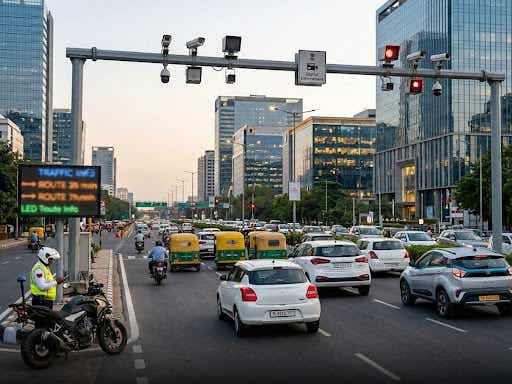
The reason is straightforward: Delhi has one of the highest vehicle densities in the world, some of India's most aggressive traffic camera infrastructure, and a well-funded traffic enforcement system. The combination of dense urban roads, millions of daily commuters, and active enforcement makes every square kilometre of Delhi disproportionately productive in terms of challans issued.
Haryana: A Mid-Sized State With Outsized Numbers
Haryana is a mid-sized state, but it contributes 9.02% of India's total traffic challans. This is more than Maharashtra, West Bengal, and Bihar, all of which are significantly larger by population. Haryana's high numbers are driven by its dense network of national highways, heavy goods vehicle movement, proximity to Delhi, and enforcement that has ramped up sharply in recent years. Its position as a transit corridor between Delhi and the rest of northern India means vehicle density on key routes is extremely high.
Tamil Nadu: Enforcement Meets Urban Density
Tamil Nadu's 10.90% share of national challans reflects both its urban density and its investment in traffic enforcement technology. Chennai is one of India's most vehicle-saturated cities. The state has invested in speed cameras and red light cameras across its major urban corridors, which automatically translates into higher e-challan volumes regardless of officer presence.
The States That Punch Below Their Size
Bihar: Large Population, Low Challan Share
Bihar is one of India's most populous states, yet its contribution to national challan volumes is a fraction of what its population would suggest. This is not because Bihar's drivers are more law-abiding. It reflects the lower density of formal traffic enforcement infrastructure, fewer camera-based systems, and a higher proportion of rural roads where violations occur but are not systematically recorded.
Low challan volume in a high-population state is often a sign of enforcement gaps rather than driver discipline. For a state like Bihar, the challan data likely undercounts actual violations significantly.
West Bengal and Gujarat: Below Population Weight
Both West Bengal and Gujarat are large states with significant vehicle populations, yet both contribute less to national challan totals than their size would predict. This again points to variations in enforcement intensity and camera infrastructure rather than any meaningful difference in driver behaviour. Kolkata and Ahmedabad both have serious traffic problems, but the challan data does not fully reflect the scale of violations occurring there.
Small States, Big Lessons
Some of the most interesting data points in the challan landscape come from India's smallest states and union territories.
Goa: Tiny State, Best Compliance in India
Goa contributes a very small share of India's total challans simply because it is a small state with a modest vehicle population. But as per Cars24 data, it has the highest challan payment rate in the country at 87.30%. Nearly 9 in every 10 challans issued in Goa are paid. This tells us something important: small scale enables better follow-through. Enforcement is more contained, notifications are more likely to reach the right person, and the consequences of non-payment are harder to avoid.
Lakshadweep, Ladakh, and Andaman and Nicobar: Near Zero Contribution
These territories contribute virtually nothing to India's national challan totals, which is entirely expected. Their tiny populations, limited road networks, and minimal vehicle counts mean that large-scale traffic enforcement simply does not apply. Lakshadweep's contribution to India's total challan amount is recorded as approximately 0.00% in Cars24 data. These are outliers in the best sense, places where the challan problem genuinely does not exist at scale.
So Are Bigger States Bigger Offenders? The Real Answer
The honest answer is: partly, but not because of size alone. Here is what the data actually shows.
| Factor | Does It Correlate With High Challan Volume? |
| State population | Partially. UP aligns. Bihar does not. |
| Urban vehicle density | Strongly yes. Delhi is the clearest example. |
| Camera and e-challan infrastructure | Strongly yes. Tamil Nadu and Haryana demonstrate this. |
| Highway and transit corridor presence | Yes. Haryana benefits from Delhi proximity. |
| Enforcement follow-up systems | Yes. Goa's high payment rate vs Telangana's 97% pendency. |
| Geographic size alone | Weak correlation. Not a reliable predictor. |
The states with the most challans are not simply the biggest states. They are the states with the highest urban vehicle density, the most active camera infrastructure, and the most consistent enforcement follow-through. A large rural state with poor enforcement infrastructure will always undercount its actual violations, while a dense urban territory like Delhi will generate challan numbers far beyond what its physical size suggests.
What the Tier 1 vs Tier 2 Split Tells Us
As per Cars24 data, 12 states drive approximately 80% of all traffic challans in India. These Tier 1 states are the ones where enforcement is most active, digital infrastructure is most developed, and the consequences of non-compliance are most real.
| Tier | States Included | Share of Total Challans |
| Tier 1 | UP, Delhi, Tamil Nadu, Haryana, Kerala, Gujarat, West Bengal, Maharashtra, Rajasthan, Karnataka, Bihar, Andhra Pradesh | ~80% |
| Tier 2 | All remaining states and union territories | ~20% |
The Tier 2 states are not free of traffic violations. They are simply places where those violations are less likely to result in a formal challan. This enforcement gap has real road safety consequences. Under-enforcement in large population states like Bihar or Madhya Pradesh means that dangerous driving behaviour goes unchecked, contributing to accident rates that are not reflected in challan statistics.
Practical Implications for Drivers Across State Lines
Understanding this data has direct practical value for drivers, especially those who travel between states or buy and sell used vehicles.
Know Where Enforcement Is Heaviest
If you are driving through UP, Delhi, Tamil Nadu, or Haryana, assume that cameras are watching and that any violation will result in an e-challan sent to your registered mobile number. These are not states where traffic rules are loosely enforced. Drive accordingly and make sure your vehicle documents are fully in order before entering any of these zones.
Do Not Assume Low Challan States Mean Safe Driving
A state with a low challan count does not mean its roads are safer or its drivers are more careful. It often means enforcement is weaker. Do not let the absence of challans in a particular region lead to complacency. Road safety standards apply everywhere, regardless of whether a camera is present.
Used Car Buyers: Match the State to the Risk
As per Cars24 data, vehicles from UP, Delhi, Tamil Nadu, and Haryana are statistically more likely to carry pending challans than vehicles from low-enforcement states. Before buying any used car, run a challan check on the Parivahan portal or through a platform like Cars24. This is especially important for vehicles from Tier 1 states where challan volumes are highest and the absolute number of unpaid fines is large.
Keep Your Registration Details Updated
One of the main reasons challans go unpaid is that e-challan notifications are sent to an outdated mobile number linked to the vehicle registration. If you have changed your phone number, update it in the Parivahan system at parivahan.gov.in. This simple step ensures you are notified of any challan the moment it is issued, giving you the chance to pay it quickly and avoid complications.
The Bottom Line
Bigger states are not automatically bigger offenders. They are states where enforcement is more visible and more data is captured. The real story behind India's challan map is about urban density, camera infrastructure, and the quality of follow-through systems, not state size alone.
For drivers, the takeaway is clear. Whether your state is at the top of the challan list or barely on it, the responsibility to drive safely and stay compliant with traffic rules does not change. And if you are in a Tier 1 state like UP, Delhi, Tamil Nadu, or Haryana, staying on top of your challan status is not optional. It is a practical necessity.
Frequently Asked Questions
Expand all