
The title of the most expensive car in the world is not awarded to a vehicle you can simply buy off a showroom floor. The highest-priced cars represent the absolute pinnacle of automotive artistry, with ultra-limited runs defined by precision engineering, hyper-personalisation, and bespoke craftsmanship.
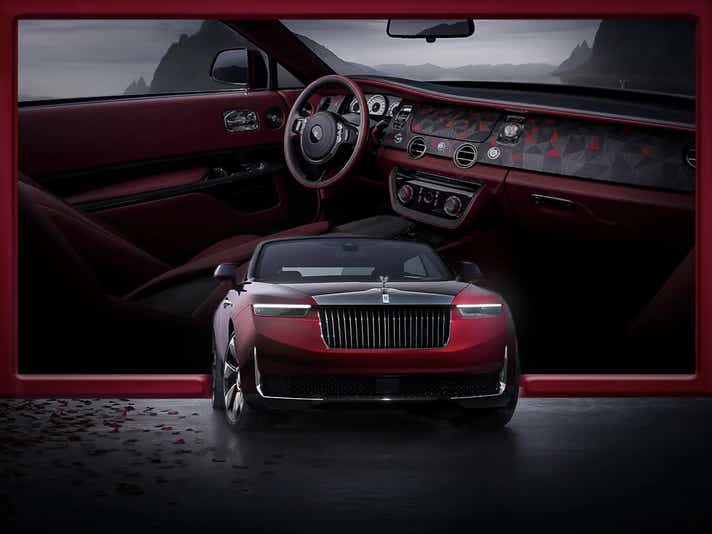
The costliest cars in the world are marked by an obsessive level of detail and are built for the world's most demanding collectors. Instead of choosing from a list of optional extras, buyers commission entire interiors. The Rolls-Royce Droptail, which is the most expensive car in the world in 2026, for instance, features a cabin painstakingly pieced together from 1,603 individual wood veneers to mimic scattered rose petals.
From the elegant Rolls-Royce Sweptail, to the handcrafted Pagani Zonda, we bring you a list of 16 most expensive cars in the world in 2026. And if you’re a car aficionado like us, read on to find out what makes these highest price cars on the planet so exquisite, expensive and desirable!
List of the Top 16 Most Expensive Cars in the World in 2026:
| S.No | Car Name | Price in Rupees (as on 22-06-2026) | Price in Dollars | No. of Cars | Standout Features |
| 1 | Rolls-Royce La Rose Noire Droptail | ₹283.47 crore | $30 million | 4 | Interior handcrafted from 1,603 pieces of Black Sycamore wood, mimicking falling rose petals |
| 2 | Rolls-Royce Boat Tail | ₹264.57 crore | $28 million | 3 | Aft deck hosting suite with a dual champagne fridge, Christofle silverware, and a pop-up umbrella |
| 3 | Bugatti La Voiture Noire | ₹176.70 crore | 18.7 million | 1 | Exposed aluminium "backbone" running hood-to-tail, echoing the riveted seam of the original Type 57 Atlantic |
| 4 | Pagani Zonda HP Barchetta | ₹160.63 crore | $17 million | 3 | Permanent open-top design with a cropped windshield and rear-wheel fairings inspired by Group C race cars |
| 5 | SP Automotive Chaos | ₹136.07 crore | $14.4 million | 15-20 (annually) | Fingerprint recognition and stress-sensing electronics that adjust the car's performance in real time |
| 6 | Rolls-Royce Sweptail | ₹122.84 crore | $13 million | 1 | Elegant, boat-inspired profile paired with one of the largest and most complex glass canopies ever fitted to a motor car |
| 7 | Bugatti Centodieci | ₹85.04 crore | $9 million | 10 | Carbon-fibre stabilisers and lightweight glass, making it 20 kg lighter than the Chiron |
| 8 | Mercedes Maybach Exelero | ₹75.59 crore | $8 million | 1 | One-off reinterpretation of the 1930s Maybach SW 38, with an elongated hood and all-black "Gothic" design |
| 9 | Pagani Huayra Codalunga | ₹69.92 crore | $7.4 million | 5 | First-in-class exposed titanium exhaust weighing only 4.4 kg, finished in white ceramic coating |
| 10 | Pagani Huayra Imola Roadster | ₹56.69 crore | $6 million | 8 | Just 1,280 kg dry weight lets its 850 hp Mercedes-AMG V12 push it past 350 km/h |
| 11 | Bugatti Divo | ₹54.80 crore | $5.8 million | 40 | Rear grille houses 44 3D-printed fins that light up in varying intensities to emphasise the car’s wide stance. |
| 12 | Koenigsegg Sadair’s Spear | ₹48.19 crore | $5.1 million | 30 | V8 screams to its 8,500 rpm redline with virtually zero inertia, reacting in just 0.2 seconds |
| 13 | Bugatti Mistral | ₹47.24 crore | $5 million | 99 | Open-top W16 roadster engineered with extensive aerodynamic reworking to ensure high-speed stability |
| 14 | Pininfarina B95 | ₹45.36 crore | $4.8 million | 10 | Jet-fighter-inspired open cockpit design featuring electronically adjustable aero screens instead of a traditional windshield |
| 15 | Koenigsegg CCXR Trevita | ₹45.36 crore | $4.8 million | 2 | Carbon-fibre bodywork finished in Koenigsegg’s proprietary diamond-weave “Trevita” coating that delivers a shimmering, crystalline appearance |
| 16 | Bugatti Bolide | ₹44.41 crore | $4.7 million | 40 | Ultra-lightweight track-only construction with extreme aerodynamic bodywork generating massive downforce |
1. Rolls-Royce La Rose Noire Droptail | $30M | ₹283 Crores
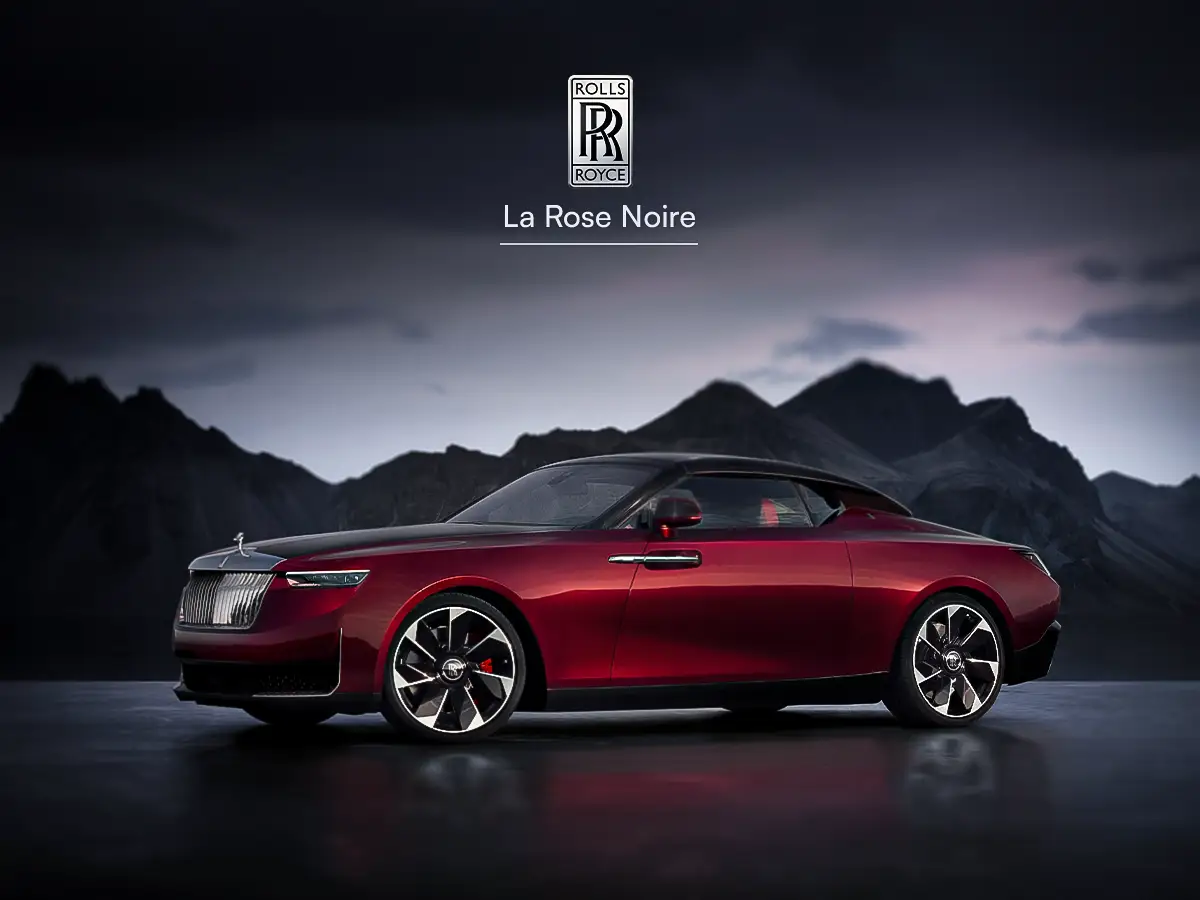
Touted as the most expensive car in the world at a staggering Rs. 283 crores ($30M), the Rolls-Royce La Rose Noire Droptail serves as the British luxury car maker’s tribute to automobile craftsmanship. The client’s matriarch adored the dark red-burgundy Baccara rose, which inspired the car's name.
The car was made from a combination of aluminium, steel and carbon fibre, which is a first-in-class for the Coachbuild division. Inspired by the 1912 Rolls-Royce Silver Ghost 'Sluggard,' the La Rose Noire is part of the four-car Droptail series.
It boasts many state-of-the-art features, including a custom sound system and a starlight headliner. The car shines with a 150-layer custom paint job blending the “True Love” red and “Mystery” black. Creating this car’s stunning interior took over two years of development and nine months of craftsmanship.
This cocoon-shaped roadster features a powerful 6.8-litre V12 twin-turbo engine. This makes it a prized possession for collectors. All in all, it took over four years to complete the build of this exquisite masterpiece.
What Makes It the Most Expensive Car in the World:
- Handcrafted Woodwork: A handcrafted interior featuring 1,603 pieces of Black Sycamore wood, mimicking falling rose petals.
- Custom Dashboard Clock: It features a luxury Audemars Piguet watch built directly into the dash, which the owner can pop out and wear on their wrist.
- Transformative Roof: A detachable carbon-fibre hardtop with electrochromic glass that shifts from opaque to translucent at a touch.
Extreme Exclusivity: It is part of an elite four-car run, with every single model entirely custom-made so that no two are exactly alike.
Key specifications: Rolls-Royce La Rose Noire Droptail
| Units Produced | 4 |
| Engine Configuration | 6.8 litres V12 Twin-turbocharged |
| Transmission | 8-speed automatic transmission |
| Maximum Power | 563 bhp |
| Peak Torque | 840 Nm |
| 0–100 kmph | under 5 seconds |
| Top Speed | 250 kmph |
| Weight | 2,700 kg |
| Dimensions | 5,300x2,000 mm (approx.) |
2. Rolls-Royce Boat Tail | $28M | ₹264 Crores

The Rolls-Royce Boat Tail, the second most expensive car in the world, is priced at a staggering Rs. 264 crores ($28M). It's a magnificent feat of nautical inspiration and top-notch craftsmanship, with currently only three produced specimens.
Personalised and hand-built, this Rolls-Royce masterpiece pays tribute to the client’s (famous celebrity couple Jay-Z and Beyoncé) reverence for life at sea. It features their preferred oceanic blue colour, infused with shimmering crystals. The Boat Tail’s elegant design draws inspiration from graceful J-class yachts and the 1932 Rolls-Royce Boat Tail.
With innovative features like a sweeping butterfly gesture deck, the Boat Tail reveals an intricate hosting suite. The interior features a double refrigerator to keep the client’s favourite champagne, Armand de Brignac vintage cuvée, at the perfect serving temperature, accompanied by caviar and blinis, a Russian delicacy.
In fact, powering the rear deck's butterfly mechanism and dual fridges itself requires five dedicated ECUs and bespoke wiring just for that section of the car. Nothing about this car is even remotely ordinary, because propelling this nearly 6-metre-long, rolling piece of statement is a naturally aspirated 12-cylinder front-mounted engine.
What Makes It So Expensive:
- Aft Deck Hosting Suite: Features a dual champagne refrigerator (calibrated perfectly to 6°C), bespoke Christofle silverware, and a pop-up umbrella for luxury outdoor dining.
- Bovet 1822 Horology: Two reversible, handcrafted timepieces that can be worn on the wrist or docked into the dashboard as the car's primary clock.
- Nautical Woodwork: An open-pore wooden rear deck with stainless steel pinstripe inlays, mimicking the hull of a luxurious motorboat.
Ultra-Luxury Cabin Details: Interior with high-end, functional art, including mother-of-pearl accents and special built-in holders for custom Montblanc pens.
Key specifications: Rolls-Royce Boat Tail
| Units Produced | 3 |
| Engine Configuration | 6.7 litres V12 |
| Transmission | 8 Speed Automatic |
| Maximum Power | 570 bhp |
| Peak Torque | 720 Nm |
| 0–100 kmph | 5.8 seconds |
| Top Speed | 250 kmph |
| Weight | 2,560 kg |
| Dimensions | 5,760 x 2,032 mm |
3. Bugatti La Voiture Noire | $18.7M | ₹176 Crores

The Bugatti La Voiture Noire might not be the most expensive car in the world in 2026, but it is one of the rarest automotive assets in existence, with a singular 1-of-1, custom commission.
The La Voiture Noire by Bugatti, which was unveiled at the 2019 Geneva Motor Show, was envisioned by the Design Director Achim Anscheidt as a one-off black beauty over 20 years ago, but various factors delayed its creation.
The Bugatti La Voiture Noire serves as a tribute to Jean Bugatti’s (Son of Bugatti’s Founder) personal all-black Type 57 Atlantic, which was mysteriously lost during a train transport in World War II.
The minimalist coupe’s exterior showcases striking elements like an exposed backbone, unique front and rear fascias, six exhaust pipes, and an insect-like light pattern. Powered by an 8-litre quad-turbo 16-cylinder engine, the La Voiture Noire delivers around 1,500 hp and accelerates from 0 to 100 km/h in just 2.4 seconds.
Not only that, but the La Voiture Noire is also a predecessor to the much-touted 2020 Chiron Noire from Bugatti.
What Makes It So Expensive:
- Signature Centre Fin: An exposed aluminium "backbone" runs from the hood to the rear, mirroring the legendary riveted seam of the original Type 57 Atlantic.
- Six Exhaust Pipes: A striking rear fascia design featuring six individual tailpipes, a bold visual nod to the massive power of the 16-cylinder engine.
- Handcrafted Precision: The bodywork is composed of visible carbon fibre with a specialised clear coat, requiring over two years of artisanal development.
- Exclusive Ownership: Highest price car in the World from Bugatti, with only a single unit ever built as a custom commission for a private collector.
Key specifications: Bugatti La Voiture Noire
| Units Produced | 1 |
| Engine Configuration | Quad-turbocharged 8.0-liter W-16 |
| Transmission | 7-speed dual-clutch (from Chiron) |
| Maximum Power | 1,479.9 bhp |
| Peak Torque | 1,600 Nm |
| 0–100 kmph | 2.4 seconds |
| Top Speed | 418 kmph |
| Weight | 1,995 kg |
| Dimensions | 4,544x2,038 mm |
4. Pagani Zonda HP Barchetta | $17M | ₹160 Crores

The Pagani Zonda HP Barchetta, the most expensive car in the world from Horacio Pagani, is a handbuilt 789 bhp monster, under the brand’s ultra-exclusive, bespoke division (Uno‑di‑Uno program).
What makes this expensive car even more special is that there are only three of these beauties!
The first of the three Zonda Barchetta cars was reserved for the company’s founder, Mr Horacio Pagani, at its 2017 launch at the Pebble Beach Concours d' Elegance.
Barchetta, meaning ‘roofless’ in Italian, reflects the car’s design, similar to the Huayra BC. It features a uniquely designed roof scoop that highlights its roofless nature. The absence of a roof provides a visceral driving experience, while a stunning interior with blue, cream, and tartan accents enhances its charm. Its beefy brakes and distinct forged aluminium wheels with gold and blue inlay add to its style.
Weighing just 1,250 kg with a carbon-titanium body, the Zonda HP Barchetta packs a powerful V12 engine, enabling it to fly from 0 to 100 kmph in just 3.1 seconds.
What Makes It So Expensive:
- Signature Barchetta Design: Features a permanent open-top configuration with a short, cropped windshield and unique rear-wheel fairings (spats) inspired by Group C race cars.
- Analogue Mastery: Unlike modern hypercars, it utilises a pure six-speed manual transmission and a mechanical self-locking differential for an authentic connection between driver and machine.
- Artisanal Interior: The cabin is a blend of blue and cream leather with tartan accents, a nod to Horacio Pagani’s mentor, racing legend Juan Manuel Fangio.
Advanced Material Science: Built using Pagani’s proprietary Carbo-Triax HP52, a material offering the rigidity of a Formula 1 chassis while maintaining a featherweight profile.
Key specifications: Pagani Zonda HP Barchetta
| Units Produced | 3 |
| Engine Configuration | V12 48 valve DOHC by Mercedes-Benz |
| Transmission | 6 Speed Manual |
| Maximum Power | 789 bhp |
| Peak Torque | 850 Nm |
| 0–100 kmph | 3.1 seconds |
| Top Speed | 355 kmph |
| Weight | 1,250 kg |
| Dimensions | 4,435x2,055 mm |
5. SP Automotive Chaos | $14.4M | ₹136 Crores

Meet Chaos - the “ultracar” from Greek start-up turned serious-chaos SP Automotive, boasting a staggering 3,000 horsepower. Who would have thought that an adrenaline-inducing car could be 3D printed using materials from aerospace technology?
Even the wheels and brakes are made from 3D-printed magnesium. Propelled by a twin-turbocharged 4-litre, 90-degree V10 engine with hybrid assist, it accelerates to 100 km/h in just 1.9 seconds!
The monocoque body is constructed from Poly, the world’s strongest man-made fibre, offering strength that surpasses steel and carbon fibre. The ultracar's roof incorporates a unique chemical called SAM2XS-630, resulting in a hard yet elastic structure that resists deformation, even when bent beyond its limits.
For those who want a more modest option, there’s also an “Earth” model (compared to the full-blown Zero Gravity trim), which offers 2,000 horsepower. With production limited to 15 to 20 units annually, the SP Automotive Chaos Zero Gravity is priced at an eye-watering Rs 136 crores ($14.5 M).
What Makes It So Expensive:
- Generative 3D Design: Key components, including the engine block, ceramic pistons, and titanium exhaust, are created using "Anadiaplasi" design to maximise strength while minimising weight.
- Biometric Integration: High-tech interior electronics feature fingerprint recognition and sensors that monitor the driver’s stress levels to adjust the car’s performance parameters.
- Magnesium 3D-Printed Wheels: Features 21-inch front and 20-inch rear wheels 3D-printed from ultra-lightweight magnesium alloy to reduce unsprung mass.
- Augmented Reality UI: The cockpit replaces traditional dials with a futuristic AR interface.
Key specifications: SP Automotive Chaos
| Units Produced | 15-20 (Annually) |
| Engine Configuration | 4 litres Twin-turbo V10 |
| Transmission | 6 Speed Manual |
| Maximum Power | 3,065 bhp |
| Peak Torque | 1,390 Nm |
| 0–100 kmph | 1.9 seconds |
| Top Speed | >500 kmph |
| Weight | 1,270 kg (Zero Gravity) |
| Dimensions | 5,053x2,068 mm |
6. Rolls-Royce Sweptail | $13M | ₹123 Crores

Launched in May 2017 at the Concorso d'Eleganza Villa d'Este, the Rolls-Royce Sweptail was the world's most expensive car until Bugatti La Voiture Noire took the title in 2019.
An exquisite, one-of-one creation for a priced Rolls-Royce owner, the Sweptail is inspired by early 20th-century cars and various vintage and modern yachts.
Rolls-Royce has developed a sleek bodyline incorporating the distinctive swept tail. Built for Hong Kong-based patron Sam Li, the car took four years to craft and features an elegant roofline and an uninterrupted glass roof that floods the interior with natural light. The minimalist interior design allows fine materials like ebony and dark spice leather to take centre stage. At the time of its creation, the Sweptail featured the largest grille ever fitted to a modern Rolls-Royce.
What Makes It So Expensive:
- Panoramic Glass Roof: One of the largest and most complex glass canopies ever fitted to a motor car.
- Yacht-Style Rear Deck: Instead of traditional back seats, the rear is styled like a luxury boat deck, complete with beautiful wood panelling and glowing glass accents.
- Champagne Deployment: The centre console features a motorised mechanism that reveals a chilled bottle of vintage champagne and two crystal flutes at the touch of a button.
Minimalist Dashboard: A purified interior design that removes all non-essential switchgear, featuring a clock crafted from the same Macassar Ebony as the fascia.
Key specifications: Rolls-Royce Sweptail
| Units Produced | 1 |
| Engine Configuration | 6.75 litres V12 |
| Transmission | ZF 8 Speed Automatic |
| Maximum Power | 623 bhp |
| Peak Torque | 800 Nm |
| 0–100 kmph | 5.6 seconds |
| Top Speed | 250 kmph |
| Weight | 2,750 kg |
| Dimensions | 5,285.7x1,948.2 mm |
7. Bugatti Centodieci | $9M | ₹85 Crores

Hand-built in the Molsheim Atelier, the Bugatti Centodieci draws inspiration from the legendary EB110 Supersport, celebrated for its performance and design during the Romano Artioli era.
Distinct styling elements from the EB110, such as the five cooling holes in the B-pillar and quad exhausts, are reimagined in the Centodieci. Aerodynamic enhancements, including a new light signature and enlarged rear diffuser, ensure stability at high speeds.
Utilising the latest technology, the aggressive styling took just six months, leveraging computer-assisted 3D and virtual reality tools. The car boasts of an underbody spoiler and a fixed overhanging rear wing for enhanced aerodynamics. This is coupled with the 1,578 bhp, quad turbocharged, W16 engine that orchestrates symphonies at various RPMs for those with the acquired taste of this genre of music. However, this luxury ride is limited to only ten units.
What Makes It So Expensive:
- EB110 Heritage Design: Reinterprets the classic Bauhaus-inspired shape with modern aerodynamic elements, including a smaller horseshoe grille and slimline LED headlights.
- Aggressive Aerodynamics: Features a massive fixed rear wing and an enlarged rear diffuser that provides high-speed stability and significant downforce.
- Chessboard Interior: The cabin features a bespoke "chessboard" quilted pattern on the seats, roof liner, and floor mats, a meticulous process taking 16 weeks to complete.
- Weight Reduction: Utilises carbon-fibre stabilisers and lightweight glass, making it 20 kg lighter than the Chiron for enhanced agility and handling.
- Exclusive Light Signature: The rear is defined by a unique, continuous LED light bar with eight individual elements, creating a futuristic "floating" effect.
Key specifications: Bugatti Centodieci
| Units Produced | 10 |
| Engine Configuration | Quad-turbocharged 8.0-liter W-16 |
| Transmission | 7 Speed Dual-clutch |
| Maximum Power | 1,578 bhp |
| Peak Torque | 1,600 Nm |
| 0–100 kmph | 2.4 seconds |
| Top Speed | 380 kmph |
| Weight | 1,995 kg |
| Dimensions | 4,665x2,183 mm |
8. Mercedes-Maybach Exelero | $8M | ₹75 Crores

The most expensive car in the world from Mercedes, the Exelero, is a one-off high-performance sports car that debuted at the Tempodrom in Berlin in 2005 and was crafted by Stola in collaboration with DaimlerChrysler.
Interestingly, the Exelero was commissioned by Goodyear’s German subsidiary, Fulda, to test the Carat Exelero tyre range, aiming to reach speeds exceeding 350 kmph. While the car was built on the existing Maybach 57 platform, the design was influenced by the Maybach SW 38.
Powered by a twin-turbo V12 engine which churns out 690 bhp, the motor came from Maybach, which is now a part of Mercedes-Benz. With alloy wheels, Fulda Carat Exelero tyres, and a striking black exterior complemented by a red leather interior, the Exelero marries old-world luxury with modern-day benchmarks of performance.
Notable for its appearances in popular culture and ownership by rapper Birdman before being acquired by Mechatronik, the Maybach Exelero remains not only an icon in the automotive world but also amongst the costliest cars in the world, now showcased in an automobile museum in Dietzhölztal, Germany.
What Makes It So Expensive:
- One-of-a-Kind Design: A modern reinterpretation of the 1930s Maybach SW 38 streamline car, featuring an elongated hood and a menacing, all-black "Gothic" aesthetic.
- Testing Precision: Engineered for high-speed durability, utilising specialised 23-inch Fulda tyres and aerodynamic bodywork refined by Pforzheim University students.
- Luxury Interior: A cockpit finished in dark and red Nappa leather, complemented by glossy carbon fibre trim and neoprene accents for a sport-luxury feel.
- Racing Safety: Equipped with four-point harness seatbelts and ultra-bolstered sports seats, acknowledging its status as a high-speed performance tester.
Cultural Icon: Gained global fame for its appearance in Jay-Z’s "Lost One" music video and remains one of the most recognisable "1-of-1" vehicles in history.
Key specifications: Mercedes-Maybach Exelero
| Units Produced | 1 |
| Engine Configuration | 6 litres M275 AMG Twin-turbo V12 |
| Transmission | 6 Speed |
| Maximum Power | 690 bhp |
| Peak Torque | 1,020 Nm |
| 0–100 kmph | 4.4 seconds |
| Top Speed | 351 kmph |
| Weight | 2,660 kg |
| Dimensions | 5,834.4x2,120.9 mm |
9. Pagani Huayra Codalunga | $7.4M | ₹70 Crores

This one’s for the dreamers! In 2022, Pagani unveiled the Huayra Codalunga, a bespoke hypercar paying homage to the sleek lines of Italian race cars of the 1960s, particularly the Porsche 917, which is thought to be Pagani founder Horacio's favourite.
Codalunga, which means 'long-tail' in Italian, is a limited edition of five vehicles and was crafted with a special design philosophy in mind to create a long-tail version of the Pagani Huayra Coupe. It is, in fact, 360 mm longer than the Huayra and features a sweeping 3.7 m² rear cover, bringing about aesthetics that would please not only on the road, but at international Concours events as well. Astonishingly, the beautiful and powerful car complies with global regulatory compliance.
Powered by a 6-litre twin-turbocharged V12 from Mercedes-AMG, the Codalunga boasts an astounding 829 bhp, and can reach from 0 to 100 kmph in just 2.8 seconds.
Weighing just about 1,280 kg and featuring aerodynamic flaps (a hallmark of the Huayra series), the Codalunga exemplifies Pagani's commitment to pushing the boundaries of automotive artistry and performance.
What Makes It So Expensive:
- Aeronautical Cockpit: The interior features hand-aged Nubuck leather and machined aluminium switchgear designed to mimic the tactile feel of vintage aircraft toggles.
- Ceramic-Coated Exhaust: A first-in-class, exposed titanium exhaust system weighing only 4.4 kg, finished with a white ceramic coating that pays homage to 1960s race cars.
- Advanced Long-Tail Aero: The extended rear silhouette and active aero-flaps allow for a drag coefficient reduction that eliminates the need for a traditional rear spoiler.
- Artisanal Wood and Leather: Incorporates woven leather and brushed aluminium accents, reflecting a "Renaissance" approach where art and science are perfectly integrated.
Key specifications: Pagani Huayra Codalunga
| Units Produced | 5 |
| Engine Configuration | 6 litres V12 Twin-turbo Mercedes-AMG |
| Transmission | 7 Speed Auto |
| Maximum Power | 828 bhp |
| Peak Torque | 1,100 Nm |
| 0–100 kmph | 2.8 seconds |
| Top Speed | 349 kmph |
| Weight | 1,280 kg |
| Dimensions | 4,912x2,280 mm |
10. Pagani Huayra Imola Roadster | $6M | ₹57 Crores
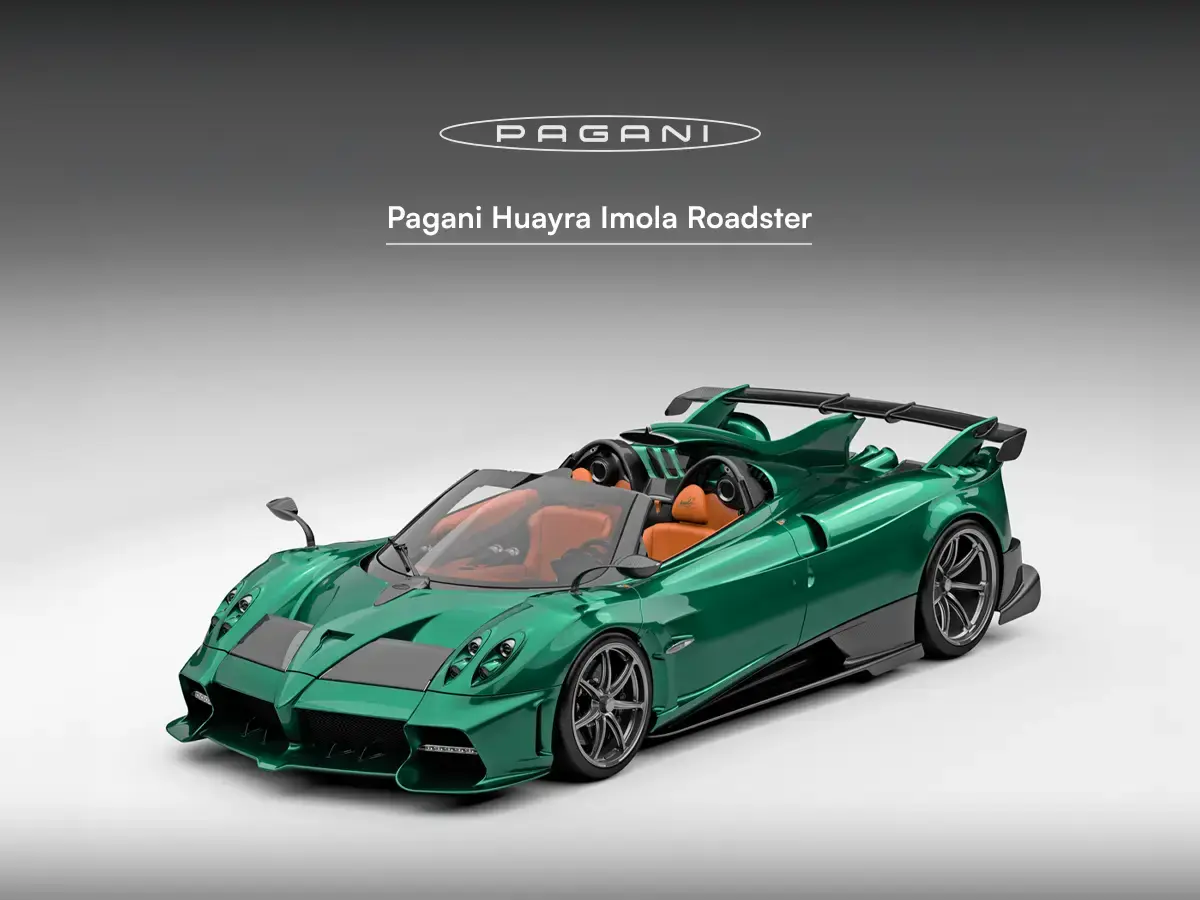
Pagani has never been shy about exclusivity, but the Imola Roadster takes that philosophy to its extreme. Revealed in 2023 under the ultra-exclusive Grandi Complicazioni division, this limited-run drop-top hypercar is far from just a simple open-top version of the Imola Coupe. Limited to just eight units worldwide (practically sold overnight), it melds the Huayra Roadster BC’s advanced technology with the radical aerodynamics of the Huayra R.
Enlarged front air intakes and a dual warm-air outlet manage cooling, while the massive rear wing and central fin help the car generate a staggering 600 kg of downforce at 280 km/h. There is no shortage of power too, as the Huayra Imola Roadster is powered by a 5,980 cc twin-turbo V12 developed by Mercedes-AMG exclusively for Pagani. This hand-built masterpiece revs to a mind-numbing 8,700 rpm and unleashes 850 hp, making it Pagani’s most powerful roadster ever. How's that for an open top speed adventure?
The Pagani Huayra Imola Roadster sits at a higher realm than the Coupe, being priced at nearly ₹57 crores ($6M). It stands confidently among the most expensive cars on the planet, but we know that price is only part of the story.
What Makes It So Expensive:
- Advanced Aerodynamics: Features a massive rear wing, a stabilising central fin, and a dedicated roof scoop that feeds the twin-turbo V12 while optimising high-speed stability.
- Extremely Light-Weight: With a dry weight of only around 1,280 kg, coupled with 850 hp, the Imola Roadster rockets past 350 kmph (217mph)
- Acquarello Light Paint: Utilises a sophisticated painting system that reduces vehicle weight by 5 kg without compromising colour depth or gloss.
- Exposed Six-Pipe Exhaust: A signature titanium exhaust system coated in ceramic for superior heat dissipation, delivering Pagani’s iconic "unfiltered" V12 soundtrack.
Key specifications: Pagani Huayra Imola Roadster
| Units Produced | 8 |
| Engine Configuration | 6.0-liter twin-turbo V12 (5,980 cc) |
| Transmission | 7-speed transversal sequential by Xtrac |
| Maximum Power | 850 hp |
| Peak Torque | 1,100 Nm |
| 0–100 kmph | 2.8 seconds |
| Top Speed | >350 kmph |
| Weight | 1,280 kg |
| Dimensions | 4,670x2,038 mm |
11. Bugatti Divo
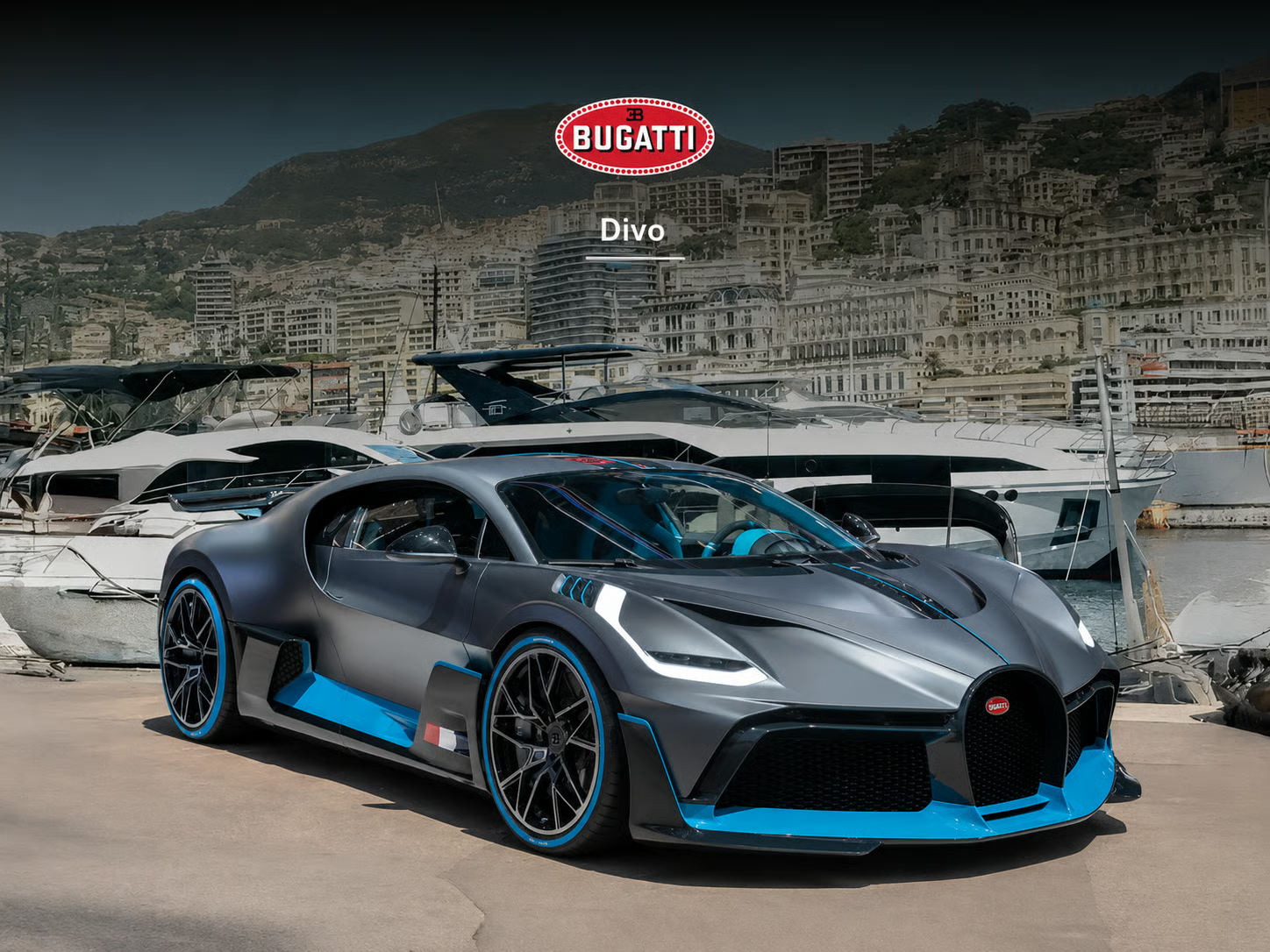
The last edition of the list of the most expensive cars in the world is the Bugatti Divo. Unveiled in August 2018, the Bugatti Divo pays tribute to Bugatti's rich racing history and the legendary racer Albert Divo. It draws design cues from iconic predecessors like the Bugatti Type 57SC Atlantic and Vision Gran Turismo concept, embodying track-focused performance with its sleek design.
On the technical front, the Divo features a quad-turbocharged W16 engine, delivering exceptional agility and power. With stiffer springs, reduced weight, and aerodynamic refinements, it offers an extraordinary driving experience, accelerating from 0 to 100 km/h in just 2.4 seconds. Although its top speed is limited to 380 km/h, lower than the Chiron’s 480 km/h, the Divo outpaced the Chiron by nearly 8 seconds at the Mardo test track.
Limited to 40 units, the Divo sold out on its debut day! It has kept auto enthusiasts enthralled ever since, as it continues to set new benchmarks in hypercar performance.
What Makes It So Expensive:
- Active Aerodynamics: Features a 1.83-meter-wide height-adjustable rear wing that is 23% wider than the Chiron's, acting as both a stabiliser and an air brake.
- Complex 3D Taillights: The rear grille houses a stunning light system composed of 44 3D-printed fins that light up in varying intensities to emphasise the car’s wide stance.
- Advanced Cooling: The front fascia includes wider air intakes and a new "air curtain" system that optimises airflow to the brakes and the massive W16 engine.
- Driver-Focused Interior: The cabin features an asymmetrical colour scheme in "Divo Racing Blue" and Alcantara-covered seats designed specifically for high lateral support (up to 1.6 G).
- NACA Air Duct: A specialised roof intake serves as a central fin to channel air directly into the engine bay, ensuring peak performance under extreme thermal loads.
Key specifications: Bugatti Divo
| Units Produced | 40 |
| Engine Configuration | 8 litres Quad-turbocharged W16 |
| Transmission | 7 Speed Dual-clutch |
| Maximum Power | 1,479 bhp |
| Peak Torque | 1,600 Nm |
| 0–100 kmph | 2.4 seconds |
| Top Speed | 380 kmph |
| Weight | 1,961 kg |
| Dimensions | 4,641x2,018 mm |
12. Koenigsegg Sadair’s Spear
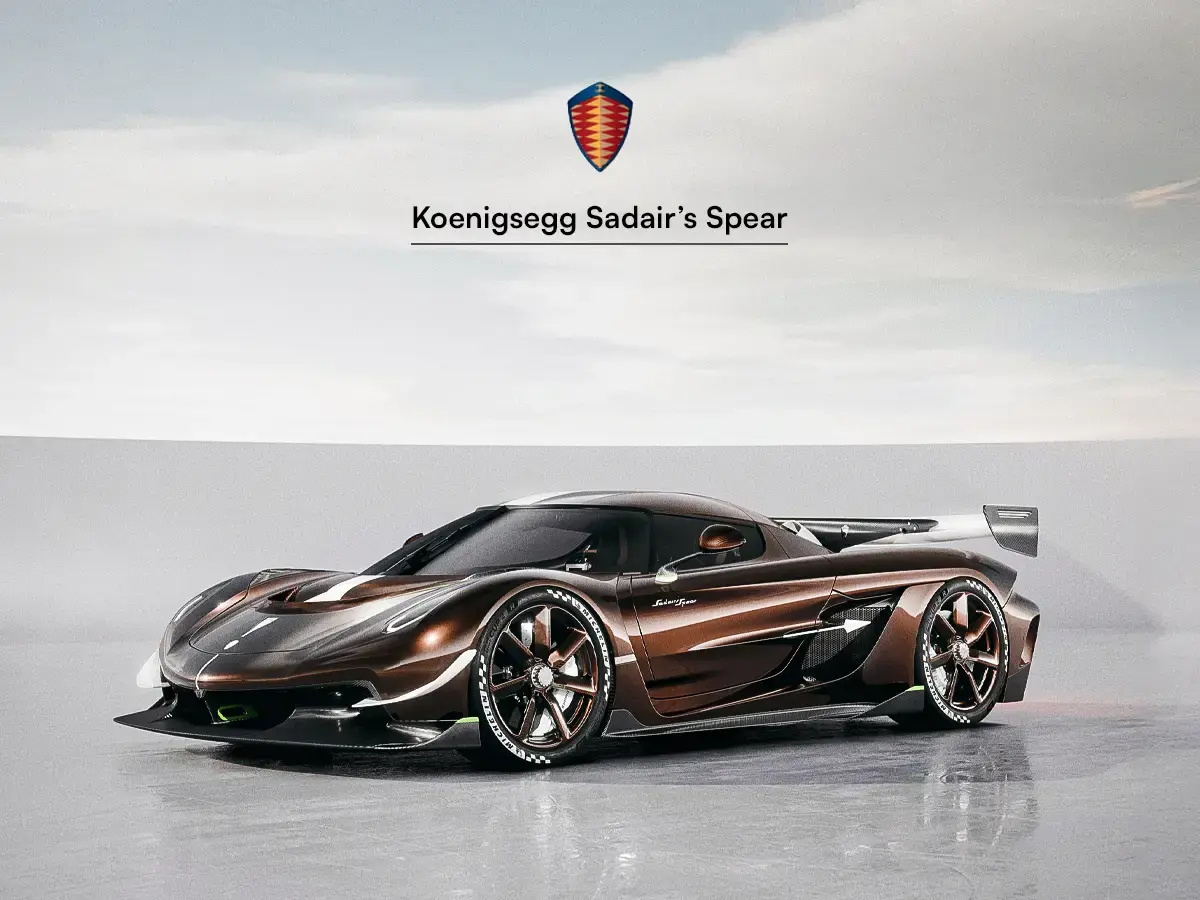
It’s absurd to think that there’s something common between a Honda CRV and a Koenigsegg Sadair’s Spear, and that’s the fact that both are road legal. But Koenigsegg has a habit of redefining what “road legal” can mean, and the Sadair’s Spear is the latest, and most unhinged example of that philosophy. Debuting in 2025, this hypercar takes the already outrageous Jesko Attack and pushes it into territory only Christian von Koenigsegg would dare explore.
Named after the last horse Christian Koenigsegg’s father rode as a gentleman jockey, the Sadair’s Spear is a machine engineered not just to set lap times, but to obliterate them.
Under the rear clamshell of Koenigsegg’s most aggressive street-legal creation to date sits the familiar 5.0-litre twin-turbo V8 from the Jesko, paired to Koenigsegg’s lightning-fast nine-speed Lightspeed transmission. But in true Koenigsegg fashion, “familiar” doesn’t mean unchanged. Revised engine calibration, redesigned air intakes, and improved cooling boost output by 25 bhp, pushing the Sadair’s Spear to a staggering 1,603 bhp on E85.
Of course, rarity comes with the territory. Only 30 units of the Sadair's Spear will ever exist, and unsurprisingly, every single one was sold long before production began. Each buyer paid the price for Koenigsegg Sadair’s Spear of about ₹46 crores, securing a place in the list of most expensive cars in the world.
What Makes It So Expensive:
- Active Aero Mastery: Features a top-mounted, double-blade active rear wing and extended venturi tunnels that suck the car to the tarmac with record-breaking downforce.
- Flywheel-Free V8: A revolutionary engine design that allows the V8 to scream to its 8,500 rpm redline with virtually zero inertia, reacting in just 0.2 seconds.
- Enhanced Cooling: A 30% improvement in thermal efficiency over the Jesko, achieved through larger hood vents, new rear intake scoops, and a secondary oil heat exchanger.
- Lightweight Precision: Achieves a power-to-weight ratio exceeding 1:1 by stripping sound insulation and utilising advanced carbon-fibre and Kevlar construction.
- Track-Centric Cockpit: Includes carbon sport bucket seats with six-point racing harnesses and a steering column-mounted SmartCluster digital display for total driver focus.
Key specifications: Koenigsegg Sadair’s Spear
| Units Produced | 30 |
| Engine Configuration | 5.0-liter twin-turbocharged V-8 |
| Transmission | 9-speed Lightspeed transmission |
| Maximum Power | 1,603 bhp (on E85) |
| Peak Torque | 1,106 ft lbs |
| 0–100 kmph | 2.6 seconds |
| Top Speed | 361 kmph |
| Weight | 1,320 kg |
| Dimensions | 4,690x2,0303mm |
13. Bugatti Mistral
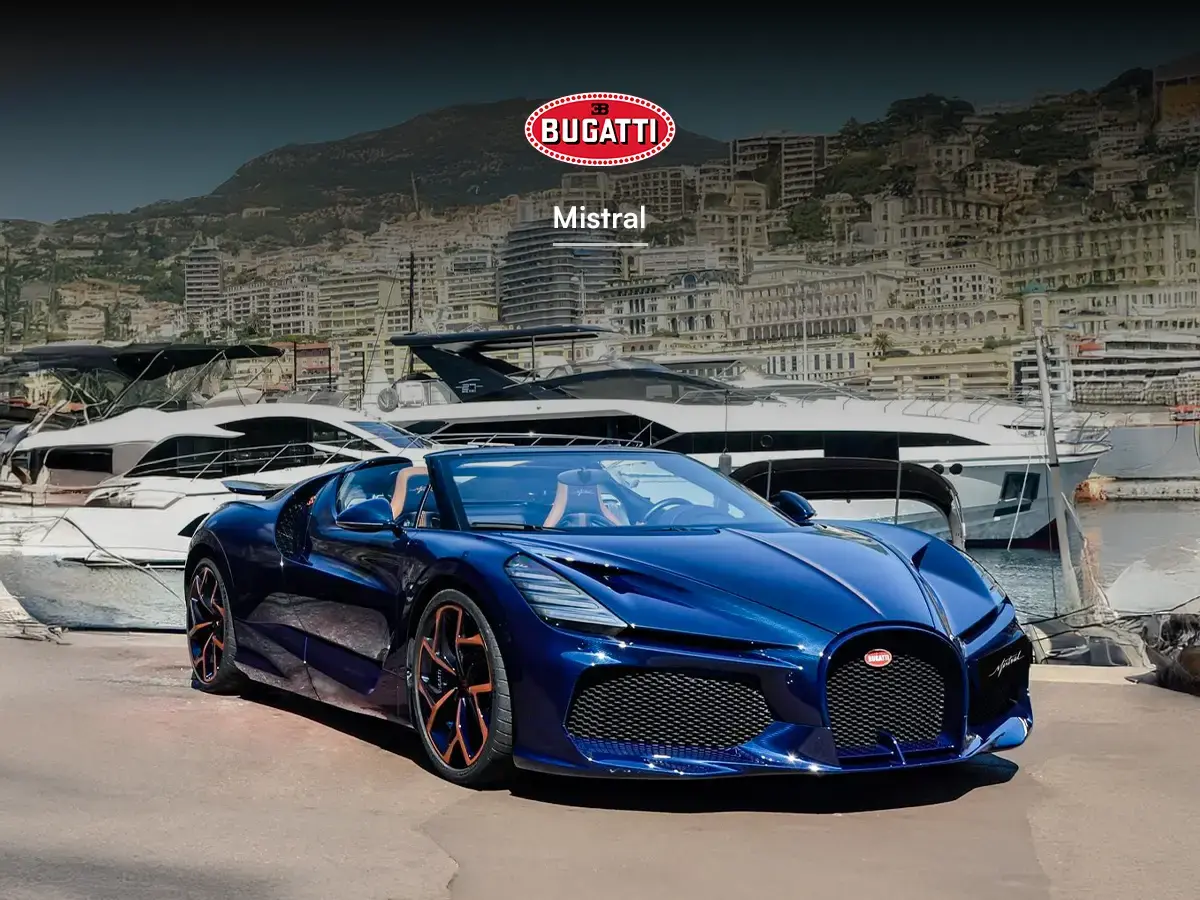
Of course, like all Bugattis, the Mistral is a luxurious hypercar capable of earth-shattering acceleration and top speed figures, but there’s something beyond that which truly makes it unique. The Mistral represents one of the last breaths of the iconic quad-turbo 8.0-litre W16; an engine that shaped an entire era of top-speed domination. And with just 99 units produced, all already spoken for, Bugatti ensured the farewell would be nothing short of historic.
Although the Mistral is based on the Chiron, Bugatti reimagined it so thoroughly that it feels like an entirely new model. It shares the Chiron’s suspension, gearbox, brakes, and the monstrous 1,578 hp tune from the Super Sport’s W16, yet not a single carbon-fibre body panel is carried over. This lends Bugatti the permission to claim it never built an “open-top Chiron,” but rather coachbuilt an all-new roofless masterpiece on familiar foundations. Visually, the Mistral carries a broader, more muscular stance, injecting fresh drama into the seven-year-old platform.
Performance, of course, borders on surreal. The Mistral sprints from 0–60 mph in 2.4 seconds, and even became the fastest open-top production car ever made with an achieved top speed of 453.9 km/h (282.04 mph). Pricing of the Bugatti Mistral is just as surreal, nearing almost ₹45 crores, making it one of the costliest cars in the world.
What Makes It So Expensive:
- World Record Speed: Officially verified as the fastest roofless car in history, surpassing the long-standing record held by the Hennessey Venom GT Spyder.
- W16 Swan Song: The final road-going model to feature the quad-turbo 16-cylinder engine, representing the pinnacle of internal combustion development at Bugatti.
- Aero-Acoustic Engineering: Roof-mounted air intakes located directly behind the occupants' heads provide a visceral aural experience of the engine’s induction and turbo-blow-off valves.
- Homage to Heritage: The gear lever is machined from a solid block of aluminium and features a "Dancing Elephant" sculpture encased in amber, a nod to Rembrandt Bugatti’s art.
- Functional Art: The X-themed LED taillights serve a dual purpose, acting as a cooling vent for the side oil coolers by creating a pressure drop to extract hot air.
Key specifications: Bugatti Mistral
| Units Produced | 99 |
| Engine Configuration | Quad-turbocharged 8.0-liter W-16 |
| Transmission | 7-speed dual-clutch (from Chiron) |
| Maximum Power | 1,578 bhp |
| Peak Torque | 1,180 ft lbs |
| 0–100 kmph | 2.4 seconds |
| Top Speed | 453 kmph |
| Weight | 1,995 |
| Dimensions | 4,694x2,034mm |
14. Pininfarina B95
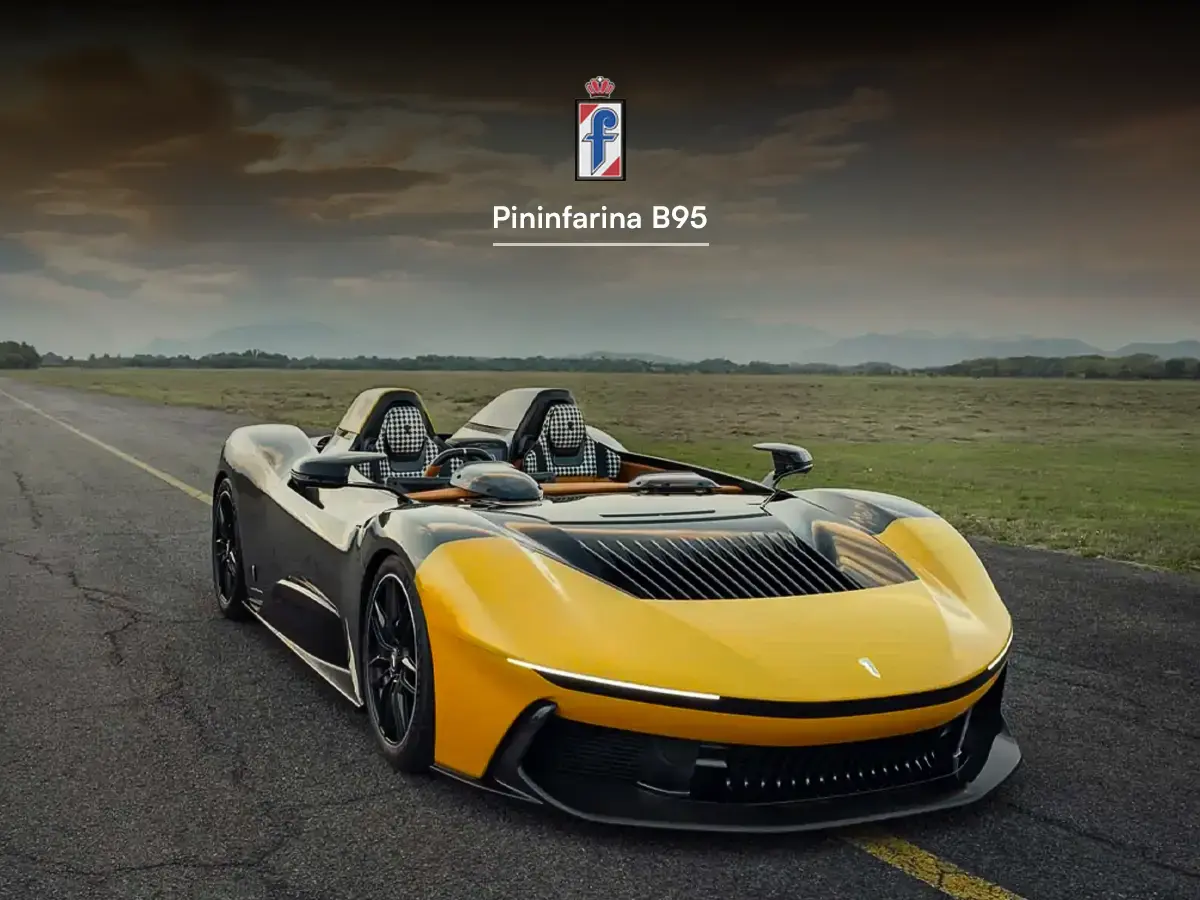
While the name of the Pininfarina’s latest exotic creation itself is simple: B for Barchetta, 95 for the Brand’s anniversary, nothing about this roofless electric hypercar is remotely simple. This is a machine that can catapult you to 100 kmph in under two seconds, without the courtesy of a roof. Just imagine processing that kind of acceleration with nothing but the horizon and your own bravery ahead of you.
Only 10 units will ever exist, each Pininfarina B95 priced from ₹43 crores, instantly placing it as the most expensive electric car in the world. The B95 sits in rarefied roofless hypercar world occupied by the Aston Martin V12 Speedster, Ferrari Monza SP1/SP2, and McLaren Elva. Before you assume this roofless, battery-powered Barchetta to be a hair-drying missile, look closely, and you’ll spot a pair of aerodynamic screens designed to channel air over the occupants, allowing the car to cheat physics just a little.
Underneath, the B95 borrows its powertrain from the Battista, which means a 120kWh liquid-cooled lithium-ion battery sitting in a T-shaped carbon-fibre housing, feeding a colossal 1,874 bhp to the wheels. The Pininfarina B95 may look like a design study brought to life, but it’s very real, very fast, and very limited.
What Makes It So Expensive:
- Adjustable Aero Screens: A patented world-first, these electronically adjustable polycarbonate screens are inspired by vintage fighter planes and shield occupants from high-speed airflow.
- T-Shaped Battery Pack: Features a liquid-cooled 120 kWh battery housed in a carbon-fibre casing, strategically positioned to maintain a low centre of gravity and optimal weight distribution.
- Rapid Charging Technology: Capable of high-speed 270 kW DC charging, allowing the battery to replenish from 20% to 80% in just 25 minutes.
- Artisanal Customisation: Every unit is a unique 1-of-1 commission, with owners offered colour-matched helmets and bespoke interior finishes like laser-embossed tan leather.
- Five Driving Modes: Includes specialised dynamics settings: Calma, Pura, Energica, Furiosa, and Carattere, tailoring the torque vectoring for everything from city cruising to track dominance.
Key specifications: Pininfarina B95
| Units Produced | 10 |
| Battery | 120kWh lithium-ion battery |
| Maximum Power | 1,874 bhp |
| Peak Torque | 2,340 Nm |
| 0–100 kmph | 1.86 seconds |
| Top Speed | 350 kmph |
| Charging | 20–80% in 25 mins (270kW) |
| Weight | 2,200 kg |
15. Koenigsegg CCXR Trevita

Even by Koenigsegg standards, the CCXR Trevita occupies a special, almost mythical corner of hypercar history. Only two were ever produced, making it far rarer than its more famous siblings.
Running on E85 fuel, the Trevita pushes out an astonishing 1,018 bhp and 1,060 Nm of torque, enough for a claimed 400 km/h top speed. We are talking 0–100 kmph in 3.1 seconds and 0–200 kmph in just 8.75 seconds. Numbers like these put it right up there with the wildest machines from Ferrari, Lamborghini, or Aston Martin, but the Trevita’s real magic lies in something far more visual.
If Koenigsegg’s now-famous visible carbon weave bodywork wasn’t enough, they developed a special coated-fibre process that transformed traditional black carbon fibre into a shimmering silvery-white. Under sunlight, the Koenigsegg CCXR Trevita sparkles as though millions of microscopic diamonds are embedded in its skin. It’s automotive engineering crossed with jewellery-making, wrapped around a hypercar capable of stratospheric speeds, which of course, doesn’t come cheap; the CCXR Trveita price sits at a staggering price of ₹43 crores making it one of the most expensive cars in the world.
What Makes It So Expensive:
- Diamond Weave Carbon: Features a world-first, proprietary coating that transforms traditional black carbon fibre into a sparkling, silvery-white finish that glitters under direct sunlight.
- Dual-Fuel Performance: Engineered as a "flex-fuel" vehicle, its engine management system optimises performance for either standard gasoline or high-octane E85 ethanol.
- Advanced Aerodynamics: Equipped with a unique twin-deck carbon fibre rear wing and a flat underside with rear venturi tunnels to maximise high-speed downforce.
- Exceptional Power-to-Weight: Despite its luxury finish, it weighs just 1,280 kg (dry), utilising an F1-style Inconel exhaust system and carbon-ceramic brakes for track-ready agility.
- Iconic Ownership: Its extreme rarity is cemented by its provenance; notably, one of the two existing models was famously owned by boxing legend Floyd Mayweather.
Key specifications: Koenigsegg CCXR Trevita
| Units Produced | 2 |
| Engine Configuration | 4.8L twin-supercharged V8 engine |
| Transmission | transversal 6-speed sequential gearbox |
| Maximum Power | 1,018 bhp (on E85) |
| Peak Torque | 1,060 Nm |
| 0–100 kmph | 3.1 seconds |
| Top Speed | 400 km/h |
| Weight | 1,280 kg |
| Dimensions | 4,293x1,996 mm |
16. Bugatti Bolide
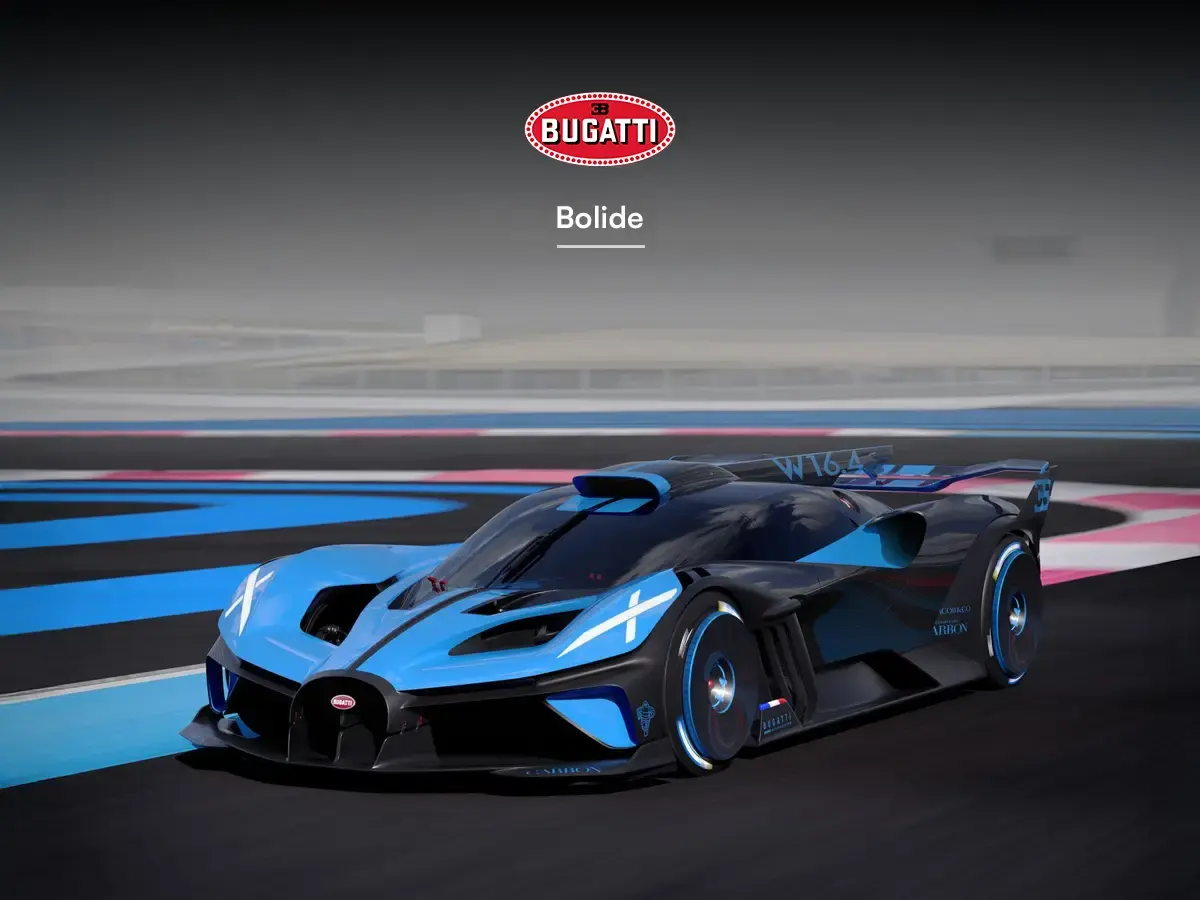
The Bugatti Bolide is the wild, unfiltered, track-only tribute to everything the brand’s legendary W16 engine ever stood for. Debuting publicly at Le Mans in 2023, the Bolide was engineered to give you the kind of lap-time-shattering performance that feels like setting a new personal record every time you strap in.
Only 40 examples exist, and the last one serves as a particularly sentimental send-off for the legendary quad-turbocharged W16, a powerplant that made its debut nearly 20 years ago with the Bugatti Veyron. The W16 make way for the new first ever V-16 from Bugatti, which while not see any reduction in cylinder count, would not feature quad turbochargers like the Bugatti Mistral, but feature some form of electric hybridisation.
The Bugatti Bolide price stands at ₹42 crores, making this track-only icon one of the most expensive cars in the world. The Bugatti Bolide launches from 0–100 kmph in a scarcely believable 2.17 seconds. It’s paired with extreme weight reduction, resulting in a total mass of just 1,450 kg.
Matching the earth-moving roar of its W16, is the loud visual stance of the Bolide which trades off Bugatti’s usual flowing elegance for something far more angular, dramatic, and purpose-driven. And because it isn’t street-legal, everything about it exists purely in pursuit of speed.
What Makes It So Expensive:
- Morphing Outer Skin: Features a world-first "dimple" air intake on the roof scoop; at high speeds, the surface remains smooth, but at lower speeds, it bulges with "bubbles" to reduce aerodynamic drag by 10%.
- Extreme Downforce: The Bolide utilises a massive double-blade rear wing and an LMP1-style central fin to generate nearly 3,000 kg of downforce, keeping it glued to the track during high-speed cornering.
- Carbon-Carbon Braking: Equipped with specialised Brembo carbon-carbon brakes, technology derived directly from Formula 1, offering superior heat resistance and stopping power compared to standard carbon-ceramics.
- Aviation-Inspired Cockpit: The interior features an "X-theme" aesthetic with two racing seats and a reclined seating position where the driver's heels are slightly raised, mirroring the ergonomics of a Le Mans prototype.
- Track-Optimised W16: While the engine core is shared with the Chiron, the Bolide features four newly developed turbochargers and a revised dry-sump lubrication system to handle extreme lateral G-forces.
Key specifications: Bugatti Bolide
| Units Produced | 40 |
| Engine Configuration | Quad-turbocharged 8.0-liter W-16 |
| Transmission | Dual-clutch automatic |
| Maximum Power | 1,578 hp |
| Peak Torque | 1,180 ft lbs |
| 0–100 kmph | 2.17 seconds |
| Top Speed | 380 kmph |
| Weight | 1,450 kg |
| Dimensions | 4,835x2,100 mm |
Why Are These Cars So Expensive? Key Factors
What separates a ₹270-crore Rolls-Royce Droptail from a ₹2-crore luxury saloon? The answer isn't a single factor; it's a convergence of five distinct forces, each compounding the last, that pushes these machines into a price stratosphere most buyers can barely imagine. Here's what truly drives the cost of the world's most expensive cars.
1. Bespoke, Handcrafted Manufacturing
The most expensive cars in the world are not assembled on a production line; they are built. A single Rolls-Royce Droptail, for instance, took over four years and nine months of hand-finishing alone for its interior woodwork. At Pagani's atelier in San Cesario sul Panaro, artisans hand-lay carbon-titanium composite panels and hand-stitch every surface. Where a mainstream luxury car might require 30–50 hours of skilled labour, a hypercar commission routinely demands hundreds, sometimes thousands, of hours of painstaking, non-automated work. This isn't inefficiency; it's intentional. Each hour invested is an hour of craft, precision, and personalised attention that simply cannot be replicated at scale, and that labour cost is reflected directly in the sticker price.
2. Exotic Materials
The raw ingredients that go into these machines are extraordinary in their own right. Carbon fibre, which is the structural backbone of cars like the Bugatti Centodieci and Pagani Huayra, is enormously expensive to weave, cure, and finish to the standards these brands demand. Koenigsegg's proprietary diamond-weave "Trevita" coating, for example, involves a process so complex the company originally planned to build just two units. Beyond carbon fibre, these cars incorporate titanium exhaust systems, gold-leaf detailing, diamond-dust paint pigments, meteorite dashboard inlays, and aerospace-grade aluminium alloys sourced for purity rather than cost. When the material itself costs more than an entire family hatchback, the final car's price follows accordingly.
3. Ultra-Limited Production — Scarcity as a Feature
Economics 101: When supply is deliberately and permanently constrained, price ascends. Many of the cars on this list exist in single-digit quantities, such as three Boat Tails, four Droptails, one La Voiture Noire. Some are literal one-of-ones, never to be replicated. This scarcity is not incidental; it is the core value proposition. Buyers at this level are not purchasing transportation, but they are acquiring an object that no one else on earth can own in identical form. The rarer the car, the more fiercely collectors compete for it, and the higher the price climbs — both at point of sale and at resale.
4. Celebrity and Royal Commissions
Several of the world's priciest cars exist because an extraordinarily wealthy individual requested something that had never been built before, and was willing to pay whatever it took to see it realised. The Rolls-Royce Boat Tail's hosting suite, with its champagne refrigerator calibrated to 6°C and bespoke Christofle silverware, was conceived around a specific client's passion for entertaining on the water. The car's reported association with Beyoncé and Jay-Z brought it global attention and permanently elevated its cultural cachet. Similarly, the Sweptail was a decade-long commission for a single buyer who wanted the closest thing to a bespoke yacht on wheels. These one-off briefs require entirely new engineering solutions, custom supply chains, and dedicated design teams, costs that are absorbed entirely into a single vehicle's price.
5. Brand Heritage and Legacy
There is an intangible yet enormously powerful premium attached to certain names. Rolls-Royce has been synonymous with the absolute apex of motoring luxury since 1904. Bugatti's lineage of record-breaking, uncompromising hypercars stretches back to Ettore Bugatti's original atelier in Alsace. Pagani, though younger, has built an almost mythological reputation for merging Italian art with aerospace engineering. These brands command premiums not just for what they build today, but for what they have always represented: the belief that no cost is too great in the pursuit of perfection. When you buy a Rolls-Royce, you are buying into over a century of royal warrants, motorsport victories, and the quiet confidence that comes with owning the world's most recognised symbol of automotive excellence.
Most Expensive Cars Sold at Auction (All Time)
When people ask, "What is the most expensive car in the world?" the answer depends heavily on which world you're asking about. There is an important distinction between the most expensive new cars, such as bespoke commissions and limited-production hypercars sold directly by manufacturers at retail, and the most expensive cars ever sold, which are almost exclusively rare historic racing and road cars that change hands at prestigious auction houses decades after they were built. The latter category produces the truly staggering numbers.
The cars below aren't exotic for their technology or personalisation, they're extraordinary because of what they did, who drove them, and how impossibly few survived. They represent automotive history in its most concentrated and valuable form.
| Rank | Car | Sale Price (USD) | Auction House | Year Sold |
|---|---|---|---|---|
| 1 | 1955 Mercedes-Benz 300 SLR Uhlenhaut Coupé | $143 million | RM Sotheby's (private) | 2022 |
| 2 | 1963 Ferrari 250 GTO | $70 million | Private sale | 2018 |
| 3 | 1962 Ferrari 250 GTO | $51.7 million | Bonhams | 2023 |
| 4 | 1962 Ferrari 250 GTO | $48.4 million | RM Sotheby's | 2018 |
| 5 | 1957 Ferrari 335 Sport Scaglietti | $35.7 million | Artcurial | 2016 |
The undisputed king of auction results is the 1955 Mercedes-Benz 300 SLR Uhlenhaut Coupé, which sold for a breathtaking $143 million (approximately ₹1,287 crores) through RM Sotheby's in May 2022; the highest price ever paid for any car, at any auction, in history. Only two were ever built as personal transport for Mercedes' chief engineer Rudolf Uhlenhaut; the other remains in the Mercedes-Benz Museum in Stuttgart. Its sale was conducted privately and without public fanfare, which only deepened its legendary status.
The Ferrari 250 GTO dominates the remainder of the list, a testament to the model's peerless reputation as the holy grail of collector cars. Ferrari built just 36 examples between 1962 and 1964, each hand-built, race-homologated, and fiercely contested by the world's wealthiest collectors. Three separate 250 GTO transactions appear in the all-time top five, with prices ranging from $48.4 million to $70 million, underscoring just how ruthlessly the global collector community pursues this one model.
Most Expensive Cars in the World — Price in India (₹) & Import Duty Breakdown
India's appetite for ultra-luxury cars has grown considerably in recent years, but for anyone curious about what these machines would actually cost on Indian roads, the answer is simultaneously fascinating and eye-watering. Due to the country's import duty structure, the landed cost of a hypercar in India can be two to three times its base price abroad, and for most cars on this list, official registration is an additional hurdle entirely.
India's Import Duty Structure for Luxury Cars
For cars valued over ₹40 lakh, India levies one of the world's steepest import duty regimes. The effective tax burden breaks down as follows:
- Basic Customs Duty: 100–125% of the CIF (Cost, Insurance & Freight) value
- GST (Goods and Services Tax): 28% on the post-duty value
- Compensation Cess: 20–22% additional cess on top of GST
- Total Effective Duty: Approximately 200–300% of the ex-showroom (base) price
This means that a car priced at $10 million abroad doesn't cost ₹90 crores in India, it can cost ₹270 crores or more, once all duties, taxes, and compliance costs are factored in.
Worked Example: Bugatti La Voiture Noire
The Bugatti La Voiture Noire has a base price of $18.7 million (approximately ₹168 crores at current exchange rates). After applying India's full import duty structure, the estimated landed cost in India rises to approximately ₹500–520 crores. That is nearly double the already-staggering price tag, making it one of the most expensive objects ever likely to touch Indian tarmac.
A Practical Caveat: Homologation and Registration
For most buyers in India, the greater obstacle isn't the price, it's homologation. The majority of the hypercars listed above have never been type-approved or homologated for Indian road use. They do not meet CMVR (Central Motor Vehicles Rules) compliance requirements, which govern emissions standards, safety equipment, and pedestrian impact norms specific to the Indian market. As a result, most of these vehicles, even if purchased and imported, cannot be registered or driven legally on Indian public roads.
Most Expensive Production Car vs. One-Off Bespoke Models
Not all expensive cars are expensive for the same reason, and understanding the distinction between production cars, bespoke commissions, and concept or auction cars is essential to making sense of the numbers on this list.
Production Cars (Limited but Defined Runs)
A production car, even a hyper-limited one, is a vehicle built to a defined specification with a fixed number of units planned from the outset. Every example shares the same fundamental engineering, body structure, and performance targets, even if personalisation is offered within those parameters. The Bugatti Centodieci, at 10 units, and the Bugatti Divo, at 40 units, are production cars by this definition. So is the Bugatti Mistral (99 units) and the Aston Martin Valkyrie Spider (85 units). Each buyer receives a version of the same car. The most expensive production car in the world in 2026 is the Bugatti Centodieci at $9 million (approximately ₹85 crores), with 10 units manufactured. All 10 were sold out before the car was even publicly revealed.
One-Off Bespoke Commissions (Coachbuilt Masterpieces)
A bespoke commission is a fundamentally different proposition. Cars like the Rolls-Royce Sweptail and the Rolls-Royce Boat Tail were not products in the traditional sense; they were private collaborations between the manufacturer and a single client, built entirely around that individual's vision, lifestyle, and aesthetic. No two are alike, no two share the same brief, and by definition, no one else can ever own an identical car. These commissions sit above the production car market entirely; they are closer to fine art than automobiles. Their prices reflect not just the engineering and materials involved, but the absolute exclusivity of owning something genuinely unique.
Concept and Auction Cars
A third category, typified by the Mercedes-Benz 300 SLR Uhlenhaut Coupé, occupies its own rarefied space. These are cars that were never intended for sale, never road-registered for public use, and often exist as engineering or design exercises from a specific moment in automotive history. When they do come to market, typically through major auction houses decades later, they command prices that bear no relationship to their original cost of production, only to their historical significance, provenance, and irreplaceability.
Not merely expensive cars!
In conclusion, the top 10 most expensive cars are not a mere number of lofty price tags! While one would imagine that the most expensive Ferrari cars, or cars from other renowned brands, such as the most expensive BMW cars, would be part of this list, ultra-exclusive, luxe models from brands dominate when it comes to price. In fact, while SUVs are the craze, the most expensive SUVs in the world also don’t hold a candle to these cars.
These costly cars epitomise the pinnacle of the automotive industry’s design innovation, performance, and luxury. Needless to say, for the ultra-rich, luxury cars represent an unparalleled fusion of exclusivity and prestige. But beyond being things of beauty, these are technological marvels that push the boundaries of automotive excellence and performance.
While these cars are globally priced possessions being the costliest cars in the world, if you want to know which ultra-luxe models dominate in India, have a look at our list of the most expensive cars in India.
Moreover, while these hypercars may be out of reach, you can still own a piece of luxury with our range of second-hand luxury cars at a far more attainable price.