10 Fastest Cars in the World 2026: Ranked by Top Speed
- 1The fastest car in the world in 2026 is the Koenigsegg Jesko Absolut (310 mph)
- 2The second fastest car in the world in 2026 is the Bugatti Chiron Super Sport
- 3The land speed record for fastest car in the world is held by the ThrustSSC
- The Fastest Cars in the World (2026 Edition)
- 10. McLaren Speedtail | 250 mph (403 km/h)
- 9. Czinger 21 C V Max | 253mph (407km/h)
- 8. Aspark Owl | 256 mph (413 km/h)
- 7. Rimac Nevera R | 268 mph (431 km/h)
- 6. Hennessey Venom F5 | 272 mph (438 km/h)
- 5. Bugatti Tourbillon | 276 mph (445 km/h)
- 4. Bugatti Mistral | 282 mph (453 km/h)
- 3.SSC Tuatara | 295 mph (474 km/h)
- 2. Yangwang U9 Xtreme | 308mph (496 km/h)
- 1. Koenigsegg Jesko Absolut | 310 mph (500 km/h)
- Conclusion
The Koenigsegg Jesko Absolut takes the crown of the fastest car in the world in 2026. Building on a mind-bending fastest car in the world record of 500 km/h or 310 mph, it represents the absolute peak of theoretical velocity. Although it has not yet run the official top-speed course, the design, aerodynamic simulations, and engineering credentials of the car render this claim difficult to refute.
Close behind this beast, the second fastest car in the world, is the Yangwang U9 Xtreme. However, unlike the Koenigsegg, the Yangwang has officially completed a top-speed test run, with a verified maximum speed of 308 mph (496.22 km/h). In terms of the highest top speed cars with a verified test run, the Yangwang U9 Xtreme officially beat the modified Bugatti Chiron version that originally broke the 300 mph barrier. However, since that specific Chiron model is out of production, it is excluded from our list of 10 fastest cars in the world of 2026.
The Fastest Cars in the World (2026 Edition)
In 2026, the hypercar arena is defined by blazing-fast, track-inspired machines that deliver rocket-like acceleration and staggering top speeds. The competition for the title of the world’s fastest car is fiercer than ever, with cutting-edge technology pushing the limits of what’s possible on the road. Below is a curated list of the fastest cars in the world in 2026, showcasing vehicles that set new benchmarks for speed, engineering, and design.
| S. No. | Car | Top Speed (km/h) | Top Speed (mph) | bhp | Nm | 0–100 km/h | Most Notable Feature |
|---|---|---|---|---|---|---|---|
| 10 | McLaren Speedtail | 403 km/h | 250 mph | 1,036 | 1,150 | 3.0 s | Longest McLaren ever, 3-seat layout |
| 9 | Czinger 21 C V Max | 407 km/h | 253 mph | 1,250 | 938 | 1.9 s | AI-designed structure & 3D-printed parts |
| 8 | Aspark Owl | 413 km/h | 256 mph | 1,953 | 1,920 | 1.78 s | One of the quickest accelerating EVs ever |
| 7 | Rimac Nevera R | 431 km/h | 268 mph | 2,107 | 2,340 | 1.72 s | Fastest production EV with torque vectoring |
| 6 | Hennessey Venom F5 | 438 km/h | 272 mph | 1,817 | 1,617 | 2.6 s | World's most powerful pure ICE car |
| 5 | Bugatti Tourbillon | 445 km/h | 276 mph | 1,800 | 900 | 2.0 s | Naturally aspirated 8.3L V16 hybrid |
| 4 | Bugatti Mistral | 453.9 km/h | 282 mph | 1,578 | 1,600 | 2.4 s | Fastest convertible in the world |
| 3 | SSC Tuatara | 474.8 km/h | 295 mph | 1,750 | 1,735 | 2.5 s | Jet-fighter-inspired aerodynamics |
| 2 | Yangwang U9 Xtreme | 496.22 km/h | 308 mph | 3,000 | 1,680 | < 2.0 s | 1,200V architecture & independent torque vectoring |
| 1 | Koenigsegg Jesko Absolut | 500 km/h | 310 mph | 1,600 | 1,500 | 2.5 s | Lowest drag Koenigsegg ever |
10. McLaren Speedtail | 250 mph (403 km/h)

When McLaren set out to redefine speed and elegance, the result was the Speedtail – a hyper-GT that blurs the line between science fiction and engineering reality, making it one of the fastest cars in the world in 2026. Designed not just to be fast, but to exude futuristic sophistication, the Speedtail is McLaren’s fastest road car ever built, capable of achieving a mind-bending top speed of 250 miles per hour (403 kmph). A top speed legend in its own right, the McLaren Speedtail is a futuristic hybrid hyper-GT that blends opulence with rocket-like pace.
The Speedtail is crafted using a Monocage II carbon-fiber structure, keeping the car ultralight yet immensely strong. This carbon-fiber monocoque is complemented by carbon-fiber body panels, aluminum suspension components, and active aerodynamic elements, including unique flexing carbon-fiber rear ailerons that subtly change shape to optimize downforce without disrupting the car’s fluid silhouette.
Powering the Speedtail is a 4.0-litre twin-turbocharged V8 hybrid engine, delivering a jaw-dropping 1,035 bhp, enabling the car to accelerate from 0 to 60 mph (0 to 97 kmph) in just 2.9 seconds. But the real astonishment begins beyond the 60 mph mark. Thanks to its hybrid boost and aerodynamic wizardry, the Speedtail can push past the 100 mph barrier in under 6.6 seconds, a figure that even some race cars struggle to match.
Limited to just 106 units worldwide, the McLaren Speedtail is a rare masterpiece – a collector’s dream and a high-speed statement of exclusivity. Each Speedtail is hand-assembled at the McLaren Production Centre in Woking, England, with a level of customization that ensures no two are exactly alike. As for the price? Expect to part with around $2.3 million USD (₹19.65 crores), a figure that reflects both the performance and the artful design imbued in every inch of the car.
McLaren Speedtail – Top Speed & Performance
| Metric | Time / Speed |
|---|---|
| 0–100 km/h | 3.0 seconds |
| 0–200 km/h | 6.6 seconds |
| 0–300 km/h | 12.8 seconds |
| 0–400 km/h | N/A |
| Top Speed | 250 mph (403 km/h) Verified |
Key Features
- Aerodynamic design mastery: Monocage II carbon-fiber chassis with flexing rear ailerons.
- Hybrid power boost: Combines a twin‑turbo V8 and electric motor to produce 1,035 bhp.
- Effortless speed build: Hits 0–60 mph in 2.9 seconds, breezing past 100 mph before many can react.
- Luxurious ride: Seats drivers corridor-style for an immersive cockpit experience.
Collector’s hybrid gem: Only 106 units, making it a rare velocity statement combining tech and elegance.
McLaren Speedtail Specifications:
| Specification | Details |
|---|---|
| Engine (Motors) | 4.0L Twin-Turbocharged V8 + Parallel Hybrid eMotor |
| Power | ~1,036 bhp |
| Torque | 1,150 Nm |
| Curb Weight | ~1,597 kg (Dry weight: ~1,430 kg) |
| Transmission | 7-speed dual-clutch automatic |
| Body | 2-door coupe (3-seat layout), Carbon-fibre Monocage II |
| No. of Units | Strictly limited to 106 worldwide |
9. Czinger 21 C V Max | 253mph (407km/h)
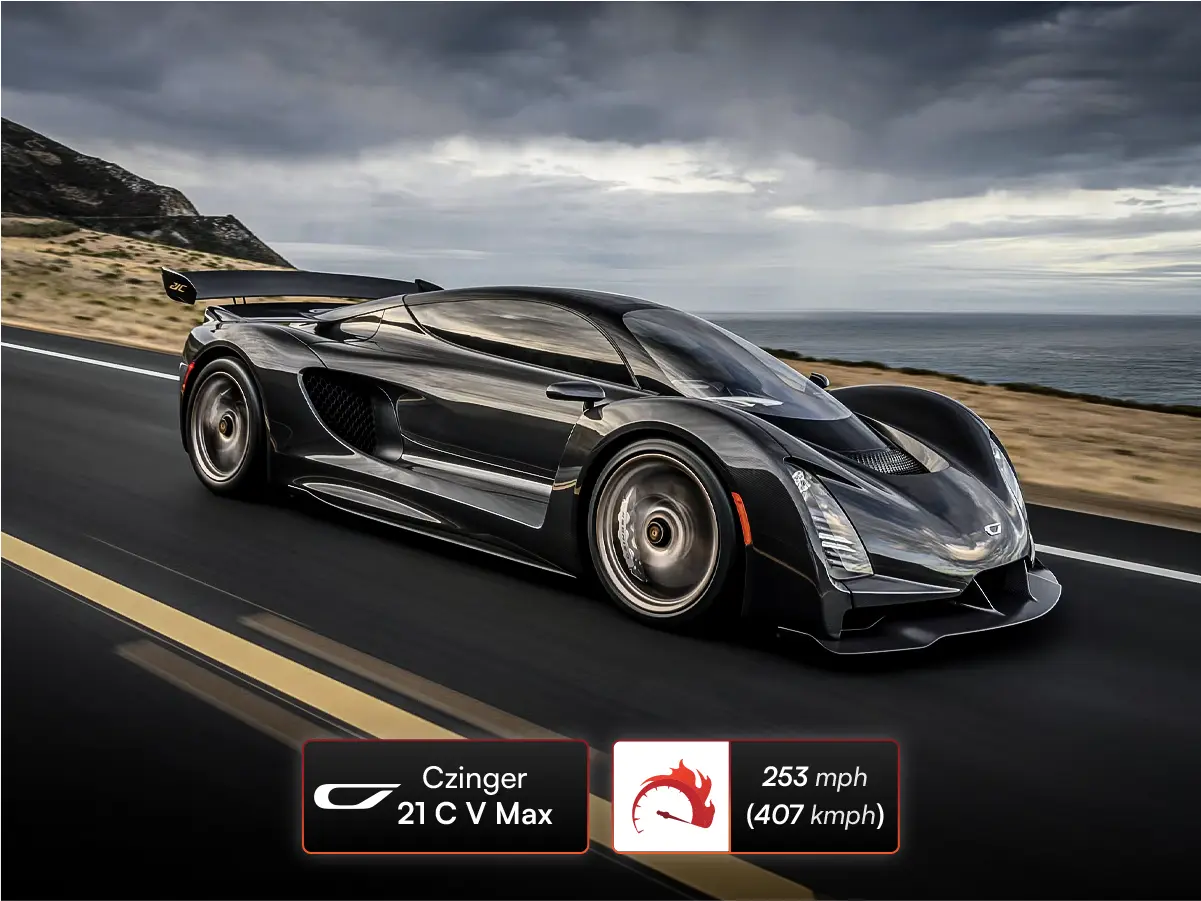
If the fastest cars in the world are usually born in Europe, the Czinger 21C V Max is California’s mic-drop moment. Built by Czinger Vehicles Inc., a company founded in 2019, it’s a technological experiment that escaped the lab and shattered expectations.
The Czinger 21C V Max looks insane. It has two seats laid out one behind the other, creating a narrow, fighter-jet-style bubble that slices through the air with terrifying efficiency. It is a road-legal racecar that does 0-60 mph in a blistering 1.9 seconds. With a top speed of 253 mph (407 km/h), the V Max iteration cements its status as a serious contender for the title of the fastest car in the world. The experience is equally visceral as you are encased in a carbon-fibre tub, screaming towards the horizon with nothing but the track and your own courage ahead of you.
Only 80 examples of this American-made hypercar will ever exist, with a price tag starting at $2.36 million (approx. ₹19.6 Crore), a figure so stratospheric that mere adjectives don't do it justice. The Czinger 21C has already proven its dominance by storming past the finish line at the Goodwood Festival of Speed 2024 in just 48.83 seconds, setting a new production road car record.
Powering this 3D-printed marvel is a 2.88-litre twin-turbocharged V8 that screams all the way to 11,000 rpm. Paired with two front-mounted electric motors and an 800-volt system, the hybrid powertrain generates a whopping 1,250 hp. But the real magic lies in how it’s built: using artificial intelligence and additive manufacturing to create organic, bone-like structures that save weight without sacrificing strength.
Czinger 21 C V Max – Top Speed & Performance
| Metric | Time / Speed |
|---|---|
| 0–100 km/h | 1.9 seconds |
| 0–200 km/h | 4.8 seconds |
| 0–300 km/h | 8.5 seconds |
| 0–400 km/h | ~21.3 seconds |
| Top Speed | 253 mph (407 km/h) Claimed |
Key Features
- AI-Designed Structure: Uses evolutionary solving algorithms to simulate biological evolution, creating highly organic chassis forms that use the absolute minimum amount of material.
- 3D Printed Components: Manufactured by parent company Divergent Technologies, the car features hundreds of 3D-printed parts that make up 17% of the total mass, optimising weight and stiffness.
- Tandem Seating Layout: A unique 1+1 seating configuration places the passenger directly behind the driver, minimising frontal area for maximum aerodynamic efficiency and a Le Mans racer feel.
- 11,000 RPM V8 Hybrid: A bespoke 2.88-litre flat-plane crank V8 that revs to a stratospheric 11,000 rpm, combined with high-output electric motors for a total of 1,250 hp.
- Record-Breaking Pedigree: The platform has proven its capabilities by shattering the production car hill-climb record at Goodwood, validating its "supersonic" performance credentials
Czinger 21 C V Max Specifications
| Specification | Details |
|---|---|
| Engine (Motors) | 2.88L Twin-Turbocharged V8 (Flat-plane crank) + Twin Front Electric Motors |
| Power | 1,250 bhp (Optional 1,350 bhp upgrade) |
| Torque | ~938 Nm (692 lb-ft combined) |
| Curb Weight | ~1,250 kg (Dry weight: ~1,240 kg) |
| Transmission | 7-speed automated sequential manual |
| Body | 1+1 tandem seating coupe, Carbon-fibre & 3D-printed alloy structure |
| No. of Units | Strictly limited to 80 worldwide |
8. Aspark Owl | 256 mph (413 km/h)
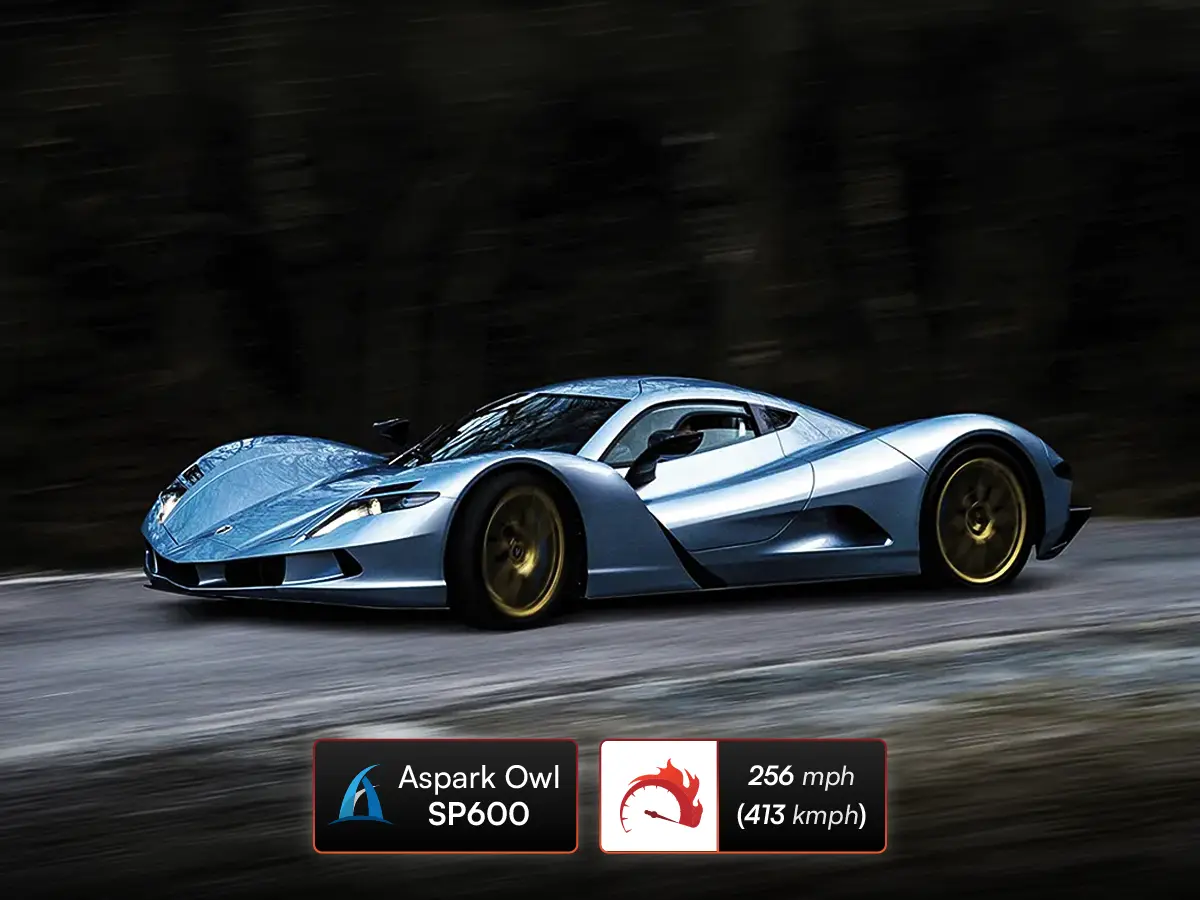
The Aspark Owl is a revolutionary Japanese hypercar that redefines what electric vehicles can do, serving as the first true electric hypercar from Japan. Pushing the absolute limits of EV performance, this all-electric speedster is among the fastest-accelerating cars in the world and a true electric hypercar powerhouse. With mind-blowing acceleration that rockets it from 0-60 mph in roughly 1.72 seconds, the Owl leaves combustion rivals in the dust.
Developed by the Osaka-based Aspark engineering firm and manufactured in Italy by Manifattura Automobili Torino, the Owl is a masterclass in extreme packaging. Standing a mere 99 cm tall, it boasts one of the lowest centers of gravity of any road-legal hypercar, allowing its 1,980-horsepower quad-motor setup to fiercely slice through the air and remain glued to the tarmac.
It acts as a beacon for the future of high-performance electric vehicles, offering an extreme blend of exclusivity, a price tag of roughly $3.2 million, and blistering speed
Aspark Owl – Top Speed & Performance
| Metric | Time / Speed |
|---|---|
| 0–100 km/h | 1.75 seconds |
| 0–200 km/h | 4.76 seconds |
| 0–300 km/h | 9.74 seconds |
| 0–400 km/h | N/A |
| Top Speed | 413 km/h (256 mph) |
Key Features
- Quad Electric Motors: Four motors, one at each wheel, offering independent control and supreme traction.
- Ultra-Low Profile: The vehicle boasts a height of just 99 cm, making it one of the lowest road-legal electric hypercars in the world, allowing for an incredibly low center of gravity and aerodynamic efficiency.
- Full Carbon Construction: Built around a single-piece carbon fibre monocoque with full carbon fibre body panels, keeping the dry weight down to a manageable 1,900 kg.
- Record-Breaking Acceleration: Set two Guinness World Records in 2023 for the fastest average speed over an eighth-mile and quarter-mile by an electric car in the UK.
Aspark Owl Specifications
| Specification | Details |
|---|---|
| Engine (Motors) | Quad-Motor Electric Powertrain (4 independent PMSM) |
| Power | 1,980 hp (1,456 kW) / up to 2,012 bhp |
| Torque | ~2,000 Nm |
| Curb Weight | 2,000 kg (Dry weight: 1,900 kg) |
| Transmission | Single-speed direct drive with All-Wheel Torque Vectoring |
| Body | 2-door coupe, full Carbon Fibre Monocoque |
| No. of Units | Strictly limited to 50 worldwide |
7. Rimac Nevera R | 268 mph (431 km/h)
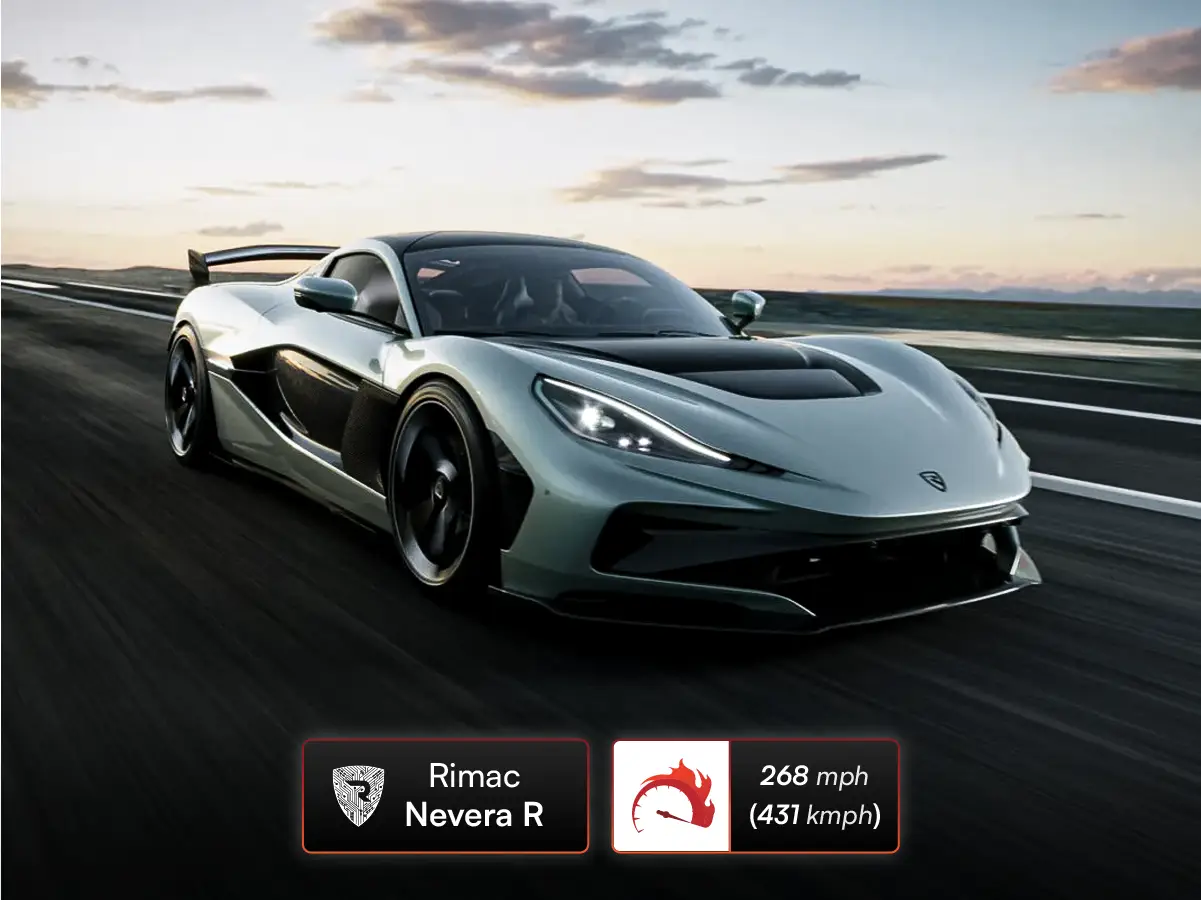
The Rimac Nevera R stands as a pinnacle of modern electric hypercar engineering, showcasing the extraordinary potential of cutting-edge materials and technology. Shifting its focus from a Hyper GT to a hardcore, track-focused Hyper Sportscar, it serves as the aggressive alter ego to the standard Nevera. At the heart of the Nevera R lies a sophisticated all-electric powertrain comprising four independent permanent-magnet electric motors, one powering each wheel. The crown jewel of electric engineering, Rimac’s Nevera R combines advanced aerodynamic mastery, including a large fixed rear wing and a new front diffuser, with a next-generation torque-vectoring system and over 2,100 bhp for unrivalled quick acceleration.
These motors collectively deliver an astonishing 2,107 bhp and 2,340 Nm of torque, enabling the Nevera R to rocket from 0 to 60 miles per hour in just 1.74 seconds. This acceleration figure firmly places the Nevera R among the fastest-accelerating production cars ever made.
In fact, the Nevera R has shattered every performance record that was previously held by the standard Nevera. It did a 0-400-0 km/h (0-249-mph) with a time of 25.79 seconds. While the Rimac Nevera R features a limited top speed of 258 miles per hour (412 kilometres per hour), it recently shattered records by hitting an unrestrained 268.2 mph (431.45 km/h) during a verified run, making it one of the fastest electric production car in the world and a serious contender among the fastest cars overall. Extremely limited in production, Rimac will build only 40 units of the Nevera R worldwide. The price tag reflects its elite status, with a base cost of approximately $2.5 million USD (approx. ₹21 crores).
Key Features
- Four independent motors: Deliver about 2,107 bhp and 2,340 Nm torque across four wheels.
- Track-Focused Aerodynamics: A sleeker, more aggressive profile featuring a large fixed rear wing and a new diffuser, which together improve downforce by 15% and overall aerodynamic efficiency by 10%.
- Next-Generation Battery: Utilises a newly developed, lighter 108 kWh battery pack that provides a higher power output than the standard 120 kWh model.
- Advanced Handling: Equipped with the next-generation Rimac All-Wheel Torque Vectoring system and Michelin Cup 2 tyres to drastically reduce understeer and increase lateral grip.
Upgraded Braking Dynamics: Features new EVO2 carbon-ceramic brakes with a silicone matrix layer to ensure fade-resistant stopping power, improved cooling, and maximum durability during hard track usage
Rimac Nevera R – Top Speed & Performance
| Metric | Time / Speed |
|---|---|
| 0–100 km/h | 1.81 seconds |
| 0–200 km/h | 4.38 seconds |
| 0–300 km/h | 8.66 seconds |
| 0–400–0 km/h | 25.79 seconds |
| Top Speed | 268.2 mph (431.45 km/h) Verified / 258 mph Limited |
Rimac Nevera Specifications:
| Specification | Details |
|---|---|
| Engine (Motors) | Quad-Motor Electric Powertrain (Four independent permanent-magnet motors) |
| Power | 2,107 bhp (1,571 kW) |
| Torque | 2,340 Nm |
| Curb Weight | ~2,125 kg |
| Transmission | Four independent single-speed gearboxes |
| Body | 2-door coupe, full Carbon Fibre Monocoque |
| No. of Units | Strictly limited to 40 worldwide |
6. Hennessey Venom F5 | 272 mph (438 km/h)
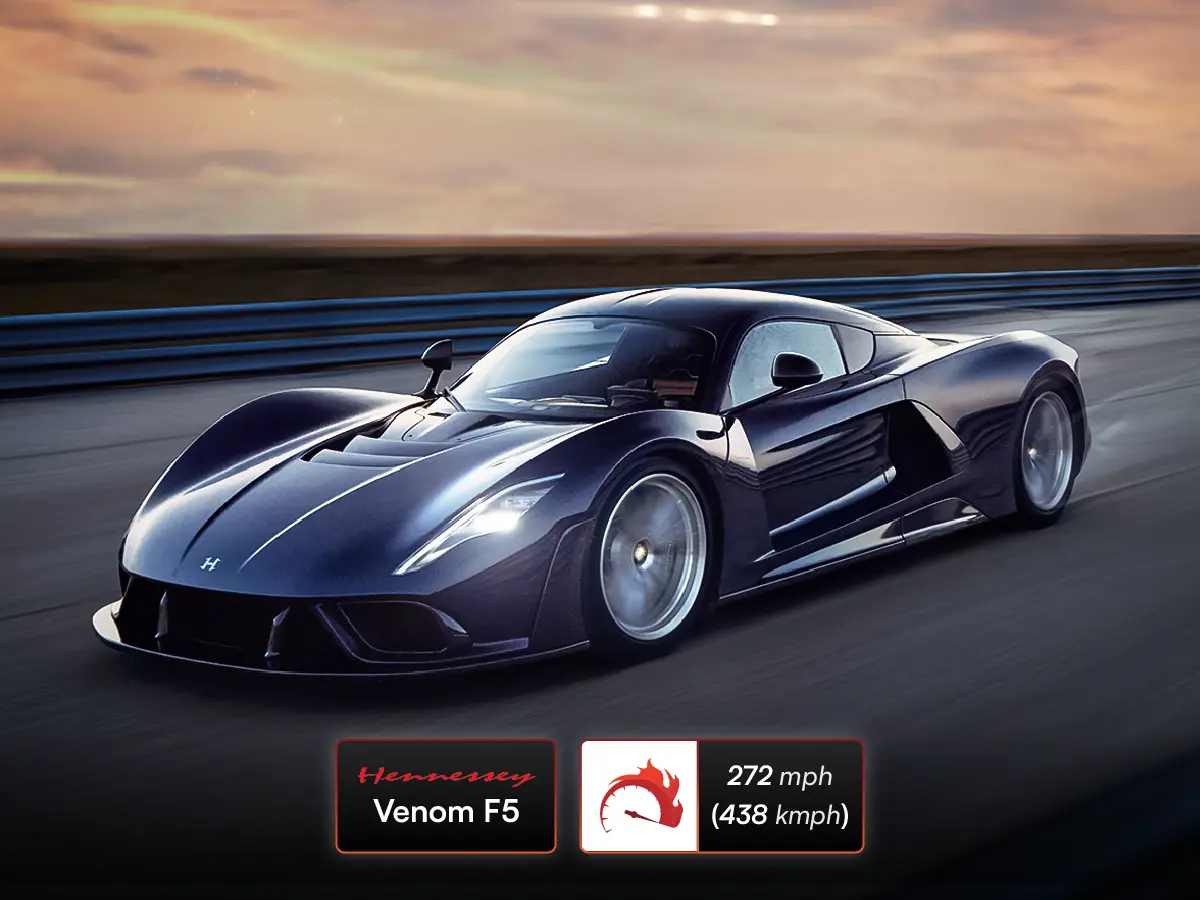
The Hennessey Venom F5 is an American-built, street-legal rocket designed to challenge the laws of physics. Crafted by Hennessey Special Vehicles, it’s engineered under the mantra of an “F5 tornado – but faster,” and lives up to that claim with a mind-bending top speed of 272 mph (438 km/h).
With its bespoke engineering, extreme power output, and aerospace-grade aerodynamics, the Venom F5 firmly cements its place among the elite high-speed titans, currently ranking as one of the fastest cars in the world in 2026. Stripped of heavy hybrid batteries and complex all-wheel-drive systems, the rear-wheel-drive F5 provides a raw, unfiltered driving experience that relies purely on monstrous internal combustion and ultra-lightweight architecture to achieve its staggering performance.
While the verified 272 mph (438 km/h) figure comfortably secures its spot among the world’s elite, Hennessey is quick to point out that it is not the car's absolute ceiling. This speed was recorded during high-speed engineering validation testing at the Johnny Bohmer Proving Grounds in Florida. Hennessey has been fiercely transparent that this was merely an aerodynamic shakedown run where the test driver simply ran out of runway, rather than a definitive V-Max attempt. The Texas-based manufacturer remains locked to finding a long enough stretch of tarmac to officially shatter the mythical 300 mph barrier.
Hennessey Venom F5 – Top Speed & Performance
| Metric | Time / Speed |
|---|---|
| 0–100 km/h | 2.6 seconds |
| 0–200 km/h | 4.7 seconds |
| 0–300 km/h | 8.4 seconds |
| 0–400 km/h | 15.5 seconds |
| Top Speed | 272 mph (438 km/h) |
Key Features
- Fury Engine: A massive 6.6-liter twin-turbo V8; hand-built and designed for raw, unfiltered speed.
- Ultra-Lightweight Chassis: Made entirely of carbon fibre, with a dry weight of just 1,360 kg.
- Advanced Aero Package: Features an active rear wing, rear diffuser, and front splitter, all forged from carbon fibre.
- Aggressive Styling: Built to look as fast as it is, with smooth lines and aggressive proportions.
- Limited Production: Only 24 units will be built globally, making it one of the rarest hypercars ever made.
Hennessey Venom F5 Key Specifications
| Specification | Details |
|---|---|
| Engine | 6.6L Twin-Turbocharged V8 ("Fury") |
| Power | 1,817 bhp |
| Torque | 1,617 Nm |
| Curb Weight | ~1,385 kg (Dry weight: 1,360 kg) |
| Transmission | 7-speed single-clutch automated manual |
| Body | 2-door coupe, full Carbon Fibre Monocoque |
| No. of Units | Limited to 24 worldwide |
5. Bugatti Tourbillon | 276 mph (445 km/h)
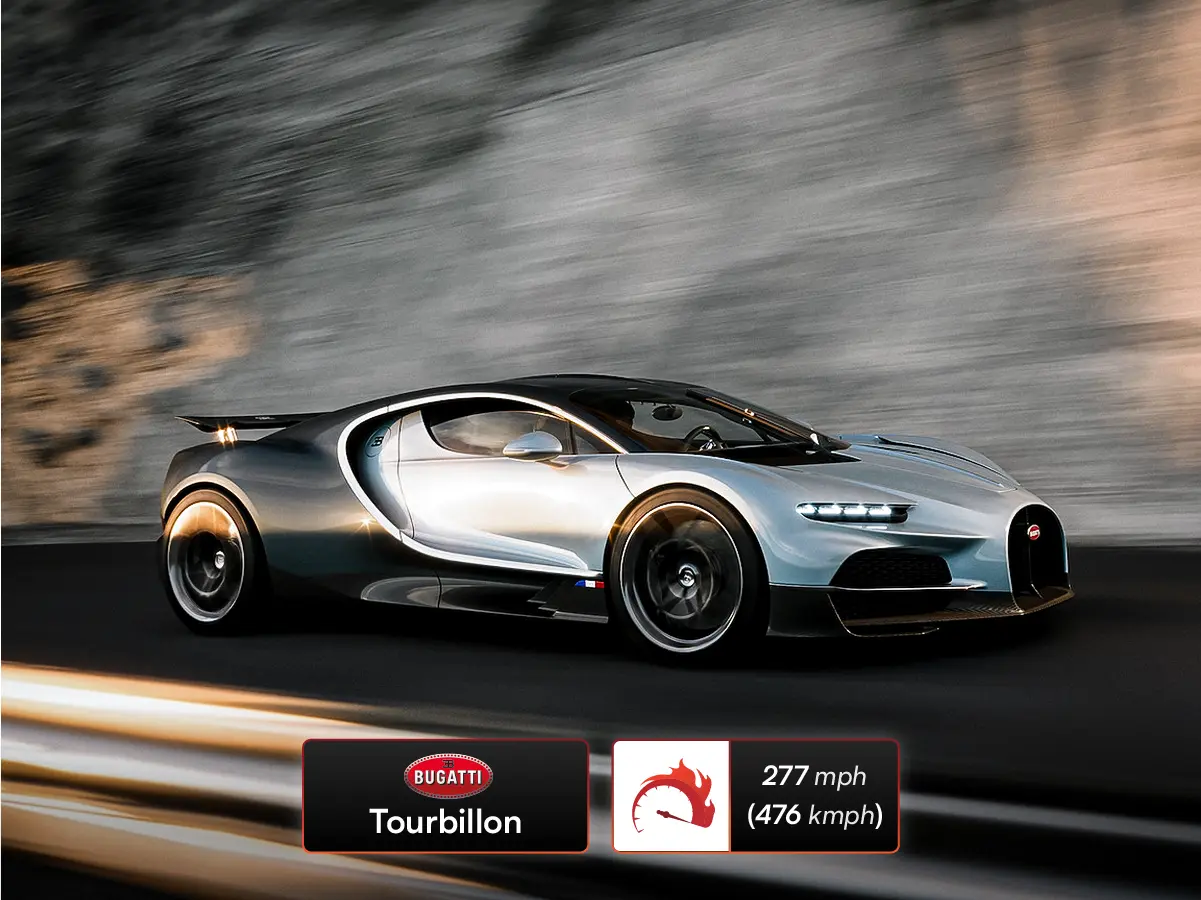
If you grew up in the 2000s, the phrase “fastest car in the world” probably takes you straight to a Top Gear runway scene with a Bugatti Veyron storming past fighter jets. That obsession with absolute speed now wears a new name: the Bugatti Tourbillon.
The legendary quad-turbo W16 is gone. In its place sits an all-new, naturally aspirated 8.3-litre V16, developed with Cosworth. On its own, it produces close to 1,000 horsepower. Add three electric motors contributing roughly 800 horsepower, and you get a combined output of around 1,800hp for the Tourbillon, making it the most powerful Bugatti ever built.
The Bugatti Tourbillon's top speed stands at 445 km/h (276 mph), which is a figure that keeps it firmly in the conversation for the fastest production car in the world. It rockets from 0–60mph in under 2.0 seconds, and Bugatti claims it can reach 250mph in just 25 seconds. And if history tells us anything, remembering what Bugatti extracted from the Bugatti Chiron Super Sport 300+, an even faster variant, may well follow.
However, unlike its predecessors, Bugatti says not a single component is shared. The hybrid V16 is paired with an eight-speed dual-clutch transmission and all-wheel drive, ensuring that all 1,800 horses translate into relentless forward thrust.
The Bugatti Tourbillon is expected to be priced at around $4.6 million (₹41.7 Crore). This isn’t just another hypercar. One of the most expensive cars in the world, Bugatti’s next statement in the ongoing battle for the fastest car in the world crown.
Bugatti Tourbillon – Top Speed & Performance
| Metric | Time / Speed |
|---|---|
| 0–100 km/h | 2.0 seconds |
| 0–200 km/h | < 5.0 seconds |
| 0–300 km/h | < 10.0 seconds |
| 0–400 km/h | < 25.0 seconds |
| Top Speed | 276 mph (445 km/h) With Speed Key |
Key Features
- Cosworth V16 Engine: A naturally aspirated 8.3-litre V16 marvel that delivers 1,000 hp of raw, emotive performance without a single turbocharger, ensuring an unmatched auditory experience.
- Tri-Motor Hybrid System: Features three electric motors that contribute an additional 800 hp, filling in torque gaps and sharpening the throttle response to millisecond perfection.
- Analogue Instrument Cluster: Rejects the trend of digital screens for a stunning, watch-like instrument cluster made of titanium, sapphire, and ruby, fixed to the steering column.
- Unshared Architecture: A completely clean-sheet design where no parts are borrowed from the Chiron, utilising a new carbon-composite structure to handle the immense forces of 1,800 hp.
Formula One Tech: The powertrain is infused with F1-derived technologies, including an 8-speed dual-clutch gearbox and a 25kWh oil-cooled battery, maximising efficiency at extreme velocities.
Bugatti Tourbillon Key Specifications
| Specification | Details |
|---|---|
| Engine | 8.3-litre Naturally Aspirated V16 + Tri-Motor Hybrid System |
| Power | 1,800 bhp combined (1,000 hp ICE + 800 hp Electric) |
| Torque | 900 Nm (ICE) + Massive Electric Torque Vectoring |
| Curb Weight | < 1,995 kg |
| Transmission | 8-speed dual-clutch automatic (DCT) |
| Body | 2-door coupe, T800 Carbon-composite monocoque |
| No. of Units | Strictly limited to 250 units worldwide |
4. Bugatti Mistral | 282 mph (453 km/h)

The Bugatti Mistral is more than just a hypercar, it’s a legacy on wheels. Unveiled in 2022, this stunning open-top beast is not only the fastest roadster in the world but also Bugatti’s final tribute to the iconic W16 engine that redefined speed in the 21st century.
Wrapped in a lightweight carbon fibre monocoque and powered by the 8.0L quad-turbo W16, it delivers blistering performance and a rare blend of roofless freedom and raw power.
The Mistral officially cemented its legacy in November 2024 by shattering the open-top world speed record. Piloted by Bugatti’s chief test driver and Le Mans winner Andy Wallace, the hypercar clocked a verified 282.04 mph (453.9 km/h) at the ATP Automotive Testing Papenburg oval in Germany.
Bugatti Mistral – Top Speed & Performance
| Metric | Time / Speed |
|---|---|
| 0–100 km/h | 2.4 seconds |
| 0–200 km/h | 5.6 seconds |
| 0–300 km/h | 12.1 seconds |
| 0–400 km/h | ~29.0 seconds |
| Top Speed | 282 mph (453.9 km/h) Verified |
Key Features
- Iconic W16 Powerplant: Final appearance of the quad-turbocharged 8.0L W16, delivering 1,578 bhp.
- Convertible with Carbon Monocoque: Combines lightweight agility with structural rigidity.
- Airflow-Tuned Aerodynamics: Every panel sculpted for performance, even without a fixed roof.
- Heritage Meets Hyper Speed: Inspired by the Bugatti Type 57 Roadster Grand Raid with 21st-century performance.
- Fastest Open-Top Car Ever: Reaches a jaw-dropping 282 mph, officially the fastest roadster on the planet.
- Extreme Rarity: Only 99 units will be built, all of them already sold.
Bugatti Mistral Key Specifications
| Specification | Details |
|---|---|
| Engine | 8.0L Quad-Turbocharged W16 |
| Power | 1,578 bhp (1,600 PS) |
| Torque | 1,600 Nm |
| Curb Weight | ~1,960 kg |
| Transmission | 7-speed dual-clutch automatic (DSG) |
| Body | 2-door roadster (open-top convertible), full Carbon Fibre Monocoque |
| No. of Units | Strictly limited to 99 units worldwide |
3.SSC Tuatara | 295 mph (474 km/h)

In the relentless race to build the fastest car in the world, SSC North America (formerly Shelby SuperCars) stunned the hypercar scene with the Tuatara, a jet-inspired marvel engineered to bend the limits of physics.
While many boutique hypercar manufacturers borrow and modify existing powertrains, SSC took a purist approach. The heart of the Tuatara is a bespoke 5.9-litre, flat-plane crank twin-turbocharged V8 developed in collaboration with Tom Nelson of the legendary Nelson Racing Engines. Revving to a screaming 8,800 rpm, this meticulously crafted powerhouse delivers up to 1,750 bhp.
Named after a New Zealand reptile known for its resilience, the SSC Tuatara isn't just fast, it’s one of the most aerodynamically efficient and technically advanced production cars ever made.
After an initial, heavily disputed 316 mph claim in 2020 was retracted by SSC due to telemetry discrepancies, the company vowed to return with absolute transparency. They delivered in May 2022 at the Kennedy Space Center in Florida. Driven by the car's owner, Larry Caplin, the Tuatara hit a stringently verified 295 mph (474.8 km/h) over a mere 2.3-mile stretch. The telemetry data showed it was still accelerating hard at the braking zone, proving that with a longer runway, it possessed the momentum to easily eclipse the 300 mph mark.
SSC Tuatara – Top Speed & Performance
| Metric | Time / Speed |
|---|---|
| 0–100 km/h | ~2.5 seconds |
| 0–200 km/h | ~4.36 seconds |
| 0–300 km/h | ~7.37 seconds |
| 0–400 km/h | ~12.08 seconds |
| Top Speed | 295 mph (474.8 km/h) |
Key Features
- Aerospace-Inspired Aerodynamics: Jet fighter aesthetics, a drag coefficient of just 0.279, and carbon-fibre sculpting from designer Jason Castriota.
- Full Carbon Construction: Both monocoque chassis and body panels are made from aerospace-grade carbon fibre.
- Lightweight Speed Machine: Weighs just 1,247 kg (2,750 lbs), lighter than most rivals in its class.
- Track-Tested Speed: Verified real-world speeds above 286 mph.
- Exclusivity: Limited to just 100 units worldwide, a future collector’s gem.
SSC Tuatara Key Specifications
| Specification | Details |
|---|---|
| Engine | 5.9L Twin-Turbocharged V8 (Flat-plane crank) |
| Power | 1,750 bhp (E85 Biofuel) / 1,350 bhp (91-Octane) |
| Torque | ~1,735 Nm (Estimated) |
| Curb Weight | ~1,350 kg (Dry weight: 1,247 kg) |
| Transmission | 7-speed CIMA automated manual (sub-100 ms shifts) |
| Body | 2-door coupe, full Carbon Fibre Monocoque |
| No. of Units | Limited to 100 worldwide |
2. Yangwang U9 Xtreme | 308mph (496 km/h)
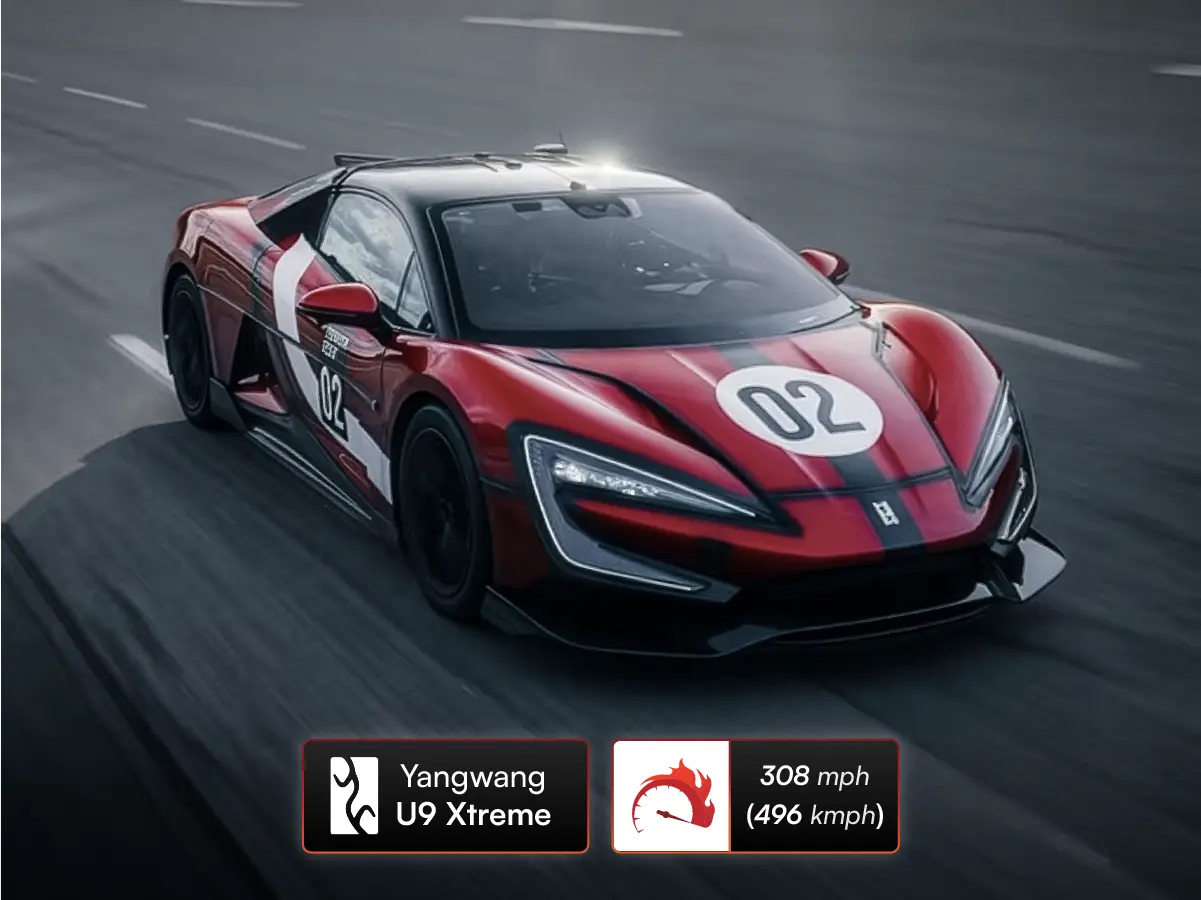
While the standard U9 was already a disruptor, the Yangwang U9 Xtreme exists to make everything with a combustion engine look a bit weak.
This is the performance flagship of YANGWANG, which is BYD’s ultra-luxury sub-brand. In September 2025, the U9 Xtreme officially rewrote the rulebook, recording a verified 308 mph (496.22 km/h) top speed at the ATP Automotive Testing Papenburg track in Germany. This makes the Yangwang U9 Xtreme not only the fastest electric car in the world, but also the highest top speed car with a verified test run, beating the previous record holder, the Bugatti Chiron Super Sport 300+. The monumental 308 mph run was executed by German track specialist and GT racing veteran Marc Basseng.
Under the skin, the U9 Xtreme features a revolutionary 1,200V high-voltage platform capable of generating a colossal 3,000 bhp, delivering a power-to-weight ratio of 1,217 hp per tonne.
Only 30 units of this high-speed machine will ever be produced, making it a strictly limited slice of automotive history. While prices are expected to start north of £200,000 (approx. ₹2.15 Crore), the U9 Xtreme offers performance that rivals hypercars costing ten times as much. The Yangwan U9 Xtreme has already proven its mettle on the Green Hell, lapping the Nürburgring Nordschleife in just 6:59.157, shaving five seconds off the previous record to become the quickest electric super sports car to dip under the seven-minute mark.
Yangwang U9 Xtreme – Top Speed & Performance
| Metric | Time / Speed |
|---|---|
| 0–100 km/h | < 2.0 seconds |
| 0–200 km/h | < 4.5 seconds |
| 0–300 km/h | < 8.0 seconds |
| 0–400 km/h | < 15.0 seconds |
| Top Speed | 308 mph (496.22 km/h) Verified |
Key Features
- 1,200-Volt Ultra-High-Voltage Platform: The world’s first series-production car to run a 1,200V architecture, allowing immense power transfer, reduced heat losses, and sustained high-performance output under extreme loads.
- Four 30,000rpm Electric Motors (e4 Platform): Each motor produces 555kW, delivering over 3,000PS combined.
- DiSus-X Intelligent Body Control: A full active vehicle body control system with independent active force regulation at each wheel. It manages vertical posture, axle-load transfer, and body stabilisation in milliseconds, reshaping cornering dynamics at hypercar speeds.
- World’s Largest Carbon-Fibre Monocoque: Constructed from aerospace-grade T700/12K carbon fibre, with over 110kg of composite material. Five to six times stronger than steel at a fraction of the weight, forming an ultra-rigid structural core.
- Titanium Calipers & Carbon-Ceramic Brakes: High-rigidity titanium callipers paired with slotted and drilled carbon-ceramic discs deliver fade-resistant stopping power, even after repeated 300mph assaults.
BYD’s Battery Technology: Supporting it all is BYD’s lithium-ion phosphate Blade Battery with an extraordinary 30C discharge rate, designed to withstand track-level punishment.
Yangwan U9 Extreme Key Specifications
| Specification | Details |
|---|---|
| Engine (Motors) | Quad-Motor Electric Powertrain (Four independent 30,000rpm motors) |
| Power | > 3,000 PS (~2,959 bhp / 2,220 kW) |
| Torque | ~1,680 Nm (with immense independent wheel torque vectoring) |
| Curb Weight | ~2,555 kg |
| Transmission | Four independent single-speed direct drive gearboxes |
| Body | 2-door coupe, Aerospace-grade T700/12K Carbon-Fibre Monocoque |
| No. of Units | Strictly limited to 30 worldwide |
1. Koenigsegg Jesko Absolut | 310 mph (500 km/h)

Claimed by Koenigsegg as the fastest production car ever made, the Jesko Absolut is a hypercar engineered for maximum straight-line speed. With a theoretical top speed of 310 mph (500 km/h), it holds the crown as the fastest car in the world in 2026, blending extreme aerodynamic efficiency, ultra-lightweight construction, and mind-bending performance.
Unveiled as the ultimate evolution of the already formidable Jesko, the Absolut variant is designed solely to shatter speed records. It ditches downforce-heavy components from the Jesko Attack in favour of a sleeker, low-drag silhouette, taking direct inspiration from supersonic jets.
Under its carbon-fibre skin, the Jesko Absolut is powered by a monstrous 5.0-litre twin-turbocharged V8 engine. To cut through the air with minimal resistance, the Absolut boasts an incredibly low drag coefficient of just 0.278 Cd, utilising twin F-15 fighter-jet-inspired tail fins to maintain absolute stability at warp speeds
While the Jesko Absolut holds the crown for the highest theoretical top speed car, the Agera RS is another legendary Koenigsegg for setting the actual, verified, real-world Guinness World Record back in 2017, with a top speed of 277.9 mph.
Koenigsegg Jesko Absolut – Top Speed & Performance
| Metric | Time / Speed |
|---|---|
| 0–100 km/h | ~2.5 seconds |
| 0–200 km/h | 5.23 seconds |
| 0–300 km/h | 8.86 seconds |
| 0–400 km/h | 16.77 seconds |
| Top Speed (theoretical) | 310 mph (500 km/h) |
Key Features
- Carbon Fibre Construction: Full carbon monocoque chassis with aluminium honeycomb core for rigidity and weight savings.
- Aerospace-Inspired Aerodynamics: Low-drag profile, no rear wing, minimal turbulence, all to maximise top-end speed.
- Ultra-Lightweight: Dry weight of just 2,888 lbs (1,310 kg).
- Rear Stabilising Fins: Designed for directional stability at speeds over 300 mph.
Custom Wheels & Tires: 20-inch front and 21-inch rear wheels with speed-rated performance tyres.
Koenigsegg Jesko Absolut Key Specifications
| Specification | Details |
|---|---|
| Engine | 5.0L Twin-Turbocharged V8 (Flat-plane crank) |
| Power | 1,280 bhp (Petrol) / 1,600 bhp (E85 Biofuel) |
| Torque | 1,500 Nm @ 8,500 RPM |
| Curb Weight | ~1,390 kg |
| Transmission | 9-speed Light Speed Transmission (LST) |
| Body | 2-door coupe, full Carbon Fibre Monocoque |
| No. of Units | Limited to 125 units |
Conclusion
From renowned brands like Bugatti, known for revolutionizing speed standards of production grade cars, to custom car builders like Hennessey, the enthusiasm for achieving top speed records on land continue to compel the evolution of cars. With acceleration times constantly dropping, and top speed figures already North of 500 kmph, the next generation of the fastest cars in the world only continue to shatter records, with engineering marvels designed to blur reality with sheer speed.
Fastest cars also tend to come with added luxury features, and if you're looking for an affordable luxury car option, a used luxury car can fit the bill perfectly.
Frequently Asked Questions
Expand all