
A report by ICRA states that by 2027, Compressed Natural Gas (CNG) will be the second most preferred fuel, at least for passenger vehicles, in India. Additionally, the decision by the Ministry of Petroleum and Natural Gas to set up 17,500 CNG pumps in India by 2030 may also help expand the infrastructure to support the growing demand. With rising fuel prices, CNG projects create a win-win situation for both the environment and the end user, justifying the CNG kit price in India. Not only is it eco-friendly and more efficient, but it is also easier on the CNG car owners’ pockets. CNG is a safer fuel, compared to petrol and diesel, as it has a much higher auto-ignition temperature (540 °C) and has low flammability, reducing the chances of the gas catching fire.
Automakers, like Maruti Suzuki, Tata Motors and Hyundai India are the key players among CNG-powered cars in India. Some of the most popular CNG-powered cars include the Maruti Suzuki WagonR CNG, Dzire CNG and the Tata Tigor iCNG. However, if you’re looking to buy a vehicle equipped with a CNG kit from the factory, or retrofitted with an aftermarket kit, here’s everything you need to know before buying one, including CNG Kit installation price, best brands, things to keep in mind, and more.
What is a CNG kit?
While it is not possible to convert a petrol engine car into a diesel engine car, or vice versa, it is possible for some petrol or diesel engine cars to be converted to CNG by using a CNG kit. In fact, retrofitting a CNG kit gives drivers the option to swap between CNG and normal fuel usage with the flip of a switch.
Of course, you will first need the permission from your local Regional Transport Office (RTO) to install a CNG kit in your car.
A CNG kit converts your internal combustion engine (ICE) vehicle to run on Compressed Natural Gas (CNG) as well. The kit includes:
- Electric Control Unit (ECU): A new/remapped ECU that controls the flow of compressed natural gas into the engine
- Pressure gauge: Indicates the gas pressure and ensures it is in sync with the car’s fuel injection system
- Refill valve: The valve where the CNG refilling pipe is inserted at the pump
- High-pressure tubes: Carry compressed gas throughout the system and prevent high-pressure gas explosions
- CNG tank: Used to store the Compressed Natural Gas in the vehicle
- Clamps: Hold the pipes in position as they run from the CNG tank to the engine
- Regulator: A valve that will cut the gas flow if it exceeds a certain pressure
How CNG kits work in cars
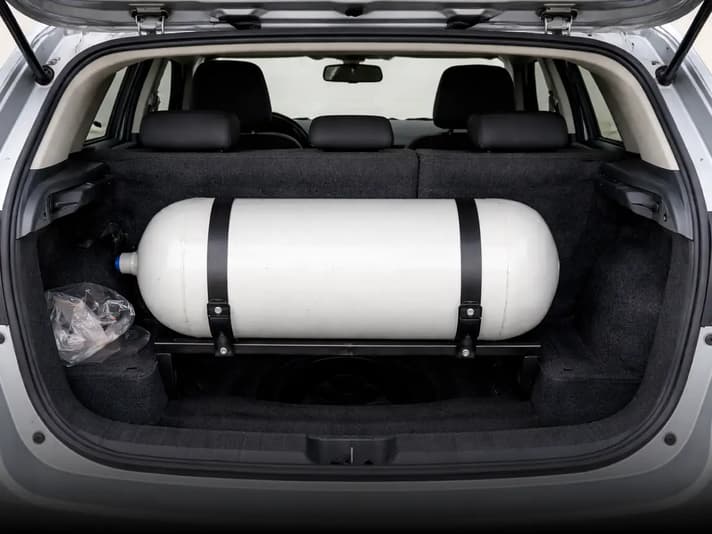
- Along with the CNG kit, a secondary fuel tank is installed, usually in the boot of the vehicle. The compressed gas tank is used to store the CNG fuel, which usually ranges between 10-12 kgs in capacity. The CNG travels through the high pressure lines to the fuel injectors that flow the fuel into the combustion chamber of the engine.
- A pressure regulator controls the pressure of the gas, and once an acceptable pressure is achieved, the gas is moved into the fuel injection system, from where it finally reaches the engine. The gas/fuel is then ignited by a spark plug in the combustion chamber, providing power to move the car forward.
CNG Kit Prices in India
If you are researching the CNG kit price in India, the price depends on the type of kit, brand, vehicle compatibility, and more.
For the modern passenger car segment, BS6-compliant sequential kits are mandatory. These systems involve complex wiring, high-speed gas injectors, and sophisticated ECUs
The realistic market figure for the CNG Kit price in 2026 is ₹40,000 to ₹60,000 for a good-quality after-market BS6 sequential retrofit, while a factory-fitted or dealer-installed kits cost between ₹90,000 and ₹1,00,000.
| CNG Kit Category | Price (₹) | Target Vehicle Type | Key Benefit |
| Venturi Kit | ₹15,000 – ₹35,000 | Older MPFI/Carbureted | Low initial investment |
| Sequential (Open Loop) | ₹15,000 – ₹20,000 | Entry-level MPFI | Better performance than Venturi |
| Sequential (Closed Loop) | ₹22,000 – ₹50,000 | Modern Hatchbacks/Sedans | Good emissions control; ROI in 1 year |
| BS6 OBD-II Kit | ₹45,000 – ₹70,000 | New BS6 Phase 2 Cars | Real-time tuning; maximum mileage |
| Factory/Dealer Fitted | ₹75,000 – ₹1,00,000 | New Showroom Purchases | Warranty protection; high safety |
RTO-Approved CNG Kit Price List
The Indian market is populated by several global and domestic brands that have secured ARAI or ICAT certification. Choosing an RTO-approved CNG kit price option ensures legal compliance, insurance validity, and safety certification (ARAI/ICAT).
Here are trusted brands in India:
| Brand | Origin | Approx Kit Price | Used By |
| Lovato | Italy | ₹30,000 – ₹35,000 (₹48,000 – ₹65,000 for OBD-2) | Honda dealer kits |
| BRC | Italy | ₹30,000 – ₹40,000 | Used historically by Maruti |
| Tomasetto | Italy | ₹35,000 – ₹45,000 | Aftermarket retrofits |
| Landi Renzo | Italy | ₹30,000 – ₹40,000 | Legacy OEM association |
| Mijo Auto Gas | India | ₹40,000 – ₹55,000 | BS6 integrated advancer kits |
| Motozen | India | ₹45,000 – ₹60,000 | ICAT-approved, used in Tata Punch |
These are BS6-compliant CNG kits and widely accepted across major Indian states. Always choose certified brands when evaluating the CNG kit price in India, not just the cheapest option.
CNG Kit Installation Cost & Fitting Charges
Apart from the installation charges, the following additional charges must also be accounted for:
- Registration fees and RC endorsement: ₹2,000 – ₹3,000
- RTO licence fee: Costs differ depending on the state in which the licence is being issued
- Maintenance: Varying costs as per the repairs and checks required
- Additional insurance endorsement fee: ₹1,200 – ₹1,500
- Apart from these, there are miscellaneous expenses such as additional pipes, clamps, brackets, wiring harness adjustments, and documentation support. These can add another ₹1,000 to ₹2,000, depending on the vehicle and kit type.
So when calculating the real CNG kit installation cost, expect ₹5,000-₹8,000 over the base kit price. This means the practical CNG kit price in India, including installation, usually lands around ₹45,000–₹65,000 for a proper BS6 sequential kit.
Different types of CNG kits
Before deciding which kind of CNG kit to go for, it would help to know that the performance of a factory-fitted or retro-fitted CNG kit is nearly identical. The difference lies in the brand and quality of the CNG kit selected.
There are two kinds of CNG kits, both with their own pros and cons. The right choice, of course, depends on the car and use case.
- Venturi kit

A Venturi CNG Kit is designed to work with vehicles with carburettors. Venturi cng kit price in India is generally between ₹15,000 and ₹35,000, making it a cost-effective choice that is easy to install in a car with no complex wiring or processes involved. One of the key advantages is that a Venturi Kit does not require a new/remapped ECU. However, it requires more maintenance due to its irregular performance, which ultimately adds more expenditure for the user. The repeated cleaning or maintenance occurs owing to the lack of control over the amount of fuel going to the engine. Additionally, cars with Venturi CNG Kits suffer from slow acceleration and regular stalling of the engine.
2. Sequential kit

The sequential CNG kit regulates the fuel flow into the engine and runs only on fuel-injected vehicles, where fuel is directly injected into the combustion chamber. A Sequential CNG kit requires a new/remapped ECU to regulate the fuel being injected into the engine. This is one of the key reasons why a Sequential cng kit price is more expensive than a Venturi kit. However, despite the higher cost and installation complications, a Sequential kit offers better mileage/fuel economy.
The two types of Sequential CNG kits:
A. Closed Loop System
The closed-loop sequential kit interacts with the Lambda sensor (or oxygen sensor) and is installed in the exhaust system of every car. It transmits information about exhaust emissions to the ECU, thus enabling it to control the fuel flow into the engine. As a result, the emissions are kept under control, allowing the CNG fueled-car to serve its main purpose of being an eco-friendly means of travel.
However, the downside of using a closed-loop sequential kit is that it reduces the performance of the car and allows for slower acceleration due to the regulated fuel flow. This type of kit is compatible with newer cars that come with a Lambda sensor.
B. Open Loop System
The open-loop system keeps the flow of fuel to the engine "open," implying that the flow is not dependent on the emission levels from the exhaust pipe. This allows for better performance from the vehicle, allowing for smooth acceleration.
But it is a less preferred choice for those who wish to reduce emissions and focus on ensuring their car is providing optimum eco-friendly performance. Additionally, it may lead to heating issues due to more emissions from the exhaust valves, eventually damaging the valves.
Among the two types of sequential kits, a closed-loop kit is good not only for the environment but also for the engine.
Difference between Venturi CNG kit and Sequential CNG kit
Here is a quick glance at the features of each type if you want to know about the difference between Venturi CNG kit and Sequential CNG kit:
| Parameter | Venturi Kit | Sequential Kit |
| Fundamental Mechanism | Delivers a predetermined amount of fuel into the engine | Fuel flow is determined by the Electronic Control Unit (ECU). |
| Installation Cost | Lower costs; no need for a new ECU | New ECU adds to a higher one-time cost |
| Installation Process | Easier, as the absence of an ECU requires less wiring | Labour intensive because of the ECU |
| ECU | No | Yes |
| Additional Types | No | Closed loop and open loop system |
| Engine Compatibility | Compatible with cars that are equipped with a carburettor | Only compatible with fuel-injected vehicles |
| Maintenance | Requires more frequent cleaning and maintenance
| Requires less maintenance
|
| Engine Performance | Slower acceleration
| Smoother acceleration, better long run performance |
What is a CNG Advancer? (Static vs Dynamic)
When you install a sequential CNG kit, one important component that often gets discussed is the CNG timing advancer.
One of the most frequent concerns among Indian car owners is the perceived loss of power post-conversion. CNG burns slower than petrol. It also has a higher auto-ignition temperature (around 540°C). If the ignition timing remains calibrated for petrol, the spark occurs too late for CNG, resulting in incomplete combustion by the time the exhaust valves open. This leads to a sluggish throttle response and a noticeable power lag during acceleration.
Without advancing the spark timing, you may experience:
- Sluggish acceleration
- Loss of pickup
- Slight drop in power
This is where a CNG advancer becomes important.
How does a CNG Advancer Work (Timing Advancer)?
A CNG Advancer, also known as a Timing Advance Processor (TAP), is designed to intercept signals from the vehicle’s crankshaft or camshaft position sensors. By modifying these signals, the advancer forces the original ECU to fire the spark plugs earlier (advancing the timing). It helps the engine compensate for slower combustion.
In simple terms, a CNG timing advancer is a CNG pickup problem solution.
There are two types: Static Advancer and Dynamic Advancer
A static advancer applies a fixed timing advance across all RPMs, while a dynamic (variable) advancer adjusts the spark advance based on engine speed/load for optimal performance.
Static Advancer
- Applies a fixed ignition advance.
- Same timing adjustment across RPM range.
- Affordable but less adaptive.
Dynamic Advancer
- Adjusts ignition timing dynamically based on engine load and RPM.
- Better performance and smoother drivability.
- Preferred for BS6 engines.
If you’re wondering about dynamic advancer vs static advance, dynamic is more suitable for modern cars because BS6 engines are highly ECU-controlled.
The CNG advancer price in India typically ranges between ₹1,500 and ₹4,000 depending on brand and compatibility.
Many modern sequential BS6 CNG kits (like Mijo and Motozen) come with an integrated dynamic advancer, while some older kits require separate installation.
OEM factory-fitted CNG cars usually have calibration done at ECU level, so no external module is required.
Best CNG Kits in India: Brand Recommendations
| Vehicle Manufacturer | Recommended Kit Brand | Rationale |
| Maruti Suzuki | BRC, Lovato | Sourced from BRC for factory units; Lovato offers excellent tuning |
| Hyundai / Kia | Lovato, Tomasetto | High compatibility with Korean VTVT engine electronics |
| Honda | Lovato (OBD-2) | Sensitivity of i-VTEC requires the precise fuel trim reading of OBD-2 kits |
| Nissan / Renault | Motozen | Frequently endorsed by Nissan dealers for Magnite conversions |
| Tata Motors | Motozen, Mijo | Strong local support and ICAT approval for Revotron engines |
Leading Italian brands such as Lovato, BRC, and Tomasetto continue to hold significant market share. Lovato, in particular, is highly favored for its compatibility with Korean (Hyundai/Kia) and Japanese (Honda) engines. The Lovato CNG kit price in India for a sequential system generally starts at ₹31,999 and can go up to ₹58,000 for advanced OBD-II versions. In fact, OEMs like Honda and Kia prefer Lovato kits in their dealer-fitments.
BRC Gas Equipment, which serves as the OEM supplier for many of Maruti Suzuki’s S-CNG models, offers premium aftermarket kits typically priced between ₹30,000 and ₹45,000.
Difference between company-fitted CNG vs. aftermarket CNG

A company-fitted CNG kit may cost almost the same (if not higher) as a retrofitted CNG kit. A value-added benefit of having a company-fitted CNG kit is that the company provides a warranty in case the engine fails. However, if an aftermarket CNG kit is installed in a car, it voids the manufacturer’s warranty .
Furthermore, when you purchase a CNG-fitted car, you can be sure of the high quality of the kit and all its components. While buying vehicles with aftermarket CNG-kits bring in the possibility of low-quality/unapproved equipment. OEM CNG kits, installed by the factory, are generally more reliable.
Dealer-Fitted CNG Options
When comparing the CNG kit price in India, the decision is also about warranty, long-term reliability, and peace of mind.
Today, several car manufacturers offer dealer-fitted CNG options, even if the car is not originally manufactured as a factory CNG model. This has changed the way buyers approach CNG conversions.
Many manufacturers now offer dealer-fitted CNG options:
- Honda (Amaze, Elevate)
- Kia (Carens, Seltos)
- Citroen (C3)
How Dealer-Fitted CNG Works
When you opt for a dealer-fitted CNG kit:
- The dealership installs a branded and approved kit (commonly Lovato or Motozen).
- Installation is done at an authorised workshop.
- The vehicle is delivered with proper calibration and documentation.
- RTO endorsement support is usually handled by the dealer.
However, most dealer-fitted kits are more expensive than local aftermarket conversions. Dealer-fitted CNG prices in India are comparatively higher than aftermarket CNG fitments, costing nearly ₹70,000 - ₹90,000. While the upfront CNG kit price in India appears higher in this case, it includes peace of mind as the fitment doesn’t void the factory car warranty.
Advantages of CNG kits

- Value for money: Not only is a CNG-fitted car less expensive than a diesel engine car, but the price is only nominally higher than that of a petrol engine car. It is estimated that if a CNG car is run regularly, it will recover the iCNG kit nstallation cost within two years, as the fuel itself costs much less than diesel or petrol.
- Mileage: A CNG car is more fuel efficient than a diesel or a petrol engine car. In practical terms, it means that a CNG car offers better efficiency on 1 kg of CNG than 1 litre of petrol. On the same amount of fuel, a petrol engine car will run 25 per-cent less distance than a CNG car. In fact, the best mileage CNG cars offer up to 34 km/kg of mileage.
- No harmful effects: There are no known harmful effects of running a vehicle on CNG. In fact, using CNG reduces the chances of wear to the engine. Since there is no lead in CNG, it prevents lead fouling and, hence, increases the life of the spark plug. Gas does not interfere with the lubricating oil in the engine, thus reducing the possibility of damage.
- Environmentally friendly: The primary purpose to introduce CNG as an alternate fuel was its eco-friendly attributes. CNG emits fewer carbon monoxide, nitrogen oxides, and particulate matter as compared to petrol and diesel, making it a cleaner fuel option.
- Safe fuel: CNG is a safer choice of fuel than petrol or diesel. Compressed natural gas has a higher auto ignition temperature, and therefore the chances that the fuel will easily ignite is reduced when compared to petrol or diesel.
- Good-quality fuel: There are many instances where fuel pump owners mix petrol or diesel with either kerosene, pentaerythritol tetranitrate (aka penta), or naphthene. These mixed fuels not only damage the vehicle but also have high emissions. On the other hand, CNG is almost impossible to pollute; hence, a buyer is always assured that they are purchasing a good-quality, unadulterated version of the gas.
- Flexibility: With the option to switch between CNG and petrol/diesel, cars installed with CNG kits offer the driver flexibility in the choice of fuel on which they wish to run their car.
- Noise, Vibrations, and Harshness (NVH): CNG retrofitted cars have the same NVH as petrol cars, which puts them on par with petrol cars in some aspects of passenger experience.
Disadvantages of CNG kits
- Installation cost and complex process: The one-time CNG kit installation price is high (approximately ₹ 50,000 - ₹60, 000) and requires a complex procedure to retrofit them into a vehicle.
- Maintenance: While installation may be a one-time cost, it is the regular, more frequent maintenance and checks for CNG cars that are an added expense, which is not the case with cars powered by other fuels.
- Boot space: If a car owner wants to install a CNG kit in their car, they must sacrifice boot space, as the CNG fuel tank takes up a significant amount of space.
- Availability of fuel: While the Ministry of Petroleum and Natural Gas is working on substantially increasing the number of CNG pumps in the country, for now, the availability is limited compared to petrol and diesel. There are much longer waiting lines for CNG refuelling.
- Impact on performance: CNG cars offer reduced performance compared to petrol or diesel cars, and one common example of this is the ineffective air-conditioning in the summer.
- Higher insurance premium: A lesser-known disadvantage of a CNG kit is that the car’s insurance premium is about 10 per-cent higher. The insurance premium amount increases, even for vehicles with aftermarket CNG Kits.
Things to keep in mind when making the move to CNG
Compatibility:
While car manufacturers offer warranties for factory-fitted CNG kits, aftermarket CNG kits do not offer as comprehensive coverage for retrofitted equipment. The cost of a CNG kit depends on the quality of the product. It is imperative to thoroughly research the correct CNG kit that is compatible with your vehicle, should you choose an aftermarket CNG kit installation.
This depends on the manufacturer, engine, and fuel type. Many cars are not compatible with CNG kit installations, especially older cars. Visiting the local RTO will help any buyer know whether their car is compatible to be converted to CNG, as the RTO releases a list of compatible cars.
Quality:
It is essential to check that the CNG kit is RTO-approved. There are many counterfeit or unapproved, poor quality CNG kits on the market, and therefore, every buyer must do their due diligence to check that they are purchasing a genuine, quality product.
Availability:
The easy availability of a CNG kit is another factor to consider when deciding on a CNG kit. The availability of CNG pumps and stations are not as abundant and easily accessible, when compared to petrol and diesel pumps, this also creates congestion at the CNG stations, which needs to be considered.
RTO permission:
No car can be converted to CNG without an RTO approval. Every car owner who wishes to convert their car to CNG must get their local RTO’s approval. Additionally, an Registration Certificate (RC) endorsement is also required, which means they must submit a request to the RTO for approval of the installation into their car and updating this information on the original vehicle RC. Getting approval for an older car is a longer process, which requires that the RC of the vehicle be updated, with the ‘fuel type’ changed to CNG from petrol or diesel.
Impact on the long-term performance of the car:
With time, the performance of a retrofitted CNG car decreases. In ICE powered cars, the fuel works as a kind of lubricant for the valve and cylinder. However, in CNG cars, there is no such 'lubricant', which can make them more vulnerable to corrosion, thus reducing their overall longevity.
Informing insurance companies:
While not as serious as the RTO permissions, the insurance company must also be informed if a car’s fuel type has changed. Failure to do so could lead to a claim being rejected in the case of a settlement. The insurance company must be informed as soon as the kit is installed and not at the time of renewal. Installing a CNG kit will also increase the insurance premium by about 10 per-cent.
Maintaining a CNG Kit
Cars are originally created to work with petrol or diesel; therefore, it is evident that when a car is changed to run on a different fuel, there are some maintenance rules that must be followed. It would be wrong for any car owner to assume that a company-fitted or branded kit would imply that they do not need to pay attention to maintenance. Along with the regular car service, there are some additional points to keep in mind.
- Hydrotesting: Every CNG cylinder must undergo a Hydrostatic Stretch Test every 3 years.
- Air Filter: The air filters must be cleaned every six months and replaced every 12 months. You could also mark the distance travelled and get them cleaned every 5,000 km and replaced after 10,000 km.
- Spark Plugs: It is recommended to change the spark plugs at 40,000 km intervals, but some car owners may choose to get the replacement done earlier, at every 20,000 kms, for better performance. Furthermore, they must be cleaned every 12 months.
- Throttle Body: The throttle body connects the air filter and intake, which should be cleaned of carbon deposits once every 10,000 kms to ensure optimum performance of the car.
- CNG Reducer and Low-pressure Filter Cartridge: Also known as CNG filters, these need to be changed regularly just like other filters. The CNG reducer filter cartridge should be replaced every 40,000 kms, while the low-pressure filter cartridge should be replaced every 20,000 kms.
- CNG Cylinder: The cylinder must be checked regularly, and hydrotesting of the cylinders is a compulsory check.
Suspension Tuning for CNG Cars
A full CNG cylinder typically weighs between 60–80 kg, and since it is mounted in the boot, most of that weight sits over the rear axle. Over time, this additional load can affect the vehicle’s ride height and suspension components. To counter the rear sag and restore proper ride height, many owners opt for simple suspension support upgrades when getting an aftermarket CNG fitment. CNG spacers (rubber or aluminium pads placed above rear springs) or urethane buffers (inserted between spring coils to reduce compression) are usually affordable fixes and do not require major suspension modification.
Tips to increase the CNG kit life span
Apart from the regular maintenance measures, here are some tips that can be followed to increase the CNG kit lifespan:
- For at least the beginning of the journey, the car should run on petrol, before switching to CNG power. This will help lubricate the engine and reduce the overall long-term corrosion of CNG on the engine.
- Be a step ahead of your service cycle. Get your car serviced before it's due. Each part may require a different kind of care; however, a minimum of bi-annual service is recommended, irrespective of which fuel car you use. Following are some recommended milestones for CNG kit maintenance: - Complex parts like spark plugs must be cleaned up every 20,000 kms, air filters must be checked and replaced more frequently, and the gas cylinder must be checked approximately every three years.
- Avoid running the car at low gas levels for a long time, as it is harmful for the valves and can also cause an explosion.
- Park in a shaded area. As the CNG evaporates, parking in the shade will prevent this from happening.
Can Diesel Cars Run on CNG? (Dual Fuel Technology)
While the majority of the consumer market focuses on petrol-to-CNG conversions, significant progress has been made in dual-fuel technology for diesel engines.
While technically, yes, diesel engines can run on CNG, but they do not work in the same way petrol cars do.
In a dual-fuel CNG system, the engine does not switch entirely to gas. Instead, it burns a mixture of diesel and CNG simultaneously. Because diesel engines lack spark plugs and rely on compression ignition, a small quantity of diesel is injected to act as a "liquid spark plug" that ignites the compressed air-CNG mixture
Therefore, in diesel dual-fuel technology:
- Diesel acts as a pilot fuel (to ignite)
- CNG is injected along with air
- The engine burns both simultaneously
The ECU continuously calculates the ideal diesel-CNG ratio to maintain power and reduce emissions
Typical Fuel Ratio:
- 60–70% CNG
- 30–40% Diesel
For private diesel cars:
- Conversion is expensive
- RTO approval is complex
- Insurance compliance is tricky
- Limited approved kits available
Hence, it is generally not recommended for private diesel car owners.
Dual-fuel diesel systems are mostly used in commercial vehicles, generators, and fleet transport.
Conclusion
While CNG offers a cleaner alternative, the main draw from customers towards CNG-powered cars can be credited to the better fuel economy and lower running cost. While the initial and maintenance costs are higher, the savings on fuel help recover the added costs quickly, should the vehicle be driven regularly for medium to long distances. Additionally, if you’re looking for a CNG car on a budget, check out our collection of used CNG cars in India and drive home the car of your choice with attractive loan and emi options.
One must bear in mind that running the vehicle on CNG will require a compromise on luggage space, as well as, engine performance. It can also impact the value of the vehicle. Before committing to buying a new CNG-powered vehicle, or retrofitting a CNG kit to an existing vehicle, one must thoroughly do their research.