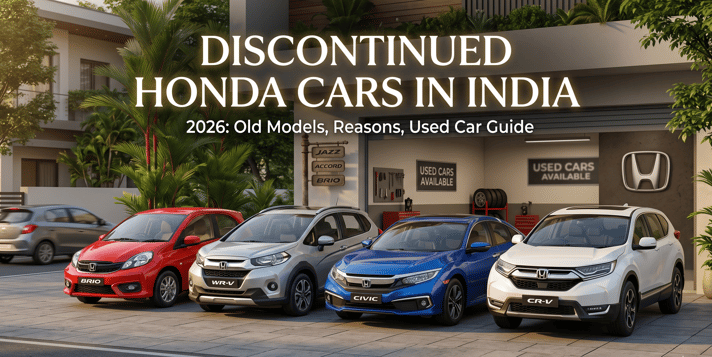
Honda Discontinued Cars in India (2026): Old Honda Models, Why They Were Stopped & Where to Buy Them
- 1The SUV boom and strict BS6 norms ended the run for iconic Honda passenger cars
- 2Used Civics and CR-Vs offer premium luxury, but watch out for pricey imported parts
- 3The Jazz and WR-V remain top used-car picks for their unmatched space and lifespan
The glory days of low-slung, premium sedans dominating Indian roads are fading, and while many believed Honda’s fiercely loyal customer base would shield it from this wave of high-riding SUVs, the shift is well and truly here. At first, looking at a modern Honda showroom devoid of the legendary Civic or the immensely practical Jazz might feel like a loss of automotive heritage. For decades, nameplates like the City, Civic, Accord, and CR-V defined premium aspirational motoring in India, building an ironclad reputation for bulletproof i-VTEC engines, serene refinement, and robust safety structures.
But modern market dynamics, stringent emission regulations, and a relentless consumer appetite for SUVs have changed the game. Honda’s decision to streamline its portfolio meant shedding slow-selling models and moving away from diesel powertrains entirely. Let’s walk through the comprehensive list of Honda discontinued cars in india, explore the strategic reasons why each model was halted, and, more importantly, figure out what that means for you as a used-car buyer looking for reliable motoring today.
Quick Snapshot: Discontinued Honda Cars in India
| Model | Segment | Discontinued In | Why It Was Stopped |
| Civic | Premium sedan | 2020 | Low sales, factory closure |
| CR-V | Premium SUV | 2020 | Expensive pricing, weak demand |
| Jazz | Premium hatchback | 2023 | BS6 Phase 2 transition |
| WR-V | Cross-hatch/SUV | 2023 | Product strategy shift |
| BR-V | 7-seater crossover | 2020 | Low sales, BS6 transition |
| Accord | Executive sedan | 2020 | Expensive CKD pricing |
| Mobilio | MPV | 2017 | Weak demand, strong rivals |
| Brio | Hatchback | 2019 | Market shift to larger cars |
Key Takeaways
- Honda discontinued several globally respected cars in India despite maintaining incredibly strong owner loyalty and high safety ratings.
- Most discontinued Honda cars are still considered exceptionally reliable options in the second-hand market.
Spare parts availability is generally very manageable for mainstream, high-volume models like the Jazz and WR-V, though premium imports require patience.
Why Honda Discontinued So Many Cars in India
Honda Missed India’s SUV Boom
The Indian automotive landscape shifted heavily towards compact and mid-size SUVs over the last decade. While competitors rushed to fill every possible SUV sub-segment, Honda remained primarily sedan-focused for far too long. Although they introduced models like the WR-V and BR-V, these crossovers lacked the commanding stance and aggressive real-world road presence that buyers were flocking toward, meaning they never quite became segment leaders. This delayed reaction is a frequent talking point among driving enthusiasts and long-term owners who wished for a true Honda SUV much earlier than the Elevate.
BS6 & BS6 Phase 2 Emission Norms Changed Honda’s Lineup
The transition to BS6, and subsequently the stricter BS6 Phase 2 (Real Driving Emissions) norms, forced a massive portfolio restructuring. Upgrading low-volume cars to meet these stringent exhaust requirements was financially unviable. This regulatory shift resulted in the complete discontinuation of Honda’s excellent 1.5-litre i-DTEC diesel engines, which were renowned for delivering exceptional real-world mileage. Consequently, models heavily reliant on diesel sales or those struggling to justify the mechanical upgrade costs, such as the Jazz, WR-V, and BR-V, were axed.
Greater Noida Plant Closure Changed Everything
In late 2020, Honda made a major operational decision to consolidate its manufacturing footprint by shutting down vehicle production at its Greater Noida facility. Because this specific plant was responsible for assembling completely knocked down (CKD) kits, its closure immediately marked the end of the road for flagship models like the Civic and the CR-V in the Indian market.
Honda Civic
The tenth-generation Civic remains one of the most striking cars ever sold in the country. Enthusiasts covet it for its low-slung sporty design, premium cabin layout, and the incredibly refined 1.8-litre naturally aspirated petrol engine. It offers brilliant high-speed highway manners and a driving feel that few modern crossovers can match.
Why Honda discontinued it:
Despite the hype, premium sedan demand was already in steep decline. Its expensive positioning, combined with the traditional low ground clearance that made buyers nervous over harsh Indian speed breakers, resulted in poor sales.
Should you buy a used Civic today?
- Pros: Timeless design, excellent steering feedback, premium structural safety, and high long-term reliability.
- Cons: The low ground clearance requires careful driving, parts are significantly more expensive than a City, and resale values remain stubbornly high.
Best for: Driving enthusiasts, highway commuters, and dedicated sedan lovers.
Honda CR-V
It was the quintessential comfort-focused premium SUV. It offered a car-like driving dynamic, an incredibly plush ride quality, and a highly refined petrol engine, alongside an AWD option for those wanting extra grip.
Why it failed in India:
It suffered from expensive CKD pricing. Furthermore, in a segment entirely dominated by the rugged, diesel-powered Toyota Fortuner, the CR-V's lack of a punchy diesel engine and its softer, more urban-focused appeal severely limited its audience.
Used CR-V ownership reality:
- Strengths: Unmatched highway comfort, bulletproof reliability, and premium cabin materials.
Challenges: Expensive replacement parts, single-digit real-world city fuel efficiency for the petrol models, and limited resale demand.
Honda Jazz
The Jazz redefined interior packaging. With its massive glass area and legendary magic seats, it offered cabin space that put some mid-size sedans to shame. Paired with a smooth CVT gearbox, it was the ultimate, fuss-free city commuter with excellent all-around visibility.
Why did Honda discontinue it?
The transition to BS6 Phase 2 and a general market shift away from premium hatchbacks towards sub-compact SUVs made it unviable to keep updating.
Why are used Honda Jazz models still popular?
Enthusiast communities and practical buyers alike still consider used Honda Jazz models as one of the most sensible premium hatchbacks ever sold. It is robust, safe, and returns highly consistent real-world mileage if driven sensibly.
Things to check before buying used:
Inspect the CVT fluid history, check for suspension wear if the car was heavily loaded frequently, and ensure body panels are intact.
Best for: City buyers, small families, and first-time automatic car buyers.
Honda WR-V
Based heavily on the Jazz platform, the WR-V brought crossover styling, a slightly higher seating position, and increased ground clearance while retaining a remarkably practical cabin and standard sunroof.
Why do owners still like it?
Many diesel WR-V owners continue to praise its phenomenal highway mileage, stable high-speed dynamics, and overall mechanical reliability.
Why did Honda stop it?
Like the Jazz, it was a victim of the BS6 Phase 2 transition and Honda's broader portfolio restructuring to make way for proper SUVs.
Used WR-V buying advice
- Good choice for: Buyers wanting a reliable mix of city and highway usage with ample space.
Not ideal for: Feature-focused buyers wanting cutting-edge digital interiors or aggressive acceleration.
Honda BR-V
The BR-V utilised proven City-derived engines and an extended platform to offer a highly practical three-row layout with SUV-inspired exterior cladding.
Why it didn’t succeed: Indian consumers perceived its styling as more of an MPV than a true SUV. Against stronger, better-equipped competition from Hyundai and Renault, it struggled to find a footing.
Is a used BR-V worth buying?
Yes, if you need a reliable 7-seater on a budget. A used Honda BR-V offers great value in the used market and boasts engines that easily surpass the 1 lakh kilometre mark with basic maintenance.
Honda Accord
For years, the Accord was the ultimate boardroom status symbol. Known for cavernous rear-seat space, vault-like build quality, and highly refined petrol and hybrid powertrains.
Why did it disappear?
The executive sedan segment practically vanished overnight as buyers spending upwards of 40 lakhs shifted exclusively to luxury German SUVs. High pricing and low localisation sealed its fate.
Used Accord ownership reality: While they offer fantastic comfort, sourcing parts for older generations is increasingly difficult, and upkeep can be very expensive.
Honda Brio & Mobilio
Enthusiasts remember this compact hatchback for its lightweight, peppy feel and brilliant visibility. It was eventually discontinued due to evolving safety expectations, shrinking margins, and a polarising all-glass rear hatch design.
Mobilio: This highly practical, diesel-efficient family MPV offered flexible seating but ultimately failed due to bland interior styling and being entirely overshadowed by the Maruti Suzuki Ertiga. Resale values are low, making it a decent budget buy for large families today.
Which Discontinued Honda Cars Are Still Worth Buying?
| Buyer Type | Recommended Honda |
| Enthusiast / Highway driver | Civic |
| Practical family hatchback buyer | Jazz |
| Budget crossover buyer | WR-V |
| Large family on a budget | BR-V / Mobilio |
| Premium urban SUV buyer | CR-V |
| Chauffeur-driven comfort | Accord |
Are Spare Parts Still Available for Old Honda Cars?
The Good News: For mainstream models that shared platforms and engines, like the Jazz, WR-V, and Brio, parts availability remains generally manageable. Because these cars share crucial mechanical components (like the 1.2L petrol engine) with newer or longer-running models like the Amaze, independent garages and authorised service centres rarely struggle to source routine consumables, brake pads, or suspension components.
The Bigger Challenge: Older premium models are a different story. If you own an Accord, CR-V, or Civic, you are dealing with premium imported components. Enthusiast forums frequently highlight the difficulty of sourcing specific electronic modules, body panels, or hybrid battery replacements outside of authorised workshops, and waiting periods for imported parts can stretch for weeks.
Where Can You Buy Discontinued Honda Cars Today?
- Certified Used-Car Platforms: Manufacturer-certified programmes (like Honda Auto Terrace) and organised used-car retailers are the safest bets, offering thoroughly inspected cars with limited warranties.
- Online Used-Car Marketplaces: These platforms offer transparency through detailed inspection reports and facilitate easy financing options.
Local Used-Car Dealers: While they might offer better pricing negotiation, you must exercise caution and ideally take a trusted mechanic for an independent inspection.
What to Check Before Buying a Discontinued Honda
- Service History: Honda engines age phenomenally well, but only if routine oil changes are respected. Always verify the service records.
- Spare Parts Availability: Double-check panel and trim availability in your local city before committing to a rare model like the Accord or CR-V.
- Transmission Health: Honda’s CVTs are generally robust, but older automatics require timely transmission fluid changes. Jerky acceleration is a red flag.
Suspension & Rubber Components: Older Hondas, particularly the heavier sedans, are prone to suspension wear over harsh roads. Check for clunking noises during test drives.
Why Discontinued Hondas Still Have Strong Fan Following
Honda’s engineering reputation still matters deeply in the Indian market. Driving purists and daily commuters alike continue to praise the brand for delivering some of the most refined petrol engines, slick-shifting gearboxes, and reassuring crash-safety structures available at their respective price points. Many enthusiasts still view a well-maintained used Honda car as one of the most balanced, headache-free daily drivers you can own in India.
Honda’s Future in India
Looking ahead, Honda is aggressively pivoting its strategy. The brand is now focusing heavily on capitalising on the SUV momentum with the successful Elevate, whilst laying down concrete plans for future sub-compact SUVs and a broader expansion of their highly efficient strong-hybrid technologies to meet upcoming emission standards.
Conclusion
Honda may have discontinued several iconic cars in India, but their engineering legacy ensures they remain highly desirable in the used-car market. Models like the Jazz, Civic, WR-V, and CR-V continue to attract buyers not just for nostalgia, but for their proven reliability, brilliant interior practicality, and refined driving dynamics. However, smart buyers must carefully evaluate spare-part availability, local service support, and long-term ownership costs before taking the plunge. For those willing to do their homework, a well-maintained discontinued Honda still offers a remarkably compelling and reassuring ownership experience today.
Frequently Asked Questions
Expand all