How Deemed Ownership Works When You Sell a Used Car in India
- Do most used-car sales in India go through dealers or transacted directly between individuals?
- What is the liability gap between selling a car and RC transfer?
- How does deemed ownership close the seller liability gap?
- What is Form 29C and why does it matter for car sellers?
- Why this is better governance, not just convenience
- Does deemed ownership work for all car sales in India?
- What should I ask before selling my car in India?

The last two essays made an argument: selling a car in India does not end your liability, and there is a law from 2022 that was meant to fix that but barely got implemented.
This piece does something simpler. It explains, in plain language, what that law actually does, who it is for, and where it stops — because most people have never had it explained to them, and it is the mechanism the rest of this series stands on. If you sell a car in India, this is worth ten minutes. It is the difference between walking away clean and carrying a stranger's risk for years.
It is called deemed ownership. Here is how it works.
Do most used-car sales in India go through dealers or transacted directly between individuals?
Start with a fact most people get wrong about this market. More than half of used-car transactions in India do not happen directly between two individuals. They go through an intermediary. Sometimes that is an old car handed to an OEM dealer in exchange when someone buys a new one. Sometimes it is a platform like ours that buys the car. Sometimes it is a local used-car dealer who takes the car into inventory and resells it.
This matters, because the deemed ownership framework was written for exactly that intermediary. It is built around the idea that a professional dealer — someone who buys and holds cars as a business — sits in the middle of the transaction, and that the dealer is the right party to carry the liability while the car is in their hands. So when you understand who handles the majority of India's used-car sales, you understand who deemed ownership is actually for. It is not a niche fix. It addresses the path that most of the market already travels.
What is the liability gap between selling a car and RC transfer?
Normally, when you sell your car, there is a gap. You hand over the keys and take the money on day one. The registration certificate transfers to the new owner on day — well, that is the problem. Day sixty, day three hundred, day never. Until that transfer is recorded, the law still considers you the owner. Every challan, every accident claim, every police query in that gap lands on you.
That gap, between handing over the car and the record catching up, is where all the damage happens. The longer it stays open, the more exposure you carry for a car you no longer have.
How does deemed ownership close the seller liability gap?
The deemed ownership framework closes that gap by putting someone in it.
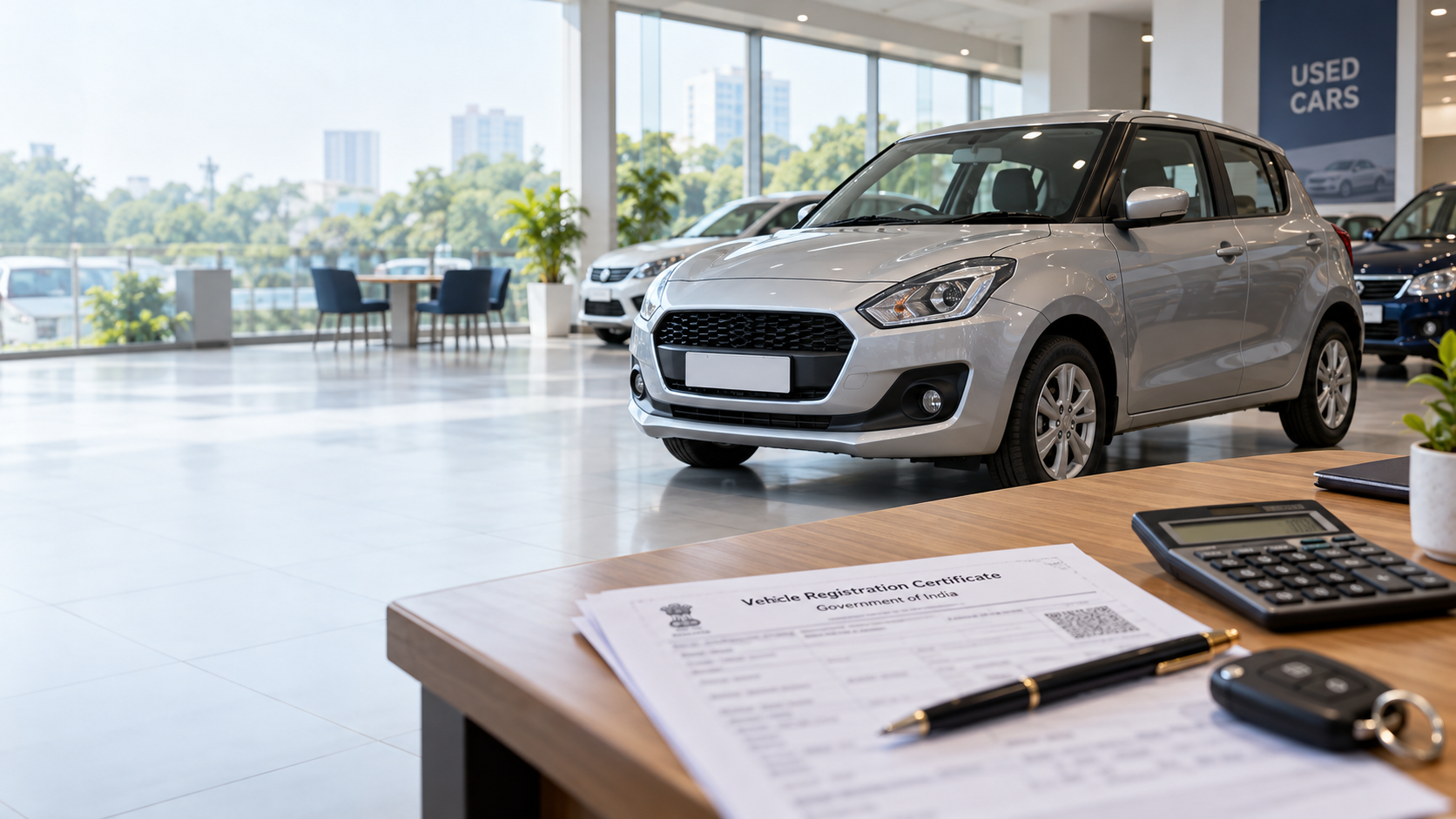
When you sell your car to an authorised dealer of registered vehicles — a dealer who has registered with the RTO under this framework — and that handover is recorded on the government's VAHAN portal, the dealer becomes the deemed owner of the car from that moment.
Read the word deemed carefully, because it is doing important work. The car is not re-registered in the dealer's name. The dealer does not own it the way a person owns a car they bought to drive. What happens is narrower and more useful. For the purpose of liability — challans, accidents, legal responsibility — the dealer is now treated as the owner, for as long as the car sits in their custody, until it is finally sold to its end buyer and the RC transfers to that person.
The chain looks like this: you, then the authorised dealer as deemed owner in the gap, then the final buyer as registered owner.
Your liability ends when the handover to the dealer is recorded. Not when the final buyer's name appears on the RC weeks or months later. The dealer carries the responsibility through the messy middle. Someone finally has to own the car during the period when, today, nobody does — and the framework says it should be the party who actually has it.

What is Form 29C and why does it matter for car sellers?
You do not need to memorise this, but it helps to know the moving parts are real, not theoretical. Form 29C is the seller's intimation that the car has been handed over to the dealer. It is the document that triggers deemed ownership; once it is filed on VAHAN and acknowledged, the clock on your liability stops. Form 29D is the dealer's trip log while the car is in custody. Forms 29 and 30 are the final transfer to the end buyer, when the car is sold and the RC moves into the buyer's name.
The one that matters to you as a seller is Form 29C. Everything that protects you flows from that single recorded handover.
Why this is better governance, not just convenience
It would be easy to read this as a dealer convenience, a smoother way to handle paperwork. It is more than that, and the distinction matters.
The framework assigns responsibility to the party best placed to carry it. The dealer has the car. The dealer can ensure it is parked safely, not misused, properly documented. Making the dealer the deemed owner during custody simply matches legal responsibility to physical reality. That is good design. It also improves traceability. A system that records, at every step, exactly who is responsible for a vehicle is better for everyone — the seller who is protected, the buyer who gets clean title, and the State, which can trace accountability instead of chasing a name on an outdated record. When a used car is involved in something serious, "who was responsible for this vehicle on this date" should have a clear answer. Deemed ownership is what makes that answer clear.
So this is not just an industry shortcut. Done properly, it is a small piece of genuinely better governance.
Does deemed ownership work for all car sales in India?
A framework explained without its limits is a framework half-explained, and the limits here are real.
Deemed ownership does not cover every car. A meaningful share of vehicles — by our estimate around a third of what flows through the market — are structurally ineligible for one reason or another. A car with certain pending legal status, or specific documentation gaps, or particular hypothecation situations, may not be eligible for the clean handover the framework provides. The framework is powerful. It is not universal, and anyone who tells you it covers everything is selling you something.
There is also a deliberate boundary that often surprises people. Deemed ownership does not cover a direct sale from one individual to another. It was designed that way. The framework's logic assumes that when a private person buys a car for themselves, they will register it in their own name promptly, because it is now their car to drive. So the law puts the deemed-owner responsibility on a dealer holding inventory, not on a private buyer who is simply buying a car to use.
The trouble is that the assumption does not always hold in practice, and that is precisely where a lot of the risk lives. When two individuals transact directly — often introduced by a classified listing site — the buyer frequently does not transfer the car promptly, for exactly the resale-value reason I covered in the first essay. The car stays in the seller's name. And a classified platform cannot step into that gap, because a classified platform is not a dealer. It connects two people and steps away. It never takes the car onto its own books, so it never becomes the deemed owner, and the framework gives the seller no protection on that path. This is one of the reasons direct individual-to-individual sales remain the riskiest way to sell a car in India, and the most common setting for the frauds that follow a sale.
There are practical blockers too, the ones from the last essay. It only works where the state has actually implemented the framework, and where the dealer you are selling to is genuinely registered as an authorised dealer. Hand your car to a dealer who is not registered, in a state that has not implemented this, and you get none of the protection. You are back in the old liability gap, exposed.
So the protection is not automatic. It exists only when several things are true at once: the framework is live in that state, the buyer is a registered authorised dealer rather than a private individual or a classified counterparty, and the car is eligible. Miss any one of them, and the clean break does not happen.
What should I ask before selling my car in India?
If you remember one thing, make it this: the moment that protects you is the recorded handover to an authorised dealer — Form 29C on VAHAN. That recorded handover is the line between walking away clean and carrying a stranger's car on your name. Everything else is detail.
And the practical implication follows directly. When you sell a used car, the smartest question is no longer only "what price am I getting." It is also "does this buyer make my liability actually end the day I hand over the keys, or does it linger in a grey zone I do not control." Those are different transactions, even at the same price. One ends your ownership cleanly. The other hopes it ends, eventually.
We built our selling experience around making the first kind the default — getting sellers to that clean break, on eligible cars, in every state where we have earned the registration to do it. What that took, and where it gets hard, is the rest of this series.
The concept itself is worth holding onto, because it is the most underused piece of consumer protection in Indian car ownership.
Deemed ownership is the clean break. It moves your liability the day you hand over the car, not the day the paperwork finally catches up. The catch is that it only works when you sell into a system built to deliver it — a registered dealer who takes the car onto their books, not a private buyer or a listing that connects you and disappears.
Frequently Asked Questions
Expand all