
India has one of the largest road networks in the world. Furthermore, India is the world’s third-largest automobile market in terms of sales. To contain these millions of vehicles on this labyrinth of road network, traffic signal rules are a must.
Generally, most people describe the traffic scenario in India as ‘organised chaos,’ a situation that looks chaotic from the surface with an underlying order to the things that makes all the cogs move. Traffic rules bring that order to traffic movement, and among them, traffic signal rules form the basis of road safety in India.
The traffic signals act as visual cues, guiding drivers and pedestrians alike. Whether you are a seasoned driver or have just gained access to your learner’s licence, understanding the basics of traffic signs in India is very important for the safety of yourself and others on the road. We ‘drive’ into the traffic light rules, detailing what they are and their types, and things to remember about rules of the road and how to follow the signs.
When the Lights First Turned Green: India’s Traffic Signal Journey
India’s traffic management story is, in many ways, a mirror to its urban transformation. As cities swelled and roads filled up, the need for structure and control on the streets became unavoidable.
The First Traffic Signal in India
It all began in 1928, when Kolkata (then Calcutta) installed the country’s first traffic signal at the intersection of Dalhousie Square and Esplanade. What might’ve seemed like a small civic experiment at the time ended up shaping how Indian cities would move for decades.
After independence, the system caught on. As cities expanded and motor traffic surged, signals became an urban necessity rather than an innovation.
- Chennai (then Madras) followed with its first signal at Egmore Junction in 1953, marking South India’s entry into organised traffic control.
Bengaluru, a decade later, joined the movement, lighting up Corporation Circle with its first set of signals in 1963.
Shaping of the Legal Framework
Parallel to this physical evolution was a growing legal framework. The Motor Vehicles Act of 1914 laid the early groundwork for motor regulation, but it was the Motor Vehicles Act of 1988 that truly defined the modern traffic light rules governance model, as it covers everything from vehicle registration and licensing to safety standards.
The Current Scenario
Since those early installations, the number of traffic lights across India has exploded. The logic was simple: more cars, more signals. The trend is visible in the numbers. In just five years, Bengaluru witnessed a 33% rise in the number of traffic lights. Today, the city operates over 400 signals, while other major metros like Delhi operate over 990 signals, followed by Mumbai, managing around 660.
However, there is also a new school of thought emerging that challenges the long-standing belief that more signals mean better traffic flow. The city of Kota, Rajasthan, has flipped the idea on its head, earning the title of India’s first traffic light-free city. The city treats traffic lights as friction points. Its planners have invested heavily in redesigning intersections by building 24 flyovers and underpasses to eliminate cross-path conflicts altogether. The result is seamless traffic flow, no stop-start frustration, and a model that questions India’s traditional “signal = solution” mindset.
What are the rules of traffic signals in India?
As the name suggests, traffic signals are essentially the signals designed to control the traffic. They dictate how drivers and pedestrians should behave on the roads, especially at intersections to regulate traffic flow and prevent accidents. Although the type of traffic signals and rules for traffic lights may vary across the world, the meaning of traffic lights remains the same. So, first, let us understand traffic lights, which is the most fundamental tool used worldwide for traffic signals.
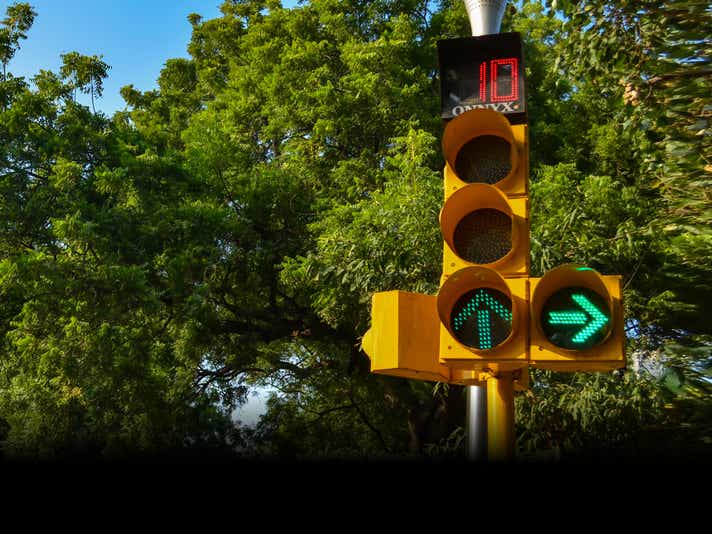
If you have been on the road anywhere, you have unmistakably come across a traffic light towering above you. Typically housed in a yellow box, it consists of a controller, sensors, signal heads, and power supply. The signal heads are what we see mounted on poles at different junctions. They consist of three lights: red, yellow (amber), and green. Each colour signifies a specific action or restriction for drivers and pedestrians.
Red light traffic rule: Stop

A fundamental traffic light rule, when the red light is illuminated, it indicates a complete stop. Crossings have a designated stop line and vehicles must come to a halt before it. Pedestrians may cross safely during this time.
Flashing red light
A flashing red light asks you to be cautious, but is treated exactly like a STOP sign.
- Bring your vehicle to a full stop before the stop line or intersection.
- Check for oncoming vehicles and pedestrians as they have the right of way.
- Move only when the road ahead is completely clear.
This traffic signal is usually seen at railway crossings or in areas with low traffic density.
Yellow light traffic rule: Pause

The yellow light is a warning signal and indicates that the green light will soon change to red. When the yellow light is on, drivers should slow down and prepare to stop. Pedestrians, too, should exercise caution and avoid crossing the road.
However, if you are crossing an intersection and the yellow light turns on, then you should not stop in the middle of the road. Rather, you must continue driving and cross the intersection to avoid stalling the oncoming traffic.
Flashing yellow light
A flashing yellow means “proceed with caution.”
- Slow down as you approach the intersection.
- You don’t have to stop if the path is clear.
- Stay alert and be ready to brake if other drivers or pedestrians act unpredictably.
Some places may resort to a flashing yellow light in the wee hours when there is not much traffic on the road. The purpose is to alert the drivers and the pedestrians to be on the lookout and proceed with caution.
Green light traffic rule: Go

A green light signifies that vehicles can proceed as the oncoming traffic has been halted. Pedestrians, meanwhile, should wait until the red light is on or the green pedestrian signal is illuminated.
Green arrow
When a green arrow is illuminated on a traffic signal, it indicates the direction in which the vehicles can move. This type of signal, in coordination with red arrow, is used to regulate the traffic movements in a particular direction.
Types of traffic signal rules in India
One crucial aspect of safe driving is to understand and adhere to traffic signal rules for navigating safely through the bustling Indian roads. Now that we have laid out the basic traffic light indicators, let us have a look at the other types of traffic signal rules in India.
Traffic control signals
As mentioned in the previous section, these are the most common type of traffic signals, featuring an arrangement of red, yellow, and green lights. According to their working mechanism, the are divided into:
- Fixed time signals: They are the red, yellow, and green lights which turn on according to the pre-set timers. These are free of human intervention and decided as per the traffic load on a particular route.
- Manually operated signal: This type of traffic signal is used where the traffic intensity varies during the day. They allow the traffic police to manually modify the timings of the traffic light as per the situation for a smooth flow of vehicles and to avoid any stalling.
Pedestrian signals
These signals are specifically designed for pedestrians, often featuring a ‘walk’ and ‘don't walk’ symbol. They work in sync with traffic light signals to make the roads safer for pedestrians.
Flashing lights
Flashing red or yellow lights are used at intersections with low traffic volumes or to warn of hazards ahead. These are also called Special Signals.
Arrow signals
These signals are used to control specific traffic movements, such as left turns or right turns. They are used when traffic flow in a particular direction needs to be restricted.
What to Do When Traffic Lights Malfunction
A non-functional or malfunctioning traffic signal is one of the most hazardous situations a driver can face. In such moments, knowing the right legal response is crucial. Here’s how to handle each possible scenario safely and correctly.
When the Signal Is Completely Off (Blackout)
If the lights are off or the signal isn’t working at all, the junction is no longer “signalized.” It becomes an uncontrolled intersection, where normal right-of-way rules apply.
- Approach the crossing slowly and be ready to stop.
- Yield to the right: Vehicles coming from your right always have priority.
- Main road rule: If you’re exiting a smaller road onto a main road, let the main road traffic go first.
- Pedestrian first: Always give way to people crossing the road.
While the law sets a clear “yield-to-the-right” procedure, the on-ground reality in India is often far messier. Many drivers ignore or are unaware of these rules, leading to confusion and chaos.
So, your best move?
- Know the rules, understand how right-of-way works.
- Expect disorder, so drive defensively, make eye contact with other drivers, and never assume they’ll stop.
Importance of traffic signal rules
Adhering to traffic light rules and traffic signals is crucial for maintaining road safety and preventing accidents. These road rules and signs are the foundations for smooth movement of vehicles and an efficient network of roads.
Accident prevention: By following the road safety rules, road users can avoid collisions and injuries. Traffic signals play a crucial role in preventing accidents by regulating the flow of vehicles and ensuring that drivers and pedestrians regulate their movement on the road.
Traffic congestion mitigation: Well-timed and efficient traffic signals help to reduce traffic congestion by coordinating the movement of vehicles and preventing bottlenecks. This improves traffic flow, reduces travel times, and saves fuel.
- Pedestrian safety: Traffic signs and signals provide clear instructions and warnings to pedestrians, allowing them to safely cross the road at designated times. This reduces the risk of pedestrian accidents.
Fines for Signal Violations
The system behind signal compliance is built on deterrence, with penalties designed to make drivers think twice before running a red. A major turning point came with the Motor Vehicles (Amendment) Act, 2019, which replaced token fines with sharp, consequential penalties.
The old ₹100–₹300 fines that once felt like pocket change and were often treated as a "cost of doing business" were gone. The amendment introduced steep financial penalties and more severe consequences, even imprisonment or license suspension.
Red Light Violations
Jumping red lights constitutes a serious traffic violation. Under the Motor Vehicles Act, signal jumping violations can result in penalties ranging from ₹1,000 to ₹5,000, imprisonment from 6 months to 1 year, or license seizure in severe cases.
Here’s how the fines stack up across major states and cities:
| State | First Offense Fine (INR) | Repeat Offense Fine (INR) |
| Delhi | ₹1,000 | ₹2,000 |
| Maharashtra | ₹1,000 | ₹2,000 |
| Karnataka | ₹1,000 | ₹2,000 |
| Tamil Nadu | ₹1,000 | ₹2,000 |
| Uttar Pradesh | ₹1,000 | ₹2,000 |
| West Bengal | ₹1,000 | ₹2,000 |
| Kerala | ₹1,000 | ₹2,000+ |
| Odisha | ₹5,000 | ₹10,000 |
Note: Fines are subject to change by state government notifications..
Related Penalties
Some violations tied to signal rules attract even steeper fines. Failing to give way to emergency vehicles, for instance, can set you back ₹10,000, making it one of the highest penalties on record. Crossing the stop line without halting may cost between ₹300 and ₹600, while ignoring stop signs can result in a court challan, with the fine amount determined by the court.
Things to keep in mind while driving
1. Stop at red lights: Always come to a complete stop at red lights, even if there is no oncoming traffic.
2. Be cautious during yellow light: Do not try to cross the signal by speeding up. The correct approach is to prepare to stop when the yellow light appears.
3. Yield to pedestrians: It is a good practice to always yield to pedestrians, especially at zebra crossings.
4. Follow arrow signals: Pay attention to arrow signals that indicate specific traffic movements.
5. Avoid unnecessary honking: Unnecessary honking leads to noise pollution and can also increase stress levels.
6. Use indicators when taking turns: Always use indicators while changing lanes or taking turns. This keeps the other road users informed about your movements, making their navigation safe.
Conclusion
According to FADA, more than 2.22 crore vehicles were sold in India in FY’23, and this number has been increasing year on year. With this, traffic congestion is likely to increase too.
As a responsible driver and pedestrian, you can contribute to a safer and more efficient road network by understanding and obeying road safety rules in India, instead of following them just to avoid fines and penalties.
If you’ve received a traffic challan recently, you can easily check and pay traffic challan online. When on the road, being patient, calm, and respectful, and of course, becoming a vigilant driver goes a long way.