




Toyota Rumion Specifications
 Arai mileage
 Transmission type
 Body type
 Fuel type
 Engine displacement
 Seating capacity
Toyota Rumion Variants: Price & Spec Cards
Images of Toyota Rumion

Toyota Rumion Overview: A No Non-sense Practical MPV
Given that the Rumion is essentially a cross-badged product, it shares everything with the Maruti Suzuki Ertiga. This includes the platform, engine and gearbox, features, and even the in-cabin space. Although Toyota has given it some visually differentiating elements inside and out, the Rumion carries on with all the key aspects of the Ertiga which is not a bad thing.
Its 1.5-litre naturally aspirated petrol engine makes 103 PS and 136.8 Nm. It can be had with either a 5-speed manual transmission or a 6-speed torque converter automatic gearbox. The CNG version, on the other hand, gets the same 1.5-litre engine (although in a reduced state of tune at 88 PS and 121.5 Nm, paired with the manual transmission only.
The second row is the most versatile part of the cabin. It can slide and recline, leaving the occupants with more room when the third row is empty. The last row is usable for shorter journeys, although adults will find less legroom and under-thigh support than in the middle row. With all seven seats occupied, boot space is limited to 209 litres.
The Rumion also has the sort of ride quality expected from a family MPV. Its suspension deals well with potholes and speed breakers, while the light steering wheel and compact dimensions make it manageable in crowded streets. The car’s priorities are clear once you spend time with it: comfort and practicality come ahead of outright performance or a particularly modern cabin.
The Toyota Rumion price ranges from Rs 9.79 lakh to Rs 14.21 lakh (ex-showroom Delhi). The range consists of E, S, G and V variants, with an automatic gearbox available on S, G and V variants, while CNG is restricted to the S manual. The optional CNG kit is provided with only the 1-above-base S variant.
| Variant | Engine / Power / Torque/ Transmission | Claimed Mileage | Ex-showroom Price |
| Rumion E (base) | 1.5L Petrol / 103 PS / 136.8 Nm / 5-speed MT | 20.51 kmpl | Rs 9.79 lakh |
| Rumion S (top selling) | 1.5L Petrol / 103 PS / 136.8 Nm / 5-speed MT | 20.51 kmpl | Rs 10.77 lakh |
| Rumion S CNG | 1.5L CNG / 88 PS/ 121.5 Nm / 5-speed MT | 26.11 km/kg | Rs 11.69 lakh |
| Rumion G | 1.5L Petrol / 103 PS / 136.8 Nm / 5-speed MT | 20.51 kmpl | Rs 11.93 lakh |
| Rumion S AT | 1.5L Petrol / 103 PS / 136.8 Nm / 6-speed AT | 20.11 kmpl | Rs 12.35 lakh |
| Rumion V (top selling) | 1.5L Petrol / 103 PS / 136.8 Nm / 5-speed MT | 20.51 kmpl | Rs 12.70 lakh |
| Rumion G AT | 1.5L Petrol / 103 PS / 136.8 Nm / 6-speed AT | 20.11 kmpl | Rs 13.44 lakh |
| Rumion V AT (top) | 1.5L Petrol / 103 PS / 136.8 Nm / 6-speed AT | 20.11 kmpl | Rs 14.21 lakh |
Note: The final Toyota Rumion on-road price will be higher than the given ex-showroom prices after it incorporates state road taxes, mandatory RTO registration charges, comprehensive insurance coverage, and optional dealer fitments.
The Rumion’s 1.5-litre petrol engine is shared across the petrol and CNG versions, with the CNG tune producing lower output. The petrol engine makes 103 PS and 136.8 Nm, and can be paired with either a 5-speed manual or a 6-speed automatic gearbox. The CNG version develops 88 PS and 121.5 Nm, only available with the 5-speed manual transmission.
| Engine | Power | Torque | Transmission | Claimed Mileage |
| 1.5L Petrol | 103 PS | 136.8 Nm | 5-speed MT/ 6-speed AT | 20.51 kmpl/ 20.11 kmpl |
| 1.5L CNG | 88 PS | 121.5 Nm | 5-speed MT | 26.11 km/kg |
1.5L Petrol
The 1.5-litre petrol engine has a smooth, linear character and works well in city driving, with the 5-speed manual offering light shifts and the 6-speed automatic keeping things relaxed. Paddle shifters add control when quicker responses are needed, while performance becomes more measured with a full load and the engine gets louder when pushed harder at highway speeds.
1.5L CNG
The CNG version prioritises running costs over outright performance, with its lower output becoming more noticeable as speeds rise. It is comfortable in normal city traffic and can cruise around 80 kmph, but higher-speed overtakes need more planning. It is available only with the 5-speed manual shifter, making the trade-off between performance, convenience and efficiency fairly straightforward.
City Performance
City driving is where the Rumion's powertrain feels most at home. The engine responds predictably at lower speeds, the manual clutch is light and the automatic removes much of the effort associated with stop-and-go traffic.
The automatic does not deliver an immediate kick when the accelerator is pressed suddenly. It takes a moment to choose the appropriate gear, after which acceleration builds progressively. The manual gives the driver more control over when to hold a gear or downshift.
Highway Performance
The Toyota Rumion car can easily cruise at highway speeds. The manual gearbox is useful when an overtaking manoeuvre calls for an immediate drop in gear, while the automatic can be managed through its paddle shifters or manual mode.
The limitation appears when the car is fully occupied. The 1.5-litre engine has to work harder to build speed, particularly during overtakes from 60 km/h and above. Drivers covering long distances with seven occupants will need to leave more room for overtaking than they would in a more powerful MPV.
Ride & Handling
Ride quality is one of the Rumion's more convincing attributes. The suspension absorbs potholes, broken surfaces and speed breakers without transmitting excessive impact into the cabin.
The tall MPV body does move through corners, especially with a full load, but the steering remains light and easy to use. The car is also simple to place in tight spaces, with its compact dimensions and easy three-point turns working in its favour around town.
The third row can feel more movement over rough surfaces because of its position at the rear of the cabin. For the driver and first two rows, the overall ride remains comfortable.
Which Rumion Powertrain Should You Choose?
- Petrol Manual: Suits buyers who want the straightforwardness of a manual gearbox and the highest claimed efficiency among the petrol versions.
- Petrol Automatic: Best suited to buyers who spend most of their time in city traffic, where the 6-speed automatic makes the Rumion easier to drive in congestion.
- CNG Manual: The choice for buyers who prioritise running costs, with a claimed 26.11 km/kg efficiency. The manual-only configuration and lower performance at higher speeds are the main trade-offs.
The Rumion is available in E, S, G and V trims. The S, G and V can be paired with the petrol automatic, while CNG is restricted to the S manual.
Rumion E
The E is the entry point and is offered only with the petrol-manual powertrain. It gets 15-inch steel wheels, black ORVMs and door handles, halogen headlamps and LED tail lamps.
Inside, the E has a dual-tone black and beige cabin, fabric seats, manual AC, power windows, tilt-adjustable steering and an analogue instrument cluster with a coloured MID. Safety equipment includes six airbags, ABS with EBD, electronic stability control (ESC), hill-start assist and rear parking sensors.
Rumion S
The S is the most important step up in the range because it opens up all three powertrain choices: petrol-manual, petrol-automatic and CNG-manual.
It adds body-coloured ORVMs and door handles, chrome detailing, keyless entry and powered ORVMs. The second-row seats slide and recline, while the third row gets a 50:50 split. Adjustable headrests across all three rows and a second-row centre armrest add to its family-oriented layout.
The S also gets roof-mounted AC vents, cooled cupholders and a basic audio system with Bluetooth, four speakers, steering-mounted controls, USB and AUX connectivity.
Rumion G
The G moves the Toyota Rumion car into the comfort-and-convenience part of the range. It gets 15-inch alloy wheels, front fog lamps and additional chrome detailing outside.
Inside, the equipment list grows substantially with a height-adjustable driver's seat, sliding front armrest, push-button start and automatic climate control. The 7-inch touchscreen infotainment system adds wireless Android Auto and Apple CarPlay, connected-car technology and a 6-speaker Arkamys-tuned audio system.
Rumion V
The V is the top-spec variant and adds equipment aimed at making everyday use easier. It gets leatherette trim on the steering wheel, automatic folding ORVMs, cruise control, automatic headlamps and a rear parking camera.
It is available with both the petrol manual and automatic, with the V AT occupying the top of the Toyota Rumion price range.
Which Toyota Rumion Variant Should You Buy?
- E: The E comes with just the basic equipment and a single powertrain option, while featuring a good set of safety tech.
- S: The S is the most versatile point in the range, adding useful family equipment over the E while offering the widest choice of petrol-manual, petrol-automatic and CNG powertrains.
- G: The G is suited to buyers who want more convenience and cabin equipment, with features such as automatic climate control, push-button start, touchscreen connectivity and additional comfort features.
- V: The V adds equipment such as cruise control, automatic headlamps, folding ORVMs, TPMS and a rear camera, making it the equipment-focused step up from the G.
- V AT: The V AT combines the highest equipment level with the 6-speed automatic and is aimed at buyers who want the most fully equipped Rumion without compromising on transmission choice.
The petrol-manual Toyota Rumion MPV has a claimed efficiency of 20.51 kmpl, while the automatic is rated at 20.11 kmpl. The CNG version claims 26.11 km/kg.
| Powertrain | ARAI-claimed Mileage | Real-world City Mileage | Real-world Highway Mileage |
| 1.5L Petrol Manual | 20.51 kmpl | 14-15 kmpl | 18-19.5 kmpl |
| 1.5L Petrol Automatic | 20.11 kmpl | 13-14 kmpl | 17-19 kmpl |
| 1.5L CNG Manual | 26.11 km/kg | 21-22 km/kg | 24-25 km/kg |
The CNG version has the highest claimed efficiency and is the natural fit for buyers covering substantial monthly distances. The petrol manual has the strongest claimed efficiency among the petrol versions, while the automatic gives up a small amount of efficiency for the convenience of two-pedal driving.
Actual fuel economy will change with traffic, load, road conditions and driving style. A fully occupied Toyota Rumion car, particularly on hilly roads, will use more fuel than the same car carrying fewer passengers.
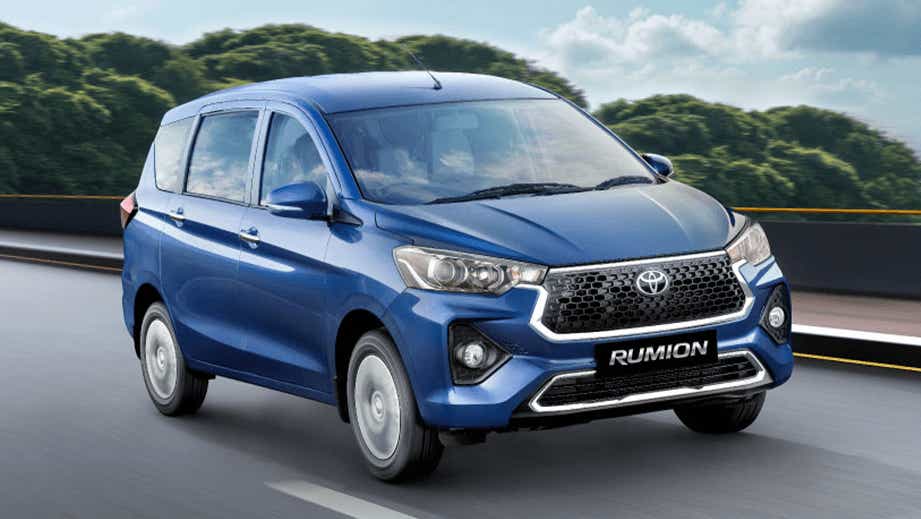
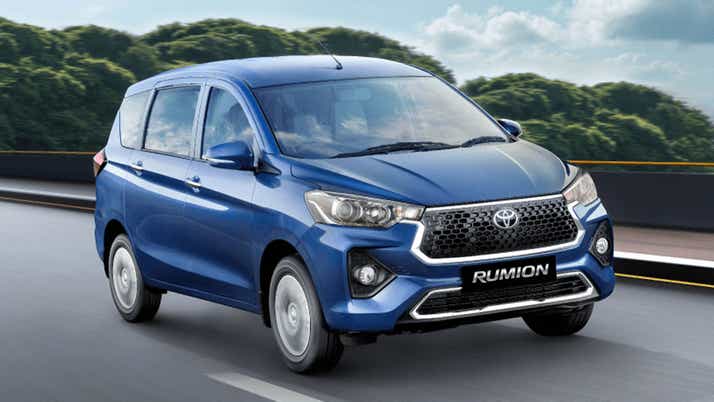
The Rumion retains the tall, upright proportions expected of a compact MPV. Its long wheelbase, large windows and tall roof are dictated as much by the need for three rows as by styling.
Toyota's changes are concentrated around the front and rear rather than involving a completely different body shell.
Front Profile
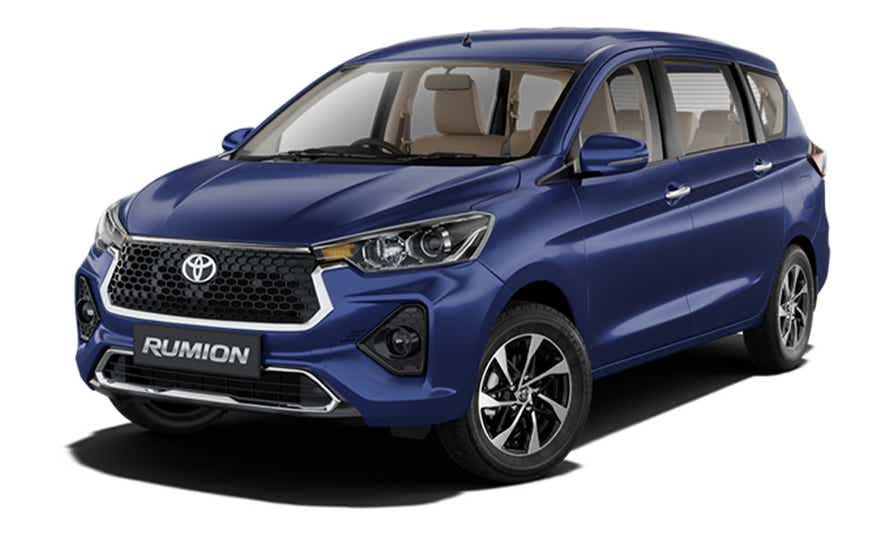
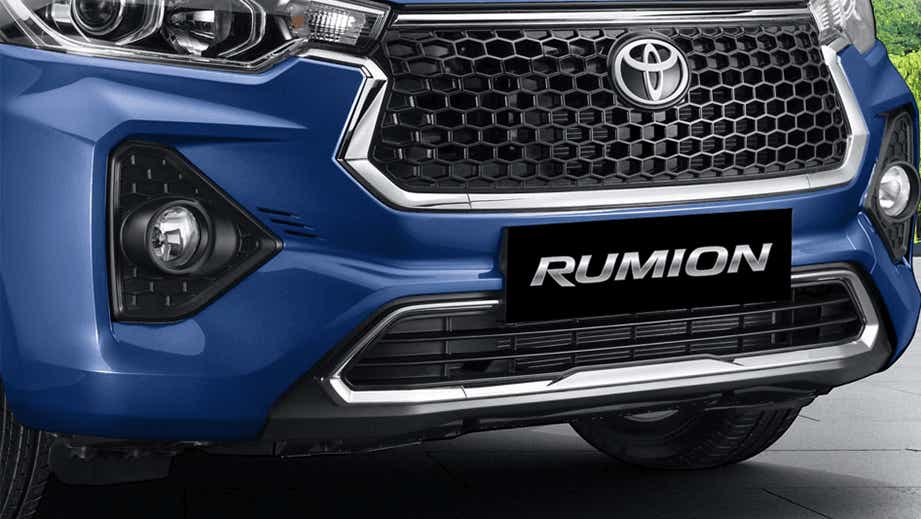
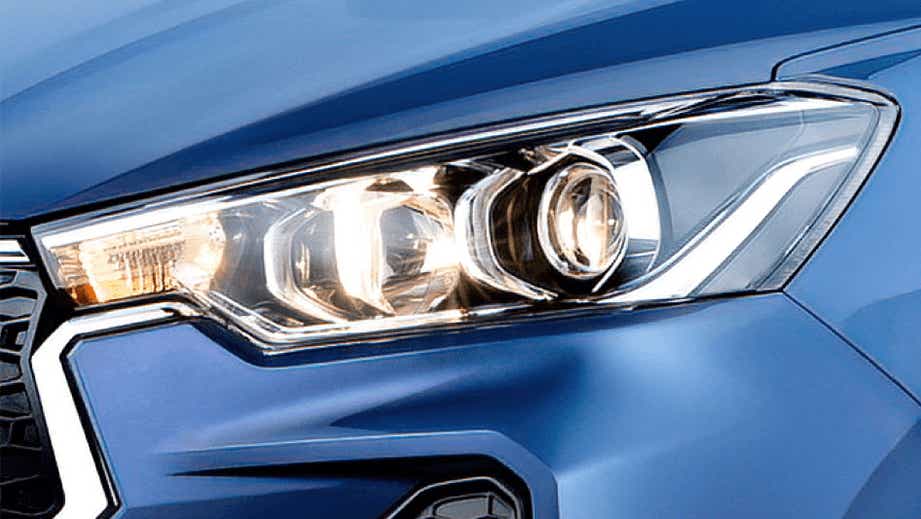
The front gets a Toyota-specific grille with chrome detailing and a revised bumper. The headlights retain the basic shape associated with the underlying MPV, with higher variants adding front fog lamps.
The design is deliberately familiar. There is enough chrome and Toyota-specific detailing to distinguish the Rumion at a glance from the front, although the relationship with the Ertiga remains obvious.
Side Profile
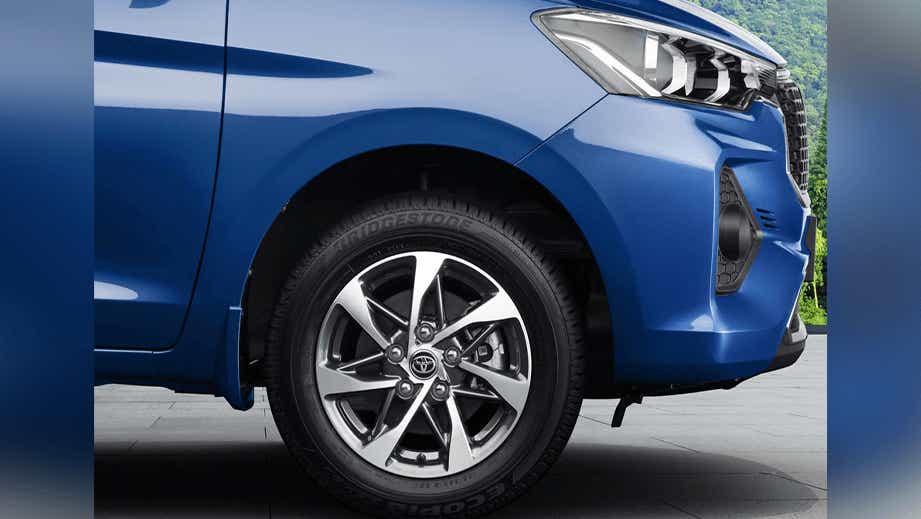
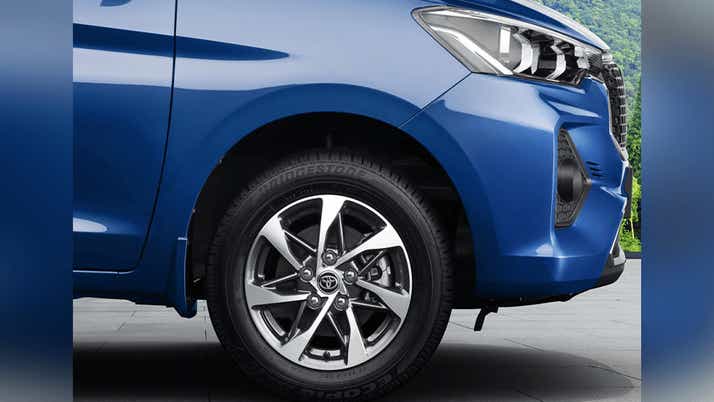
The side profile of the Toyota Rumion car is dominated by the long wheelbase and large doors. Lower variants use steel wheels, while higher variants feature 15-inch alloy wheels.
Chrome door handles, ORVM-mounted turn indicators and the tall glass area add detail without changing the basic MPV silhouette. The 185mm ground clearance also gives the Rumion enough clearance for typical Indian speed breakers and broken urban roads.
Rear Profile
The rear gets L-shaped LED tail lamps and a simple bumper design. A chrome strip between the tail lamps is one of the clearer Toyota-specific details.
When viewed from the side or rear, the Rumion's relation to the Ertiga is much easier to spot than it is from the front.
Toyota Rumion Colours
The Toyota Rumion MPV is available in a total of five shades: Rustic Brown, Iconic Grey, Spunky Blue, Cafe White and Enticing Silver.
The Rumion's cabin follows the same practical approach as its exterior. It uses a dual-tone theme with beige surfaces, silver detailing and wood-finish elements on higher variants.
The dashboard is functional rather than elaborate. The large beige surfaces help make the cabin feel open, while the lighter upholstery also means dirt will be more visible with regular family use.
Front Seats
Getting into the front seats is easy because of the Rumion's upright seating position. The cushioning is suited to long drives and the driver gets a height-adjustable seat on higher variants.
The steering offers tilt adjustment but no telescopic adjustment. Visibility is good from the driver's seat, which helps when manoeuvring the car through crowded streets and parking areas.
Second Row
The second row is the cabin's strongest seating area. There is enough headroom and knee room for three adults, while the sliding and reclining functions allow the occupants to change the balance between second- and third-row space.
The centre armrest adds some comfort for longer journeys, and roof-mounted AC vents help distribute air beyond the front of the cabin. The middle passenger does not get a headrest, which is worth noting when the car is regularly used with three adults in the second row.
Third Row
The third row needs to be judged in the context of the Rumion's size. It is a genuine third seating area, but it is not equivalent to the second row for adult comfort. Access requires moving the second-row seat forward, and the third-row seating position places the knees higher. Under-thigh support is therefore limited, particularly on longer journeys. Reclining the seat improves the seating position, while the large side windows and raised seating position make the area feel reasonably open.
For children and shorter adults, the third row is useful. Seven adults can be carried, but families regularly doing long journeys with all seven seats occupied should spend time in the rear before deciding.
The Rumion's feature list is concentrated in the mid- and higher-spec S, G and V trims. Depending on the variant, buyers get keyless entry, automatic climate control, cruise control, automatic folding ORVMs, automatic headlamps, rear parking camera and connected-car technology.
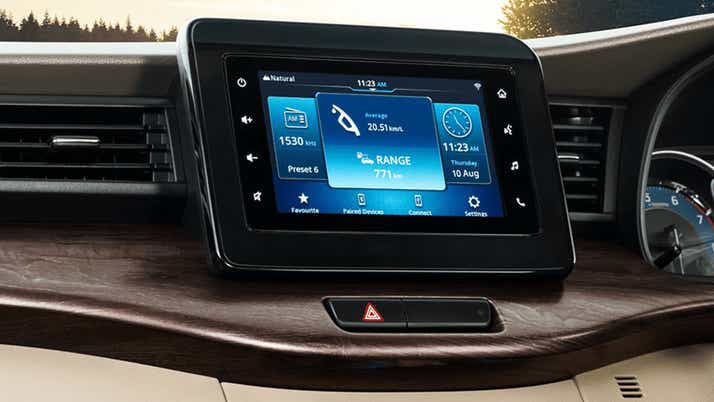
The 7-inch touchscreen infotainment system supports wireless Apple CarPlay and Android Auto. It covers the essential smartphone functions, while the coloured MID in the analogue instrument cluster keeps the driver's information easy to read.
The G and higher variants also get a 6-speaker Arkamys-tuned audio system. It adds a more complete audio package without changing the basic, functional character of the cabin.
The Toyota Rumion MPV has storage spaces spread throughout the cabin. The doors get 1-litre bottle holders, while the centre console provides two cooled cupholders and a tray for smaller objects.
The front cabin also gets a storage compartment near the steering wheel and a reasonably large glovebox. Seatback pockets serve the second row, while the third row gets dedicated cupholders.
The practical advantage of the cabin is the ability to play with the amount of space that each row has on offer. Sliding the second row forward can free additional legroom for the third row, while folding the third row creates a much larger luggage area.
Device Charging Options
The Rumion offers a front 12V socket with smartphone storage, while S/G/V variants get illuminated Type-C charging ports in the second and third rows.
Boot Space
The Rumion has 209 litres of boot space with all three rows occupied. That is enough for a few smaller bags, but families travelling seven-up will have to pack carefully.
Folding the third row increases capacity to 550 litres and changes the car's usefulness considerably. The split-fold arrangement also lets owners retain one third-row seat while using the other side for luggage.
Folding both rear rows creates a substantially larger loading area. The CNG version has less usable luggage space because of the CNG tank, making the petrol versions more versatile when carrying luggage is a regular requirement.
The important figure for a 7-seat MPV is therefore the 209-litre capacity with all seats in use. The larger quoted figures apply once the seating configuration is changed.
The Toyota Rumion MPV gets six airbags as standard, ABS with EBD, electronic stability control (ESC), hill-start assist, ISOFIX child seat mounts and rear parking sensors. Higher variants also come with a rear parking camera. The Rumion itself has not been crash-tested by Global NCAP or Bharat NCAP.
Passive & Structural Safety
Its passive safety is made up of six airbags, 3-point seatbelts and ISOFIX child-seat mounts. Seatbelt reminders are also provided as part of the safety package. The 6-airbag setup covers the front, side and curtain airbag requirements, giving the Rumion a consistent basic airbag package across its range.
Active Safety & Driver Assistance
ABS with EBD, ESC, and hill-start assist form the main electronic safety systems. Rear parking sensors help with low-speed manoeuvring, while higher variants add a rear-view camera.
Automatic headlights are available on the top-spec V variant. The Rumion does not offer the more extensive advanced driver assistance systems (ADAS) functions found on some newer and larger MPVs.
Safety Features by Variant
The main safety equipment is consistent across the range, with the higher variants adding camera and convenience equipment.
| Variant | Safety Features |
| E | 6 airbags, ABS with EBD, ESC, hill-start assist, rear parking sensors, ISOFIX |
| S | 6 airbags, ABS with EBD, ESC, hill-start assist, rear parking sensors, ISOFIX |
| G | Adds front seatbelt height adjuster |
| V | Adds rear parking camera |
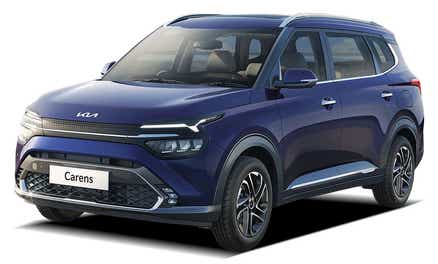
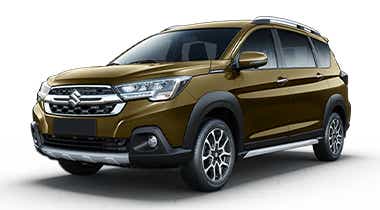
The Rumion is a compact family MPV, where its closest rival is its donor vehicle itself: the Maruti Suzuki Ertiga. On the other hand, the Maruti Suzuki XL6 takes the same basic formula of the Ertiga towards a more premium 6-seat layout, while the Kia Carens offers a larger and more feature-rich proposition.
The Rumion's positioning is the easiest to understand via its choice of powertrains. The CNG option gives it a running-cost angle, which the XL6 does not offer, while the automatic makes it suitable for buyers who spend considerable time in urban traffic.
Toyota Rumion vs Maruti Suzuki Ertiga
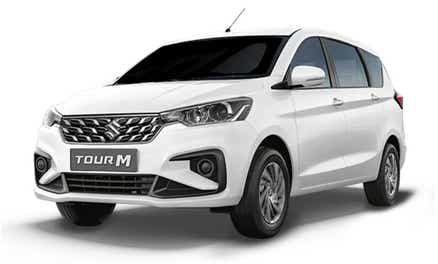
The Ertiga is obviously the closest comparable model as both these cars share the platform, cabin architecture and even the 7-seat configuration. The driving experience and space on offer are consequently very similar.
The price difference and ownership package become more important here than the powertrain specification. Those who want the Toyota version are paying for the Toyota-specific styling, equipment distribution and ownership proposition rather than for a fundamentally different MPV.
For someone comparing the two purely as a people-mover vehicle for their family, the decision comes down to the equipment and ownership factors attached to each badge.
Toyota Rumion vs Maruti Suzuki XL6
The XL6 changes the seating layout by using captain seats in the second row, making it a 6-seater. Its cabin also has a more premium presentation and additional equipment such as ventilated seats and a 360-degree camera.
The Rumion retains a 3-person second-row bench and therefore carries seven occupants. That makes the two cars relevant to slightly different family requirements: one prioritises individual second-row space, while the other retains the extra seating position.
Toyota Rumion vs Kia Carens
The Carens sits further towards the feature-rich end of the MPV segment. It offers a more premium cabin, additional features and a wider choice of powertrains, including diesel options.
The Rumion's answer is a simpler powertrain line-up, a factory CNG option and the familiar 1.5-litre petrol engine. Buyers who do not need the Carens' additional performance and equipment can keep the Rumion on the shortlist for its straightforward 7-seat layout.
Toyota Rumion: Suits buyers who want a 7-seat layout, petrol automatic and factory-fitted CNG, along with compact dimensions and a comfortable ride for predominantly urban use.
Maruti Suzuki Ertiga: Follows almost the same mechanical formula as the Rumion and makes sense for buyers focused on purchase price and service reach.
Maruti Suzuki XL6: Offers six individual seats and a more premium cabin, making it the alternative for buyers who prefer a more upmarket layout.
Kia Carens: Brings a more feature-heavy package for buyers willing to move further up the MPV price ladder.
| Model | Price Range | Key Strength |
| Toyota Rumion | Rs 9.79 lakh to Rs 14.21 lakh | Space, comfort and CNG option |
| Maruti Suzuki Ertiga | Rs 8.90 lakh to Rs 13.04 lakh | Lower price and wider service network |
| Maruti Suzuki XL6 | Rs 11.62 lakh to Rs 14.68 lakh | Premium 6-seat cabin and captain seats |
| Kia Carens Clavis | Rs 11.39 lakh to Rs 21.79 lakh | Features, space and diesel option |
The Rumion's strengths mainly centre on basic family-car use. Its cabin is flexible, the ride is comfortable, and buyers have three powertrain options to pick from, depending on their usage. Its limitations, however, become clearer with a full load. Performance is modest, third-row comfort is best suited to shorter journeys, and the cabin and infotainment system no longer feel particularly fresh beside newer MPVs.
| Pros | Cons |
| Spacious 7-seater cabin with a comfortable second row | Performance drops noticeably with a full load |
| Smooth petrol engine with a 6-speed automatic option | No diesel engine option |
| Factory-fitted CNG option for those with a high running | Third-row under-thigh support is limited on longer journeys |
| Comfortable ride over potholes and broken roads | Cabin and infotainment system feel dated beside newer rivals |
| Wireless smartphone connectivity and automatic climate control on higher variants | Styling remains very close to the Maruti Suzuki Ertiga |
The Rumion is a straightforward family MPV, and its strengths become most apparent when it is used for exactly that purpose. The second row is roomy, the third row provides genuine additional seating, the suspension deals well with poor roads and the automatic option takes the effort out of city driving.
The petrol engine is adequate rather than powerful. With fewer passengers, it has enough performance for everyday driving. Seven occupants and luggage change the equation, particularly on highways, where overtaking needs more planning.
The CNG version is likely to suit buyers who have a high monthly running. While it has a higher claimed mileage figure than that of the regular petrol version, the manual-only option and lower output make it a more case-specific choice.
The 1-above-spec S petrol manual is the variant to go for the minimum. It brings the equipment that makes the Rumion feel complete without moving too far into the price range of larger MPVs. The S AT is the better fit for buyers who spend much of their time in traffic, while the G earns its higher price through convenience and cabin equipment.
The top-spec V makes sense when the additional features are important enough to justify the jump in price. There is no fundamental change in the car itself at the top of the range.
The Rumion is therefore at its strongest as a practical, easy-going 7-seater. Its third row and modest performance need to be considered before buying, but its core package remains well suited to families that value space, comfort and running-cost flexibility over outright performance or the latest cabin technology.
Toyota Rumion Mileage
View MileageToyota Rumion Videos


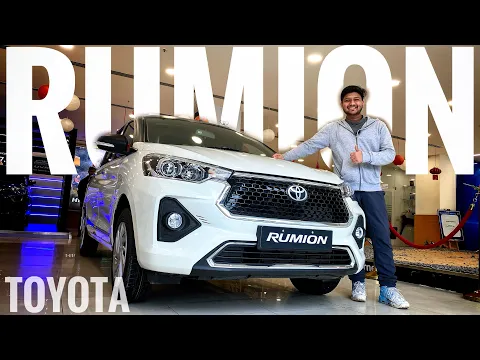

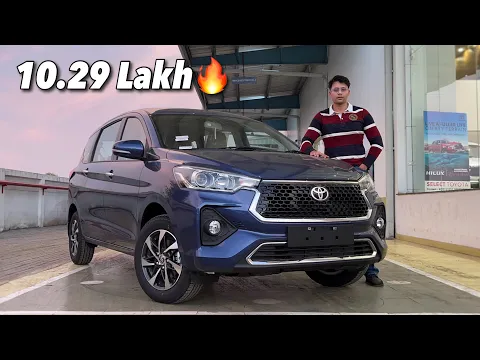
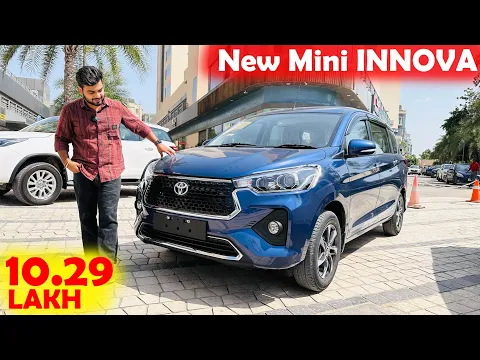

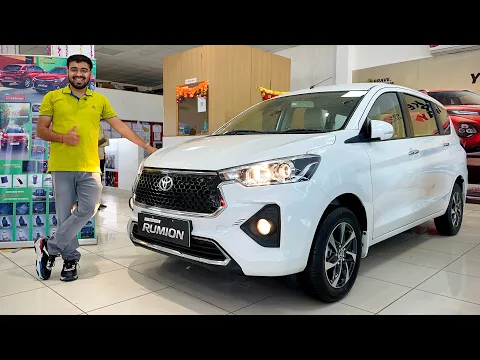

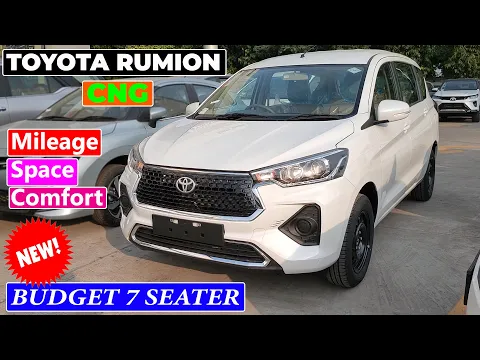

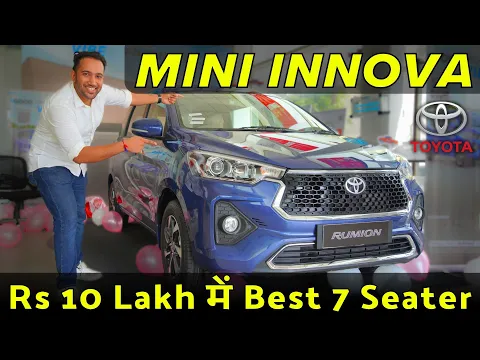
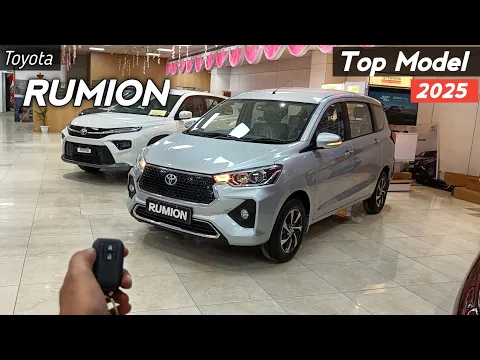

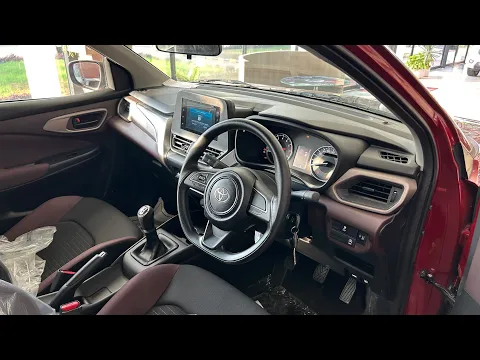

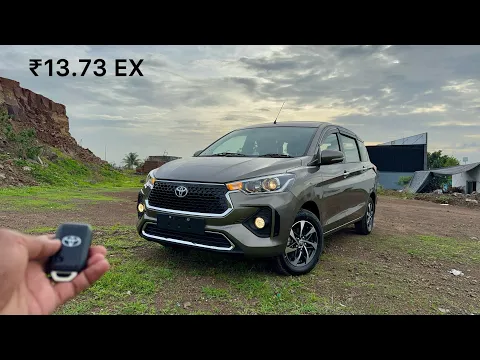

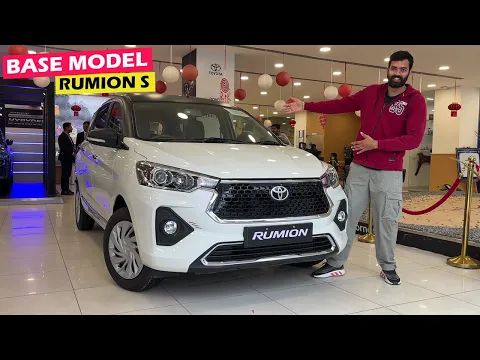



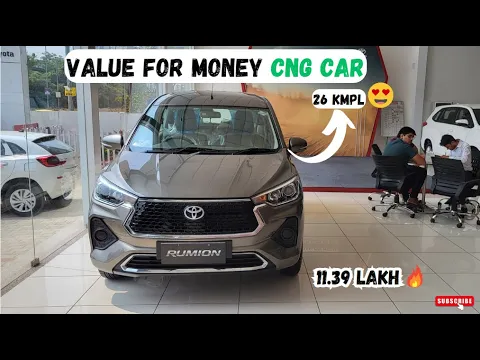





Mileage spotlight: Rumion cruises into top ranks
Discover this standout car, currently ranked 2 on the Cars24 mileage Leaderboard. With 20.51 kmpl mileage, Rumion continues to impress with its combination of style and performance.

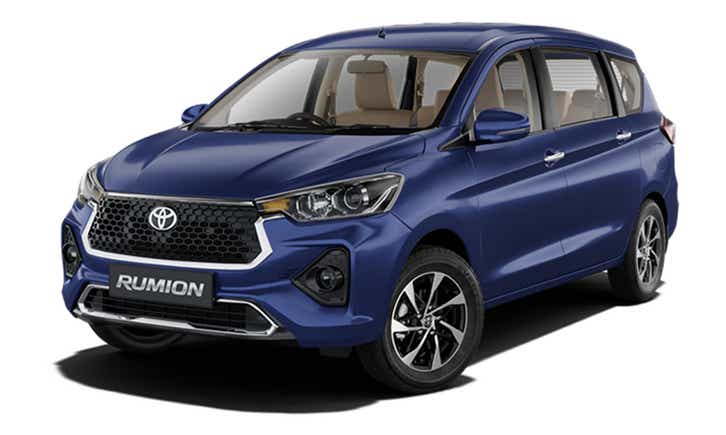
Rumion last 6 months Sales
Toyota Rumion Shorts
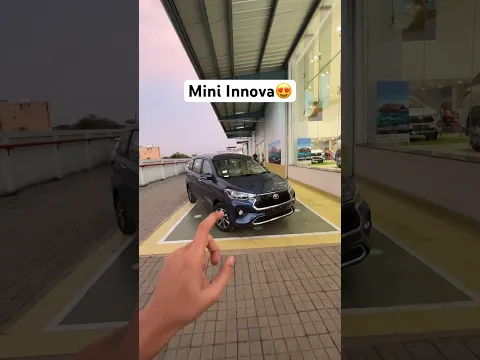
- Mini Innova by Toyota😍 Toyota Rumion
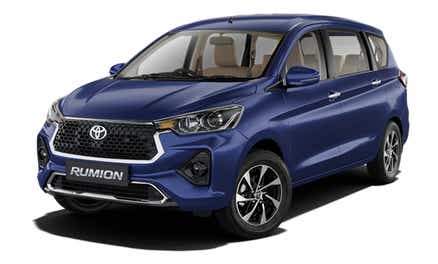
Compare Toyota Rumion with Similar Cars
Parallel picks for you!
Frequently Asked Questions
The Toyota Rumion is priced between Rs 9.79 lakh and Rs 14.21 lakh (ex-showroom Delhi), depending on the variant and transmission option chosen.
Yes. The Toyota Rumion is sold as a 7-seater with three rows of seats.
The Rumion comes with a 1.5-litre naturally aspirated 4-cylinder petrol engine making 103 PS and 136.8 Nm. It is available with a 5-speed manual or 6-speed automatic. The CNG version produces 88 PS and 121.5 Nm and is available with the manual transmission only.
Yes. The Rumion gets a factory-fitted CNG powertrain with 88 PS and 121.5 Nm. It is offered only with the 5-speed manual gearbox.
The petrol-manual version has a claimed mileage of 20.51 kmpl, while the petrol automatic is stated to return 20.11 kmpl and the CNG version offers 26.11 km/kg.
Does the Toyota Rumion have an automatic gearbox?
Yes. The petrol versions are available with a 6-speed automatic transmission on the S, G and V variants.
Has the Toyota Rumion received a Global NCAP rating?
No. The Toyota Rumion has yet to be crash-tested by Global NCAP or Bharat NCAP.




All Sibling Models of Toyota

All Model Make Filter
- Recently Launched 7 Seater Cars
- Recently Launched Manual Cars
- Recently Launched Automatic Cars
- Recently Launched Muv Cars
- Recently Launched Petrol Cars
- Recently Launched Cng Cars
- Recently Launched 1000 to 1500cc Cars
- Recently Launched Upto 30kmpl Cars
- Recently Launched 4 Cylinder Cars
- Recently Launched Abs Cars
- Recently Launched Esc Cars
- Recently Launched Hill Hold Assist Cars
- Recently Launched Cars Under 15 Lakhs
- 7 Seater Manual Cars
- 7 Seater Automatic Cars
- 7 Seater Muv Cars
- 7 Seater Petrol Cars
- 7 Seater Cng Cars
- 7 Seater 1000 to 1500cc Cars
- 7 Seater Upto 30kmpl Cars
- 7 Seater 4 Cylinder Cars
- 7 Seater Abs Cars
- 7 Seater Esc Cars
- 7 Seater Hill Hold Assist Cars
- 7 Seater Cars Under 15 Lakhs
- Manual Muv Cars
- Manual Petrol Cars
- Manual Cng Cars
- Manual 1000 to 1500cc Cars
- Manual Upto 30kmpl Cars
- Manual 4 Cylinder Cars
- Manual Abs Cars
- Manual Esc Cars
- Manual Hill Hold Assist Cars
- Manual Cars Under 15 Lakhs
- Automatic Muv Cars
- Automatic Petrol Cars
- Automatic 1000 to 1500cc Cars
- Automatic Upto 30kmpl Cars
- Automatic 4 Cylinder Cars
- Automatic Abs Cars
- Automatic Esc Cars
- Automatic Hill Hold Assist Cars
- Automatic Cars Under 15 Lakhs
- Muv Petrol Cars
- Muv Cng Cars
- Muv 1000 to 1500cc Cars
- Muv Upto 30kmpl Cars
- Muv 4 Cylinder Cars
- Muv Abs Cars
- Muv Esc Cars
- Muv Hill Hold Assist Cars
- Muv Cars Under 15 Lakhs
- Petrol 1000 to 1500cc Cars
- Petrol Upto 30kmpl Cars
- Petrol 4 Cylinder Cars
- Petrol Abs Cars
- Petrol Esc Cars
- Petrol Hill Hold Assist Cars
- Petrol Cars Under 15 Lakhs
- Cng 1000 to 1500cc Cars
- Cng Upto 30kmpl Cars
- Cng 4 Cylinder Cars
- Cng Abs Cars
- Cng Hill Hold Assist Cars
- Cng Cars Under 15 Lakhs
- 1000 to 1500cc Upto 30kmpl Cars
- 1000 to 1500cc 4 Cylinder Cars
- 1000 to 1500cc Abs Cars
- 1000 to 1500cc Esc Cars
- 1000 to 1500cc Hill Hold Assist Cars
- 1000 to 1500cc Cars Under 15 Lakhs
- Upto 30kmpl 4 Cylinder Cars
- Upto 30kmpl Abs Cars
- Upto 30kmpl Esc Cars
- Upto 30kmpl Hill Hold Assist Cars
- Upto 30kmpl Cars Under 15 Lakhs
- 4 Cylinder Abs Cars
- 4 Cylinder Esc Cars
- 4 Cylinder Hill Hold Assist Cars
- 4 Cylinder Cars Under 15 Lakhs
- Abs Cars Under 15 Lakhs
- Esc Cars Under 15 Lakhs
- Hill Hold Assist Cars Under 15 Lakhs
- Toyota Upcoming Cars
- Toyota Recently Launched Cars
- Toyota Discontinued Cars
- Toyota 5 Seater Cars
- Toyota 7 Seater Cars
- Toyota 8 Seater Cars
- Toyota Manual Cars
- Toyota Automatic Cars
- Toyota Sedan Cars
- Toyota Suv Cars
- Toyota Hatchback Cars
- Toyota Muv Cars
- Toyota Minivan Cars
- Toyota Pickup Truck Cars
- Toyota Petrol Cars
- Toyota Cng Cars
- Toyota Electric Cars
- Toyota Diesel Cars
- Toyota Hybrid Cars
- Toyota 0 to 1000cc Cars
- Toyota 1000 to 1500cc Cars
- Toyota 1500 to 2000cc Cars
- Toyota 2000 to 3000cc Cars
- Toyota Above 3000cc Cars
- Toyota Upto 30kmpl Cars
- Toyota 30 to 40kmpl Cars
- Toyota Awd Cars
- Toyota Fwd Cars
- Toyota Rwd Cars
- Toyota 4wd Cars
- Toyota 4 Cylinder Cars
- Toyota 6 Cylinder Cars
- Toyota Abs Cars
- Toyota Esc Cars
- Toyota Hill Hold Assist Cars
- Toyota Traction Control Cars
- Toyota Tpms Cars
- Toyota Adaptive Cruise Control Cars
- Toyota Sunroof Cars
- Toyota Panoramic Cars
- Toyota Moonroof Cars
- Toyota Cars Under 7 Lakhs
- Toyota Cars Under 10 Lakhs
- Toyota Cars Under 15 Lakhs
- Toyota Cars Under 20 Lakhs
- Toyota Cars Under 25 Lakhs
- Toyota Cars Under 30 Lakhs
- Toyota Cars Under 35 Lakhs
- Toyota Cars Under 50 Lakhs
- Toyota Cars Under 1 Crore
- Toyota Cars Under 2 Crore
- Toyota Cars Under 5 Crore
- Maruti Suzuki
- Tata
- Hyundai
- Mahindra
- Kia
- Honda
- Renault
- Skoda
- Mg
- Nissan
- Volkswagen
- Citroen
- Bmw
- Mercedes Benz
- Xiaomi
- Ford
- Jeep
- Audi
- Jaguar
- Land Rover
- Rolls Royce
- Byd
- Force
- Tesla
- Vinfast
- Bentley
- Lamborghini
- Ola Electric
- Maserati
- Volvo
- Aston Martin
- Ferrari
- Isuzu
- Mclaren
- Mini
- Lotus
- Porsche
- Lexus
- Jsw Cars