How to Check If a Used Car Is Stolen Before You Buy It in India
- 1Match the chassis number across the car, RC and official records
- 2Check the vehicle's registration details on the Parivahan VAHAN portal
- 3Run the registration through NCRB's Vehicle NOC service before paying
- Why this check matters more than most buyers assume
- How does a stolen car end up back on the resale market?
- How do you check the chassis number for tampering?
- How do you verify the RC against the government's own record?
- How do you actually run a stolen vehicle check?
- What documentation and seller behaviour should raise a flag?
- What actually happens if you unknowingly buy a stolen car?
- Where this checklist doesn't fully apply
- Which checks matter most, depending on how you're buying
- A practical checklist before you hand over any money
A used car can look perfectly legitimate and still carry a problem that isn't visible from the outside. The registration plate may be genuine, the paperwork may appear complete and the seller may have no idea that something is wrong. That is why checking a car's ownership and crime records should be part of the buying process, not an afterthought.
The good news is that you don't need to rely entirely on the seller's word. Three checks can establish a much clearer picture before you hand over any money: inspect the chassis number on the physical car, match it with the Registration Certificate and government vehicle records, and run the vehicle through the NCRB's Vehicle NOC service.
These checks cover different parts of the same question. The chassis inspection helps identify physical tampering, the Parivahan record confirms whether the vehicle details match the official registration, and the NCRB search can indicate whether the vehicle is linked to a reported crime. Here's how to carry out each check and what to do when the information doesn't line up.
Why this check matters more than most buyers assume
A vehicle went missing in India roughly once every two and a half minutes in 2024, according to NCRB figures, with Delhi alone accounting for over 40,000 of those cases. In fact, car theft in India spiked 2.5 times over in 2023 compared to the year before, with New Delhi responsible for more than 56% of the total. That's a lot of stolen inventory that has to go somewhere. Some of it gets stripped for parts. A meaningful share gets re-registered under fabricated paperwork and sold to someone who has no idea they're buying trouble.
Sellers rarely mention this, and buyers rarely ask: by the time a stolen car reaches you, it's usually three or four transactions removed from the actual theft. The person showing you the car in most cases genuinely believes it's clean, and that belief offers you zero protection once police trace the chassis back to an FIR. The car gets seized regardless of who's holding the keys at the time.
How does a stolen car end up back on the resale market?
The process is faster and more organised than most first-time buyers expect. A car gets taken, and within hours it's often moved to a different city or state, away from where the theft was reported and where local police would recognise the plate. Then the paperwork gets reworked: a fabricated RC, a re-stamped or "cloned" chassis number copied from a legitimately registered vehicle of the same make and model.
Once that groundwork is done, the car moves through a chain of resales, sometimes three or four deep, before it lands in front of a retail buyer. Each intermediate seller adds a layer of distance from the original crime. The person you're negotiating with may be entirely unaware their own seller obtained the car dishonestly. Only the paperwork trail, and the metal itself, can tell you the truth.
How do you check the chassis number for tampering?
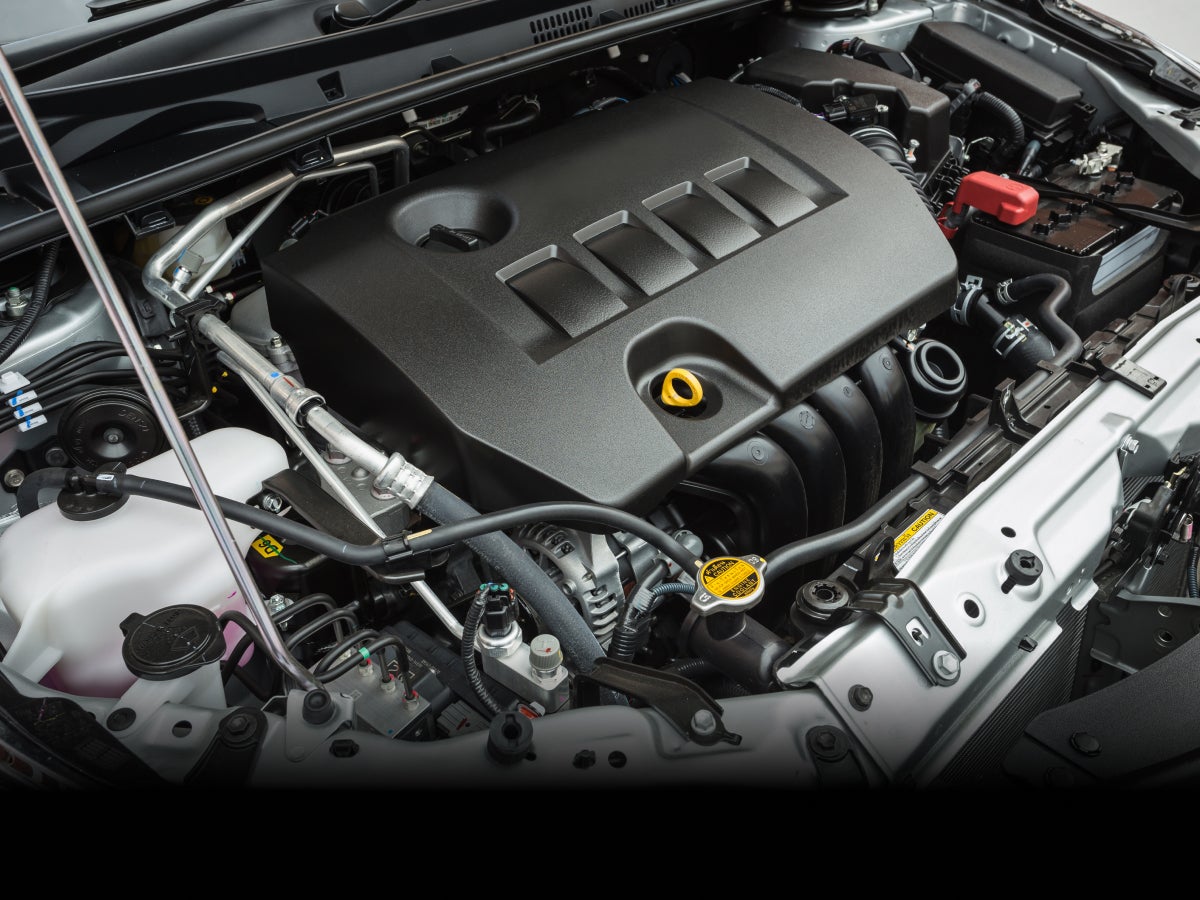
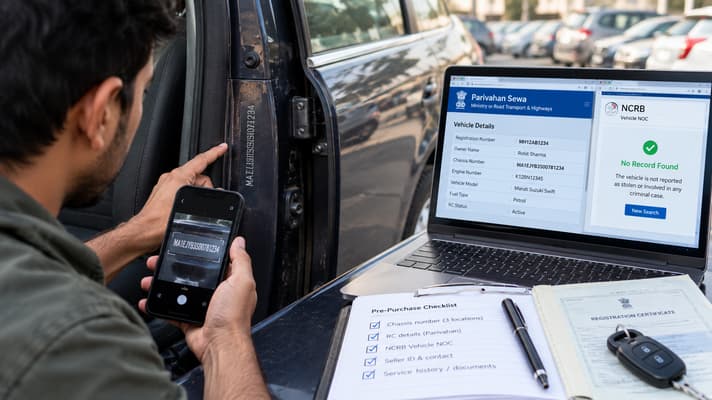
The chassis number (also called the VIN) is stamped directly onto the vehicle's body in three standard locations: the engine bay, the driver's side door frame, and the base of the windshield. On a legitimate vehicle, all three should read identically.
Look closely at the quality of the stamping itself, beyond the digits alone. A factory stamp is uniform, sits flush with the metal, and looks like it was pressed in during manufacturing because it was. If the digits look uneven, freshly engraved, or slightly raised compared to the surrounding surface, treat it as a warning sign rather than a coincidence. Check the metal around the stamp too. Fresh welding, mismatched panel colors, or seams that don't quite align are the visible scars left behind when a chassis plate gets swapped or altered, a process sometimes called "re-birthing" in the trade.
None of this requires special equipment. A flashlight, your own eyes, and roughly ten minutes at the seller's location will tell you more than any conversation will.
How do you verify the RC against the government's own record?
Once the chassis checks out, cross-reference the Registration Certificate against India's central vehicle database. The Ministry of Road Transport and Highways runs this through the Parivahan Sewa VAHAN portal, where entering a registration number returns the owner name, engine number, chassis number, registration date, and current RC status directly from RTO records.
The standard here is a character-by-character match against the RC, nothing looser. If the portal's owner name doesn't match the seller's ID, if the chassis or engine number differs even slightly from what's stamped on the car, or if the registration date implies a vehicle age that contradicts the visible wear on the car, something in the story doesn't hold up.
How do you actually run a stolen vehicle check?
This is the step most buyers skip entirely, usually because they don't know it exists. The National Crime Records Bureau maintains a national database of vehicles linked to open criminal cases, including theft, accessible through the Digital Police Citizen Services portal. The relevant service is called "Generate Vehicle NOC," and it lets any citizen search a vehicle before purchase using the registration number, chassis number, engine number, or a combination of these, to confirm whether it's tied to a crime or listed as stolen.
You'll need to register with a mobile number and OTP, enter the vehicle's details, and the system returns a report you can download. Several states also route stolen vehicle data through their own police citizen portals or ZIPNET-linked systems, so it's worth checking your state RTO's site as a supplementary source if the central portal returns an inconclusive result.
One caveat worth flagging: database entries lag behind real-world events by hours or occasionally days, particularly for very recent thefts or FIRs filed in a different state than where you're checking. A clean result today is a strong signal for a car with a longer history, though a theft from the past few days might not have made it into the system yet.
What documentation and seller behaviour should raise a flag?
Beyond the chassis and the RC, a handful of secondary signals tend to cluster together whenever something is off. None of these alone proves foul play, but stack two or three together and you have reason to slow down.
| What to check | What it should show | Where to verify |
| Chassis number | Identical, cleanly stamped number in the engine bay, door frame, and windshield base | Physical inspection |
| Registration Certificate | Owner name, chassis number, and engine number match the vehicle exactly | Parivahan / VAHAN portal |
| Criminal or theft status | No FIR, no open case, no stolen flag against the registration, chassis, or engine number | NCRB Vehicle NOC via Digital Police |
| Seller identity | Government ID matches the RC owner, or the seller provides a documented, verifiable ownership chain when they are not the original registrant | Physical documents, notarised sale deeds |
| Keys, service history, payment | Multiple original keys, a service record trail, and willingness to accept a documented, traceable payment | In-person verification before money changes hands |
Cash-only demands, a single set of keys with no spare, an absent service history, and reluctance to put a phone number or ID on record before any money moves are individually explainable. A legitimate seller with nothing to hide rarely objects to writing these things down. If a seller pushes back hard on that request specifically, treat the resistance itself as information.
What actually happens if you unknowingly buy a stolen car?
This is the part that surprises most people, and it's worth being precise about it rather than vague. Under India's current criminal law, receiving or dealing in stolen property is covered by Section 317 of the Bharatiya Nyaya Sanhita, which replaced the old IPC Section 411 from July 1, 2024. Conviction requires the prosecution to prove you knew, or had reason to believe, the property was stolen. Legal analysis of past rulings under this provision, shows courts declining to convict on possession alone when the prosecution can't establish that knowledge, while a pattern of questionable, undocumented dealing has been read by courts as satisfying that same standard. A documented, arm's length purchase with no red flags ignored is a materially different case from a cash deal with no paper trail and a seller you never verified.
Criminal liability is only part of what's at stake. The car itself remains stolen property regardless of your intent, and Indian courts have consistently held, in cases involving exactly this scenario, that a good-faith buyer of a stolen vehicle acquires no title over it, even after paying full value. Once the chassis gets traced back to a case, the vehicle is ordered returned to its original owner. Whoever happens to be holding the keys at that point simply loses it, along with in most cases whatever they paid, and has limited practical recourse against a seller who may already be untraceable. The legal risk depends on culpability. The financial risk lands on you either way, and for an ordinary buyer, that's the one that actually hurts.
Where this checklist doesn't fully apply
A car carrying a bank loan or hypothecation entry on its RC isn't automatically a theft concern. That's a separate issue, an unpaid lien, and it needs its own clearance from the financing bank before the RC can transfer cleanly. Don't conflate the two red flags; a hypothecated car with a matching chassis and clean NCRB result usually just needs a No Objection Certificate from the lender.
Similarly, a mismatch caused purely by a recent interstate transfer or a state RTO's data sync delay isn't automatically suspicious. RTOs correcting or updating records commonly take a day or two before the change is visible on the central portal. If a discrepancy looks like a timing issue rather than a fabrication, it's worth a direct call to the registering RTO before you walk away from an otherwise clean deal.
Which checks matter most, depending on how you're buying
If you're buying directly from a private seller, all four checks above sit entirely on you. Budget an extra day before finalising payment, run the chassis, RC, and NCRB checks yourself, and don't let urgency from the seller compress that timeline.
If you're buying through a certified platform, the ownership and legal verification is typically built into the pre-sale process, but it's still reasonable to ask what specifically was checked and when. Cars24, for instance, runs ownership, legal, and financial verification as part of its inspection process before a car is listed under its own stock.
A practical checklist before you hand over any money
- Physically inspect the chassis number in all three locations and photograph each one.
- Pull the RC on the Parivahan VAHAN portal and match every field against the physical car.
- Run the registration number through NCRB's Vehicle NOC service.
- Ask for the seller's ID, a verified phone number, and get their signature on a written record before any payment.
- Treat a suspiciously low price, cash-only insistence, or a single key as reasons to slow down and dig deeper.
- If anything about the paperwork or the metal doesn't line up, walk. A clean car elsewhere will cost you less than a legal fight over one that wasn't.
Frequently Asked Questions
Expand all