What to Do After a Car Accident in India: A Step-by-Step Guide
- 1Check for injuries and call 112 before dealing with vehicle damage.
- 2Photograph the accident scene and exchange details with the other driver.
- 3Inform your insurer and preserve documents before starting major repairs.
- You Have Legal Duties the Moment It Happens
- Step One: Check for Injuries Before Anything Else
- Step Two: Photograph the Scene Before You Move Anything
- Step Three: Exchange Details, Not Opinions
- If You Hit Another Car
- If Someone Hits You
- When the Police Need to Be Involved
- Getting the Insurance Side Right
- If Someone Is Injured, This Stops Being Just a Car Matter
- The Point of All This
One second of distraction, one badly timed brake, one blind turn, and it happens. You've hit another car, or another car has hit you. What separates a manageable Tuesday from a genuinely expensive mess isn't usually the collision itself. It's the ten minutes right after it.
A quick note before we go further. This is practical guidance on Indian road safety and insurance procedure, written for general reference. If the accident involves serious injury, a fatality, criminal allegations, drunk driving, or a large compensation claim, speak to a lawyer directly rather than relying on an article. For the ordinary fender bender or moderate collision most drivers actually face, here's what to do, in order.
You Have Legal Duties the Moment It Happens
Running from the scene is the single worst decision available to you, and Indian law is specific about why. Section 134 of the Motor Vehicles Act requires the driver involved in an accident to take reasonable steps to secure medical help for anyone injured, share information with a police officer on demand, and, if no officer is present, report the accident at the nearest police station within 24 hours. Fleeing the scene doesn't just look bad. It's a separate offence under Section 187 of the same Act, layered on top of whatever the accident itself involved.
Step One: Check for Injuries Before Anything Else
Stop the car safely and switch on your hazard lights. Scan quickly for fire, a fuel leak, broken glass, oncoming traffic, and injuries, in that order. If anyone is unconscious, bleeding heavily, trapped, confused, or complaining of neck, chest, or breathing trouble, call 112 immediately. India's unified emergency number connects you to police, ambulance, and fire response through a single call, so there's no need to hunt for a separate number depending on what's wrong.
A few things worth knowing that most people get wrong under pressure. Don't drag an injured person away from the vehicle unless there's an immediate danger like fire or smoke, since moving someone incorrectly can turn a manageable injury into a spinal one. If a motorcyclist is involved, leave the helmet on unless it's actively blocking their breathing and you genuinely know what you're doing. And resist the urge to hand out water, food, or medicine to someone badly hurt. Your job at that moment is limited to calling for help and avoiding actions that make things worse. Leave the diagnosing and treating to the paramedics who arrive.
Step Two: Photograph the Scene Before You Move Anything
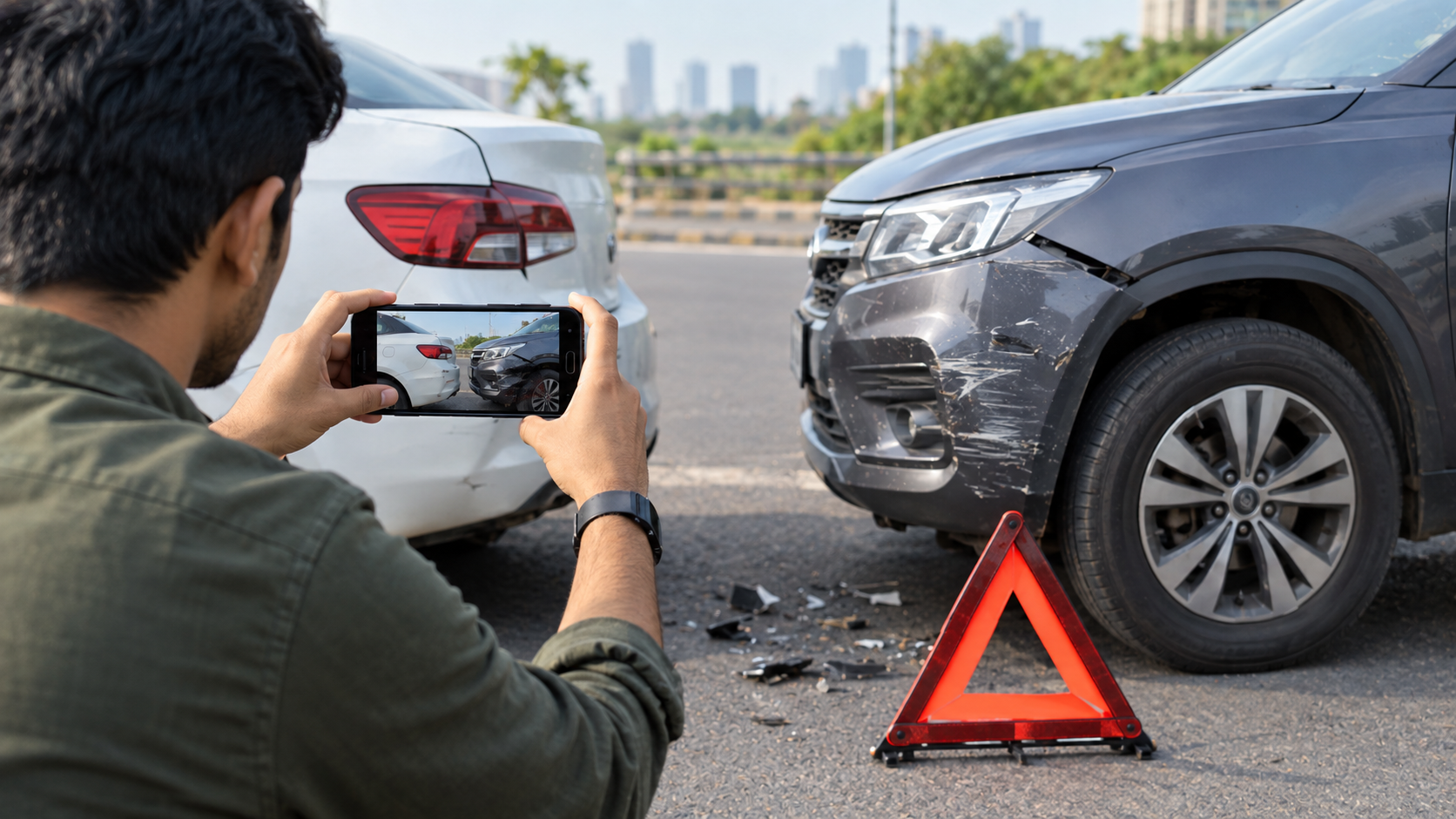
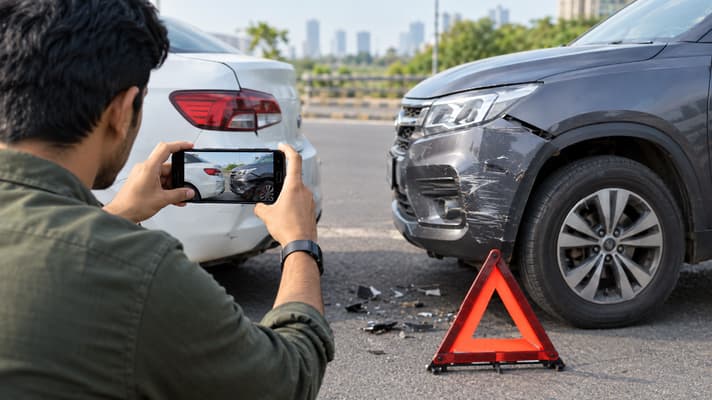
If it's safe to do so, take photos and video of both vehicles, the road position, licence plates, visible damage, and anything else relevant before either car moves an inch. This single habit does more for an eventual insurance claim than almost anything else on this list.
There's a practical exception. If there's no serious injury and the vehicles are blocking traffic, photograph first, then move them to the side so you're not causing a second accident. If there's a serious injury, suspected drunk driving, heavy impact, or a police officer has told you to wait, leave everything exactly where it is unless safety genuinely demands otherwise.
Step Three: Exchange Details, Not Opinions
Swap registration numbers, driving licences, insurance details, and phone numbers with the other party. If they refuse to cooperate, don't get into a shouting match over it. Note their registration number, record whatever you safely can, and call the police instead of escalating things yourself.
This is also the moment to say almost nothing beyond the facts. Statements like "it was my fault, I'll pay for everything, no need for police, let's settle it right here" feel like the fastest way out of an awkward situation, and they're exactly how a minor fender bender turns into a legal and financial headache three weeks later.
If You Hit Another Car
Stop, check for injuries, call 112 if the situation needs it, exchange details, take photos, and inform your insurer. For a genuinely minor scratch with nobody hurt, you're allowed to use practical judgement and handle it directly with the other party.
Bring in the police and your insurer, without exception, if there's an injury, significant damage, a commercial vehicle involved, a driver who turns out to be uninsured or underage, missing documents, or any real dispute about what happened. Avoid handing over a large cash sum on the spot just to make an awkward situation disappear faster. A driver who accepts a few thousand rupees for "bumper damage" today can just as easily come back next month claiming a hospital bill or a much larger repair cost, and a cash settlement with no paperwork gives you nothing to point to if that happens. It's also worth holding off on major repairs until after the insurance survey is done. Towing the vehicle and basic safety work are fine in the meantime, but a fully repaired car can complicate or even weaken your own claim.
If Someone Hits You
Anger doesn't count as evidence, so the first job is to get it out of the way and start documenting instead. Capture the other vehicle's registration number, make, model, and colour, the driver's face if it's safe to do so, visible damage to their car, and which direction they came from and went afterward.
If they drive off, don't chase them. That's how a fender bender becomes a genuinely dangerous situation. Call 112, report the registration number, a description of the vehicle, the direction it fled, and your location, and let the response system take it from there.
If they stay at the scene, exchange documents and record what you can, and push back on pressure lines like "no need for police, no need for insurance, I'll pay cash." For a true scratch, that might genuinely be fine, and you're entitled to use your own judgement. But modern cars hide surprisingly expensive components behind a bumper, parking sensors, cameras, mounting brackets, the radiator support, sometimes suspension parts, so a quick cash handshake isn't always the smart move it feels like in the moment. Get the documentation first. Decide what to do with it afterward.
When the Police Need to Be Involved
Call the police, or visit the nearest station yourself, whenever there's an injury, a fatality, a fleeing driver, drunk driving, a serious dispute, or property damage that isn't a trivial scratch. Where no officer is present at the scene and the case genuinely needs reporting, do it at the nearest station as soon as you reasonably can, and within 24 hours where the law requires it.
One point worth flagging for anyone searching this up using older terminology: cases registered from mid-2024 onward fall under the Bharatiya Nyaya Sanhita and Bharatiya Nagarik Suraksha Sanhita. Rash or negligent driving now sits under BNS provisions rather than the IPC sections many people still search for by habit. For anything beyond a minor scrape, don't rely solely on a state's online complaint portal. Coverage and reliability vary a lot between states, and a serious accident deserves an actual police report filed in person, since portal submissions can sit unprocessed for days.
Getting the Insurance Side Right
Call your insurer as soon as the immediate safety situation is handled, ideally the same day. Get a claim number on record, ask whether a surveyor needs to physically inspect the vehicle before repairs start, and confirm whether you're using a cashless network garage or paying upfront for reimbursement later. If you'd rather compare your current cover or explore options built around exactly this kind of claim process, Cars24's insurance arm, Insure24, is worth a look before your next renewal.
Keep every scrap of paper this generates. Photos, videos, the FIR or police report if one exists, both drivers' licences and RCs, insurance and PUC copies, garage estimates, toll receipts, the repair invoice, and any medical or MLC paperwork if someone was hurt. None of this feels urgent in the moment, and all of it becomes exactly what you need if the claim gets contested later.
One more thing worth asking before you commit to filing: what happens to your No Claim Bonus. Under IRDAI's standardised slabs, that discount on your own-damage premium starts at 20 percent after one claim-free year and climbs to 50 percent after five consecutive ones, and filing a claim resets it back to zero regardless of how small the payout was. For a small dent that costs less to repair out of pocket than the NCB you'd lose, skipping the claim is often the financially smarter move. For anything genuinely expensive, that calculation flips. Ask your insurer to run both numbers before you decide either way.
If Someone Is Injured, This Stops Being Just a Car Matter
Once an injury enters the picture, the paperwork that matters expands well beyond a repair estimate. Medical records, police documentation, and the Medico-Legal Case report all carry weight if the matter goes anywhere near a claims tribunal later.
Two protections are worth knowing about here, because both directly counter the instinct to hesitate. First, anyone who stops to help an accident victim in India is legally shielded from civil or criminal liability for that assistance under Section 134A of the Motor Vehicles Act, a protection the Supreme Court first ordered enforced back in 2016 before Parliament wrote it into law. You cannot be forced to become a witness, hand over your personal details, or face harassment simply for helping someone into a car and driving them to a hospital.
Second, road accident victims in India are entitled to cashless treatment up to Rs 1.5 lakh for the first seven days at a designated hospital under what's now branded the PM RAHAT scheme, the relaunched and expanded version of the 2025 cashless treatment framework, funded through the Motor Vehicle Accident Fund rather than out of the victim's own pocket. And if the vehicle responsible can never be traced, current hit and run compensation under the Ministry of Road Transport and Highways' 2022 scheme stands at Rs 2 lakh for death and Rs 50,000 for grievous hurt, a sharp jump from the Rs 25,000 and Rs 12,500 the old Solatium Scheme offered, confirmed in the Ministry's own PIB notification. None of this applies to a scratched bumper. It exists specifically for the cases where someone is seriously hurt and the responsible vehicle is unknown.
The Point of All This
Avoiding accidents for thirty years straight is partly luck, and plenty of genuinely careful people still end up in one through no fault of their own. What actually separates a good driver from an unlucky one is knowing exactly what to do in the ten minutes that follow, calmly, in order, without panic driving the decisions.
If the damage turns out serious enough that repair costs start approaching what the car is even worth, it's worth running the numbers before committing to a repair bill. Cars24's used car valuation tool gives you a quick read on what the vehicle would fetch as is, which is sometimes the more sensible route than pouring money into a car that's already lost significant value in the crash. Save this checklist somewhere you'll actually find it again. The day you need it, you'll need it fast, and evidence collected calmly in the first ten minutes is worth far more than any argument you could win at the scene.
Frequently Asked Questions
Expand all