Decoding the Toyota Fortuner Safety Rating: Crash Tests, Platform, and Features Explained
- 1The Fortuner secures a full 5-star rating under rigorous ASEAN NCAP testing.
- 2Equipped with 7 airbags and Vehicle Stability Control as standard in India.
- 3Built on the legendary IMV platform, known for its immense structural rigidity.
The Toyota Fortuner is a cultural phenomenon in India. It is the default choice for those who demand an imposing road presence, bulletproof reliability, and the ability to command respect in any convoy. However, in an era where the Indian car buyer is becoming increasingly obsessed with crash test videos and safety certificates, even a giant like the Fortuner must be judged on its safety.
While many buyers assume that a big car is naturally a safe car, the reality of physics is far more nuanced. A 5-star rating provides a reassuring headline, but there is a lot to understand beyond the initial score. We need to look at how a heavy ladder-frame chassis behaves when it meets a concrete barrier, how the child protection scores reflect real-world family usage, and how the platform itself has evolved. In this breakdown, we are going to see why the Toyota Fortuner earned its scores and what it truly means for your family’s safety.
Toyota Fortuner Crash Test Scores at a Glance
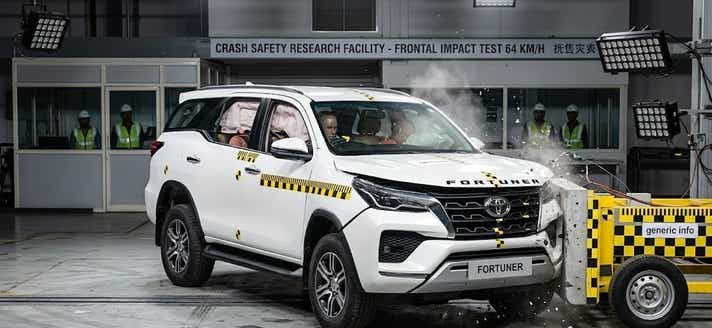
While Global NCAP focuses on budget segments, the Fortuner is traditionally tested by ASEAN NCAP, which follows protocols that are closely aligned with international safety standards.
| Testing Body | Overall Rating | Adult Protection (AOP) | Child Protection (COP) | Bodyshell Integrity |
| ASEAN NCAP | 5 Stars | 34.03 / 36.00 | 43.38 / 49.00 | Stable |
If you are exploring the elite tier of protection in the Indian market, you should also check out the safest cars in India according to GNCAP to see how different architectures compare.
How is the Toyota Fortuner Tested?
To understand the Fortuner's safety, we must look at the controlled chaos of the crash lab. ASEAN NCAP subjects the vehicle to a 64 km/h frontal offset impact. In this scenario, the vehicle strikes a deformable barrier with only 40% of its front width. This is particularly challenging for a heavy SUV like the Fortuner, as nearly two tonnes of momentum are concentrated on a single side of the chassis.
The test doesn't stop at the front. It includes a side-impact test where a mobile barrier slams into the side of the vehicle at 50 km/h. This evaluates the strength of the B-pillars and the effectiveness of the side and curtain airbags. The dummies used are calibrated to simulate humans of various sizes, measuring the precise deceleration forces acting on vital organs. For a vehicle of this height, the testing body also pays close attention to the risk of a rollover during sudden evasive manoeuvres.
Decoding the Fortuner Crash Test Rating: What the Numbers Actually Mean
- Adult Occupant Protection (AOP): The Fortuner scored a near-perfect 34.03 out of 36.00. The dummies recorded "Good" protection for the head and neck of both the driver and passenger. The "GOA" (Global Outstanding Assessment) body design ensures that the energy is diverted around the cabin through reinforced pillars, preventing the dashboard from moving into the passenger's survival space.
- Child Occupant Protection (COP): With a score of 43.38 out of 49.00, the Fortuner is one of the best in its class for young passengers. The use of ISOFIX mounts and the top-tether anchorages kept the child dummies' heads well within the protected zone during both frontal and side impacts. It ensures that the seats don't just stay in place, but actually cushion the violent snap of a crash.
Bodyshell Integrity: The verdict for the Fortuner’s shell was "Stable." In layman's terms, this means that even after a massive impact, the structure of the passenger cabin remained intact. The doors could still be opened without hydraulic tools, and the footwell area did not collapse, which is essential for preventing lower-limb injuries to the driver.
The Foundation: Analysing the Toyota Fortuner's Platform
The secret to the Fortuner's indestructible reputation and its safety performance lies in its foundation: the IMV (Innovative International Multi-purpose Vehicle) Platform. This is a heavy-duty ladder-frame architecture shared with the Toyota Hilux, a vehicle known globally for surviving the most extreme environments on Earth.
Unlike a unibody (monocoque) car where the outer skin is part of the structure, the Fortuner uses a massive steel frame as its backbone. Toyota has utilised High-Strength Steel (HSS) in critical load-bearing areas of this frame. The front portions of the frame are designed to absorb energy, while the central section remains absolutely rigid to protect the occupants.
Intra-Brand Comparison
Within the Toyota showroom, the Fortuner sits on a much more robust version of the IMV platform than the Innova Crysta. While they share the same DNA, the Fortuner features additional reinforcements in the suspension mounts and cross-members to handle the higher stresses of off-roading. This extra heft translates to a more resilient structure in multi-car highway pile-ups.
Segment Comparison
When you compare the Fortuner's structural design to a modern ladder-frame rival like the Mahindra Scorpio N Safety Rating, you see two different approaches to the same goal. While the Scorpio N is a much newer design with modern material science, the Fortuner’s platform has been refined over two decades of global crash data. The Fortuner tends to feel more analogue but its sheer mass and the thickness of its frame rails provide a level of kinetic protection that is hard to match in a lighter crossover.
Which Variant Was Tested? (And Why It Matters)
The testing usually involves the standard variant, which carries the same safety architecture as the premium Legender or GR-S trims.
Tested Model Details
| Make & Model | Kerb Weight | Safety Equipment on Board |
| Toyota Fortuner | 2,135 kg | 7 Airbags, VSC, ABS, EBD, BA |
This is a critical takeaway for the buyer. Whether you are buying the base 4x2 Petrol or the top-of-the-line 4x4 Diesel automatic, the structural safety and the airbag count remain the same. You are never penalised for choosing a more affordable variant when it comes to the safety of your family.
Toyota Fortuner Safety Features: Standard vs. Advanced Features
- 7 Airbags: This is the gold standard. It includes front, side, curtain, and a specific knee airbag for the driver. In a major crash, you aren't just hitting one cushion; you are being surrounded by an inflatable cocoon.
- Vehicle Stability Control (VSC) with Brake Assist: This is vital for a tall SUV. It prevents the car from skidding or spinning out if you have to swerve suddenly at high speeds.
- Traction Control System (TRC): Ensures the wheels don't spin fruitlessly on slippery surfaces, maintaining directional control.
Hill Start Assist Control (HAC): Prevents the car from rolling backwards on steep inclines, which is a common cause of minor accidents in hilly terrain.
Note: Unlike some global markets, the Indian Fortuner currently misses out on the full Toyota Safety Sense (ADAS) suite like Autonomous Emergency Braking, focusing instead on heavy-duty passive protection.
Toyota Fortuner Safety Rating vs. Competitors
| Car Model | NCAP Score (Testing Body) | Bodyshell Rating | Standard Safety Features | Starting Price |
| Toyota Fortuner | 5 Stars (ASEAN NCAP) | Stable | 7 Airbags, VSC, ABS | ₹33.43 Lakh |
| MG Gloster | 5 Stars (ANCAP) | Stable | 6 Airbags, ADAS, ESC | ₹38.80 Lakh |
| Mahindra Scorpio N | 5 Stars (GNCAP) | Stable | 2 to 6 Airbags, ESC | ₹13.85 Lakh |
The Verdict: The Toyota Fortuner wins the safety battle through consistency and over-engineering. While the MG Gloster offers more Active Safety (ADAS), the Fortuner’s standard 7 airbags and the proven stability of the IMV platform make it the more reassuring choice for those who value mechanical durability over electronic gadgets.
Final Verdict: Should You Trust the Toyota Fortuner with Your Family?
If you are looking for a vehicle that feels like a tank and is backed by some of the most consistent crash-test data in the world, the answer is a resounding yes. The Toyota Fortuner is safe for highway driving, not just because it is large, but because it is structurally intelligent. The stable bodyshell, the inclusion of 7 airbags as standard, and the sophisticated stability control systems work in harmony to protect you. It is a vehicle that doesn't just promise safety; it has a decades-long global track record of delivering it in the harshest conditions imaginable.
Frequently Asked Questions
Expand all