An Honest Note on ‘Accidental’ Cars and Odometer Tampering
- 1Understanding the difference between cosmetic and structural damage is crucial
- 2Spoting odometer tampering before buying a used car can help you from being cheated
- 3Use inspection reports and vehicle history to buy with confidence
- What 'Accidental' Actually Means, and What It Does Not Mean When Buying a Used Car
- How We Actually Draw That Line
- Odometer Tampering Is a Bigger Problem Than Any One of Us
- The Part I Won't Sugarcoat: What a Vehicle History Report Can and Cannot Detect
- Does Cars24 own all the cars it sells?
- What We Actually Stand Behind if Something Still Slips Through
- Where This Leaves Us
Whether an accidental car is safe to buy depends on where the damage sits. If the accident damages the chassis, pillars or firewall, the car will protect you less in the next collision. If it only affected the bumper, panels or bonnet, the car remains mechanically sound. Odometer rollback is a separate issue: it misstates usage and affects price, while safety stays unchanged.
Two kinds of complaints have often landed on my desk over the years. The first is from someone who feels we sold them an 'accidental' car. The second is from someone who believes their odometer was rolled back before it reached them. I want to address both directly, without the usual brand hedging, because I think most of this comes down to a word being misunderstood and a gap most of the industry doesn't like to talk about.
What 'Accidental' Actually Means, and What It Does Not Mean When Buying a Used Car
Every day, thousands of cars on Indian roads pick up a scratch, a dent or a scraped bumper. A car changes hands after a small parking mishap, someone repaints a panel, and life moves on. For someone buying a used car, none of this should automatically make the vehicle a cause for concern.
63.9% of used cars that Cars24 inspects in the market have at least one repainted panel, with the left and right quarter panels, the boot door, and bumpers among the most commonly repainted parts. Repainting is thus the norm on Indian roads, not the exception, which is why a repainted panel on its own tells you very little about whether a car is structurally sound.
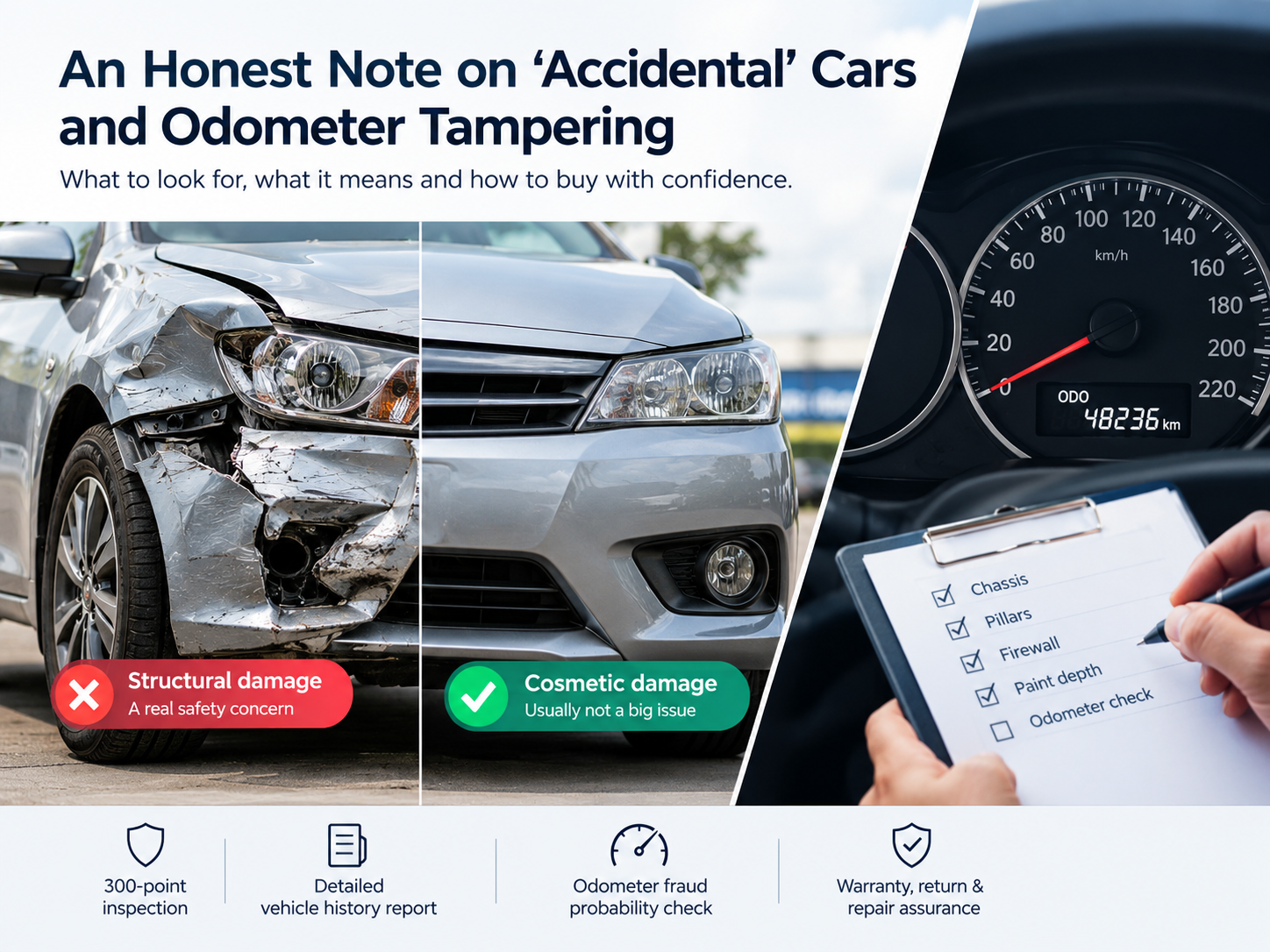
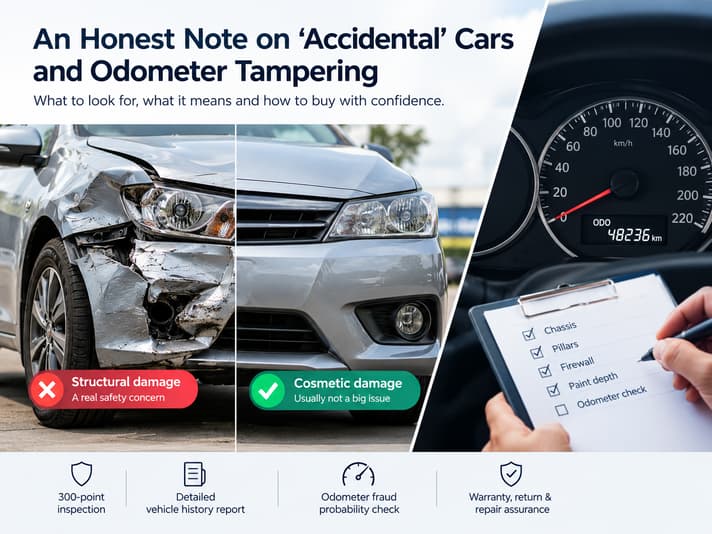
The important distinction is not whether a car has ever been involved in an accident, but what was damaged and how it was repaired. Minor cosmetic damage, such as a repainted bumper or replaced fender, generally does not affect the car’s structural integrity. The concern begins when an accident reaches the structural, load-bearing parts of the vehicle, such as the chassis, pillars or safety cage. Damage to these areas can affect how the car behaves in a future collision and how well it protects its occupants.
This is why the word ‘accidental’ can be misleading when you are buying a used car. A minor parking dent and a car that has suffered severe structural damage may both be described as accidents, but they carry very different implications for a buyer. So, when should an accident history actually make you reconsider a used car? The answer lies in understanding the extent of the damage, where it occurred and how well it was repaired.
| This is structural, genuinely 'accidental' | This is cosmetic, and on its own means nothing serious |
|---|---|
| Chassis rail bends, kinks, or repair welds | A repainted bumper or single door panel |
| Pillar (A/B/C pillar) damage or repair | Touch-up paint on a scratch or scuff |
| Firewall or engine-cradle deformation | A replaced headlamp or taillight housing |
| Airbag deployment history | Paintless dent repair |
| Frame misalignment visible at the panel gaps | A single panel resprayed for colour matching |
A car with a bent chassis rail and a car with a repainted door panel are not the same purchase, even if both technically had 'some damage' in their past. Treating them as equivalent is where most of this confusion comes from, and I think we've contributed to it by not explaining the difference clearly enough ourselves.
How We Actually Draw That Line
This isn't something we ask you to take on faith. Every used car we sell goes through a 300-point inspection, and part of that time is spent specifically checking the chassis, the pillars, and the firewall for bends, welds, or misalignment that shouldn't be there.
We also check every panel with a paint-depth gauge to see whether the paint is original or resprayed, and we look underneath for filler or putty that a visual glance would miss. When we find a repainted panel with no structural damage behind it, we don't hide that finding, and we don't treat it as a failure. It gets logged, plainly, in the report's imperfections section, and the car stays listed. You get to see exactly what we found, described in plain terms, before you decide anything.
If that structural check turns up damage to the chassis, the pillars, or the firewall, the car gets flagged as accidental right there, on the spot. If it doesn't, whatever cosmetic work we found, be it a repainted panel, a minor dent, or a replaced headlamp, gets listed transparently in the imperfections section of the inspection report for you to review before you buy.
A lot of buyers also ask me why we repaint cars even though they are not accidental. The answer is simply to restore cosmetic condition after the everyday wear that comes with driving on Indian roads. Repainting can make a used car presentable without affecting its mechanical or structural integrity.
At the same time, our refurbishment process separates cosmetic work from structural and mechanical checks. Repainted panels are transparently disclosed in the inspection report, so buyers can distinguish between a car that has simply undergone cosmetic refurbishment and one that has had significant accident damage. The aim is not to make a car appear ‘new’, but to restore its appearance while giving buyers visibility into its actual condition.
Odometer Tampering Is a Bigger Problem Than Any One of Us
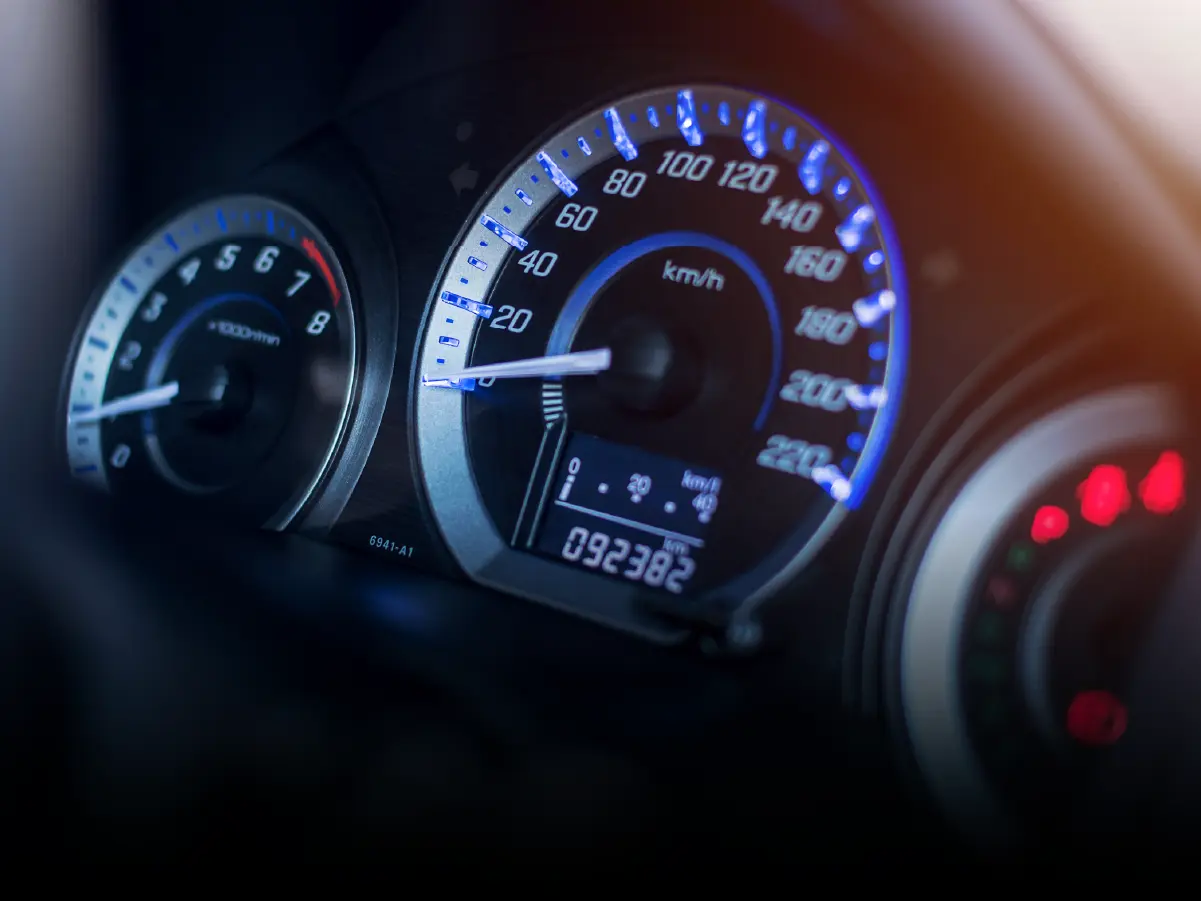
I want to be equally direct here. Rolling back an odometer is cheap and shockingly easy to do. Tools that reprogram a car's ECU to show a lower reading cost somewhere between eight and fifteen thousand rupees on the open market, and the job itself takes minutes.
What makes it worse is that Indian law hasn't caught up. The Motor Vehicles Act, 1988 doesn't mention the word 'odometer' at all. For anyone who discovers a rollback after buying a car, the only practical recourse is a complaint under the Consumer Protection Act (odometer fraud is treated as an unfair trade practice) or a cheating case under Section 318(4) of the BNS. Both of which apply after you've already paid.
According to our internal data, roughly one in five used cars in India carries a tampered odometer. That's why we built our own odometer fraud probability check, which anyone can run against a registration number before they buy. I won't oversell it: it gives you a probability, not a verdict. A high score means digging deeper into the service history. A low score doesn't mean you can skip your own checks.
The Part I Won't Sugarcoat: What a Vehicle History Report Can and Cannot Detect
We sell vehicle history reports, and I stand by them. They pull from service centre records, insurance claims, and official registration data, and they will catch a properly filed collision claim or a documented engine repair. That's genuinely useful.
But I'd be lying if I told you a VHR catches everything. It can't. If a repair was done at a local garage, paid in cash, with no insurance claim and nothing logged against the RC, there is no record for any report, ours or anyone else's, to find. If an odometer was rolled back to quietly match the last official service entry, the report can come back looking completely clean, because it's only checking consistency against records that exist. It isn't independently measuring the car in front of you.
That's the honest gap. No history report, from any company, can flag work that was never officially recorded anywhere. A physical inspection helps close part of that gap, because a paint-depth gauge doesn't care whether a repair was ever logged. That's exactly why we run the inspection and the history report as two separate checks rather than treating either one as sufficient by itself, and it's also why rare misses can still happen even when both checks are done properly.
Does Cars24 own all the cars it sells?
This is the part I think deserves more honesty than we've given it in the past. Cars24 runs two different models. Owned Stock is a car we've sourced, inspected, reconditioned, and sold ourselves, so we control the condition and the history end to end. Our marketplace also carries listings from Verified Direct Sellers, individuals who list their own cars for you to negotiate with directly.
If you want the condition, the paperwork, and the after-sale risk to sit with one accountable party, buy Owned Stock. If you'd rather have a wider inventory and more room to negotiate, and you're comfortable doing a bit more verification yourself, a Direct Seller listing can be the better fit. Neither choice makes a hidden problem impossible. It changes who is on the hook if one turns up.
What We Actually Stand Behind if Something Still Slips Through
Here's my commitment, not just our marketing line. Even with a 10-hour inspection and a dedicated odometer tool, a rare miss can still happen, especially where the damage or tampering was done off-book with nothing on paper. On every Owned Stock car, that risk sits with us, not with you:
- 30-Day Repair Assurance, covering repairs including several wear-and-tear parts for the first 30 days or 1,500 km, whichever comes first, at no extra cost.
- 30-Day Return Policy, letting you return the car within 30 days or 999 km if it doesn't meet your expectations.
- 12-month extended warranty, covering major components including the engine and transmission for a full year, bundled with every purchase.
- An optional Lifetime Warranty Plan, covering the car for up to 12 years or 1,50,000 km, with cashless repairs at our certified workshops.
The condition attached to all of this, and I'd rather state it plainly than bury it in fine print, is that we're covering issues that existed at the time of purchase. Normal wear and anything that happens to the car after delivery stays with the owner. But if we missed something that was already there, that's on us to fix, not on you to argue about. If you come across any genuine mistake, write to us at care@cars24.com, and we will make sure it is fixed, without unnecessary haggling.
Where This Leaves Us
I'd rather tell you what 'accidental' actually means and where our checks stop working than let a repainted bumper or an industry-wide odometer problem sit unexplained. Our inspection, our history reports, and our odometer tool exist to catch as much as they can. Our warranty and return policy exist for the part they can't. If you ever feel either one has let you down, I want to hear about it directly, not read about it after the fact.
Frequently Asked Questions
Expand all