Decoding the Maruti Suzuki Dzire Safety Rating: Crash Tests, Platform, and Features Explained
- 1The 4th-gen Dzire proudly boasts a 5-star Global and Bharat NCAP rating
- 2Maruti drastically reinforced the bodyshell, securing a stable integrity score
- 3Six standard airbags and stability control are now baseline features on the car
The compact sedan space in India has historically been shaped by a relentless pursuit of fuel efficiency, affordable maintenance, and exceptional rear-seat legroom. For well over a decade, the segment has been led by the Maruti Dzire, prioritising these utilitarian metrics over heavy-duty structural rigidity. However, modern consumer priorities have shifted dramatically. Today, judging the safety of the car is an absolutely non-negotiable and highly important decision category for buyers.
While looking at shiny dealership brochures and star ratings provides a solid starting point, there is significantly more to understand beneath the surface. Which exact variant was subjected to the crash tests? How effectively did the seats secure a child dummy during the brutal impact? And perhaps most importantly, how structurally sound is the foundational platform? In this comprehensive analysis, we promise you a complete breakdown of exactly why the newest generation of the Maruti Dzire earned its groundbreaking stars, and what that structural revolution means for your family’s safety on the daily commute.
Crash Test Performance Overview
The 4th-generation model has achieved something unprecedented for the brand, clearing both global and local testing protocols with flying colours. Here is a quick look at the data.
| Parameter | Global NCAP (2024 Protocol) | Bharat NCAP (2025 Protocol) |
| Overall Rating | 5 Stars | 5 Stars |
| Adult Protection | 31.24 / 34.00 | 29.46 / 32.00 |
| Child Protection | 39.20 / 49.00 | 41.57 / 49.00 |
| Bodyshell Integrity | Stable | Stable |
(Note: The previous 3rd-generation model scored a dismal 2 stars. The data above reflects the vastly superior, newly launched 4th-generation platform).
How is the Maruti Suzuki Dzire Tested?
When an independent body like Global NCAP or Bharat NCAP evaluates a car, the testing environment is a scientifically monitored laboratory designed to replicate the immense forces of severe real-world accidents.
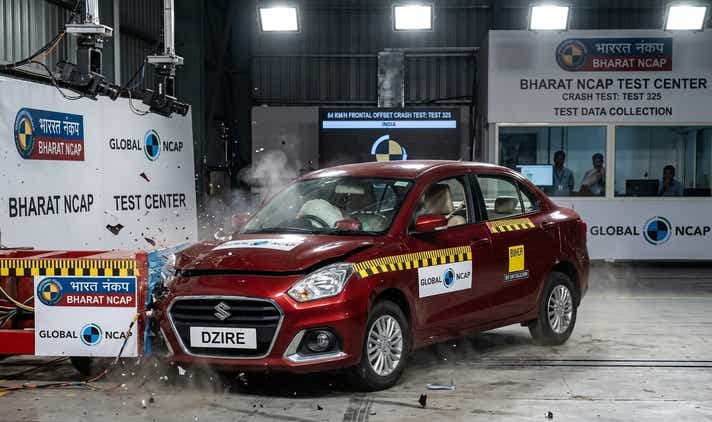
The most critical evaluation is the frontal offset deformable barrier crash test. The vehicle is pulled by cables at a constant speed of 64 km/h into a crushable aluminium block. Crucially, the impact is not distributed evenly across the front bumper. Instead, only 40% of the vehicle’s width on the driver’s side strikes the barrier. This simulates a high-speed, head-on collision where two drivers attempt to swerve at the last fraction of a second. This incredibly harsh scenario focuses massive kinetic energy onto a narrow section of the vehicle's frame, rigorously testing the Maruti Suzuki Dzire bodyshell integrity and the limits of its crumple zones.
Furthermore, the car undergoes side movable deformable barrier tests (where a barrier strikes the driver's door at 50 km/h) and strict side pole impact tests, which simulate a terrifying scenario of the car skidding sideways into a tree or telegraph pole.
Decoding the Dzire Crash Test Rating: What the Numbers Actually Mean
Adult Occupant Protection (AOP): In both Global and Bharat NCAP evaluations, the 4th-generation Dzire completely flipped the script for the manufacturer. Scoring an outstanding 31.24 out of 34 points in Global NCAP, the telemetry from the high-tech crash dummies revealed excellent engineering improvements. The driver's and passenger's heads, necks, and knees showed "good" protection. The only slight compromise was the driver's chest area, which showed "marginal" protection in the frontal offset test, meaning there is still a moderate transfer of load from the seatbelt pre-tensioners to the ribcage. However, in the side impact and side pole impact tests, the structural rigidity shone through, shielding critical organ areas exceptionally well.
Child Occupant Protection (COP): Protecting adults is one challenge, but safeguarding a child is an entirely different engineering hurdle due to their fragile neck structures and disproportionately heavy heads. The Dzire scored an impressive 39.20 out of 49 points in Global NCAP and a near-perfect 41.57 out of 49 in Bharat NCAP. The standard inclusion of i-Size ISOFIX mounts ensures that Child Restraint Systems (CRS) lock directly into the chassis rather than relying solely on seatbelts. During the violent 64 km/h frontal impact, the 18-month-old rearward-facing dummy received full protection, and the 3-year-old forward-facing dummy exhibited well-controlled head excursion, meaning the child’s head did not strike the back of the front seats.
Bodyshell Integrity: For years, this metric was a pain point for the brand, but the newest Maruti Suzuki Dzire build quality has been thoroughly verified. The bodyshell integrity is now officially rated as stable. This indicates that the passenger compartment maintained its shape post-crash and is structurally capable of withstanding even higher collision loadings without collapsing inward and crushing the occupants
The Foundation: Analysing the Maruti Suzuki Dzire's Platform
To genuinely decode the Maruti Suzuki Dzire safety rating, we must peer beneath the exterior paint and examine its skeletal structure. The car is underpinned by Suzuki’s fifth-generation HEARTECT platform.
Historically, the primary objective of the HEARTECT architecture was profound weight reduction to achieve segment-leading fuel efficiency and agile city handling. While earlier iterations (like the 3rd-gen Dzire or older Swifts) achieved this, they often sacrificed the heavy-duty structural stiffness required to deflect high-speed impact energy, resulting in cabin intrusion during severe crashes.
However, for this 4th-generation model, the engineering team went back to the drawing board. They vastly increased the utilisation of ultra-high-tensile steel in the critical load paths, specifically the A-pillars, B-pillars, and the central floorpan cross-members. This localised reinforcement strategy allowed them to massively increase torsional rigidity and crashworthiness without adding hundreds of kilograms of dead weight.
Intra-Brand Comparison: How does this compare to other cars in the Maruti Suzuki showroom? The difference is staggering. While the older 3rd-generation Swift on an earlier HEARTECT iteration scored a mere 1 star due to an unstable structure, the new Dzire demonstrates what the platform is truly capable of when the manufacturer prioritises occupant survival over pure cost-saving. It proves that a lightweight architecture can indeed be modified to deliver world-class safety.
Segment Comparison: When evaluating the structural design against its direct rivals, the Dzire has leapt from the back of the pack directly to the front. Competitors like the Honda Amaze also boast strong structural roots, but the Dzire's combination of high-tensile steel and a meticulously engineered crumple zone puts it on par with, or even slightly ahead of, heavier, more traditionally built platforms in this price bracket.
Which Variant Was Tested? (And Why It Matters)
Tested Model: Maruti Suzuki Dzire LXi (Base Variant)
It is standard protocol for independent crash testing agencies to evaluate the most basic, entry-level variant of a vehicle. This practice ensures that manufacturers cannot artificially inflate their scores by sending a top-spec model loaded with optional safety tech. The philosophy is simple: safety is a fundamental human right, not an optional extra reserved for those with larger budgets. Because the entry-level Dzire achieved 5 stars, buyers can be absolutely confident that they do not need to pay a premium for a top-spec trim just to ensure their family's survival in an accident.
Maruti Suzuki Dzire Base Model Safety Features: Standard vs. Advanced
To keep this critical information highly skimmable, here is a breakdown of the safety equipment protecting you inside the cabin.
| Category | Features Included |
| The Non-Negotiables (Standard Features) | 6 Airbags, Electronic Stability Control (ESC), ABS with EBD, ISOFIX Child Seat Mounts, 3-Point Seatbelts for all 5 seats, Seatbelt Reminders, Reverse Parking Sensors. |
| Advanced Features (Higher Variants) | 360-Degree Surround View Camera, Tyre Pressure Monitoring System (TPMS), Hill Hold Assist, LED Fog Lamps. |
Maruti Suzuki Dzire vs Competitor Safety Rating
How does the new Dzire hold its ground against the fierce competition in the sub-4-metre sedan category? Let us examine the data.
| Car Model | Global/Bharat NCAP Score | Bodyshell Rating | Standard Safety Features | Starting Price (Approx) |
| Maruti Suzuki Dzire (2024/25) | 5 Stars (GNCAP & BNCAP) | Stable | 6 Airbags, ABS, ESC | ₹ 6.79 Lakh |
| Tata Tigor | 4 Stars (GNCAP) | Unstable | 2 Airbags, ABS | ₹ 6.30 Lakh |
| Hyundai Aura | 2 Stars (GNCAP) | Unstable | 6 Airbags, ABS, ESC | ₹ 6.49 Lakh |
(Note: Competitor ratings are based on their latest available Global NCAP testing protocols. Some older protocols may have less stringent criteria for active safety).
The verdict in this specific segment is incredibly clear-cut. The Maruti Suzuki Dzire comfortably wins the safety battle. While the Tata Tigor previously held the crown for structural safety with a commendable 4-star score, its older testing protocol and unstable bodyshell rating hold it back. The Hyundai Aura offers excellent active safety equipment but falters fundamentally on structural crashworthiness. The Dzire is the only vehicle here marrying a stable, 5-star structure with a complete, modern suite of 6 standard airbags.
Final Verdict: Should You Trust the Maruti Suzuki Dzire with Your Family?
Is the Maruti Suzuki Dzire safe for highway driving and intercity family road trips? The answer is a resounding and emphatic yes.
For years, critics have rightly pointed out the safety compromises in affordable hatchbacks and compact sedans. However, the 4th-generation Dzire completely rewrites that narrative. By comprehensively reinforcing the vehicle's structural skeleton, securing a stable bodyshell integrity rating, and refusing to compromise on baseline safety features, the manufacturer has delivered a genuinely world-class product.
Whether you are navigating chaotic city junctions or cruising at high speeds on an expressway, the standard inclusion of six airbags and Electronic Stability Control provides an immense layer of active and passive reassurance. It is a milestone vehicle that proves exceptional fuel economy and top-tier crashworthiness can comfortably coexist in an affordable package.
If you are researching comprehensive safety profiles for your next purchase, you might also want to look into the safety of larger family vehicles by checking out the Maruti Suzuki Ertiga Safety Rating. Furthermore, if you wish to see how the Dzire ranks among the very best, explore our complete list of the safest cars in India according to BNCAP.
Frequently Asked Questions
Expand all