Decoding the Maruti Suzuki Ertiga Safety Rating: Crash Tests, Platform, and Features Explained
- 1A 2024 Global NCAP test gave the dual-airbag Ertiga a 1-star adult safety rating
- 2The 2025 Indian Ertiga models have been updated to feature six standard airbags
- 3The MPV's stretched HEARTECT platform earned an unstable bodyshell integrity score
The multi-purpose vehicle (MPV) segment is the ultimate backbone of large Indian families, prioritising flexibility, fuel efficiency, and cavernous space above all else. The Maruti Eryiga has been the undisputed king of this segment in the affordable category. Today, however, judging the safety of the car is an incredibly important decision category. Moving seven people means moving what matters most, and buyers are rightfully demanding robust crash protection.
While headline numbers and star ratings give a good starting point, there is a vast amount of critical engineering to understand beyond that. Which specific variant was tested against the barrier? How well did it actually score for the child in the rear seats? And crucially, how stable is the underlying platform when absorbing severe impacts? In this detailed review, we promise a complete breakdown of why the Maruti Ertiga earned its specific scores and what its structural reality means for your family’s daily commute.
Crash Test Performance Overview
To give you the most transparent picture, here is a breakdown comparing the older 2019 test with the highly stringent 2024 protocol evaluation.
| Parameter | 2019 Global NCAP Protocol | 2024 Global NCAP Protocol (Africa Spec)* |
| Overall Rating | 3 Stars | 1 Star |
| Adult Protection | 9.25 / 17.00 | 23.63 / 34.00 |
| Child Protection | 25.16 / 49.00 | 19.40 / 49.00 |
| Bodyshell Integrity | Borderline Unstable | Unstable |
(Note: The Maruti Suzuki Ertiga Bharat NCAP crash test is yet to be conducted. Furthermore, the 2024 test evaluated a dual-airbag version, whereas the 2025/2026 Indian models now feature a standard six-airbag setup).
How is the Maruti Suzuki Ertiga Tested?
The process is a highly clinical, violently destructive laboratory test engineered to replicate the severe kinetic forces experienced during a real-world collision.
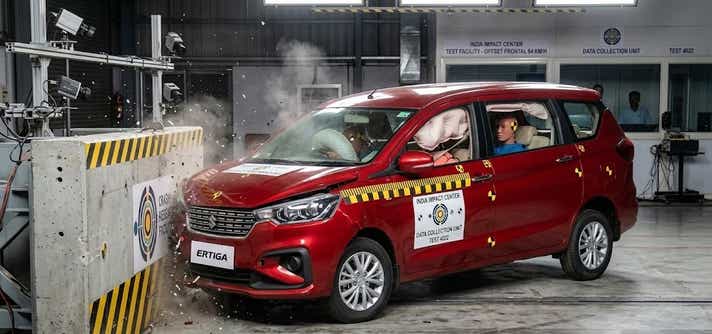
The primary test is the frontal offset deformable barrier crash. The MPV is propelled via cables at a relentless 64 km/h directly into a crushable aluminium honeycomb block. The critical element here is the word offset. Instead of the entire front bumper taking the impact, only 40% of the vehicle’s width (specifically on the driver's side) connects with the barrier. This simulates a high-speed, head-on crash where two drivers notice each other too late and attempt to swerve. This channels a massive amount of destructive kinetic energy into a very narrow section of the MPV's frame, rigorously challenging the crumple zones and the Maruti Suzuki Ertiga bodyshell integrity.
Decoding the Ertiga Crash Test Rating: What the Numbers Actually Mean
Adult Occupant Protection (AOP): In the 2024 Global NCAP evaluation (Safer Cars for Africa programme), the Ertiga secured a rather disappointing 23.63 out of 34 points, culminating in a 1-star adult safety rating. When engineers analysed the telemetry from the front-seat crash dummies, the data was mixed. While the head and neck of the driver received "good" protection, the chest area recorded "marginal" protection. This means the seatbelt load limiters transferred significant force to the ribcage upon impact. More concerning was the dashboard structure; it was deemed hazardous to the driver's and passengers' knees, which could lead to severe lower limb injuries.
Child Occupant Protection (COP): Safeguarding a toddler is vastly more complex than securing a full-grown adult. Children possess disproportionately heavy heads and fragile neck muscles that cannot withstand sudden whiplash. In the child safety evaluation, the Ertiga scored 19.40 out of 49 points (2 stars). The vehicle lost crucial points primarily due to a poor Child Restraint System (CRS) installation score. During the 64 km/h frontal impact, the forward-facing 3-year-old dummy exhibited limited protection for the neck and chest. While the 18-month-old rearward-facing dummy received better overall protection, the overall score remained heavily compromised.
Bodyshell Integrity: The most glaring vulnerability exposed during the crash tests was the vehicle's core architecture. The bodyshell integrity of the tested Ertiga was rated as unstable. In layman's terms, the passenger cabin had reached its absolute structural failure limit at 64 km/h. It was formally noted that the cabin would be incapable of withstanding any further loadings, meaning a crash at 70 km/h or 80 km/h would likely result in catastrophic cabin collapse and severe passenger intrusion.
The Foundation: Analysing the Maruti Suzuki Ertiga's Platform
To truly comprehend the Maruti Suzuki Ertiga Global NCAP rating, we must look past the family-friendly exterior and dissect the structural skeleton underneath. The Ertiga is built upon Suzuki's high-volume HEARTECT platform.
The primary engineering philosophy behind the HEARTECT architecture is profound weight reduction to guarantee segment-leading fuel efficiency and agile, car-like handling. To turn a hatchback platform into an MPV, Maruti stretched the wheelbase to accommodate a third row of seats. However, extending a lightweight platform inherently introduces vulnerabilities. When a fully loaded seven-seater MPV travelling at 64 km/h strikes a solid object, the sheer mass and kinetic energy are immense. The thinner gauge steel utilised in the Ertiga’s construction struggles to absorb and deflect this energy effectively, leading to the unstable bodyshell rating mentioned above. The Maruti Suzuki Ertiga build quality simply lacks the heavy-duty torsional rigidity found in dedicated, heavier ladder-frame utility vehicles.
Intra-Brand Comparison: How does this compare within the same showroom? The premium Maruti Suzuki XL6 is essentially identical underneath; it shares the same HEARTECT underpinnings, meaning its structural crashworthiness is fundamentally the same as the Ertiga's. However, if we look at the newly launched 4th-generation Maruti Dzire, which recently scored a perfect 5 stars, we can see that the HEARTECT platform can be safe. Maruti Suzuki achieved this on the Dzire by heavily reinforcing the pillars with ultra-high-tensile steel. Until the Ertiga receives a similar comprehensive structural overhaul, its foundational crash resilience remains a step behind its modern sedan siblings.
Segment Comparison: When stacked against direct rivals in the affordable three-row segment, the structural disparity becomes apparent. While the Renault Triber also utilises a cost-effective platform, it managed to score 4 stars in older GNCAP testing protocols by maintaining a slightly more rigid passenger cell. The Ertiga's structural weakness under the newer, stricter testing protocols highlights a gap in passive safety within its specific segment.
Which Variant Was Tested? (And Why It Matters)
Tested Model: Maruti Suzuki Ertiga Base Variant (2024 Africa Spec, Dual Airbags).
Independent testing agencies purposefully select the entry-level variant for crash evaluations. This ensures that manufacturers cannot artificially boost their scores by sending heavily optioned models.
It is vital to note a massive recent update. The 1-star rating from 2024 was awarded to a dual-airbag model. However, for the 2025/2026 model year, Maruti Suzuki has thoroughly updated the Indian-spec Ertiga. This means the Maruti Suzuki Ertiga standard airbags have been increased to six across every single variant, drastically improving the baseline safety for budget-conscious families.
Maruti Suzuki Ertiga Base Model Safety Features: Standard vs. Advanced
To keep this highly skimmable, here is what protects you inside the updated MPV cabin.
| Category | Features Included |
| The Non-Negotiables (Standard Features) | 6 Airbags (Front, Side, Curtain), Electronic Stability Control (ESC), ABS with EBD, ISOFIX Child Seat Mounts, Hill Hold Assist, Rear Parking Sensors. |
| Advanced Features (Higher Variants) | SmartPlay Pro Touchscreen with Rear Parking Camera, Front Halogen Fog Lamps. |
Maruti Suzuki Ertiga vs Kia Carens Safety Rating
How does the Ertiga hold its ground against a fierce modern competitor like the Carens? Let us examine the data.
| Car Model | Global/Bharat NCAP Score | Bodyshell Rating | Standard Safety Features | Starting Price (Approx) |
| Maruti Suzuki Ertiga | 1 Star (GNCAP 2024)* | Unstable | 6 Airbags, ABS, ESC | ₹ 9.11 Lakh |
| Kia Carens | 3 Stars (GNCAP 2024) | Unstable | 6 Airbags, ABS, ESC | ₹ 10.45 Lakh |
| Renault Triber | 4 Stars (GNCAP 2021) | Unstable | 2 Airbags, ABS | ₹ 6.00 Lakh |
(Note: The Ertiga and Carens were both evaluated under the stringent 2022-2024 GNCAP protocols, making them directly comparable, while the Triber's score reflects an older, less demanding testing protocol).
The verdict in this specific segment battle is straightforward. While both MPVs suffer from an unstable bodyshell rating, the Kia Carens wins the overall safety battle due to significantly better load management within the cabin, earning it a solid 3-star rating compared to the Ertiga's 1-star performance. Both, however, excel in offering 6 standard airbags.
Final Verdict: Should You Trust the Maruti Suzuki Ertiga with Your Family?
So, is the Maruti Suzuki Ertiga safe for highway driving and intercity family road trips?
The answer requires context. Structurally, the Ertiga is a city-biased MPV. Its 1-star adult safety rating and unstable bodyshell mean that its passive crashworthiness at high speeds is demonstrably compromised. If your primary use case involves heavily loaded, high-speed expressway driving, defensive and highly cautious driving is absolutely mandatory, as the fundamental structure cannot withstand severe kinetic impacts.
However, we must also acknowledge the massive leap forward in active safety. The 2025/2026 models now come packed with six airbags, ABS, and ESC right from the base variant. These active systems drastically reduce the likelihood of getting into a severe accident in the first place, making the modern Ertiga vastly safer than the older dual-airbag iterations.
If you are a highway-heavy driver and wish to explore stronger alternatives within this segment, you can read our detailed breakdown of the Kia Carens Safety Rating. Alternatively, if you want a broader view of the most structurally robust vehicles on the market, check out our comprehensive guide to the safest cars in India according to GNCAP.
Frequently Asked Questions
Expand all