Decoding the Tata Punch Safety Rating: Crash Tests, Platform, and Features Explained
- 1The 2026 Tata Punch ICE facelift scored a perfect 5 stars in the Bharat NCAP test
- 2Tata's robust ALFA platform guarantees a highly stable bodyshell for the SUV
- 3Six airbags and stability control are now strictly standard across all variants
The micro-SUV segment has fundamentally redefined the Indian automotive landscape, successfully blending the commanding driving position of an SUV with the agile footprint of a hatchback. At the very forefront of this urban revolution is the Tata Punch. However, as families increasingly rely on these compact vehicles for both daily city commutes and longer highway excursions, judging the safety of the car has become an incredibly important decision category.
While shiny star ratings give a good starting point, there is significantly more to understand. Which exact variant was crashed? How effectively does the rear seat shield a toddler? And most critically, how stable is the platform when subjected to immense kinetic forces? In this comprehensive breakdown, we promise you a complete, jargon-free explanation of why the Tata Punch earned its class-leading stars, and what that ultimately means for your family’s protection on unpredictable roads.
Crash Test Performance Overview
To give you the most accurate picture of its evolution, here is how the Punch performed historically and in its most recent evaluation.
| Parameter | Global NCAP (2021 Protocol) | Bharat NCAP (2026 Protocol) |
| Overall Rating | 5 Stars | 5 Stars |
| Adult Protection | 16.45 / 17.00 | 30.58 / 32.00 |
| Child Protection | 40.89 / 49.00 | 45.00 / 49.00 |
| Bodyshell Integrity | Stable | Stable |
(Note: The 2021 Global NCAP test evaluated the older dual-airbag pre-facelift model, whereas the rigorous 2026 Bharat NCAP evaluation tested the new facelift equipped with standard six airbags).
How is the Tata Punch Tested?
The testing environment orchestrated by agencies like Bharat NCAP, scientifically measured laboratory designed to replicate the devastating realities of high-speed accidents.
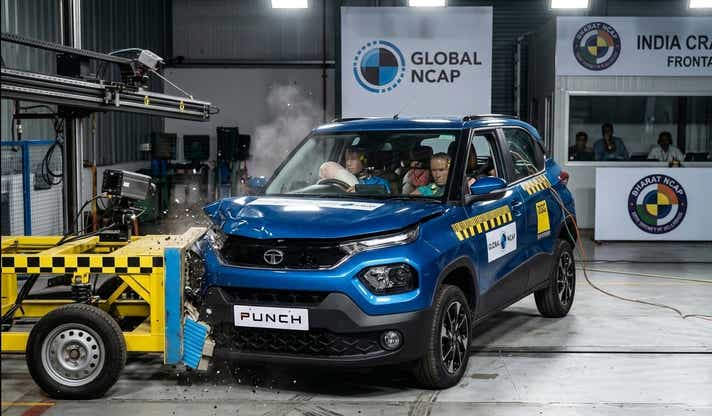
The core of this evaluation is the frontal offset deformable barrier crash test. In this scenario, the SUV is propelled at a relentless 64 km/h directly into a crushable aluminium honeycomb block. The critical element here is "offset", only 40% of the vehicle’s frontal width on the driver’s side impacts the solid barrier. This carefully simulates a terrifying real-world scenario where two drivers attempt an evasive manoeuvre at the very last fraction of a second. This brutal impact focuses massive destructive energy onto a narrow section of the car’s structural frame, fiercely testing the crumple zones and the Tata Punch bodyshell integrity. Furthermore, recent protocols include strict side movable barrier tests (at 50 km/h) and severe side pole impact tests to evaluate lateral crashworthiness.
Decoding the Punch Crash Test Rating: What the Numbers Actually Mean
Adult Occupant Protection (AOP): In the latest 2026 Bharat NCAP crash test, the Tata Punch ICE facelift recorded an exceptional adult protection score of 30.58 out of 32 points. The telemetry gathered from the sophisticated crash dummies revealed that the impact loads were beautifully managed by the chassis. The heads and necks of both front occupants received "good" protection. Crucially, the driver's chest, which often bears the brunt of the seatbelt load limiter's extreme force, showed adequate protection. The footwell area remained completely uncompromised, successfully preventing severe lower leg and knee injuries. In the demanding side pole impact test, which simulates the car violently sliding sideways into a tree, the newly added curtain airbags deployed flawlessly, ensuring superior head and pelvis shielding.
Child Occupant Protection (COP): Securing an adult is an entirely different engineering challenge compared to protecting a young child. Children possess a disproportionately heavy head and a highly fragile neck. Here, the SUV scored a phenomenal 45 out of 49 points. The performance of the ISOFIX mounts and the specific Child Restraint Systems (CRS) was exemplary. During the dynamic tests, the 18-month-old and 3-year-old child dummies, both seated in rearward-facing configurations, were firmly locked in place. The structural rigidity successfully prevented excessive forward excursion, meaning the child dummies did not violently collide with the backs of the front seats.
Bodyshell Integrity: This is arguably the most vital metric on any crash report. The bodyshell of the Punch was officially rated as stable. This signifies that the passenger cabin maintained its shape flawlessly post-impact. It did not buckle, bend, or collapse inward, and the testing engineers formally noted it was structurally capable of withstanding even higher collision loadings.
The Foundation: Analysing the Tata Punch's Platform
To genuinely understand the Tata Punch Global NCAP rating and its subsequent Bharat NCAP success, we must examine the architectural foundation beneath the exterior styling. The Punch is built upon Tata’s heavily celebrated ALFA-ARC (Agile Light Flexible Advanced Architecture) platform.
Unlike modified older platforms that merely stretch existing metal to cut costs, the ALFA architecture was engineered from the ground up with strict global safety standards acting as the primary blueprint. The design heavily incorporates ultra-high-tensile steel in the critical load paths, specifically the A-pillars, the B-pillars, and the reinforced central floorpan. This masterful engineering is the undeniable secret behind the formidable Tata Punch build quality.
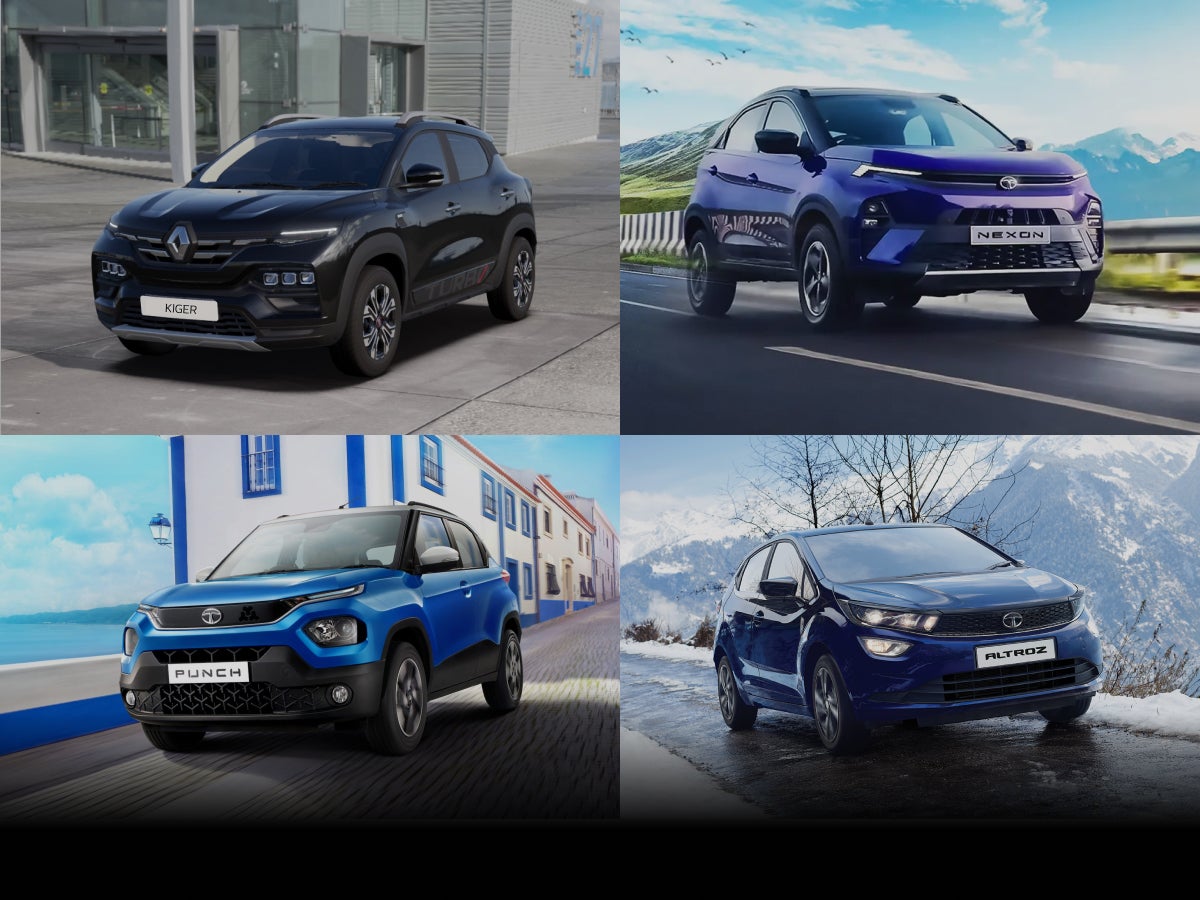
Intra-Brand Comparison: How does this ALFA platform compare to other vehicles sitting in the exact same Tata showroom? The results are highly consistent. The premium Tata Altroz hatchback is built on the exact same ALFA architecture and also boasts a stellar 5-star safety rating. This beautifully proves that Tata Motors has effectively democratised structural safety; you get the exact same foundational crashworthiness in their entry-level micro-SUV as you do in their more expensive, premium vehicles.
Segment Comparison: When we compare this structural design to direct rivals in the fiercely contested micro-SUV space, the superiority of the ALFA platform shines exceptionally bright. Many competitors utilise older, highly cost-focused platforms that notoriously struggle to manage concentrated offset impact energy, frequently resulting in borderline or completely unstable bodyshell ratings. The Punch’s platform offers a level of torsional rigidity and structural defiance that is practically unmatched in this specific price bracket.
Which Variant Was Tested? (And Why It Matters)
Tested Model: Tata Punch Pure+ and Accomplished (Base and Mid-level CNG/ICE Variants)
Independent testing agencies intentionally and relentlessly evaluate the lower-tier variants of a vehicle. The underlying philosophy is simple: fundamental safety must never be treated as a luxury feature reserved only for top-spec buyers. Because the newly tested foundational variants achieved a perfect 5 stars, consumers can confidently purchase the entry-level models knowing their family’s survival is practically guaranteed.
Tata Punch Base Model Safety Features: Standard vs. Advanced Features
To keep this critical safety information highly skimmable, here is a clear breakdown of the protective equipment inside the cabin.
| Category | Features Included |
| The Non-Negotiables (Standard Features) | 6 Airbags, Electronic Stability Control (ESC), ABS with EBD, ISOFIX Child Seat Mounts, Brake Sway Control, Rear Parking Sensors. |
| Advanced Features (Higher Variants) | 360-Degree Surround View Camera, Blind View Monitor, Tyre Pressure Monitoring System (TPMS), Auto Headlamps. |
Tata Punch vs Competitor Safety Rating
How does the robust Punch fare against the fierce competition in the sub-compact urban jungle? Let us review the hard data.
| Car Model | Global/Bharat NCAP Score | Bodyshell Rating | Standard Safety Features | Starting Price (Approx) |
| Tata Punch (2026) | 5 Stars (BNCAP) | Stable | 6 Airbags, ABS, ESC | ₹ 6.13 Lakh |
| Hyundai Exter | Not Yet Tested* | Unknown | 6 Airbags, ABS, ESC | ₹ 6.13 Lakh |
| Maruti Suzuki Swift | 3 Stars (Euro NCAP)** | Stable | 6 Airbags, ABS, ESC | ₹ 6.49 Lakh |
(Note: While the Hyundai Exter offers an excellent standard active safety suite, it currently lacks an official Bharat NCAP structural crash test validation. *The new Swift has been evaluated internationally but awaits official Indian testing under BNCAP).
Providing a definitive verdict on who wins the ultimate safety battle in this segment is incredibly straightforward. The Tata Punch completely dominates. While respectable competitors like the Hyundai Exter perfectly match the Punch in terms of offering six standard airbags and electronic stability control on a budget, the Punch is the absolute only vehicle here that marries those modern active safety features with a proven, heavily tested, 5-star stable bodyshell architecture.
Final Verdict: Should You Trust the Tata Punch with Your Family?
Is the Tata Punch safe for highway driving and cross-country family road trips? Without a shadow of a doubt, yes. Tata Motors has fundamentally altered the expectations of the Indian car buyer by decisively proving that a compact, affordable vehicle absolutely does not need to compromise on heavy-duty structural integrity.
With the introduction of the latest 2026 facelift, the brand has brilliantly closed the engineering loop. They took an already stellar 5-star passive safety structure, initially verified by Global NCAP back in 2021, and elevated it by standardising modern active safety features like six airbags and Electronic Stability Control. Consequently, it aced the rigorous new Bharat NCAP protocols with flying colours. Whether you are navigating unpredictable, chaotic city traffic or cruising at sustained expressway speeds, the Punch offers a formidable safety shield that punches well above its humble weight class.
If you are expanding your research and want to see how other popular vehicles in similar price brackets perform structurally, we highly recommend reading our detailed guide on the Maruti Swift Safety Rating. Furthermore, if you wish to explore a broader list of heavily fortified vehicles across all segments, check out the safest cars in India according to BNCAP.
Frequently Asked Questions
Expand all