Decoding the Maruti Suzuki Swift Safety Rating: Crash Tests, Platform, and Features Explained
- 1The older 3rd-gen Maruti Swift scored a 1-star Global NCAP rating
- 2The latest 4th-gen model achieved 3 stars in Euro NCAP crash tests
- 3Standard safety tech now includes six airbags and stability control
The hatchback segment has long been the undisputed backbone of the Indian automotive market, with the Maruti Suzuki Swift reigning as its charismatic leader for nearly two decades. It is a car that wrote the rulebook on sporty, accessible driving. However, as modern Indian car buyers evolve, simply offering a peppy engine and exceptional fuel economy is no longer enough. Judging the safety of the car is now an incredibly important decision category for families navigating our increasingly fast-paced and unpredictable roads.
While the headline-grabbing star ratings give a good starting point, there is a lot to understand beyond that initial number. Which specific variant was sent to the crash barrier? How well did it actually score for child protection in the rear seats? And crucially, how stable is the underlying platform when pushed to its absolute structural limit?
In this comprehensive guide, we promise you a complete breakdown of why the Maruti Swift earned its specific stars and what those results mean for your family’s daily commute. We will look at both the historical performance of the outgoing model and the structural promises of the newest generation.
Crash Test Performance Overview
To give you a clear picture, here is how the previous 3rd-generation model performed in India, alongside the international crash test results for the newly launched 4th-generation model.
| Parameter | 3rd-Gen Model (Global NCAP 2022) | 4th-Gen Model (Euro NCAP 2024)* |
| Overall Rating | 1 Star | 3 Stars |
| Adult Protection | 19.19 / 34.00 | 26.90 / 40.00 |
| Child Protection | 16.68 / 49.00 | 32.10 / 49.00 |
| Bodyshell Integrity | Unstable | Stable |
(Note: The latest 4th-generation Swift is yet to undergo a dedicated Maruti Suzuki Swift Bharat NCAP crash test, but its Euro NCAP and Japan NCAP evaluations demonstrate notable structural upgrades over the older model).
How is the Maruti Suzuki Swift Tested?
The testing environment is a brutal, scientifically calibrated laboratory designed to mimic worst-case real-world scenarios.
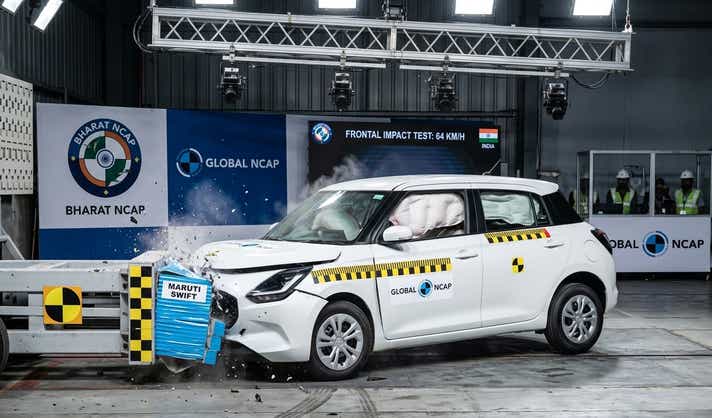
The primary evaluation is the frontal offset crash test. The vehicle is propelled at a steady speed of 64 km/h into a crushable aluminium barrier. However, instead of the whole front of the car taking the impact, only 40% of the car's width (on the driver's side) strikes the barrier. This represents a typical head-on collision where two drivers try to swerve at the last second. It places an immense amount of concentrated energy on a very small section of the car's frame, severely testing the Maruti Suzuki Swift bodyshell integrity.
Decoding the Swift Crash Test Rating
Understanding the raw scores requires looking at the damage inflicted on the test devices (crash test dummies).
Adult Occupant Protection (AOP): In the widely publicised 2022 Global NCAP test of the 3rd-generation Swift, the adult occupant score was a major point of concern, earning only 19.19 out of 34 points. The telemetry from the dummies indicated that while head and neck protection was rated as "good," the driver’s chest received "weak" protection. This means that in a severe impact, the steering column and seatbelt load limiters transferred too much force to the driver's ribcage. The footwell area was also compromised, leading to marginal knee protection. Conversely, the newer 4th-generation model tested by Euro NCAP showcased improved load dispersal, offering better shielding for critical organ areas.
Child Occupant Protection (COP): Protecting a child in a crash is vastly different from protecting an adult. Children have disproportionately larger heads and weaker neck muscles. The older Swift scored an underwhelming 16.68 out of 49 points here. The lack of standard safety features like three-point seatbelts for all passengers in older models severely hampered its score. Furthermore, while the car had ISOFIX mounts, the specific Child Restraint Systems (CRS) tested showed excessive forward excursion (movement) of the child dummies during the impact, risking head contact with the front seats.
Bodyshell Integrity: Perhaps the most critical phrase in any safety report is "bodyshell integrity." In the 2022 tests, the older Swift's bodyshell was rated as unstable. This means that the structural cage surrounding the passengers had reached its failure point during the 64 km/h crash and was deemed incapable of withstanding any further structural loadings. If the crash had occurred at 70 km/h, the cabin would have likely collapsed inward. Fortunately, early evaluations of the 2024 platform suggest a shift towards a "stable" rating, thanks to the increased use of high-tensile steel.
The Foundation: Analysing the Maruti Suzuki Swift's Platform
To truly understand the Maruti Suzuki Swift safety rating, we have to look beneath the sheet metal at the vehicle's skeleton. The Swift is built on Suzuki's proprietary HEARTECT platform.
When Maruti Suzuki introduced this architecture, the primary goal was weight reduction. By using continuous, smooth curving frames, they eliminated the need for heavy reinforcement joints. This made the car incredibly light, incredibly agile, and astoundingly fuel-efficient. However, the trade-off in the earlier generations was a lack of robust structural stiffness. The thinner gauge steel used in the Indian-spec models struggled to absorb and dissipate the massive kinetic energy of a high-speed collision, leading to cabin intrusion.
Intra-Brand Comparison: Does the HEARTECT platform inherently mean a car is unsafe? Surprisingly, no. The best evidence of this is the newly launched Maruti Suzuki Dzire. Built on a heavily modified version of the exact same platform, the new Dzire recently shocked the industry by scoring a perfect 5-star Global NCAP rating. Maruti Suzuki achieved this by heavily fortifying the Dzire's frame with high-strength steel and optimising the crumple zones. This proves that when the manufacturer prioritises structural rigidity over pure cost-efficiency, the underlying architecture is more than capable of protecting your family.
Segment Comparison: When we look at the Maruti Suzuki Swift build quality against its direct rivals, the contrast is sharp. Competitors like the Tata Tiago are built on slightly heavier, more traditional platforms. While the Tiago might not offer the same razor-sharp fuel efficiency or nimble handling as the Swift, its heavier steel construction earned it a solid 4-star safety rating, giving it a distinct advantage in structural solidity.
Which Variant Was Tested? (And Why It Matters)
Tested Model: Maruti Suzuki Swift (Base Variant)
Testing agencies almost exclusively crash the absolute entry-level, base variant of a car. Why? Because safety should not be a luxury reserved for those who can afford the top-spec trims. If the cheapest version of a car can protect a family, the higher variants will only improve upon that baseline.
With the launch of the 4th-generation Swift, Maruti Suzuki has taken a massive leap forward in democratising safety. Buyers no longer have to pay a premium just to get basic life-saving equipment.
Maruti Suzuki Swift Safety Features: Standard vs. Advanced Features
To keep things highly skimmable, here is a breakdown of what you get protecting you inside the cabin.
| Category | Features Included |
| The Non-Negotiables (Standard on Base Model) | 6 Airbags (Front, Side, Curtain), ABS with EBD, Electronic Stability Control (ESC), ISOFIX Child Seat Mounts, Reverse Parking Sensors, Seatbelt Reminders for all seats. |
| Advanced Features (Higher Variants) | Rear Parking Camera, Wider Tyres for better grip, LED Fog Lamps. |
Maruti Suzuki Swift Safety Rating vs. Competitors
How does the Swift stack up against the other popular hatchbacks vying for your hard-earned money? Let's take a look.
| Car Model | Global NCAP Score (Adult) | Bodyshell Rating | Standard Safety Features | Starting Price (Approx) |
| Maruti Suzuki Swift | 1 Star (3rd Gen) | Unstable | 6 Airbags, ABS, ESC | ₹ 6.49 Lakh |
| Tata Tiago | 4 Stars | Unstable | 2 Airbags, ABS | ₹ 5.65 Lakh |
| Hyundai Grand i10 Nios | 2 Stars | Unstable | 6 Airbags, ABS, ESC | ₹ 5.92 Lakh |
(Note: Comparisons reflect the older GNCAP testing protocols for the 3rd-gen Swift and its contemporaries. The 4th-gen Swift awaits local testing).
If we are strictly looking at the outgoing generation's crash test data, the Tata Tiago wins the raw structural safety battle in this segment, offering superior occupant protection despite having fewer standard airbags. However, the newest Swift's inclusion of six standard airbags and standard ESC makes it a much stronger contender in active collision avoidance.
Final Verdict: Should You Trust the Maruti Suzuki Swift with Your Family?
So, is Maruti Suzuki Swift safe for highway driving and family duties? The answer is nuanced. If you are looking at the older 3rd-generation model in the used car market, its 1-star rating and unstable bodyshell mean you must drive defensively, as its passive safety limitations are well-documented.
However, the brand-new 4th-generation Swift paints a much more reassuring picture. By standardising six airbags, three-point seatbelts, and Electronic Stability Control across every single variant, the manufacturer has significantly elevated its baseline safety. While we eagerly await the official Maruti Suzuki Swift Bharat NCAP crash test results to confirm its structural improvements on Indian soil, the international 3-star Euro NCAP rating indicates a positive step forward.
If you love the Swift's driving dynamics but are uncompromising on having a proven 5-star safety rating, you might want to look within the same showroom. For a deeper dive into how Maruti's platform can achieve top-tier safety, check out our guide on the Maruti Suzuki Dzire Safety Rating. Furthermore, if you want to explore all the top-rated options currently available, browse our curated list of the safest cars in India according to GNCAP.
Frequently Asked Questions
Expand all