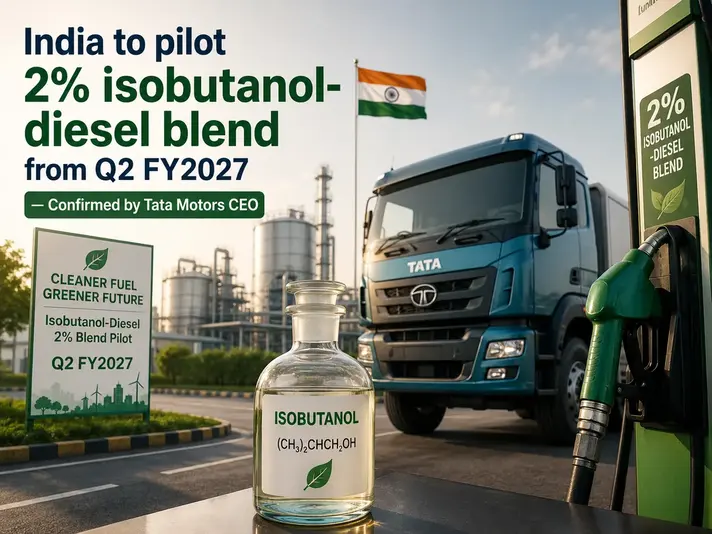
India to pilot 2% isobutanol-diesel blend from Q2 FY2027 — Confirmed by Tata Motors CEO
- 1Pilot trial for 2% isobutanol-diesel blending is expected to begin in Q2 FY2027
- 2Government has formed a high-level taskforce for the programme
- 3Isobutanol is chemically more compatible with diesel than ethanol
India has been working to reduce its dependence on imported crude oil by focusing on two major solutions: increasing the use of electric vehicles and blending ethanol with petrol. The ethanol blending programme has made steady progress over the past few years, with the government meeting several of its targets ahead of schedule.
The next big challenge is diesel. Since diesel powers a large share of commercial vehicles, buses, trucks, farm equipment and industrial machinery, reducing diesel consumption is even more important. To address this, the government is now planning to introduce isobutanol as a blending fuel for diesel. A pilot programme with a 2% isobutanol-diesel blend is expected to begin in Q2 FY2027 (July to September 2026).
India to pilot 2% isobutanol-diesel blend — Girish Wagh confirms the timeline

The Q2 FY2027 timeline for the trials was confirmed by Girish Wagh, MD and CEO of Tata Motors, making him one of the most senior industry voices to publicly acknowledge the programme's scope and schedule. Wagh also confirmed that Tata Motors will participate directly in the trial, sourcing isobutanol-blended diesel from Hindustan Petroleum for its testing activities.
The government has constituted a high-level taskforce to oversee the pilot project. The taskforce brings together multiple stakeholders: original equipment manufacturers (OEMs), testing and certification agencies, and oil marketing companies. This multi-stakeholder approach is designed to ensure that results from the trial reflect real-world operating conditions across different vehicle categories rather than being limited to controlled lab settings.
What Bharat Petroleum and ARAI are doing
This is not the start of isobutanol-diesel research in India. Bharat Petroleum has been running its own isobutanol-diesel tests for approximately two years, including trials with stationary Cummins engines that ran for a three-month period. With the formal trial now approaching, Bharat Petroleum will scale up its testing programme to cover around 33 different types of vehicles in use across the country, providing a broader and more representative dataset.
The Automotive Research Association of India (ARAI) will run a separate but complementary 10-month technical assessment programme in association with Praj Industries, a leading provider of biofuel technology solutions. ARAI's core objective is to determine whether isobutanol can work as a seamless substitute in diesel blends under real-world conditions. The Council of Scientific and Industrial Research has also been involved in earlier isobutanol research in India.
Why isobutanol and not ethanol for diesel?
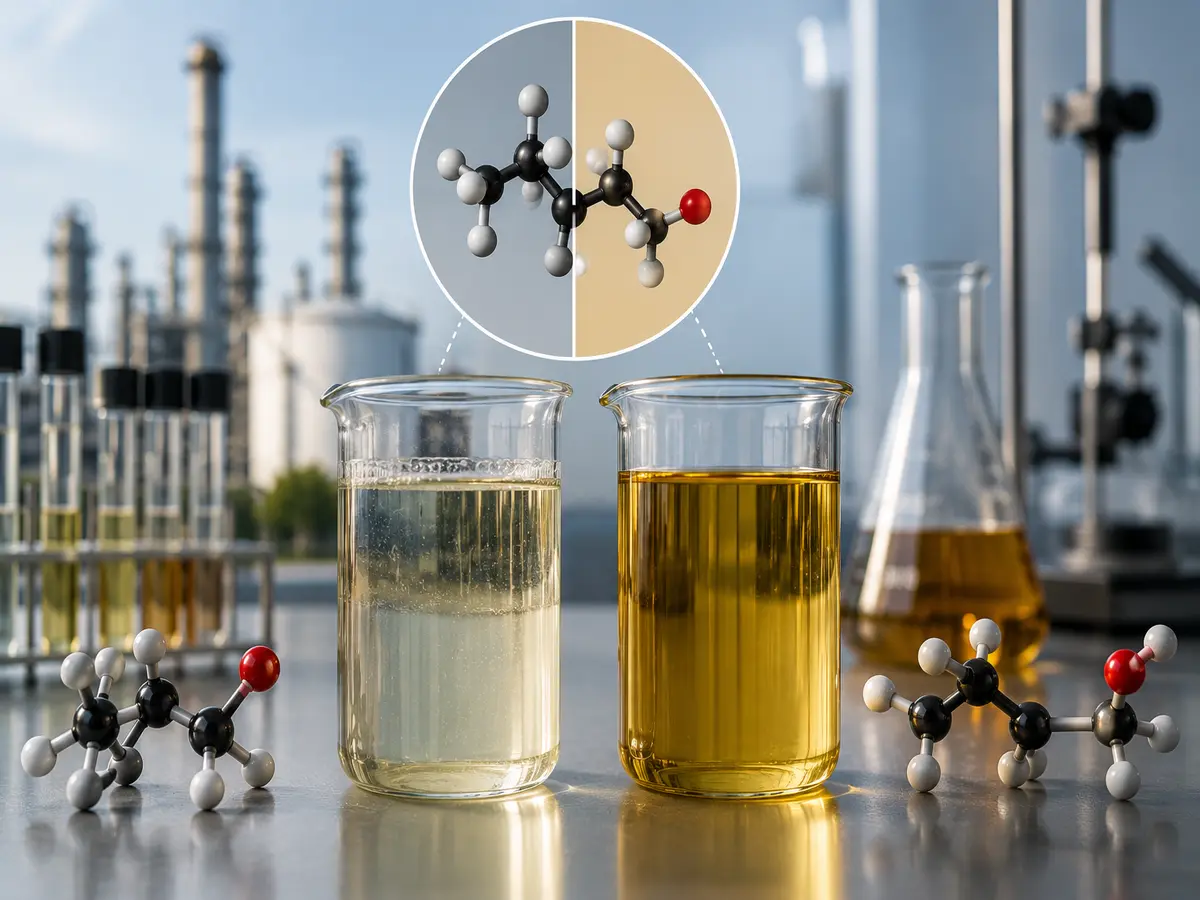
Researchers have investigated ethanol as a diesel blending agent, but it presents fundamental compatibility problems. Diesel has an oily consistency that prevents it from mixing uniformly with ethanol without the addition of specialised and expensive additives, which themselves are typically non-renewable. The chemical compositions of the two fuels are simply too different for straightforward blending.
A more practical issue is the difference in flashpoints. Ethanol's flashpoint is just 12-13 degrees Celsius, whereas diesel's is around 35 degrees Celsius. Blending the two creates a fuel with a significantly lower flashpoint than diesel, which raises fire hazard and safe storage concerns. Isobutanol is a four-carbon alcohol that is chemically much closer to diesel. Its flashpoint sits at 27-30 degrees Celsius, which is far more compatible with diesel's properties and does not create the same safety complications.
Benefits and expected impact of 2% blending
Using an isobutanol-diesel blend offers benefits beyond simply reducing diesel consumption. According to tests by Praj Industries, isobutanol remains stable for over 40 days even at a 10% blend, which is much higher than the 2% blend planned for the initial trials. This means the fuel can be stored and transported without separating, making it suitable for India's existing fuel distribution network without requiring major infrastructure changes.
The impact on fuel efficiency is also expected to be minimal. Tests with a 5% isobutanol blend showed only a 1-2% drop in mileage. Since the upcoming trials will use just a 2% blend, the difference in fuel economy is likely to be negligible for most drivers. Engine performance is also expected to remain virtually unchanged at this level.
The blended fuel is also expected to reduce tailpipe emissions compared to regular diesel, although the exact improvement will only be confirmed after the ARAI trials are completed. Overall, one of the biggest advantages of this fuel is that it can be used with existing storage, transportation, and fuel station infrastructure, making it easier to adopt on a larger scale.
Meanwhile, stay updated with all the latest happenings & developments in the automotive world by joining our official AUTOVERSE WhatsApp community. Also, don’t forget to check out our YouTube channel, AUTOVERSE by Cars24, for key details & visuals.