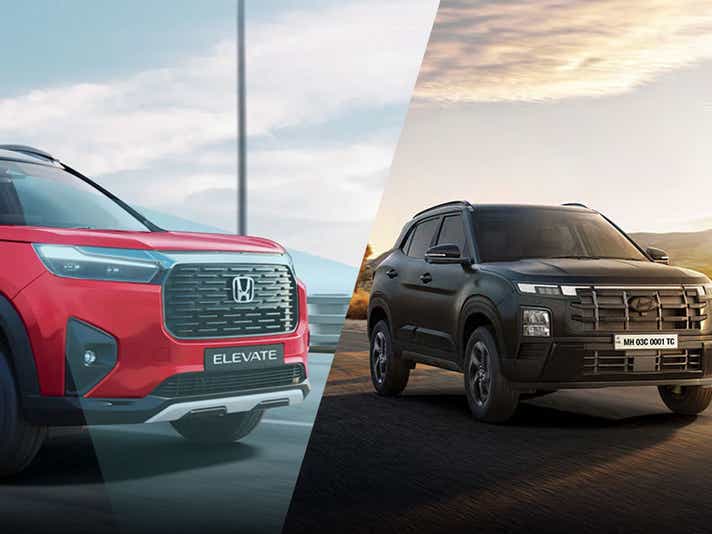
Hyundai Creta vs Honda Elevate: Which Mid-Size SUV Should You Buy in 2026?
- 1Honda Elevate boasts a massive 220mm ground clearance and a 458-litre boot.
- 2Hyundai Creta spoils buyers with three engine choices and a diesel automatic.
- 3The Elevate excels in reliability, while the Creta dominates in tech features.
- Honda Elevate vs Hyundai Creta: Overview
- Hyundai Creta vs Honda Elevate: Features Comparison
- Space and Practicality Comparison
- Hyundai Creta vs Honda Elevate: Engine & Performance
- Hyundai Creta vs Honda Elevate: Mileage in Real World
- Maintenance and Resale Value Comparison
- Hyundai Creta vs Honda Elevate: Price & Value for Money
- Final Verdict: Who Should Buy What
The mid-size SUV segment in India has graduated from a niche premium play into the most hotly contested battleground in the market. Urban families, young professionals, and corporate buyers alike now flock to it, drawn by the promise of road presence, a decent boot, and a cabin that doesn't make you feel shortchanged. Kia Seltos, Maruti Grand Vitara, and Volkswagen Taigun all have a seat at this table, but when it comes to consistent sales chart dominance and genuine buyer interest, two names keep surfacing: the Hyundai Creta and the Honda Elevate.
The Creta is practically an institution. Since its 2015 debut, it has rarely slipped from the segment's top spot, and its 2024 facelift addressed nearly every criticism levelled at the previous generation. A panoramic sunroof, multiple engine options, and a feature list that rivals cars costing significantly more make it the crowd-pleaser it has always been.
The Elevate arrived in 2023 with a different brief. Honda wasn't trying to out-feature the Creta; it was offering something quieter: mechanical refinement, long-term reliability, and a safety toolkit that has set a benchmark in its class. If the Creta is the gregarious, extrovert choice, the Elevate is its composed, no-drama counterpart.
This Hyundai Creta vs Honda Elevate comparison covers everything a buyer genuinely needs, engines, real-world mileage, features, space, resale, and pricing, so you walk away with a clear answer rather than a longer shortlist.
Honda Elevate vs Hyundai Creta: Overview
When you look at the Honda Elevate vs the Hyundai Creta from a bird's-eye perspective, the contrasting buyer profiles become immediately apparent. The Honda Elevate is an upright, traditional-looking SUV that doesn’t play by the modern gadget-obsessed rulebook. It is designed for buyers who want peace of mind, an airy cabin, stellar visibility, and an engine that will effortlessly outlast the vehicle's loan tenure. Its high ground clearance makes it a great city-friendly vehicle that is surprisingly easy to manoeuvre over broken tarmac while offering all the fundamental basics a family needs.
The Hyundai Creta, conversely, feels significantly more premium and indulgent. Despite its ubiquity on our roads, the Creta doesn’t scream "budget car" at any point. It is built for the modern consumer who values a plush cabin experience, cutting-edge technology, and the flexibility to choose between petrol, turbo-petrol, or diesel powertrains. While the Elevate targets the sensible buyer, the Creta appeals to those who want a taste of luxury in a mid-size package.
| Parameter | Honda Elevate | Hyundai Creta |
| Price (Ex-showroom) | ₹11.60 Lakh - ₹16.90 Lakh | ₹10.80 Lakh - ₹20.30 Lakh |
| Engine Options | 1.5L Naturally Aspirated Petrol | 1.5L NA Petrol, 1.5L Turbo Petrol, 1.5L Diesel |
| Performance (Max Power) | 121 bhp | 115 bhp / 160 bhp / 116 bhp |
| Mileage (ARAI Claimed) | 15.31 to 16.92 kmpl | 17.4 to 21.8 kmpl |
| Boot Space | 458 Litres | 433 Litres |
| Standout Features | Honda Sensing (ADAS), 220mm Ground Clearance | Panoramic Sunroof, Ventilated Seats, Bose Audio |
Pros and Cons of Both Cars
Summary: The Honda Elevate triumphs in sheer practicality, cabin space, and fuss-free ownership, but it lacks the engine variety and premium tech of its rival. The Hyundai Creta wins on interior opulence and powertrain choices but demands a significantly higher premium for its top-end variants. Overall winner for value: Honda Elevate. Overall winner for luxury: Hyundai Creta.
Honda Elevate Pros:
Exceptional 220mm ground clearance tackles the worst Indian roads with ease.
The 1.5L i-VTEC engine is incredibly refined and paired with a buttery smooth CVT.
Class-leading boot space and an airy cabin with excellent driver visibility.
Honda Elevate Cons:
Lacks a diesel or turbo-petrol engine option for enthusiastic drivers.
Cabin insulation could be better; engine noise creeps in at high revs.
Misses out on feel-good features like a panoramic sunroof and ventilated seats.
Hyundai Creta Pros:
A highly premium cabin experience with top-tier materials and exceptional NVH levels.
Offers a powertrain for everyone, including a highly sought-after diesel automatic.
Loaded with tech, including Level 2 ADAS, a 10.25-inch digital cluster, and a premium audio system.
Hyundai Creta Cons:
Top-tier turbo and diesel variants are quite expensive compared to segment rivals.
The exterior design can be polarising for buyers who prefer traditional SUV styling.
Hyundai Creta vs Honda Elevate: Features Comparison
Summary: If your buying decision hinges heavily on modern gadgets and a luxurious cabin ambience, the Korean offering is the undisputed champion here. The Japanese SUV provides all the necessary safety and comfort features but skips the flamboyant extras. Winner: Hyundai Creta.
Feature distribution is often the deciding factor in the mid-size segment, and looking closely at the Hyundai Creta vs Honda Elevate spec sheet reveals two very different approaches to cabin equipment.
| Feature | Honda Elevate | Hyundai Creta |
| Panoramic Sunroof | No (Single-pane sunroof) | Yes |
| Ventilated Seats | No | Yes (SX variant onwards) |
| 6 Airbags (Standard) | Yes | Yes |
| ADAS Suite | Yes (V variant onwards) | Yes (SX Tech variant onwards) |
| Digital Instrument Cluster | No (7-inch semi-digital) | Yes (10.25-inch fully digital) |
| 360-Degree Camera | No (Lane-watch camera only) | Yes |
Where Honda Elevate edges out:
The Elevate focuses on functional technology. Its Lane-Watch camera is incredibly intuitive for tight city traffic, and the Honda Sensing ADAS suite is calibrated brilliantly for chaotic Indian driving conditions, feeling less intrusive than many rival systems.
Where Hyundai Creta edges out:
The Creta feels like a vehicle from a segment above. Features like the massive panoramic sunroof, an eight-way power-adjustable driver’s seat, dual-zone climate control, and a rich Bose sound system make long journeys an absolute pleasure.
Space and Practicality Comparison
Summary: Both SUVs are spacious enough for a family of five, but the Elevate takes the crown for sheer luggage capacity and a commanding seating position, making it the more utilitarian choice. Winner: Honda Elevate.
A family SUV must excel at carrying people and their luggage in absolute comfort, and evaluating the physical dimensions is crucial to this Hyundai Creta vs Honda Elevate comparison.
| Practicality Spec | Honda Elevate | Hyundai Creta |
| Wheelbase | 2650 mm | 2610 mm |
| Ground Clearance | 220 mm | 190 mm |
| Boot Space | 458 Litres | 433 Litres |
| Rear Seat Split | 60:40 | 60:40 |
The Elevate boasts a longer wheelbase, which translates to a marginally more spacious rear cabin. The seats are well-contoured, and the massive windows prevent any feeling of claustrophobia. The Creta, while slightly more compact in wheelbase, offers superior thigh support and plusher cushioning, making it exceptionally comfortable. However, the Elevate’s staggering 458-litre boot easily swallows airport luggage, giving it a definitive edge for weekend getaways.
Hyundai Creta vs Honda Elevate: Engine & Performance
Summary: The Creta dominates with its diverse engine portfolio, catering to mileage-conscious diesel buyers and thrill-seeking turbo enthusiasts. The Elevate’s sole naturally aspirated engine is reliable but lacks high-speed punch. Winner: Hyundai Creta.
The powertrain options highlight the starkest contrast between the two models. The Elevate relies entirely on Honda's legendary 1.5-litre i-VTEC petrol engine, producing 121 bhp and 145 Nm of torque. The Creta offers a trio of 1.5-litre engines: a naturally aspirated petrol (115 bhp), a punchy turbo-petrol (160 bhp), and a highly efficient diesel (116 bhp).
City driving:
In urban traffic, the Elevate’s CVT is an absolute gem. It responds linearly to throttle inputs, making stop-and-go traffic effortless. The Creta’s naturally aspirated petrol with the iVT (intelligent variable transmission) is equally smooth, but the diesel automatic offers a beautiful surge of low-end torque that makes overtaking in the city incredibly easy.
Highway driving:
Out on the open road, the Creta’s turbo-petrol engine paired with the DCT gearbox is in a league of its own, offering blistering acceleration. The Elevate, while stable at triple-digit speeds, tends to get quite vocal when pushed hard. The rubber-band effect of the CVT becomes apparent during quick highway overtaking manoeuvres, requiring a bit more planning compared to the effortless pull of the Creta's turbo or diesel engines.
Hyundai Creta vs Honda Elevate: Mileage in Real World
Summary: ARAI figures only tell half the story. In real-world conditions, the diesel Creta is the ultimate marathon runner, while the petrol Elevate and NA Creta are neck-and-neck. Winner: Hyundai Creta (specifically the diesel variant).
Fuel efficiency remains a primary concern for Indian buyers. When researching Hyundai Creta vs Honda Elevate mileage, relying purely on ARAI figures can be misleading. Here is what real-world ownership data reveals:
| Powertrain | City Mileage | Highway Mileage |
| Elevate 1.5L Petrol MT | 11 - 12 kmpl | 15 - 16 kmpl |
| Elevate 1.5L Petrol CVT | 10 - 11 kmpl | 16 - 17 kmpl |
| Creta 1.5L NA Petrol iVT | 10 - 12 kmpl | 15 - 17 kmpl |
| Creta 1.5L Turbo Petrol DCT | 9 - 10 kmpl | 14 - 15 kmpl |
| Creta 1.5L Diesel AT | 13 - 14 kmpl | 18 - 20 kmpl |
Insights drawn from prominent automotive communities indicate that the Elevate CVT is highly sensitive to throttle inputs; driving with a light foot on the highway can easily yield upwards of 16 kmpl. However, for buyers covering large distances monthly, the Creta diesel is virtually unbeatable, routinely returning near 20 kmpl on highway cruises without breaking a sweat.
Maintenance and Resale Value Comparison
Summary: Both brands command tremendous respect in the used car market, but Honda's mechanical simplicity often results in a slightly more hassle-free long-term ownership experience. Winner: Tie.
When buying a car in this segment, anticipating the total cost of ownership is vital. Anecdotal evidence from long-term owners suggests that the Honda Elevate, free from complex turbochargers or dual-clutch transmissions, offers a highly predictable and inexpensive maintenance schedule. Honda’s naturally aspirated engines are known to comfortably cross the 100,000-kilometre mark with nothing more than routine fluid changes.
Hyundai’s service network, however, is significantly larger and penetrates deeper into rural India. The Creta enjoys a cult-like status in the used car market. Because it is highly sought after, a well-maintained Creta suffers minimal depreciation, meaning you will recover a substantial portion of your investment when it is time to upgrade. Both cars represent incredibly safe financial bets.
Hyundai Creta vs Honda Elevate: Price & Value for Money
Summary: The Elevate drastically undercuts the Creta, making it the quintessential value-for-money champion for buyers on a strict budget. Winner: Honda Elevate.
Pricing is where the Honda Elevate vs Hyundai Creta battle becomes intensely practical. The Elevate’s simplified variant lineup means you aren't forced to stretch your budget for fundamental features. When comparing the Honda Elevate V vs Hyundai Creta EX (the mid-level value trims), the Elevate offers standard ADAS, making it an incredibly compelling package for safety-conscious buyers.
The Creta justifies its higher price tag through premium materials and advanced tech, but the top-spec Creta SX (O) variants stretch well past the ₹20 Lakh mark on-road, venturing into the territory of larger, three-row SUVs.
Best variants:
Elevate VX CVT offers the absolute best value, providing alloy wheels, wireless charging, and a sunroof at a highly competitive price point.
Creta SX Tech (Petrol/Diesel) strikes the perfect balance, giving you the coveted ADAS suite, a panoramic sunroof, and premium interiors without paying the exorbitant premium of the top-spec (O) variant.
Final Verdict: Who Should Buy What
Choosing between the Honda Elevate and the Hyundai Creta ultimately boils down to what you value most during your daily commute. Here is the final report card to simplify your decision:
| Parameters | Which Model Triumphs | Slight Reasoning | Best for.. |
| Technology & Luxury | Hyundai Creta | Panoramic sunroof, ventilated seats, digital dials | Gadget enthusiasts |
| Space & Practicality | Honda Elevate | 458L boot, 220mm ground clearance | Weekend travellers |
| Engine Variety | Hyundai Creta | Option of Turbo-petrol and efficient Diesel | Enthusiasts & high-milers |
| Value for Money | Honda Elevate | Aggressive pricing for mid and top variants | Budget-conscious families |
Buy the Honda Elevate if you:
- Prioritise long-term reliability and a fuss-free ownership experience.
- Want a comfortable ride over bad roads thanks to its superior ground clearance.
- Prefer a simple, straightforward cabin with fantastic visibility.
Example: Best for chauffeur-driven buyers or practical city commuters: Honda Elevate CVT.
Buy the Hyundai Creta if you:
- Have a high monthly running and desperately need a frugal diesel engine.
- Want a cabin that feels luxurious and is packed to the brim with modern features.
- Desire the thrilling performance of a turbo-petrol paired with a quick-shifting DCT.
Example: Best for highway usage and tech lovers: Hyundai Creta (Diesel/Turbo).
Frequently Asked Questions
Expand all