What You're Actually Paying For When You Buy a Used Car Online

One of the most common criticisms I read about online used car platforms, including Cars24, is that our prices are 15-20% higher than what local dealers charge for similar cars. Cars24 sells over 5,000 cars a month, making us the largest organised used-car dealer in India. If platforms were genuinely charging a premium for nothing, that volume would not exist. Buyers are not naive. They compare, negotiate with local dealers, and still come back.
The final price once you compare like for like, is actually at par. The reason buyers still feel like they are paying a premium is not because platforms are overcharging. It is because even one rupee above the lowest available price feels expensive when the total cost of a car's acquisition is not properly compared. That is an education gap, not a pricing gap. And the way to close it is with transparency, not with discounts.
This article is an attempt to break down exactly what goes into the price of a used car on an organised platform, so buyers can compare accurately. Not just listing price, but total cost to total cost.
The price you see is not the price you pay - and that is true on both sides
Let us start with what most people miss.
When a local dealer quotes you Rs 5 lakh for a used car, that amount typically covers only the cost of the car itself. It does not include:
- Insurance: Insurance renewal- Rs 3,000 to 25,000 depending on the car's age, IDV, and whether you opt for comprehensive or third-party cover. (Source: IRDAI-regulated insurance bands, 2024-25)
- RC transfer: RC transfer fees and agent charges - Rs 3,000 to 5,000 for intrastate; significantly more for interstate transfers that require an NOC and fresh road tax (Source: RTO schedule of fees, varies by state)
- Loan processing: Loan processing fees - upto 2.95% of the loan amount, plus documentation charges, valuation fees, and stamp duty. This can go higher depending on the lending partner (Source: RBI-regulated NBFC disclosure norms)
- Inspection: Pre-purchase inspection - Rs 1,000 to 4,000 if you hire a professional.
- Immediate & hidden repairs: Small fixes like brake pads or AC issues are the visible part. The greater risk is inheriting a hidden major repair (e.g., a clutch overhaul) that surfaces within the first few months. Buyer ends up absorbing Rs 5,000 to Rs 30,000*+, or significantly more depending on what was missed
- Risk of odometer fraud: Our inspection data across Cars24's used car transactions shows tampering in an estimated 20% of pre-owned cars. To be clear- this figure reflects what our 300-point inspection catches before cars are selected and listed, not what reaches the end buyer. Tampered mileage means critical service milestones are much closer than advertised - and the buyer has no way of knowing until the bill arrives
(*Based on Cars24 Welcome Cover claim data across 14000 claims in 2024-25)
Now add these up - a car listed at Rs 5 lakh from a local dealer will cost closer to Rs 5.5 to 6 lakh once you include the full acquisition cost. A car priced at Rs 8 lakh can approach Rs 9 lakh. These are not hypothetical additions. They are the standard costs of buying a car in India that simply do not appear in a local dealer's listing price.
One more thing - no single transaction defines how an organised platform prices cars. Pricing at Cars24 is set using real-time market data across 5,000+ transactions every month. The anecdote of one buyer finding one car cheaper at one local dealer is real. But then so are the opposite cases where the Cars24 car is cheaper than at the dealer.
The local dealer did not lie about the listing price. But the listing price was never meant to be the final on-road cost anyway.
What’s included in the final price when you buy a used car from Cars24
When you buy a car from Cars24, several cost layers are already built in.
1. Pre-delivery refurbishment and 300-point inspection
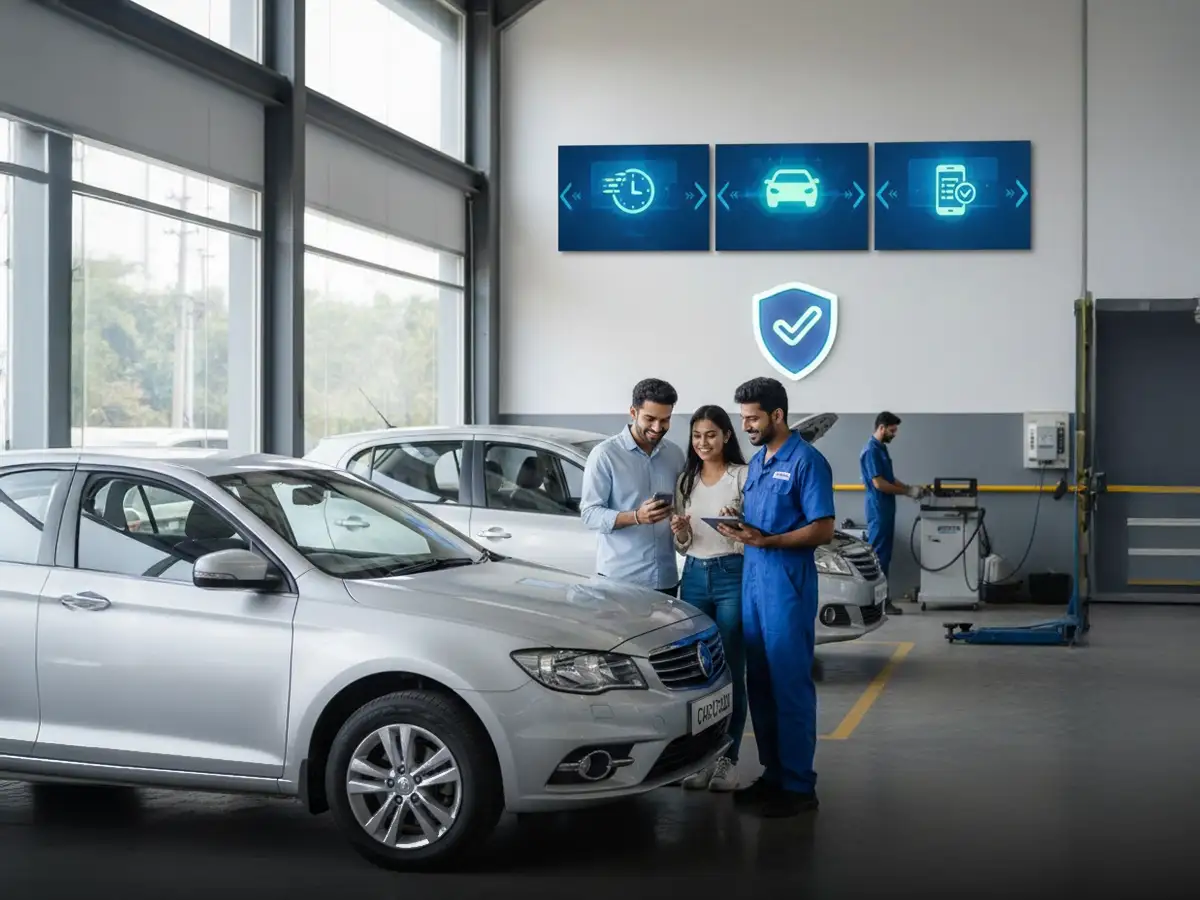
Every Cars24-owned car goes through a 10+ hour, 300-point inspection covering mechanical, structural, electrical, and legal verification. OBD scanners catch error codes in the ECU. Paint thickness gauges detect accident repairs. Specific RTO and Vahan checks verify legal history. Bank-level loan verification ensures no hypothecation issues.
This is a critical step because the most significant hidden cost in used car buying is fraud. In the unorganised market, a professional pre-delivery inspection is the only way to catch odometer tampering - a practice that affects an estimated 20% of used cars as per Cars24 internal inspection data. Tampered mileage is not just about overpaying; it means major service milestones - like timing belt replacement or a clutch overhaul -are much closer than they seem, and the cost lands entirely on the buyer within the first few months.
If you buy from a local dealer, you pay ₹1,000–₹4,000 for a third-party inspection. That inspection will still miss loan status and legal history unless you pay separately for those checks.
2. Post purchase Warranty and 30-day Repair Assurance
This is the cost that most price comparisons miss entirely.
A used car from a local dealer usually comes with no structured warranty. If the gearbox develops a fault the moment the car steps out of the showroom, that is your problem. If the AC compressor fails, you pay.
At Cars24, every Cars24 Assured car comes with 30 days of repair assurance. This covers the engine, transmission, cooling, electrical, and fuel systems. It also includes limited coverage for wear-and-tear components like tyres, clutch, brakes, and suspension. Buyers who want extended protection can opt for lifetime warranty plans covering up to 12 years or 1.5 lakh kilometres.
Some buyers ask why these protections are non-negotiable rather than optional add-ons. The answer is straightforward: mandatory inclusion is mandatory risk mitigation. The warranty and return window exist because the risks they cover are real and market-wide, not rare exceptions. And because returns are genuinely expensive for Cars24, including them as non-negotiables creates a direct incentive for the platform to invest harder in pre-delivery refurbishment. The 300-point inspection is not a formality. It is a core business necessity.
To be precise about what the warranty covers and what it does not: the 30-day repair assurance covers major mechanical systems (engine, transmission, cooling, electrical, fuel) and limited wear-and-tear items. It does not cover accidental damage, cosmetic issues, or misuse. All repairs go through Cars24-authorised service centres. The exclusions are documented in the warranty terms, and buyers can review them before purchase.
This protection requires a structured set-up that only organised platforms can provide - claims infrastructure, authorised service centres, quality inspectors, and the financial exposure of honouring those claims. That cost is included in the price you see on organised platforms.
3. RC Transfer and Legal Protection
When you buy from a local dealer, the RC transfer is often your responsibility. You either manage it yourself or pay an agent. If the transfer is delayed, you absorb the legal risk. If challans arrive in the previous owner's name, you manage the fallback.
At Cars24, RC transfer processing and tracking are included in the final purchase price. The RC transfer process is initiated and tracked centrally & legal protection provided during the interim period ensures that the new buyer is not exposed to liabilities from the previous owner while the transfer is in progress. This operational and legal infrastructure has a cost.
4. Loan Facilitation at Transparent rates
Most used car buyers in India need financing. Getting a used car loan independently can involve processing fees of up to 2.95% of the loan amount, documentation charges, and multiple visits to the bank. On a loan of Rs 5 lakh, processing fees alone can add upto Rs 15,000.
Platforms operating at scale, especially with embedded lending, can offer pre-approved financing with fewer intermediaries, and often at competitive rates because of volume-based partnerships with lenders. This reduction in friction comes at a cost to build and operate. But on a typical INR 4 lakh loan, it regularly saves the buyer more than it adds to the price.
5. 30 day Return Window
A local dealer's sale is final. Once you drive the car out, the transaction is closed.
Platforms that offer structured return windows, especially for an entire month, absorb costs that no local dealer does: the logistics, inspection, and inventory reabsorption of returned vehicles. Returns are expensive for platforms. They are also among the strongest forces ensuring high accountability for quality on organised platforms. When returns cost you money, you invest harder in getting the car right before delivery.
What an honest cost comparison looks like
Here is a simplified breakdown comparing the total acquisition cost between a local dealer listing at approximately Rs 5 lakh and an organised platform listing at approximately Rs 6 lakh.
| Cost Component | Local Dealer | Organised Platform |
| Car price (listed) | ~Rs 5 lakh | ~Rs 6 lakh |
| Insurance (new policy) | Rs 3,000–25,000 (buyer arranges) | Often facilitated; cost included or transparent |
| RC transfer + agent | Rs 3,000–5,000 (buyer manages) | Included in process; tracked centrally |
| Pre-purchase inspection | Rs 1,000–4,000 (if done) | Included (300-point inspection) |
| Warranty/repair assurance | None | Free 30-day repair assurance included Extended lifetime warranty included |
| Return option | None | 30 day return window |
| Loan processing cost | Up to 2.95% + charges (buyer arranges) | Financing (optional), with lower rejection rates. Loan rates shown transparently |
| First-month surprise repairs | Buyer absorbs (Rs 5,000–30,000+)* or more if odometer fraud is involved | Covered under 30 day repair assurance |
| Legal protection during RC transfer | None - buyer carries risk | The platform provides legal protection |
| Realistic total landed cost of car | Rs 5.5-6.0 lakh | Rs 6.2–6.5 lakh |
*Based on Cars24 Welcome Cover claim data across 14000 claims in 2024-25
Note: Figures are indicative and vary by car, state, and transaction specifics. The point is not precision. It is that the sticker price comparison most people make is structurally incomplete.
That said, a knowledgeable car buyer who knows exactly what to verify, negotiates hard on hidden fees, and arranges their own loan at competitive rates can sometimes extract a better total deal from a local dealer - potentially ₹5.8–6 lakh all-in. But these buyers are petrolheads, who are less than 1% of overall buyers.
Cars24 internal buyer data shows that 75% of overall used cars buyers are first time car buyers who do not have the expertise to reliably execute each of the required steps. For them, the platform’s transparent pricing and included protections deliver better value. For the experienced, well-prepared buyers who can independently complete the process themselves, the gap genuinely narrows.
What used car platforms should be transparent about
That said, the online platform pricing model is not above scrutiny.
If the price includes warranty, inspection, and transfer support, those inclusions should be clearly itemised at the point of sale. A single number with no breakdown creates the same opacity that platforms claim to solve.
Transparency is not just about disclosing the price. It is about disclosing the exact composition of the price. Why does this car cost Rs 6.2 lakh? What sits inside that number? The buyer deserves to see the anatomy, not just the total. If you can't explain every rupee, you haven't earned the trust you're asking for.
We understand that our single bundled price, even with inclusions, is our biggest vulnerability. We are actively working to unbundle the cost and display an itemised breakdown for every car. The goal is for every buyer to see every rupee, so that the value is clearly demonstrated.
Vikram Chopra is the founder and Global CEO of Cars24. The views expressed are based on his operating experience in large-scale automotive marketplaces.
Frequently Asked Questions
Expand all