Volkswagen Virtus Running Cost Breakdown: 5-Year Service, Fuel & Ownership Costs
- 1Expect a practical 14-17 kmpl real-world mixed mileage from the 1.0L TSI engine.
- 25-year routine service bills average a highly reasonable ₹41,500 for the 1.0L TSI.
- 3Opt for the VW Service Value Package to lock in maintenance costs for four years.
- Volkswagen Virtus: At a Glance
- Volkswagen Virtus Engine & Fuel Options
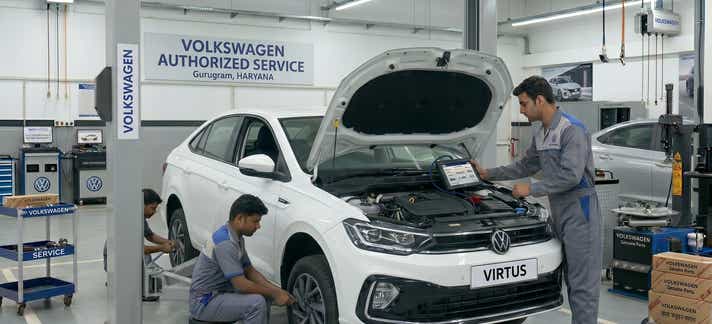
- Volkswagen Virtus Service Cost
- Other Maintenance Costs: Tyres, Battery & Insurance
- What owners talk about Virtus maintenance and reliability
- 5-Year Ownership Cost Breakdown
- Running Cost Comparison: Volkswagen Virtus vs. Rivals
- Strategies to Lower Your Maintenance Bills
The mid-size sedan segment was once declared a dying breed, overshadowed by the relentless march of compact SUVs. However, cars like the Volkswagen Virtus have emphatically proved that there is still a massive appetite for a well-engineered, low-slung sedan. Replacing the much-loved Vento, the Virtus does not just play by the rules; it brings European driving dynamics, a striking road presence, and premium features into a highly competitive space. In the past, the biggest hurdle for Indian buyers eyeing a German car was the dreaded fear of exorbitant workshop bills.
Before you let your heart dictate your purchase, understanding the total ownership costs, including fuel, insurance, and routine upkeep, is vital to ensuring this German beauty fits your long-term budget. Gone are the days when maintaining a Volkswagen was a wallet-draining affair. Thanks to massive localisation efforts under the brand’s ambitious India 2.0 strategy, the Volkswagen Virtus maintenance cost is surprisingly accessible. Let us dive deep into the numbers and see what it actually costs to run a Virtus over a five-year period.
Volkswagen Virtus: At a Glance
To give you an immediate snapshot before we dive into the granular details, here is everything you need to know about the basic economics of the Virtus.
| Specification | Details |
| Price | ₹11.56 Lakh – ₹19.41 Lakh (Ex-Showroom) |
| Engine | 1.0L TSI Petrol & 1.5L TSI EVO Petrol |
| Power | 115 PS & 150 PS |
| Mileage | 18.45 – 20.08 kmpl (ARAI Claimed) |
| Service Cost | ₹5,000 – ₹13,500 (average per service range) |
| Service Interval | 15,000 km or 1 Year |
Volkswagen Virtus Engine & Fuel Options
When analysing the Volkswagen Virtus running cost, your choice of powertrain dramatically influences the long-term numbers. Volkswagen has entirely ditched diesel. They rely strictly on highly advanced, turbocharged petrol engines (TSI) to deliver an uncompromised blend of performance and efficiency.
- Variant 1 (1.0L TSI Manual): This is a brilliant three-cylinder turbocharged workhorse. It is best for those who want a blend of driving fun and frugality. Because it uses a traditional manual gearbox, it boasts the lowest long-term maintenance bills. It offers exceptional highway cruising efficiency, making it the sensible choice for balanced usage.
- Variant 2 (1.0L TSI Automatic): Utilising a smooth 6-speed torque converter rather than a complex dual-clutch, this is the ultimate urban commuter. You sacrifice a tiny bit of fuel economy for massive convenience in stop-and-go traffic. Crucially, the torque converter is incredibly reliable over a five-year span, meaning your service costs remain nearly identical to the manual variant without the risk of expensive clutch replacements.
Variant 3 (1.5L TSI DSG): The absolute enthusiast’s pick. This buttery-smooth four-cylinder, performance-oriented engine features active cylinder deactivation technology (ACT). It seamlessly shuts down two cylinders under light throttle loads to boost fuel economy. It requires synthetic oil and slightly higher upkeep, and the lightning-fast DSG gearbox demands careful driving in heavy traffic to avoid premature wear, but it rewards you with segment-leading power.
Volkswagen Virtus Real World Mileage
A major chunk of your Volkswagen Virtus ownership cost will inherently go towards fuel. While the ARAI-certified figures look stellar on paper, real-world conditions on chaotic Indian roads often paint a different picture. The 1.0L TSI engine is quite sensitive to your driving style; aggressive throttle inputs and constant turbo spooling will see Volkswagen Virtus mileage drop significantly in congested city environments like Mumbai or Bengaluru.
Conversely, out on the open highway, the Virtus shines brightly. Cruising at a steady 100 km/h in top gear keeps the RPMs low, allowing both engines to sip fuel efficiently. The 1.5L TSI actually surprises many owners by delivering highway efficiency that frequently outpaces its smaller sibling, all thanks to its cylinder deactivation tech cutting off fuel to half the engine when coasting.
| Engine Type | Real-World Mileage (City/Hwy) | Recommended For |
| 1.0L TSI MT | 11-12 kmpl / 18-20 kmpl | Balanced city & highway usage |
| 1.0L TSI AT | 9-11 kmpl / 14-16 kmpl | Heavy city traffic commuters |
| 1.5L TSI DSG | 12-14 kmpl / 17-20 kmpl | Enthusiasts seeking performance |
Volkswagen Virtus Service Cost
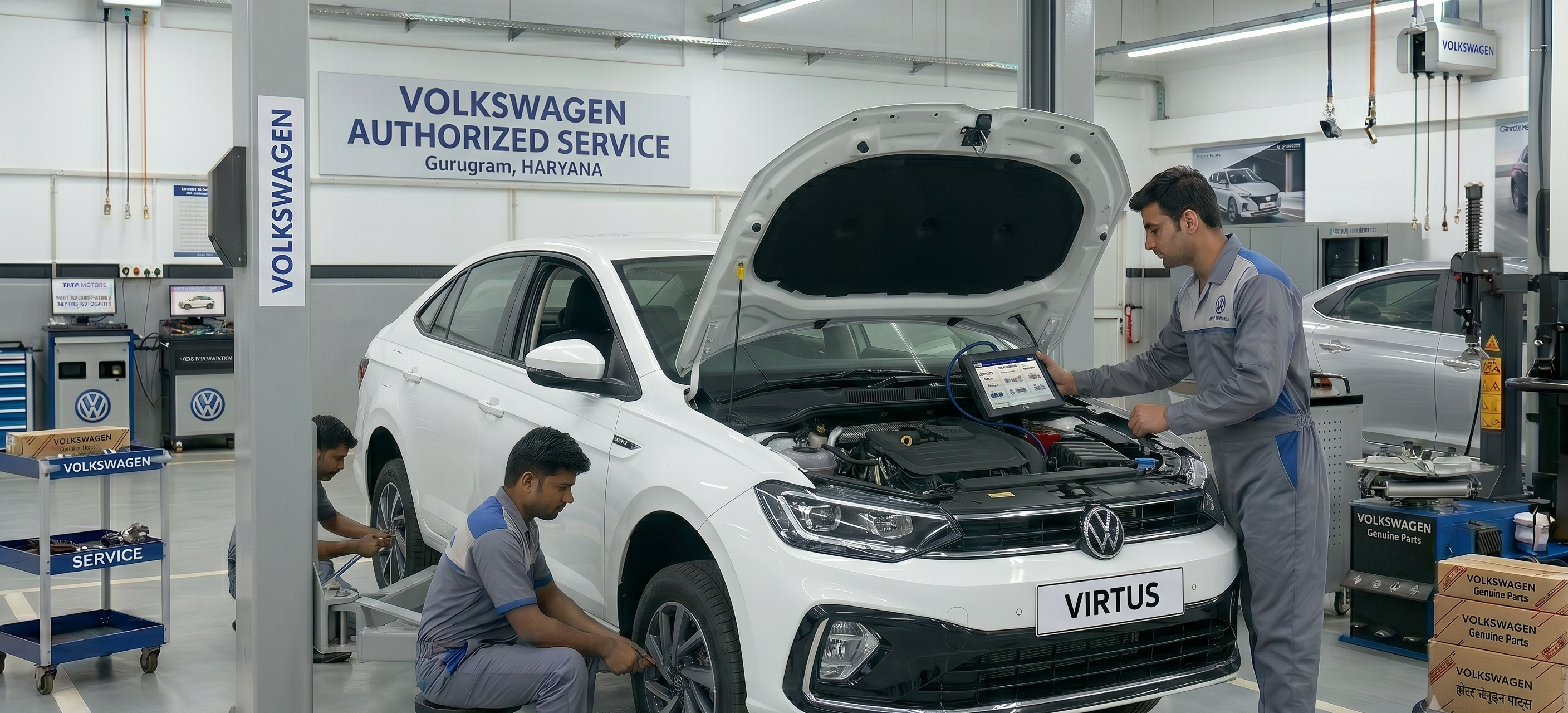
This is the core of the Volkswagen Virtus running cost equation. Thanks to a staggering 95% localisation rate under the MQB A0 IN platform, crucial spare parts are no longer shipped from Europe at a heavy premium. Furthermore, the standard service interval of 15,000 km means you will make fewer trips to the workshop compared to rivals that demand a visit every 10,000 km.
Below is the estimated schedule for the 1.0L TSI variant over a five-year timeline.
| Service Year | Interval (KM) | Key Tasks/Replacements | Estimated Cost |
| Year 1 | 15,000 | Oil change, Oil Filter, General Check-up | ₹5,168 |
| Year 2 | 30,000 | Brake fluid, Cabin filter, Spark Plugs (check) | ₹8,845 |
| Year 3 | 45,000 | Minor service, Battery & AC check | ₹7,046 |
| Year 4 | 60,000 | Major Service: Spark plugs, Drive Belt | ₹13,446 |
| Year 5 | 75,000 | Suspension & Alignment check, Fluids | ₹7,046 |
Pro-Tip: Volkswagen offers highly lucrative "Service Value Packages" (SVP). Buying the 4-year SVP upfront shields you entirely against inevitable inflation in labour and parts over the years. For the Virtus, this prepaid package is incredibly worth it, significantly slashes your overall Volkswagen Virtus service cost, and essentially locks in your maintenance budget, offering complete peace of mind.
Other Maintenance Costs: Tyres, Battery & Insurance
Most buyers solely focus on scheduled workshop visits, forgetting that consumables and policy renewals form a massive part of any five-year ownership journey. Here is a realistic overview of these peripheral expenses that heavily dictate the overall running cost.
- Tyre Replacement: The Virtus generally rolls on 205/55 R16 rubber on its higher trims. Because the chassis is set up for enthusiastic driving, the factory-fitted tyres take a fair bit of load. A set of four premium tyres (like Yokohama Earth-1 or Michelin Primacy) will set you back approximately ₹26,000 to ₹30,000. Depending on your driving conditions and alignment habits, expect to replace these around the 45,000 to 50,000 km mark.
- Battery Life: The electronics-heavy Virtus, equipped with large infotainment screens and ventilated seats, relies on a robust DIN55 or DIN60 battery. These typically last between three to four years before showing signs of fatigue. A reliable replacement from renowned brands like Exide or Amaron will cost around ₹6,000 to ₹7,000.
Insurance Renewals: While your first-year comprehensive zero-depreciation policy is heavily bundled into the on-road price (often crossing ₹35,000), subsequent renewals will taper down. However, given the cost of premium exterior parts like the LED headlamps, sticking to a zero-depreciation cover is highly advised. Assuming no major claims and accumulating your No Claim Bonus (NCB), you can expect to pay an average of ₹18,000 to ₹22,000 annually from the second year onwards.
| Cost Component | 5-Year Estimated Expense |
| Set of 4 New Tyres | ₹28,000 |
| Battery Replacement | ₹6,000 |
| Insurance (Years 2 to 5) | ₹80,000 |
What owners talk about Virtus maintenance and reliability
If you delve into dedicated enthusiast forums and owner groups, the consensus regarding the Virtus is overwhelmingly positive, marking a stark departure from the notorious reliability woes of older German cars in India. The 1.0L TSI engine is widely praised as bulletproof, happily munching thousands of miles with zero mechanical hiccups. Routine maintenance is no longer a scary prospect, with many owners reporting their annual bills staying strictly under the ₹10,000 mark.
Initially, there were murmurs regarding the lacklustre air conditioning performance in heavy, crawling traffic during peak summers. Volkswagen took the feedback seriously and promptly addressed this through a software update that tweaked the compressor’s behaviour. Another major talking point is the infamous DQ200 DSG gearbox in the 1.5L variant.
Owners report that the current iteration of this transmission feels far more robust and thermally efficient than the ones used a decade ago, significantly reducing mechatronic failure anxiety. Above all, owners continually highlight that the sheer driving pleasure, vault-like build quality, and high-speed stability far outweigh any marginally premium upkeep.
5-Year Ownership Cost Breakdown
To give you a crystal-clear picture, we have calculated the total Volkswagen Virtus running cost over 5 years, assuming an annual running of 10,000 km (50,000 km total) for the 1.0L TSI Manual variant. Fuel costs are calculated at an average petrol price of ₹95 per litre with a real-world mixed efficiency of 14 kmpl.
| Cost Component | Estimated Cost (5 Years / 50,000 km) |
| Routine Servicing | ₹41,551 |
| Fuel Cost | ₹3,39,285 |
| Insurance Renewals (Y2-Y5) | ₹80,000 |
| Tyres & Battery Replacement | ₹34,000 |
| Total 5-Year Running Cost | ₹4,94,836 |
Running Cost Comparison: Volkswagen Virtus vs. Rivals
How does the Virtus stack up against its fierce segment rivals? Here is a quick maintenance cost and efficiency comparison against the competition.
| Cost Factor | Volkswagen Virtus (1.0L MT) | Hyundai Verna (1.5L MT) | Honda City (1.5L MT) |
| 5-Yr Service | ₹41,551 | ₹25,500 | ₹32,000 |
| Fuel Efficiency | 14-16 kmpl | 13-15 kmpl | 12-14 kmpl |
| Verdict | Driver's Choice | Value Pick | Proven Reliability |
While the Virtus commands a slightly higher routine service premium over the Verna, its superior real-world highway mileage and longer 15,000 km service intervals beautifully offset the difference for frequent long-distance drivers. The Hyundai Verna benefits from cheaper spare parts and a simpler naturally aspirated engine option, making it the supreme value pick, while the Honda City relies on its legendary, fuss-free long-term reliability.
Strategies to Lower Your Maintenance Bills
Running a premium European sedan does not have to drain your savings. Implementing a few smart, practical strategies can significantly pull down your Volkswagen Virtus running costs over the years.
- Avoid Dealership Add-ons: Whenever you drop your car off for its annual service, the service advisor might enthusiastically push for "Engine Dressing," "AC Disinfection," or "Silencer Coating." Politely decline these. They inflate your bill by ₹2,000 to ₹3,000 every single time and offer virtually zero tangible mechanical benefit to your vehicle.
- Wheel Alignment Outside: Dealerships charge a hefty premium for wheel balancing and alignment. Getting this done every 5,000 km at a trusted local tyre shop using laser-guided systems will save you at least 50% compared to an authorised workshop, while ensuring your expensive tyres do not wear out unevenly.
Turbocharger Care: Because all Virtus engines are turbocharged, practising the 'Idle Rule' is crucial. Let the engine idle for 30 to 60 seconds after a long drive before shutting it off. This allows the hot oil to circulate and cool the turbo bearings, preventing premature turbo failure, which can cost upwards of ₹60,000 to fix.
Driving Habits: The turbocharged TSI engines thrive on momentum. Smooth, progressive throttle inputs rather than harsh, sudden acceleration will yield a massive 2-3 kmpl bump in your mileage. Furthermore, utilising engine braking instead of riding the brake pedal on descents can effortlessly extend your brake pad life by an additional 10,000 km.
Frequently Asked Questions
Expand all