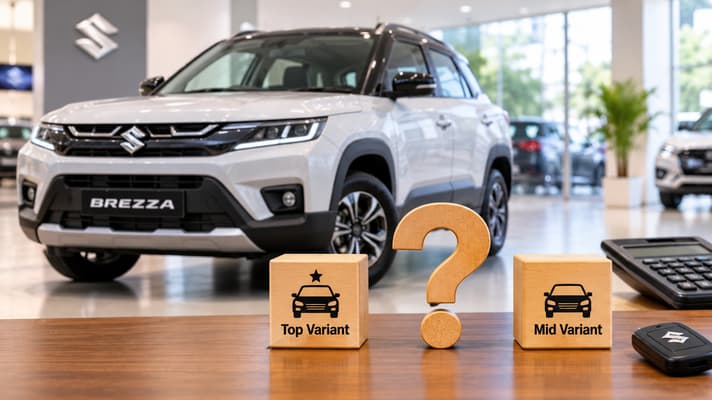
Top Variant vs Mid Variant: Is the Top Model of a Car Worth the Extra Money?
- 1Maruti Brezza ZXI Plus AT costs ₹3.37 lakh more than the VXI AT on-road Delhi
- 2Financing that gap over five years at 9% adds roughly ₹82,800 in interest
- 3A used top variant can be smarter money than a new mid variant
- Why the Top Variant Is Not Always the Best Value
- How Car Variant Packaging Works: You Buy Bundles, Not Features
- Maruti Brezza VXI AT vs ZXI AT vs ZXI Plus AT: A Real Price Example
- Ex-Showroom vs On-Road Price: The True Cost of a Top Variant
- Top Variant Resale Value: Do the Extra Features Pay You Back?
- Used Top Variant vs New Mid Variant: When the Maths Flips
- Which Top Variant Features Are Worth Paying For?
- How to Choose the Right Car Variant: A 7-Step Checklist
- So, Should You Buy the Top Variant?
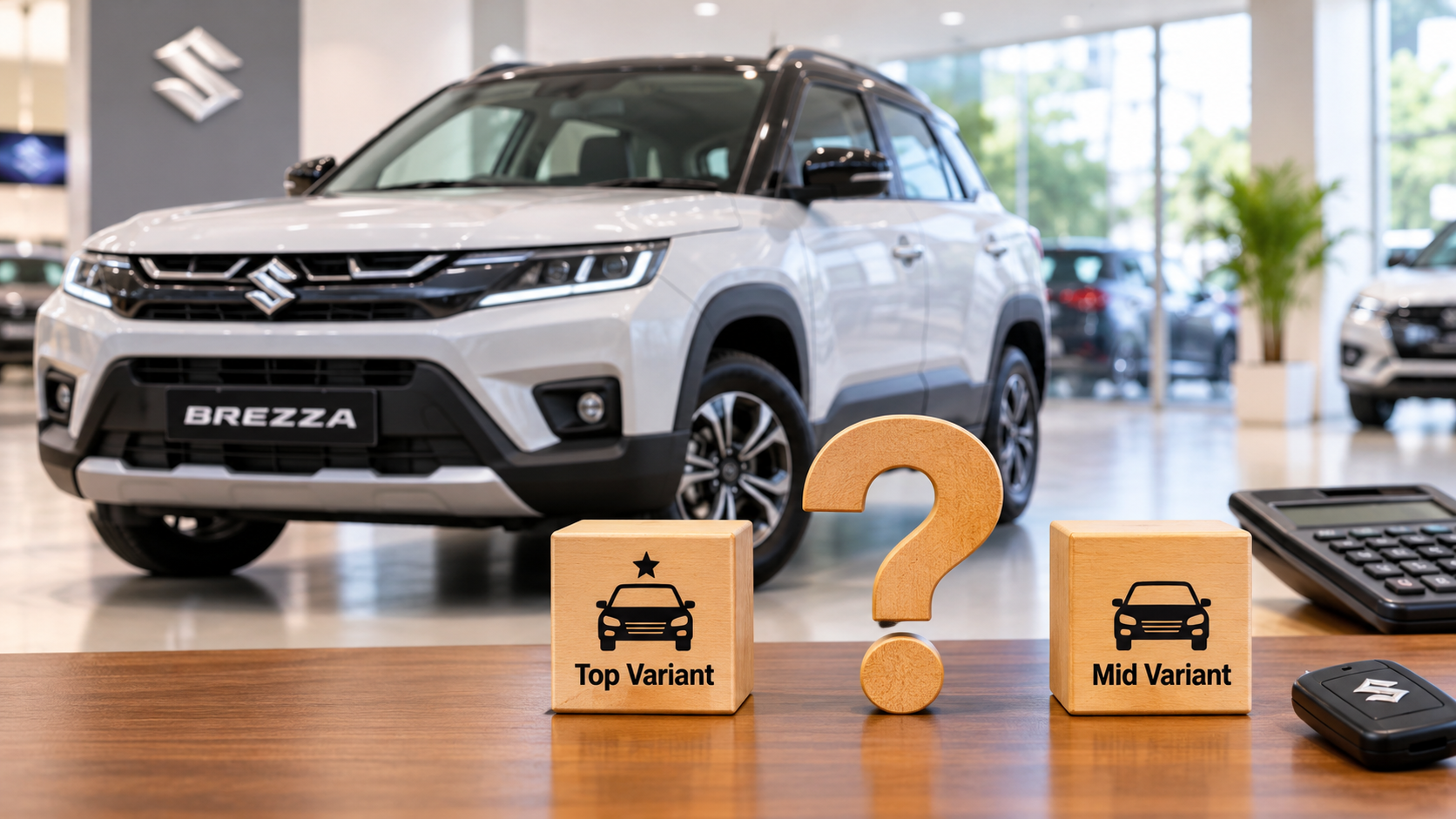
Walk into any showroom, and the salesperson will almost always steer you towards the top variant. It has the bigger screen, the sunroof, the camera that shows your car from above. On paper, it is the best version of the car. And it is. In terms of equipment.
Value for money is a different question altogether. When you pick the top variant, you pay the manufacturer's full premium for every feature on day one, and that premium then inflates your road tax, your insurance and your loan interest too. A few years later, when you sell, the next buyer will not refund you for that ambient lighting. This guide works through the real numbers, using the freshly facelifted 2026 Maruti Brezza as the example, so you can decide whether the top model is worth it for the way you drive.
Why the Top Variant Is Not Always the Best Value
The top variant is the best-equipped version of a car. That does not automatically make it the best buy.
Here is the catch most buyers miss. A brochure tells you what a variant has. It does not tell you what each item is worth to you.A panoramic sunroof is not very useful if you live in a city that most experiences hot climate for the majority of the year.
So the useful question is never "Is the top variant better?" It is this:
- Does the extra equipment justify the extra money when the car is new?
Does that answer still hold after depreciation, loan interest and insurance are counted?
The rest of this article answers both.
How Car Variant Packaging Works: You Buy Bundles, Not Features
Carmakers in India don’t sell features one at a time. They sell variants, and each variant is a bundle.
Want the larger touchscreen? You may have to take the sunroof, bigger alloys, ambient lighting and a premium sound system along with it. Want ventilated seats? They may only come packaged with connected car tech and cosmetic trim upgrades you never asked for. Sometimes a single feature you genuinely need sits two or three variants up the ladder.
That is how variant packaging works. The top variant is not priced on how much you value each item. It is priced as a bundle, and bundles are where the margin lives.
What this means for you: before you look at the price difference, list the two or three features you actually want. Then check the cheapest variant that carries them. Very often it is not the top one.
Maruti Brezza VXI AT vs ZXI AT vs ZXI Plus AT: A Real Price Example
The Maruti Brezza is a neat case study because its three automatic variants share exactly the same mechanicals. The 2026 Brezza facelift's variant-wise feature list shows the VXI AT, ZXI AT and ZXI Plus AT all use the same 1.5-litre naturally aspirated mild-hybrid petrol (103 PS, 139 Nm) with a 6-speed torque converter automatic. Six airbags, ESP and hill hold are standard across the range, and the facelift holds a 5-star Bharat NCAP rating.
The only thing that changes as you climb is the equipment.
| Brezza variant (1.5 petrol AT) | Ex-showroom price, Delhi |
| VXI AT | ₹10,60,900 |
| ZXI AT | ₹11,84,900 |
| ZXI Plus AT | ₹13,54,900 |
| ZXI Plus AT Dual Tone | ₹13,70,500 |
So the climb from VXI AT to ZXI Plus AT is ₹2.94 lakh ex-showroom, or just over ₹3.09 lakh if you want the dual-tone paint. Now, what does that money actually buy?
What the ZXI AT adds over the VXI AT (₹1.24 lakh)
- Lighting and looks: dual LED projector headlamps with LED DRLs, 16-inch alloy wheels (the VXI AT runs steel wheels with covers), roof rails and chrome grille.
- Comfort: single-pane sunroof, wireless charger with active cooling, push-button start, telescopic steering adjustment, PM2.5 cabin filter.
- Practicality: 60:40 split rear seat, rear centre armrest, parcel tray, luggage lamp.
Tech: 6-speaker ARKAMYS audio (non-turbo VXI gets 4 speakers), TFT instrument display, rear-view camera.
What the ZXI Plus AT adds over the ZXI AT (₹1.70 lakh)
- Comfort: ventilated front seats, leatherette upholstery and steering wrap, front sliding armrest with storage, cooled glovebox, winged rear headrests, rear USB fast-charging ports.
- Tech: 10.1-inch touchscreen (up from 7 inches), head-up display, 64-colour ambient lighting, connected car tech with OTA updates, inbuilt navigation and Alexa.
- Safety and assistance: 360-degree camera, front parking sensors, tyre pressure monitoring, cruise control, auto headlamps, auto-dimming IRVM, height-adjustable front seatbelts and select Level 1 ADAS functions (blind spot warning, safe exit warning, rear cross traffic alert).
Exterior: LED fog lamps, machined alloys, auto-folding mirrors.
Notice something. On the 1.5 automatic, the ZXI AT misses cruise control, TPMS and the ADAS functions, because those are limited to the turbo-petrol ZXI. That makes the ZXI Plus AT jump easier to justify for a highway-heavy driver than the brochure headline ("ventilated seats and a bigger screen") suggests. For a city commuter, though, a good chunk of that ₹1.70 lakh is comfort and gadgetry.
Is the ZXI Plus a better car? In terms of equipment, yes.
Is that equipment worth ₹2.94 lakh to every buyer? Absolutely not.
Ex-Showroom vs On-Road Price: The True Cost of a Top Variant
The ex-showroom gap is only the opening number. In India, almost every charge you pay at the time of registration scales with the vehicle's price. So the top variant costs you more, then costs you more on top of that.
| Cost head (New Delhi) | Brezza VXI AT | Brezza ZXI Plus AT | Extra you pay |
| Ex-showroom price | ₹10,60,900 | ₹13,54,900 | ₹2,94,000 |
| Registration (road tax, RTO, MCD, smart card) | ₹1,10,890 | ₹1,40,290 | ₹29,400 |
| First-year insurance | ₹51,798 | ₹62,618 | ₹10,820 |
| Others (TCS) | ₹10,609 | ₹13,549 | ₹2,940 |
| On-road price | ₹12,34,197 | ₹15,71,357 | ₹3,37,160 |
That is the number to compare: ₹3.37 lakh, not ₹2.94 lakh. And it changes by city. Road tax is a state subject, and several states charge it as a percentage of the vehicle price, sometimes with higher slabs above a price threshold. A variant that crosses a slab can attract a higher rate, not just a higher amount. Always compare on-road quotes from the same city, on the same day, for the same insurer and add-on set.
Loan interest on the extra amount
If you finance the car, you also pay interest on the top variant's premium. Assume the full on-road difference of ₹3,37,160 goes on the loan over five years:
| Interest rate | Extra EMI per month | Extra interest over 5 years |
| 9% p.a. | ₹6,999 | ₹82,773 |
| 10% p.a. | ₹7,164 | ₹92,659 |
So the top variant on a loan is really a ₹4.2 lakh decision, not a ₹2.94 lakh one.
Top Variant Resale Value: Do the Extra Features Pay You Back?
Short answer: partly, and rarely in full.
When you sell your car in four or five years, the next buyer will not look at your invoice and say, "You paid ₹1 lakh extra for the sunroof, so I'll add ₹1 lakh to my offer." The used car market does not work that way. A buyer, or a valuation engine, looks at:
- Age and kilometres driven
- Number of owners
- Service history: a documented record carries real weight on price
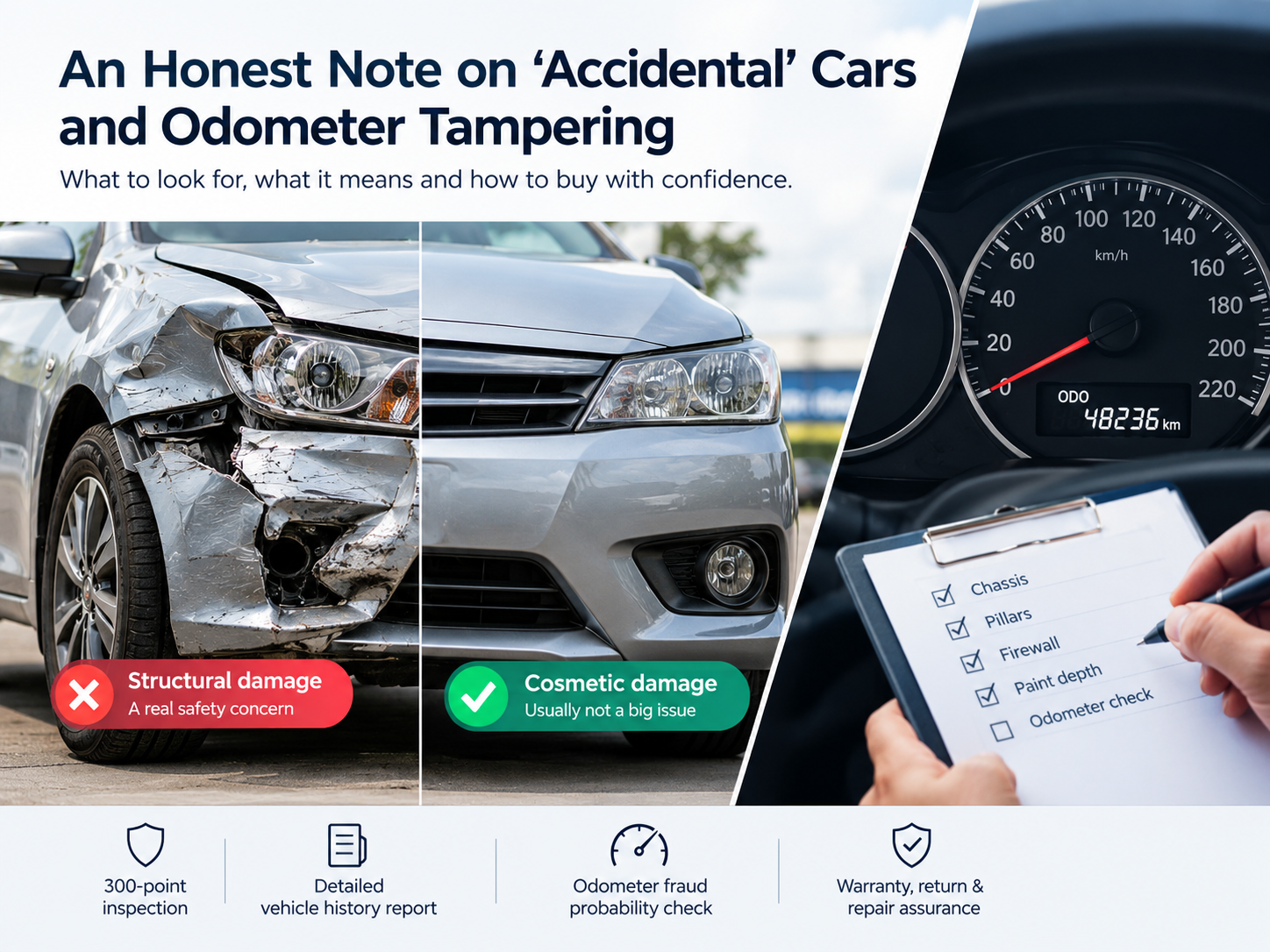
- Accident and flood history
- Mechanical condition: engine, gearbox, suspension, tyres and brakes
- Local demand for that model in that city
Prices of newer alternatives, including the current facelift
Features help a car sell faster. They do not hold their invoice value. A premium audio system improves appeal but will not recover what you paid for it. A sunroof attracts buyers but is still bolted to a depreciating vehicle. Larger alloys look sharp, yet the next buyer may be pricing in the replacement tyres.
Used Top Variant vs New Mid Variant: When the Maths Flips
Now turn the situation around.
The first owner of a top variant pays the full premium for every feature. They also absorb the steepest slice of depreciation, which happens in the first one to three years. The features, meanwhile, do not disappear. They are all still there when the car changes hands.
That is why a used top variant can be the smartest buy in the market. If a three-year-old top variant costs only modestly more than a comparable three-year-old mid variant, you are getting the fully loaded car after someone else has paid for the biggest drop in value. A ₹3 lakh gap when new can shrink to well under a lakh in the used market, depending on the model, city and condition. And a well-kept used top variant often costs about the same as a new mid variant of the same car.
The one rule you cannot break
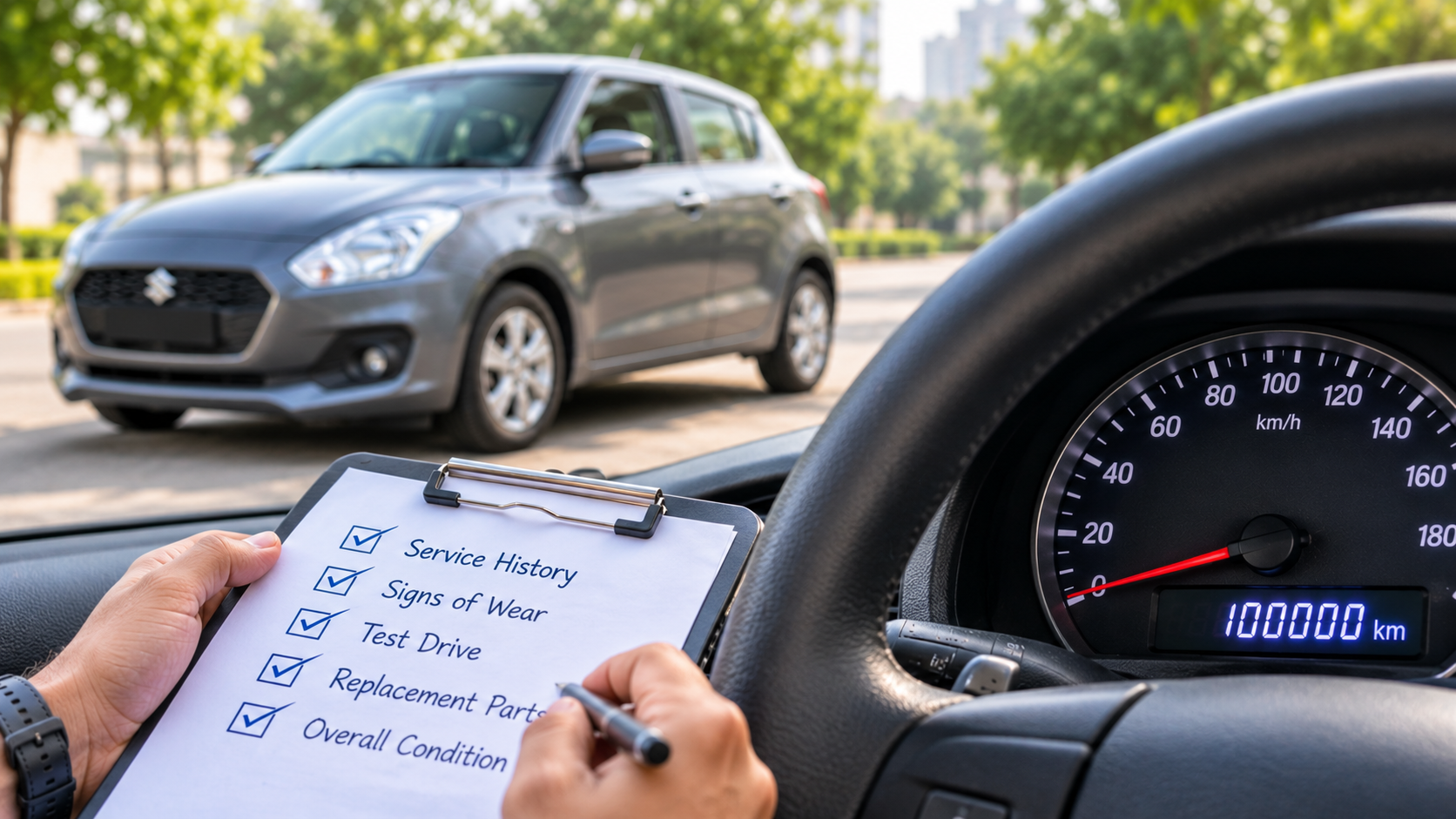
Compare like with like. A four-year-old top variant against a two-year-old mid variant is not a fair fight, and declaring the older car "a bargain" ignores two extra years of wear, warranty and remaining life. Before you compare, match:
- Model year and generation: a 2023 Brezza ZXI Plus is the pre-facelift car, so its feature list differs from the 2026 version
- Kilometres driven
- Ownership count
- Insurance and service history
- Accident and flood status
City of registration, since transfer and re-registration costs vary by state
Two more things to keep in mind. Used car loans generally carry a higher interest rate than new car loans, so run the EMI maths for both routes. And always buy from a source that gives you an inspection report and a return window; Cars24 lists its own stock cars with inspection details so you can buy a used car with the condition already on paper.
Which Top Variant Features Are Worth Paying For?
"Redundant" is too strong a word for most top variant features. A top variant is not automatically wasteful. Some upgrades materially improve ownership. Others look superb in the brochure and gather dust in real life.
The same feature can be functional for one buyer and ornamental for another. Use this table as a starting point.
| Feature | Earns its keep when... | Often underused when... |
| Automatic transmission | You drive in heavy city traffic daily | You mostly drive on open highways and enjoy a manual |
| Additional airbags, ESP, ADAS functions | Always; safety kit has value beyond resale | Rarely a waste, though check what is already standard |
| 360-degree camera, front sensors | You park in tight basements or narrow lanes | You park on an open driveway or street |
| Ventilated seats | You live somewhere hot and do long drives | Short city commutes with the AC already blasting |
| Rear AC vents | You regularly carry family in the back | You mostly drive alone |
| Cruise control | You do frequent long highway runs | Your driving is mostly stop-go city traffic |
| LED headlamps and fog lamps | You drive often at night or on unlit roads | Your driving is mostly daytime urban |
| Sunroof | You actually open it on pleasant days | It stays shut through summer, monsoon and pollution season |
| Larger touchscreen | You rely on inbuilt navigation and apps | You mirror your phone anyway, which a smaller screen does just as well |
| Ambient lighting, decorative trims | You value the cabin mood | You notice it for the first week |
| Larger alloy wheels | You like the look and accept the cost | Bigger tyres mean pricier replacements |
| Wireless charging | You make short hops and top up often | Some pads warm the phone and charge slowly |
Emotional value is real, and there is nothing wrong with paying for it. Just do not confuse it with resale value. They are not the same thing.
How to Choose the Right Car Variant: A 7-Step Checklist
- Write down your non-negotiables. Two or three features, not ten. Base them on how you actually drive and park.
- Find the lowest variant that has them. Check the official variant-wise feature list, not just the brochure highlights.
- Confirm the powertrain. Make sure the engine and gearbox you want are offered on that variant; some combinations exist only on certain trims.
- Compare on-road prices, not ex-showroom. Same city, same insurer, same add-ons, same day.
- Add the loan cost. Calculate the extra EMI and total interest on the price difference.
- Estimate resale. Assume the extra equipment will not return its full cost. Use a used car valuation tool on a three-year-old example of the same model to see real market gaps between trims.
Check the used market. Price a two- or three-year-old top variant of the same car against the new mid variant you are considering.
So, Should You Buy the Top Variant?
It depends on who you are. Here is a simple way to place yourself:
- Buy the top variant new if: you plan to keep the car for seven years or more, you will genuinely use most of the extra kit, or a safety or assistance feature you want is only offered on the top trim. Long ownership spreads the premium thin, and resale matters less.
- Buy the mid variant new if: you sell cars every three to five years, you mainly want the engine and gearbox, and you would rarely use the gadgets. You will lose less money to depreciation and interest.
Buy a used top variant if: you want the fully loaded experience on a mid variant budget, and you are willing to compare carefully on age, mileage and condition.
Ask yourself three questions before you sign: What am I paying for these features today? How much will I actually use them? What will they be worth when I sell? That is the difference between buying a top variant because the brochure impressed you and buying one because the numbers make sense.
Frequently Asked Questions
Expand all