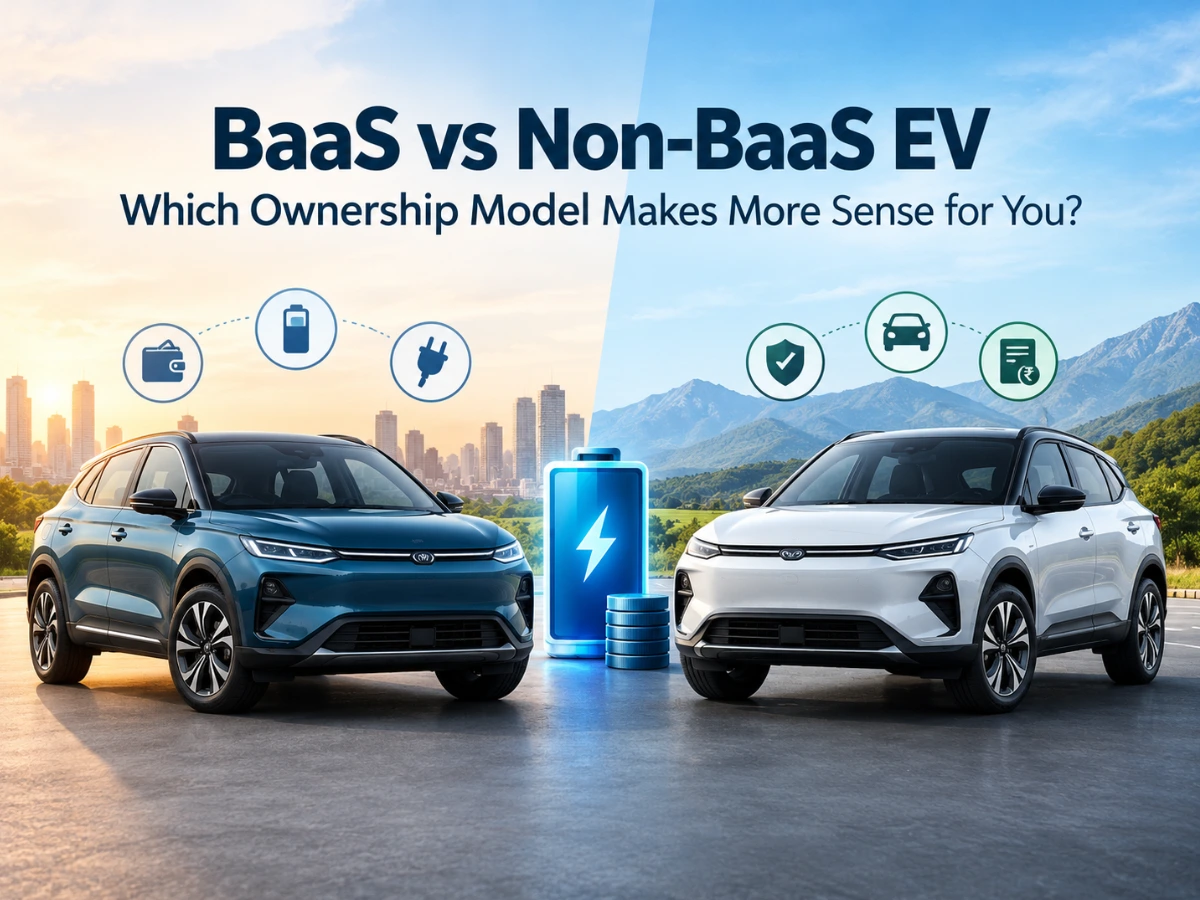
BaaS vs Non-BaaS Electric Car Purchase Model — Who Should Select What?
- 1BaaS lowers the upfront cost of an electric car
- 2BaaS involves separate battery payments
- 3Non-BaaS includes the battery in the vehicle price
- What Is BaaS in Electric Cars?
- BaaS vs Non-BaaS EV — Key differences
- How Does a BaaS Electric Car Work?
- What Is a Non-BaaS Electric Car?
- BaaS vs Non-BaaS — Which Has the Lower Upfront Cost?
- Who Should Choose a BaaS Electric Car?
- Who Should Choose a Non-BaaS Electric Car?
- How to Calculate the Real Cost of a BaaS EV
- BaaS Is Not the Same as Paying for Charging
- What Should You Check in a BaaS Agreement?
- BaaS vs Non-BaaS for Different Types of Buyers
- Does BaaS Make an EV Cheaper?
- Is BaaS Better Than Buying an EV With the Battery Included?
- BaaS vs Non-BaaS EV — Final Verdict
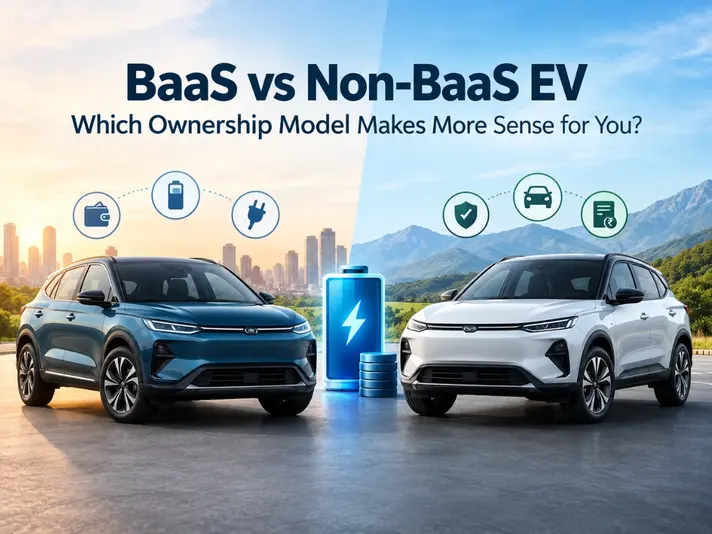
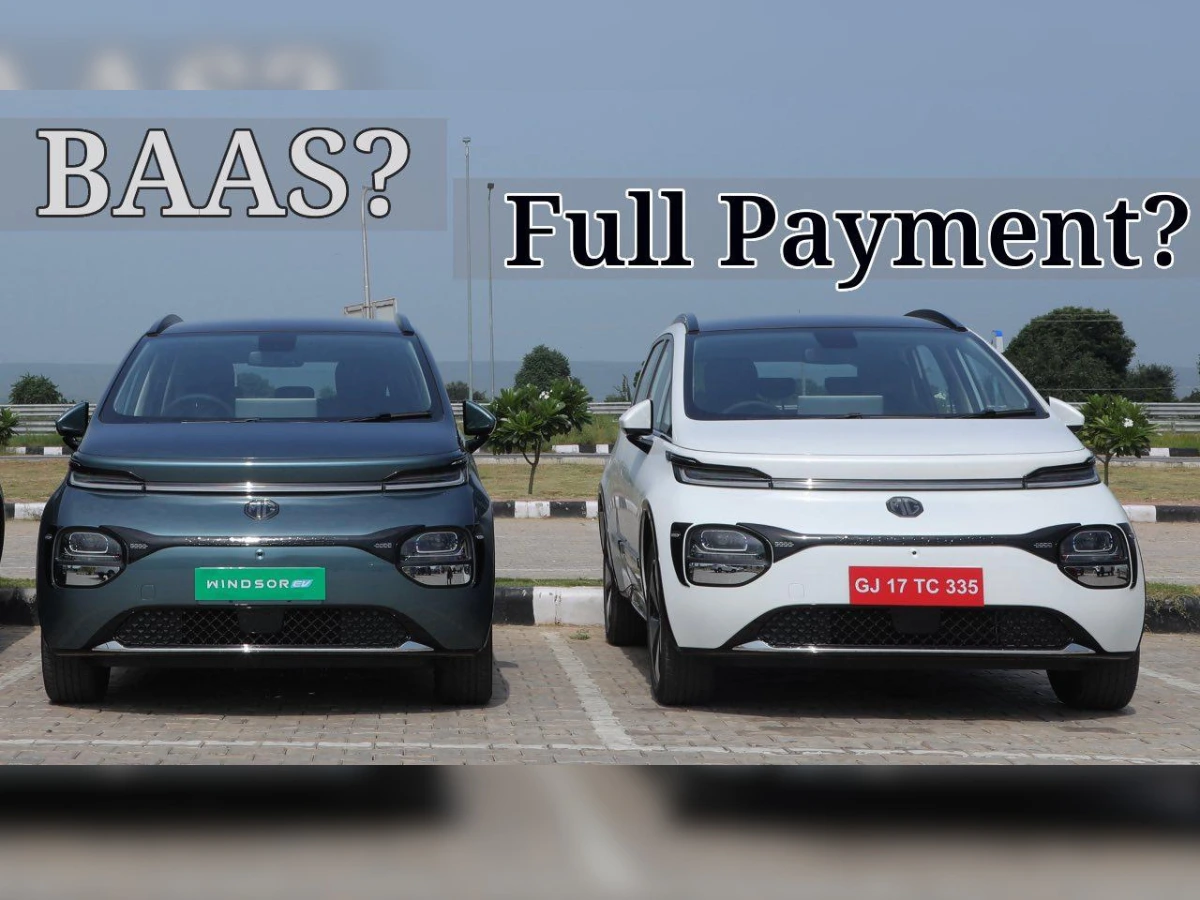
Today, electric cars can now be bought in India through two broad ownership models. In a conventional or Non-BaaS EV purchase, the battery is included in the car's price and the buyer owns the complete vehicle. Under Battery-as-a-Service (BaaS), the car's upfront price is lower because the battery cost is separated from the vehicle purchase. The buyer then pays for the battery through a separate subscription, rental or financing arrangement, depending on the manufacturer and financing partner.
At first glance, BaaS looks like an easier way to lower the cost of an electric car. However, the lower ex-showroom price does not automatically mean a lower total ownership cost. The battery payment, car EMI, charging cost, financing charges, tenure and annual running costs all need to be considered together.
So, BaaS can make more sense for buyers who want to reduce the initial purchase outlay or prefer to link part of their EV cost to usage. Non-BaaS can make more sense for buyers who drive high annual kilometres, want a simpler ownership structure or intend to keep the car for a long time.
What Is BaaS in Electric Cars?
BaaS stands for Battery-as-a-Service. In simple terms, it separates the battery from the conventional vehicle purchase. So, basically, a buyer need not pay the entire price of the vehicle up front. Instead, he or she has to make a lower initial payment to acquire the vehicle and then pay separately for the battery.
The exact amount one needs to pay for the battery is based on the BaaS structure; this scheme allows a vehicle owner to pay a lower upfront cost for the vehicle and pay separately for the battery. While exact calculations vary between schemes, this structure broadly allows an electric car owner to purchase the vehicle at a lower cost and then pay for the battery based on a per-kilometre charge, battery subscription model or a separate battery finance method.
By now, you must have understood that not all BaaS schemes are alike, but what’s common is that instead of paying the full price of an EV, including the cost of the battery, the buyer pays a lower cost of acquiring the vehicle and separately pays for the battery.
For example, some of the schemes use a usage-linked battery payment, while Mahindra's current BaaS programme describes the arrangement as a dual-financing structure in which the vehicle and battery are financed separately. Therefore, buyers should not assume that every BaaS EV simply means "pay for the battery only when you drive." The terms of the specific manufacturer's programme matter.
A conventional Non-BaaS EV works more like a normal car purchase. The battery forms part of the vehicle's price, and the buyer generally finances or pays for the complete vehicle through a standard purchase arrangement.
A Simple Example
Let’s say an electric vehicle costs ₹15 lakh with the battery included.
Under a conventional purchase:
- Car with battery: ₹15 lakh
- Battery ownership: Buyer
- Battery payment: Included in purchase/loan
- Charging: Paid separately
- No battery usage charge per kilometre
Now, let’s assume the same vehicle is available under BaaS for ₹11 lakh, with a separate battery charge of ₹3.50 per km. With this, the vehicle acquisition cost simply reduces by ₹4 lakh. However, now the buyer has to bear an additional battery-related charge based on the BaaS model. So, basically,
- At 1,000 km a month, ₹3.50 per km works out to ₹3,500 a month.
- At 2,000 km a month, it becomes ₹7,000 a month.
- At 3,000 km a month, the battery-related payment becomes ₹10,500 a month.
As this monthly payment is an addition to the upfront cost, the lower BaaS price of a vehicle should not be compared with the full EV price in isolation.
BaaS vs Non-BaaS EV — Key differences

| Factor | BaaS EV | Non-BaaS EV |
|---|---|---|
| Initial purchase price | Lower | Higher |
| Battery included in upfront vehicle price | Usually no | Yes |
| Battery payment | Separate | Included in vehicle purchase |
| Payment can depend on usage | Often, depending on scheme | No separate battery usage charge |
| Battery ownership | Depends on agreement | Buyer owns the complete vehicle |
| Charging cost | Paid separately | Paid separately |
| Car EMI | Usually separate from battery arrangement | Covers complete vehicle purchase |
| Ownership structure | More complex | Simpler |
| High annual running | Requires careful cost calculation | Usually easier to budget |
| Long-term ownership | Depends heavily on scheme terms | Generally more straightforward |
It must be noted that BaaS doesn’t reduce the overall cost of the vehicle, but modifies how you pay for the battery. It certainly doesn’t make the battery free.
How Does a BaaS Electric Car Work?
The exact BaaS model varies between carmakers and financing partners. However, the basic idea is pretty simple - the buyer selects an EV that’s offered with a BaaS purchase programme. With this, the carmaker quotes a lower vehicle acquisition price, as the payment of the battery is handled separately.
Next, the buyer of the vehicle gets into a battery usage agreement or a financial arrangement, depending on the BaaS programme on offer. Either this payment is calculated based on a per-kilometre basis or as a fixed EMI or subscription. Also, it must be noted that a buyer needs to separately pay for charging the battery. So, one must note that the BaaS payment and battery charging cost are two separate expenses.
For example, if an EV has a BaaS charge of ₹3.50 per km, the buyer pays that amount according to the scheme's terms and also pays the electricity bill for charging the battery. This means the effective running cost of a BaaS EV can be thought of as: Battery charge + electricity cost + maintenance + insurance + other ownership expenses. For a Non-BaaS EV, the comparable running-cost calculation generally excludes the separate BaaS charge: Electricity cost + maintenance + insurance + other ownership expenses. The initial purchase and financing costs, however, are different.
What Is a Non-BaaS Electric Car?
A Non-BaaS EV follows the more familiar ownership model, similar to what we see in ICE vehicles. The battery is part of the vehicle, and this means that its cost is included in the ex-showroom price. If the buyer takes a loan, the loan normally covers the complete vehicle purchase subject to the lender's terms. There is no separate battery subscription or per-kilometre battery charge.
This does not mean that the battery has no long-term cost implications. The battery is still one of the most important components of an EV, and its warranty, degradation coverage, replacement terms and resale implications should be understood before purchase.
However, from an ownership perspective, the structure is simpler. The buyer owns the car and battery together and does not have to track a separate battery payment every month or kilometre.
BaaS vs Non-BaaS — Which Has the Lower Upfront Cost?
BaaS almost always exists primarily to reduce the initial acquisition cost of an EV. This can make a substantial difference to buyers who are comfortable with the monthly or usage-linked battery expense but do not want to pay the entire battery cost at the time of purchase.
The lower upfront price can also affect the size of the initial down payment and the amount financed for the vehicle. However, the battery financing or subscription has to be considered separately.
This is where buyers can make a common mistake. Suppose:
- Non-BaaS EV price: ₹15 lakh
- BaaS vehicle price: ₹11 lakh
- Initial BaaS saving: ₹4 lakh
- Battery charge: ₹3.50/km
At first, BaaS appears to save ₹4 lakh.
- But after 50,000 km, the battery charge alone would amount to ₹1.75 lakh.
- At 80,000 km, it would reach ₹2.80 lakh.
- At 1 lakh km, it would reach ₹3.50 lakh.
This is only a simplified illustration. Actual ownership economics will also depend on financing interest, down payment, battery payment structure, taxes and the specific BaaS contract. Nevertheless, it shows why the upfront savings and the usage-linked cost need to be considered together.
Who Should Choose a BaaS Electric Car?

BaaS can be particularly relevant to a few types of EV buyers.
Buyers With a Tight Initial Budget
If the biggest obstacle to buying an EV is the upfront price, BaaS can bring a more expensive model into consideration. The lower entry price may make it possible to buy an EV without immediately financing the complete battery cost.
This is particularly relevant for buyers upgrading from an entry-level petrol or CNG car who may have a fixed budget for the initial purchase. However, the buyer should still calculate the complete monthly outflow rather than looking only at the headline BaaS price.
Buyers With Moderate or Predictable Running
A BaaS scheme can be easier to evaluate when annual usage is reasonably predictable. For example, someone who knows that the car will cover around 1,000-1,500 km a month can estimate the battery-related expense fairly easily if the scheme uses a per-kilometre rate. The calculation becomes more important if the buyer's running is much higher.
Buyers Who Prefer Lower Initial Capital Outlay
Some buyers may have the money to purchase an EV but prefer not to put a large amount into the vehicle upfront. For them, separating the battery cost can change the cash-flow profile of the purchase. This does not necessarily mean the total cost will be lower. It simply means that the cost is distributed differently.
Buyers Comfortable With a More Complicated Ownership Structure
There’s no denying the higher complications involved with the BaaS ownership model. The buyer needs to understand the payment rate, minimum monthly usage requirement (if any), excess kilometre cost (if any), foreclosure charges, ownership transfer charges and resale terms and conditions. Someone comfortable with this structure may find BaaS useful. A buyer who wants the simplest possible ownership arrangement may prefer a conventional EV purchase.
Who Should Choose a Non-BaaS Electric Car?
A Non-BaaS EV can be more straightforward for buyers whose priorities are different.
High-Kilometre Users
This is perhaps the most important group to evaluate carefully. If the BaaS payment is linked to kilometres, the battery expense rises as the car is driven more. A buyer covering 2,500-3,000 km every month should therefore compare the total battery payments over the intended ownership period with the additional upfront amount required for the Non-BaaS version.
High usage does not automatically make Non-BaaS cheaper in every case, because BaaS plans have different pricing and financing structures. But it makes the calculation significantly more important.
Long-Term Owners
If you plan to keep the EV for eight, ten or more years, the battery payment structure becomes a major part of the ownership equation. With a Non-BaaS EV, the battery is already part of the vehicle ownership. With BaaS, the buyer must understand what happens to the battery-related agreement over the full ownership period.
The terms governing continued payments, battery ownership, foreclosure and transfer can vary, so long-term buyers should examine the contract rather than assuming the BaaS arrangement automatically ends after a particular period.
Buyers Who Want Simple Ownership
The non-BaaS process of buying an electric car is far easier to understand. You purchase the entire car, including the battery. You may finance it if you wish, but whatever you pay is for the complete vehicle. There’s no requirement to make a separate payment for the battery. So, buyers looking for a simple ownership process instead of a lower initial purchase price can find the conventional model more appealing.
Buyers Concerned About Resale
Many car owners change their vehicles every few years. Resale isn’t as easy for a vehicle bought under the BaaS scheme. A used-car buyer may or may not be comfortable with the BaaS model. Also, the terms and conditions of BaaS transfer vary between carmakers.
On the contrary, with a conventional EV, the vehicle and battery are paid for as a whole by the original owner. Therefore, it gets easier to sell the vehicle. Hence, if an easier resale is important, buyers should opt for a non-BaaS model. Else, one needs to ask the carmaker about the clauses before opting for the BaaS model.
How to Calculate the Real Cost of a BaaS EV
The simplest way to compare BaaS with Non-BaaS is to stop looking at the headline ex-showroom price and calculate the total ownership cost.
Use this basic framework:
BaaS total cost = vehicle purchase/EMIs + battery payments + charging + maintenance + insurance + other applicable costs
For a Non-BaaS EV:
Non-BaaS total cost = vehicle purchase/EMIs + charging + maintenance + insurance + other applicable costs
Now calculate the battery component separately.
Example: 1,000 km Per Month
Assume a BaaS plan charges ₹3.50 per km.
At 1,000 km per month:
1,000 × ₹3.50 = ₹3,500 per month
Over five years:
60,000 km × ₹3.50 = ₹2.10 lakh
Example: 2,000 km Per Month
At 2,000 km per month:
2,000 × ₹3.50 = ₹7,000 per month
Over five years:
1,20,000 km × ₹3.50 = ₹4.20 lakh
The difference is substantial.
That is why the same BaaS plan can make very different financial sense for two buyers. A low-mileage owner may accumulate relatively modest battery payments, while a high-mileage user can accumulate a much larger amount. These calculations are illustrations, not a prediction of actual savings. The actual result depends on the BaaS fee, financing structure, tenure, minimum charges and other contractual terms.
BaaS Is Not the Same as Paying for Charging
This is one of the most important points to understand before buying a BaaS EV. BaaS does not mean you pay a single per-kilometre amount and everything else is covered. The battery-related payment and charging cost are separate.
For example, if a BaaS model levies a battery charge of ₹3.50 per km, the vehicle owner still needs to charge the vehicle and pay for the electricity. If you charge at home, the electricity cost is based on the tariff. Public EV chargers can cost a lot more, depending on the charging network.
Therefore, a buyer comparing BaaS with a petrol or CNG car should not treat the BaaS rate itself as the complete running cost of the EV. The same principle applies when comparing two EVs. A lower BaaS rate does not automatically mean a lower total running cost if the vehicles have significantly different energy consumption, charging requirements or ownership costs.
What Should You Check in a BaaS Agreement?
Before signing a BaaS agreement, buyers should look beyond the advertised per-kilometre figure.
Battery Payment Structure
Find out whether the battery charge is genuinely usage-linked, a fixed monthly payment, a separate EMI or a combination of financing and usage assumptions. Do not assume that every manufacturer uses the same structure.
Minimum Running Requirement
Some BaaS arrangements can be based on assumed or minimum usage. Therefore, one needs to check if it makes sense to pay a minimum amount if the monthly usage isn’t enough to justify the payment. This is especially important for secondary car buyers or those with a low monthly mileage.
Excess-Kilometre Charges
In case the BaaS scheme caps the maximum monthly charge, one should be aware of the additional charges in case the usage is exceeded in a particular month. Basically, someone who has a monthly usage capped at 1,000 kilometres should be aware of the extra charge if his usage ends up being, say, 1,100 kilometres.
Battery Warranty
Check who is responsible for the battery under the BaaS arrangement and what warranty or performance protection applies. Do not assume that battery ownership and battery warranty are the same thing.
Foreclosure
If you decide to settle the battery financing early, find out how the outstanding amount is calculated. This becomes important if you want to sell the car before the planned ownership period.
Resale and Transfer
Ask whether the BaaS arrangement can be transferred to the next owner. A second-hand electric car buyer might not want to buy a car with a battery-related agreement. Hence, the seller might need to make an expenditure by settling the outstanding amount before selling his vehicle.
Insurance and Other Charges
Check which costs are included in the quoted BaaS price and which are not. Insurance, road tax, charging equipment, maintenance and other statutory or ownership costs may remain separate.
BaaS vs Non-BaaS for Different Types of Buyers
| Buyer profile | More relevant model to evaluate | Main reason |
|---|---|---|
| Low annual running | BaaS and Non-BaaS | Compare fixed/minimum battery charges carefully |
| 1,000-1,500 km/month | BaaS may be worth evaluating | Lower initial outlay can be useful |
| 2,000+ km/month | Compare total cost closely | Usage-linked battery payments become significant |
| Very high annual running | Non-BaaS deserves close comparison | Avoid assuming BaaS remains cheaper as usage rises |
| Tight upfront budget | BaaS | Lower initial vehicle price |
| Long-term ownership | Non-BaaS deserves close comparison | Simpler ownership structure |
| Frequent resale | Non-BaaS may be simpler to evaluate | No separate battery agreement to transfer |
| Second/weekend EV | BaaS terms need careful checking | Minimum usage charges can matter |
| Buyer prioritising simple ownership | Non-BaaS | Battery is part of the vehicle purchase |
| Buyer comfortable with separate financing | BaaS | Can reduce initial capital requirement |
The above table just provides a basic idea of the differences between the two purchase models. The exact conditions will depend on the terms and conditions of the BaaS scheme one opts for.
Does BaaS Make an EV Cheaper?
Not really. If anything, BaaS makes acquiring an EV cheaper through a lower upfront cost. It doesn’t automatically make it cheaper to own a particular vehicle. This exact distinction is important to understand before a buyer chooses to opt for this model. In essence, the car buyer is exchanging the upfront cost of the battery for a regular monthly payment.
Whether that works in the buyer's favour depends on the battery charge, financing terms, annual running and ownership duration. A buyer who only looks at the headline BaaS price may therefore underestimate the total cost. So, basically, the right comparison is choosing between a lower upfront price through BaaS + monthly payments for the battery versus a higher acquisition price through Non-BaaS but with no other monthly payment for the battery.
A buyer should compare both options and choose as per the ownership experience he expects.
Is BaaS Better Than Buying an EV With the Battery Included?
There is no universal answer. BaaS addresses a different ownership requirement: reducing the upfront cost of an EV by separating the battery-related expense from the initial vehicle purchase.
Simply speaking, an EV buyer with limited upfront funds might find the BaaS ownership model more lucrative than someone who has sufficient funds and wants a simpler ownership. Also, electric car buyers with low monthly mileage and those high mileage will always have different ownership experiences from the same BaaS plan.
The most useful way to approach the decision is therefore not to ask whether BaaS is better than Non-BaaS. Instead, ask:
- How much do I drive every month?
- How long will I keep the car?
- How much can I comfortably spend upfront?
- What is the total battery payment over my expected ownership period?
- What happens if I sell the car early?
- Can the BaaS agreement be transferred?
- Are there minimum usage requirements?
- What happens if I drive more than expected?
- Who owns and warrants the battery?
- What are the foreclosure terms?
The difference between BaaS and Non-BaaS models becomes quite clear once the above questions are answered.
BaaS vs Non-BaaS EV — Final Verdict
BaaS is primarily an alternative way of financing and paying for an electric car, rather than a guarantee of lower ownership cost. It can be useful for buyers who want to reduce the initial price of an EV, have predictable running costs, and are comfortable managing a separate battery-related payment. It can also make certain higher-priced EVs more accessible to buyers who otherwise may not be comfortable with the complete upfront cost.
Non-BaaS remains the simpler ownership model. The battery is part of the car, there is no separate battery usage payment and the ownership structure is easier to understand. This can be particularly relevant to buyers who plan to keep their EV for many years or drive high annual kilometres. The key is to compare total ownership cost rather than headline price.
A BaaS EV costing several lakh rupees less upfront can still accumulate significant battery payments over a long period. Conversely, a buyer who drives relatively little may value the lower initial outlay more than the additional complexity of the arrangement.
So, before choosing between BaaS and Non-BaaS, calculate the cost for your expected monthly running and ownership period. If the lower upfront cost solves a genuine budget constraint and the battery payments remain comfortable, BaaS can be a practical ownership route. If simplicity, long-term ownership and predictable costs are more important, a conventional EV with the battery included may be easier to live with.
Stay updated with all the latest happenings & developments in the automotive world by joining our official AUTOVERSE WhatsApp community.