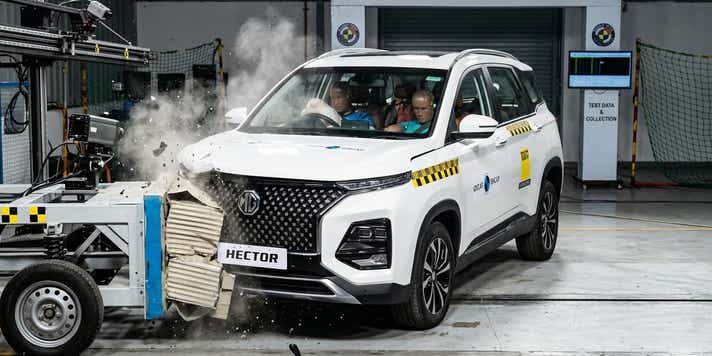
Decoding the MG Hector Safety Rating: Crash Tests, Platform, and Features Explained
- 1Currently awaiting official crash test scores from Global and Bharat NCAP
- 2Engineered with a high-strength steel platform for solid impact protection
- 3Higher variants are fully packed with six airbags and smart Level 2 ADAS
Buying a massive family SUV is a major life event. You want that commanding road presence. You want the panoramic sunroof and the giant touchscreens. But while the fancy things catch your eyes, nothing matters more than bringing your family home safely.
When it comes to the MG Hector safety rating, the car has not been officially crash-tested by either the Global NCAP or the newer Bharat NCAP, as of early 2026. So, how do you know if it is truly safe? We must dig deep into the fundamentals. We will examine its core steel platform. We will explore its standard safety kit and its active safety features. By the end of this guide, you will know exactly how the MG Hector protects your loved ones on the road.
How Will the MG Hector Be Tested?
While we await the official MG Hector Bharat NCAP crash test results, it helps to know what the SUV will face. The agency will crash the Hector at 64 km/h into a heavy deformable barrier. This mimics a severe, high-speed highway collision.
They will also strike the side of the SUV with a heavy metal trolley at 50 km/h. Finally, they will drag the car sideways into a solid steel pole. These tests push the metal frame to its absolute limit. High-tech dummies inside the cabin will record every single impact.
Decoding the Expected Crash Test Rating: What to Look For
When the MG Hector Global NCAP rating or Bharat NCAP scores finally drop, here is what you need to watch.
Adult Occupant Protection (AOP): This score will reveal how well the front airbags and seatbelts cushion the driver and passenger. A high score means the cabin absorbs the shock, keeping adult chests and heads safe from heavy pressure.
Child Occupant Protection (COP): The agency will check the ISOFIX mounts. A good child safety score means the child's car seat remains firmly locked in place without snapping forward during a sudden halt.
Bodyshell Integrity: This is the most crucial metric. We will finally learn if the MG Hector bodyshell integrity is 'stable' or 'unstable'. A stable rating means the steel cage will not crush inward during a horrific crash.
The Foundation: Analysing the MG Hector's Platform
A vehicle is only as safe as its skeleton. The MG Hector build quality is rooted in its global architecture. It is built on a modified version of the Baojun 530 platform. This structure was designed jointly by SAIC and General Motors.
The platform uses a heavy percentage of high-strength steel across the main pillars and the roof. This creates a rigid safety cage around the cabin. When a crash occurs, the front crumple zones are designed to crush and absorb the energy. The high-strength steel cabin then redirects that deadly impact away from your family.
Intra-Brand Comparison: How does it stack up inside the MG showroom? The smaller MG Astor and the MG ZS EV have both achieved perfect 5-star ratings in safety tests. Those cars use a different platform, but they prove that MG takes safety seriously for the Indian market.
Segment Comparison: How does the Hector compare to rivals? Cars like the Tata Harrier are famous for their tank-like build quality. While the Hector feels incredibly solid and heavy on the road, we simply need official crash test data to see if it can perfectly match the Harrier's proven 5-star platform.
Which Hector Variant Offers Maximum Safety?
Many buyers worry about the safety kit on cheaper models. If you buy the base model, are you compromising your family's safety?
For the Hector, the core metal structure remains the same across all trims. However, the airbag count changes. The base 'Style' variant offers dual front airbags. If you want maximum passive protection, you need to step up to the higher trims to unlock all six airbags.
MG Hector Base Model Safety Features vs. Advanced Features
Let us look at exactly what you get for your money.
| Feature Category | What You Get | Which Variant? |
| Standard Airbags | Dual Front Airbags | Base Variants |
| Advanced Airbags | 6 Airbags (Front, Side, Curtain) | Higher Variants |
| Braking Tech | ABS with EBD and All-Wheel Disc Brakes | All Variants (Standard) |
| Stability | Electronic Stability Control (ESC) | All Variants (Standard) |
| Child Safety | ISOFIX Child Seat Mounts | All Variants (Standard) |
| Active Safety | Level 2 ADAS (Adaptive Cruise, Auto Braking) | Top Variants |
The Non-Negotiables (Standard Features): MG does not compromise on braking and stability. Every single buyer gets all-wheel disc brakes for immense stopping power. Most importantly, Electronic Stability Control (ESC) and Traction Control are standard on every trim. ESC is brilliant. It stops the heavy SUV from skidding if you swerve suddenly to avoid a pothole on a rainy day.
Active vs. Passive Safety: Passive safety tools (like airbags) activate during a crash. Active safety tools try to prevent the crash entirely. The top variants of the Hector feature a cutting-edge Level 2 ADAS (Advanced Driver Assistance Systems) suite. This includes Auto Emergency Braking. If you are distracted and a car stops suddenly ahead, the Hector will literally slam the brakes for you to prevent a disaster.
MG Hector vs Tata Harrier Safety Rating & Competitors
The large SUV segment is extremely competitive. Let us see how Hector's safety kit stacks up against its fully tested rivals.
| Car Model | NCAP Score (Adult/Child) | Bodyshell Rating | Key Standard Safety Features | Starting Price |
| MG Hector | Not Yet Tested | TBD | Dual Airbags, ESC, Disc Brakes | ₹11.99 Lakh |
| Tata Harrier | 5 Stars (33.05 / 45.00) | Stable | 6 Airbags, ESC, Disc Brakes | ₹12.89 Lakh |
| Mahindra XUV7XO | 5 Stars (16.03 / 41.66) (XUV700)* | Stable | 6 Airbags, ESC | ₹13.99 Lakh |
| Hyundai Alcazar | Not Yet Tested | TBD | 6 Airbags, ESC, Disc Brakes | ₹16.77 Lakh |
*Note: XUV700 scores are based on the older Global NCAP testing protocols.
The Context: The MG Hector faces tough competition here. The Tata Harrier clearly wins the baseline safety battle by offering six standard airbags and a proven 5-star stable bodyshell right from the base variant.
Final Verdict: Should You Trust the MG Hector with Your Family?
If your absolute priority is owning a car with a certified, government-backed 5-star crash test rating, the Hector cannot give you that peace of mind just yet. We must wait for the official Bharat NCAP results. Rivals like the Harrier currently hold the proven structural crown.
However, the lack of a test score does not mean it is an unsafe car. The MG Hector is an incredibly heavy, solidly built SUV. Its platform uses high-tensile steel to protect the cabin. Furthermore, the standard inclusion of ESC and all-wheel disc brakes provides excellent high-speed stability.
If you opt for the higher variants, you are buying a technological fortress. With six airbags and an incredibly smart Level 2 ADAS system, the Hector is constantly watching the road to keep you out of trouble. For daily city commutes and relaxed family highway trips, it remains a highly secure, comfortable, and intelligent choice.
If you want to have a recognised 5-star safety but in a more affordable segment, look at the Kia Seltos Safety Rating.
Frequently Asked Questions
Expand all