Tata Tiago EV vs Petrol: The Ultimate 5-Year Ownership Cost Breakdown
- 1Home charging cuts Tiago EV running costs to under ₹1 per kilometre
- 2Tiago EV needs less routine maintenance ( no engine oil or spark plug replacements)
- 3Petrol Tiago offers more predictable resale value in the used car market
Every Tiago buyer eventually hits the same wall in the showroom. The EV costs more to drive home, but everyone keeps saying it costs less to actually run. So which is it? This Tata Tiago EV vs petrol ownership cost comparison skips the sales pitch and does the actual math, covering fuel, maintenance, insurance, and resale value over a full 5-year ownership period, not just the number printed on the brochure.
We're not going to stop at ex-showroom prices, because that's where most comparisons quietly give up. Instead, we'll calculate real running costs using current petrol rates and home electricity tariffs, factor in Tata's newly introduced Battery-as-a-Service plan, and work out the exact point where the EV starts paying for itself. By the end, you'll know your own break-even kilometre count, not just a generic answer.
Upfront Acquisition Costs & Insurance
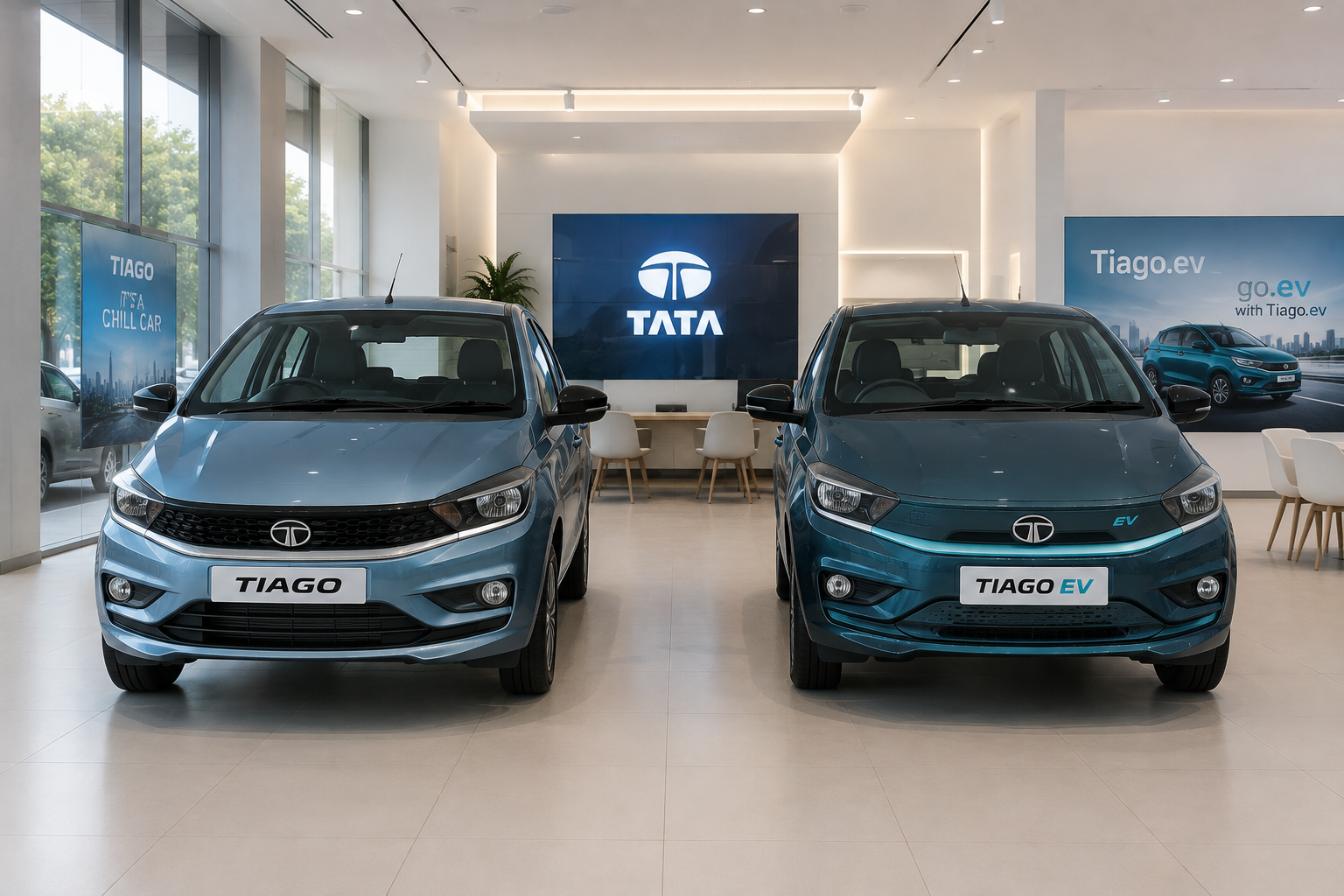
Start with the sticker price and the gap looks significant. The 2026 Tata Tiago petrol range runs from about 4.70 lakh to 8.55 lakh rupees ex-showroom, while the Tiago EV starts at 6.99 lakh and tops out at 9.99 lakh. That's a real premium of roughly 2 to 2.3 lakh rupees for a similarly specced EV, before you even add insurance or registration.
That gap narrows once you look past the ex-showroom number. EVs generally get a road tax waiver in most Indian states, since state governments are actively trying to encourage EV adoption, and EV insurance premiums also tend to run slightly cheaper than the petrol equivalent, since there's no engine to insure against certain mechanical claims. Own damage premiums on the Tiago EV typically come in a notch lower than the petrol Tiago's equivalent trim, mainly because there are fewer moving mechanical parts for an insurer to price risk against. None of this closes the price gap entirely, but it does shrink the effective on-road difference by a noticeable margin, often by ten to fifteen thousand rupees once you account for the first year's insurance and registration savings together.
Specific model match-ups worth comparing:
- The Base Match: Tiago Petrol Smart MT versus Tiago EV Smart 19.2 kWh, roughly a 2.3 lakh rupee gap ex-showroom
- The Mid-Spec City Commuter: Tiago Petrol Pure+ AMT versus Tiago EV Pure+ 24 kWh, where the EV premium typically stays in a similar range once you match features
The Fully Loaded: Tiago Petrol Creative+ AMT versus Tiago EV Creative+ 24 kWh, comparing the top trim of each lineup
The 2026 BaaS Financial Loophole
Here's the genuinely interesting bit that most comparisons miss entirely. Tata's 2026 Battery-as-a-Service plan, or BaaS, prices the Tiago EV Smart at around 4.69 lakh rupees, which lands almost exactly on top of the Tiago Petrol Smart MT's 4.70 lakh price tag. Under this Tata Tiago EV BaaS plan, you own the car and the battery outright from day one, but you pay a battery rental of roughly 2.6 rupees per kilometre driven, on top of your electricity costs.
The resulting dynamic flips the usual EV math on its head. Instead of paying a big upfront premium and slowly earning it back through cheaper fuel, a BaaS buyer starts at price parity with the petrol Tiago, then pays a per-kilometre fee that still works out cheaper than a litre of petrol. That means the break-even question mostly disappears for BaaS buyers, since there's no premium left to recover in the first place.
Fuel, Energy Costs & Daily Running
This is where the real Tiago EV vs ICE running cost gap shows up. With petrol currently sitting around 105 rupees a litre in most Indian cities, and the petrol Tiago returning a realistic 15 to 17 km per litre in mixed city and highway driving, your running cost lands around 6 to 7 rupees per kilometre.
Charge the Tiago EV at home, and the picture changes dramatically. Assuming a typical domestic electricity tariff of around 8 rupees per unit, a Tiago petrol mileage vs EV range comparison based on the 19.2 kWh pack's efficiency works out to roughly 70 to 80 paise per kilometre, nearly ten times cheaper than petrol. The 24 kWh pack behaves similarly on cost per kilometre, since the extra capacity mainly buys you range rather than changing efficiency.
That math only holds up if you're charging at home overnight on a standard AC charger. Lean on public DC fast charging regularly, and your per-unit rate can climb to somewhere between 15 and 22 rupees, which pushes your running cost closer to 1.5 to 2 rupees per kilometre. Still meaningfully cheaper than petrol, but nowhere near as dramatic a saving as home charging delivers.
Under the BaaS model, remember to add the 2.6 rupees per kilometre battery rental on top of your electricity cost. That brings total running cost to roughly 3.3 to 3.4 rupees per kilometre, still comfortably cheaper than the petrol Tiago's 6 to 7 rupees, just not quite as dramatic as outright EV ownership on home charging.
Routine Maintenance & Consumables
The Tiago petrol needs an oil change, oil filter, and general check every 15,000 km or 12 months, whichever comes first, with the first couple of services typically free of labour charges. Estimates from OEM sources and owner forums put the realistic 5-year Tiago EV vs petrol service cost for the petrol model somewhere between 20,000 and 30,000 rupees, excluding tyres, brake pads, and clutch wear.
| Item | Tiago Petrol | Tiago EV |
| Engine oil and filter | Required every 15,000 km | Not applicable, no engine |
| Spark plugs and air filter | Replaced around every 45,000 km | Not applicable |
| Brake pads | Wear normally, replaced as needed | Last longer thanks to regenerative braking, which uses the motor to slow the car and reduces mechanical brake wear |
| Coolant | Engine coolant changed periodically | Battery thermal management coolant checked periodically |
| Clutch (manual only) | Wears with use, eventual replacement | Not applicable, single-speed transmission |
| Estimated 5-year service cost | Roughly 20,000 to 30,000 rupees | Roughly 15,000 to 25,000 rupees, varying by source |
The Tiago EV's service schedule runs every 7,500 km or 6 months, more frequent on paper, but each visit is quicker and cheaper since there's no oil, no spark plugs, and no exhaust system to inspect. Ziptron, Tata's name for its EV powertrain and battery management technology, is designed to need minimal routine intervention beyond basic checks and software updates.
Battery Degradation & Long-Term Risks
The single biggest fear for any EV buyer is battery replacement cost, and it's a fair concern. Tata addresses this with a lifetime, unlimited-kilometre battery warranty for the first registered owner on the Tiago EV's 24 kWh variant, which meaningfully reduces your financial exposure if the pack degrades faster than expected. If you're considering the smaller 19.2 kWh variant, it's worth confirming the exact warranty terms with your dealer, since Tata's communications have specifically highlighted the 24 kWh pack for this lifetime coverage.
Real-world battery degradation over 5 to 7 years typically shows up as a gradual reduction in usable range rather than a sudden failure, and most owners report losing a modest percentage of original capacity within that window under normal use. Outside of warranty, a Tiago EV battery replacement cost could run into a few lakh rupees depending on pack size, which is exactly why that lifetime warranty matters so much to your total cost of ownership.
The petrol Tiago carries its own version of this risk further down the line. Major mid-life work like a clutch replacement, suspension bushings, or a full exhaust overhaul past the 80,000 to 100,000 km mark can add up, though these costs tend to arrive gradually rather than as one large bill.
Depreciation & Resale Value
The used petrol hatchback market in India is mature and predictable, and a well-maintained Tiago petrol tends to hold its value in a fairly stable, well-understood curve. The used EV market is still finding its footing, and early generation electric cars have generally shown a steeper initial depreciation curve than their petrol equivalents.
Part of this comes down to tech obsolescence. As battery technology and range figures improve with each new EV generation, older packs can look less desirable to used buyers, even if they still function well. There's also a subtler issue specific to the Tiago EV: that lifetime battery warranty applies to the first registered owner only, so a second owner buying used loses that safety net, which could suppress resale demand until Tata clarifies whether extended coverage is available for subsequent owners.
None of this means the Tiago EV is a poor resale bet, just a less predictable one for now. As more EVs enter the used market and buyers get comfortable evaluating battery health the way they already evaluate engine condition, this gap should narrow. For the next few years, though, budget for the possibility that your Tiago EV may depreciate somewhat faster in percentage terms than an equivalent petrol Tiago, even though your running costs stayed lower throughout ownership.
Final Verdict: Finding Your Break-Even Point
Buy the Tiago EV if:
- You drive more than roughly 40 to 50 km a day and can charge at home overnight
- You're comparing options among the best electric car under 10 lakh rupees and want the lowest possible running cost
You're open to the BaaS plan, which removes almost all of the upfront price gap versus petrol
Buy the Tiago Petrol if:
- Your daily driving stays under 20 to 25 km, where fuel savings take too long to offset the EV's upfront premium
- You regularly drive long highway stretches where charging infrastructure is still patchy
You want the most predictable, well understood resale value in five years' time
As a rough rule of thumb, once your daily driving crosses about 40 km with reliable home charging access, the Tiago EV vs petrol comparison tips clearly in the EV's favour within a 5-year ownership window. Below that threshold, the dependable, well-proven petrol Tiago remains the financially sound default, especially for buyers who value predictable resale value over cutting-edge running costs.
Frequently Asked Questions
Expand all