The Ultimate Land Rover Buying Guide in India: From Evoque to Defender
- 1The Evoque and Discovery Sport are the most accessible Land Rover models
- 2Choose between the Velar and Range Rover Sport based on design or performance
- 3Learn the differences between the Defender 90, 110, and 130
- The Gateways: Range Rover Evoque and Discovery Sport
- The Mid-Tier Luxury and Performance: Velar and Range Rover Sport
- The Off-Road Purists: Defender and Discovery
- The Ultimate Pinnacle: The Range Rover Flagship
- The Land Rover Persona and Capability Matrix
- Ownership Experience, Reliability, and After-Sales in India
- Which Land Rover model should I buy in India?
Walk into a Land Rover showroom in India with a budget in mind, and you will likely walk out more confused than when you entered. The badge covers everything from a compact city SUV to a three-row off-roader with a wading depth deep enough to cross a flooded street. That range is why so many buyers need a proper Land Rover buying guide India shoppers can actually follow.
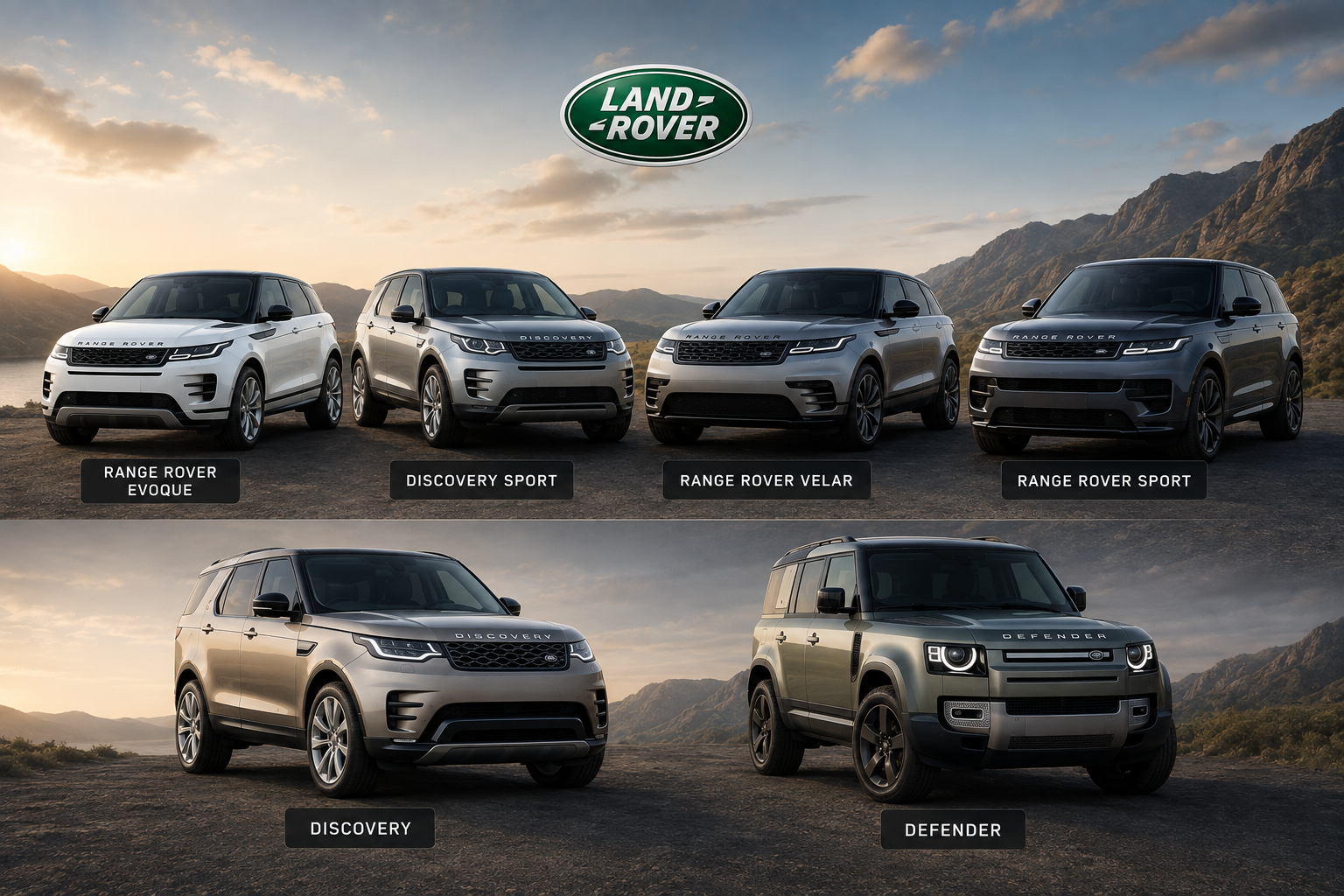
The confusion makes sense once you understand the brand's structure. Land Rover in India is really three families wearing one badge. The Range Rover line chases refinement and road presence, the Discovery line is built around family practicality, and the Defender carries the brand's original off-road DNA into a modern, monocoque body. This Land Rover lineup explained guide walks through every tier, from the Range Rover vs Defender question buyers ask most often, down to the specific model that fits your budget and how you actually plan to drive it.
The Gateways: Range Rover Evoque and Discovery Sport
For most first-time Land Rover buyers in India, the decision starts and ends with these two. Both sit in a similar price bracket, both are built for city use with occasional weekend trips, and both wear the badge without demanding a flagship budget. A straight Range Rover Evoque vs Discovery Sport comparison usually comes down to style versus space, so it helps to know exactly what you are trading off.
The Entry Level: Evoque vs Discovery Sport
The Range Rover Evoque is the style pick. Its coupe-like roofline and tighter cabin favour couples and young families who care more about how the car looks than how many bags it can swallow. The Discovery Sport, by contrast, is the practical sibling, with a boxier shape, a genuinely usable third row in some configurations, and more headroom in the second row.
Pricing for both currently sits in the range of roughly Rs 63 lakh to Rs 70 lakh ex-showroom depending on variant, which also answers the cheapest Land Rover car price in India question most first-time buyers start with. Land Rover has signalled that the Discovery Sport nameplate may eventually be phased out as the brand moves toward its newer EMA-based platform, so it is worth confirming current availability with a dealer before you commit.
Is Range Rover Evoque a good family car?
Mostly yes, with a caveat. The Evoque comfortably seats a family of four with luggage for a weekend trip, and its raised seating position gives parents a good view of the road. Where it struggles a little is third row or bulky stroller duty, since its sloped roofline eats into rear headroom and cargo height more than the Discovery Sport does. If your family regularly travels with grandparents or needs flexible seating, the Discovery Sport is the safer bet between the two.
Both cars share Ingenium engines, JLR's modern turbocharged petrol and diesel engine family designed for a balance of efficiency and refinement. Neither is built for serious off-roading, but both come with a Terrain Response System, an electronic mode selector that adjusts throttle response and traction settings for mud, sand, or snow, which is genuinely useful during Indian monsoons even on tarmac.
The Mid-Tier Luxury and Performance: Velar and Range Rover Sport
Step up a rung, and the Range Rover Velar and Range Rover Sport take over. This is where design starts to matter as much as capability, and where buyers usually have a clearer sense of what they want from the car.
The Style/Pace Clash: Velar vs Range Rover Sport
Framed as a straight Range Rover Velar vs Sport contest, this comparison usually splits buyers along one line: design lovers pick the Velar, while performance-minded buyers lean toward the Sport. The Velar is the design statement of the pair, with a minimalist cabin, flush door handles, and a lower, sleeker stance than anything else in the Range Rover family. It is priced from roughly Rs 87 lakh onward and works well as a daily driver that still turns heads outside a five-star hotel or a weekend resort.
The Range Rover Sport, priced from around Rs 1.43 crore and climbing well past Rs 2 crore for performance-oriented SV trims, is the sportier and more powerful option. It borrows heavily from the flagship Range Rover's platform and cabin architecture, then adds sharper steering and stronger engine options on top. If you want genuine performance alongside luxury, the Sport pulls ahead. If you want the most striking design in a slightly smaller footprint, the Velar remains the more interesting car.
Both models get air suspension as standard on most trims, which automatically adjusts ride height and stiffness for speed and road surface. This is a noticeable difference from a mainstream luxury SUV, since ride quality changes on the move rather than staying fixed.
The Off-Road Purists: Defender and Discovery
This is where Land Rover's engineering heritage shows up most clearly, and where the brand's original reputation for going anywhere still holds up.
The Heritage Battle: Full-Size Discovery vs Defender
The Discovery is the seven-seat family off-roader, priced from roughly Rs 1.25 crore to Rs 1.37 crore, and built around comfort first. It rides on a comfort-tuned suspension and prioritises a plush, quiet cabin even when the terrain gets rough. The Defender takes a more direct approach, with a stiffer setup, boxier proportions, and a character that leans into its off-road identity rather than smoothing it over.
Structurally, both use a monocoque body rather than the ladder frame chassis older Land Rovers relied on. A ladder frame is a separate rigid steel frame with the body bolted on top, tough but heavy. A monocoque integrates the body and structure into one stiffer shell that is generally lighter and more composed on paved roads. Land Rover says the current Defender's structure is meaningfully stiffer than the ladder frame model it replaced, though independent long-term durability data on Indian roads is still limited since this generation only launched a few years ago.
Land Rover Defender 90 vs 110 vs 130
The Defender comes in three distinct body lengths, and the difference is bigger than a simple trim change. The 90 is the short wheelbase, tighter-turning, five seat version built for buyers who want maximum manoeuvrability without giving up off-road hardware. The 110 is the volume seller in India, with five doors and an optional 5+2 seating layout for occasional third row use. The 130 stretches the wheelbase further still, making a proper three-row layout standard rather than optional, at the cost of some off-road agility in tight trails.
Every current Defender runs on JLR's Ingenium engine family, paired with an eight-speed automatic gearbox, and offers a maximum wading depth of around 900mm, roughly waist deep, a figure worth remembering if your city floods during monsoon season. Interestingly, the Defender is the one Land Rover model in India still imported as a fully built unit rather than assembled locally, which brings us to a keyword worth addressing directly.
Local assembly Land Rover price difference
Most other Land Rover models sold in India, including the Evoque, Discovery Sport, Velar, and Range Rover Sport, are assembled locally through CKD, or completely knocked down, kits at Tata's Pune facility. This local assembly meaningfully reduces import duty compared to a fully built unit, which is part of why the Defender carries a noticeably steeper price than its size and features alone would suggest. If landed cost matters to you, favour the CKD assembled models over the Defender's CBU import route wherever the two are otherwise comparable.
The Ultimate Pinnacle: The Range Rover Flagship
At the very top of the lineup sits the Range Rover itself, priced from around Rs 2.4 crore and stretching well past Rs 4 crore for long wheelbase and SV Special Vehicle Operations variants. SV, in Land Rover's language, refers to bespoke, hand-finished trims built in smaller volumes with extensive personalisation options.
The flagship's long wheelbase, or LWB, variant adds meaningful rear leg room and is the version most chauffeur-driven owners in India choose. Inside, most current Range Rover models run Pivi Pro, JLR's newer infotainment system built around faster response times and cleaner menus than the software it replaced. The flagship remains the brand's showcase for cabin refinement, sound insulation, and effectively silent ride quality, qualities that matter more here than outright off-road ability, even though the vehicle can still hold its own away from tarmac.
Chauffeur-driven Land Rover options
If you are buying primarily to be driven rather than to drive, the long wheelbase Range Rover is the obvious starting point, followed by the standard wheelbase Range Rover Sport for buyers who want a smaller footprint with similar comfort. The Discovery is a reasonable third option for chauffeur duty when the priority shifts toward carrying a full family rather than maximum plushness for two rear passengers.
The Land Rover Persona and Capability Matrix
| Model | Ideal Buyer Persona | Seating Layout | Max Wading Depth | Primary Driving Focus |
| Evoque | Urban, fashion conscious | 5 | Approx. 500mm | Agility |
| Discovery Sport | Young family, first Land Rover buyer | 5 or 5+2 | Approx. 600mm | Comfort with practicality |
| Velar | Design-focused executive | 5 | Approx. 650mm | Agility and style |
| Range Rover Sport | Performance-minded executive | 5 | Approx. 850mm | Performance and comfort |
| Defender (90/110/130) | Hardcore overlander, adventure family | 5, 5+2, or 7 | Approx. 900mm | Trail capability |
| Discovery | Large family, weekend off-roader | 7 | Approx. 900mm | Maximum comfort with off-road ability |
| Range Rover (flagship) | Chauffeur-driven executive | 5 | Approx. 900mm | Maximum comfort |
Wading figures above are approximate and vary slightly by model year and configuration, so treat them as a general guide rather than a certified number for any specific unit.
Ownership Experience, Reliability, and After-Sales in India
Land Rover maintenance cost India buyers should budget for is genuinely higher than mainstream luxury brands, largely because of specialised parts, synthetic fluids, and labour that requires factory-trained technicians. Routine services on entry models can run into tens of thousands of rupees, while flagship Range Rover and Defender models push considerably higher once the vehicle is out of its factory warranty period.
An extended warranty is worth serious consideration here. Land Rover's standard warranty typically runs a few years from purchase, and one major repair after that window closes can outweigh what an extended plan would have cost. International reliability data has historically flagged Land Rover for above-average repair frequency, though newer platforms show improvement, and Indian ownership patterns do not always mirror that data exactly.
The service network is the other practical consideration. Land Rover's Indian footprint stays concentrated in metro and tier one cities, with only a few dozen authorised sales and service outlets covering roughly fifteen cities nationwide. Tier two buyers should plan for longer drives to scheduled service before assuming ownership will be as convenient as it is in Delhi, Mumbai, or Bengaluru.
Which Land Rover model should I buy in India?
If budget is the strict priority, the Discovery Sport or Evoque are your entry points, with the Discovery Sport offering more everyday practicality per rupee. If maximum off-road capability matters most, the Defender 110 is the sensible middle ground between the tighter 90 and the longer 130, unless you specifically need three-row seating as standard.
For most Indian families who want one Land Rover that does almost everything well, the Discovery remains the best Land Rover for family use, combining seven-seat practicality with genuine off-road ability and a comfort-focused ride. Buyers chasing pure prestige and chauffeur comfort should look straight at the long-wheelbase Range Rover, while anyone torn between design and performance in the mid-tier should let the Velar versus Range Rover Sport decision come down to whether style or outright pace matters more to their daily drive.
Whichever tier fits your budget and driving style, confirm current on-road prices, wading and towing figures, and warranty terms directly with a dealer before signing, since Land Rover's India lineup continues to shift as new platforms and facelifts roll in through 2026 and beyond.