What Is Battery Regeneration In Electric Cars? How To Use Regen Braking To Increase Range
- 1Regenerative braking recovers some energy when an electric car slows down
- 2Electric motor works as a generator to convert motion into electricity
- 3Higher regeneration settings can be useful in congested city traffic
- What Is Battery Regeneration In An Electric Car?
- How Does Regenerative Braking Work?
- Does Regenerative Braking Charge The Battery?
- How To Use Regen To Increase EV Range
- Benefits Of Regenerative Braking
- Is Regenerative Braking Bad For The Battery?
- What Is The Difference Between Battery Regeneration And Battery Reconditioning?
- The Bottom Line
In the Indian market, electric vehicles are becoming more and more popular for a number of reasons, including the growing cost of new cars, their comparatively greener fuel alternative, and their ability to lower operating expenses.
One of the main benefits of purchasing an electric vehicle (EV) is that it may recover part of the energy wasted when slowing down. This is where regenerative braking, or "regen," becomes useful. An EV may use its electric motor to slow down while producing electricity, in contrast to an internal combustion engine (ICE) car, where braking mainly turns the vehicle's kinetic energy into heat. After that, it is returned to the battery so the vehicle can be powered once more.
While you're driving, it sounds almost like the car is charging itself, and in some ways, that's exactly what occurs. Regenerative braking does not, however, replenish all of the energy used to move your automobile, nor is it a replacement for charging it. What is battery regeneration, how does it function, and how can you use it to extend the range of each charge? Let's find out.
What Is Battery Regeneration In An Electric Car?

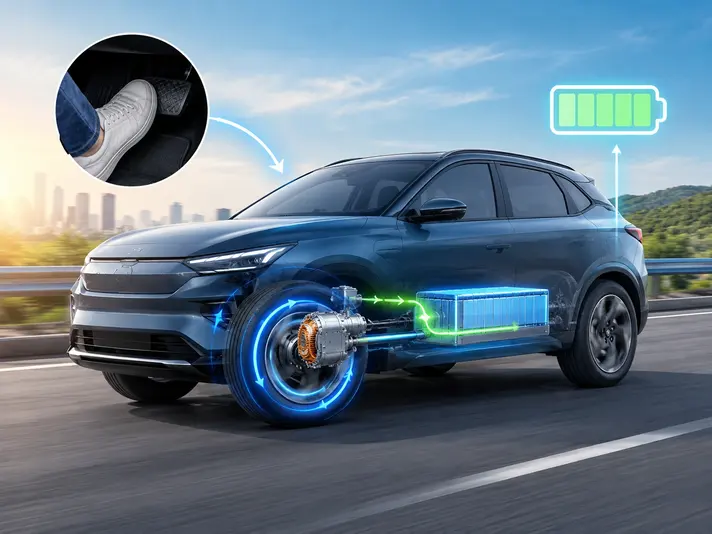
Battery regeneration is the process of replenishing the battery with some of the energy produced as an electric vehicle slows down. Another more popular name for it is “regenerative braking.” The EV uses electricity from its battery to power the motor and move the wheels whenever it accelerates. It increases its kinetic energy – the energy an object has due to motion – as it accelerates.
A large portion of that kinetic energy is transformed into heat at the brake discs and pads when using traditional friction brakes to slow down. Instead, an electric motor can recover some of that energy through regenerative braking.
The method is also utilised in hybrid vehicles, where the recovered electricity can support the electric motor and aid in charging the hybrid battery. Regenerative braking in an EV can increase overall efficiency, lower energy consumption, and help increase driving range, especially in situations when frequent slowing down is necessary.
Also read: BaaS vs Non-BaaS Electric Car Purchase Model
How Does Regenerative Braking Work?
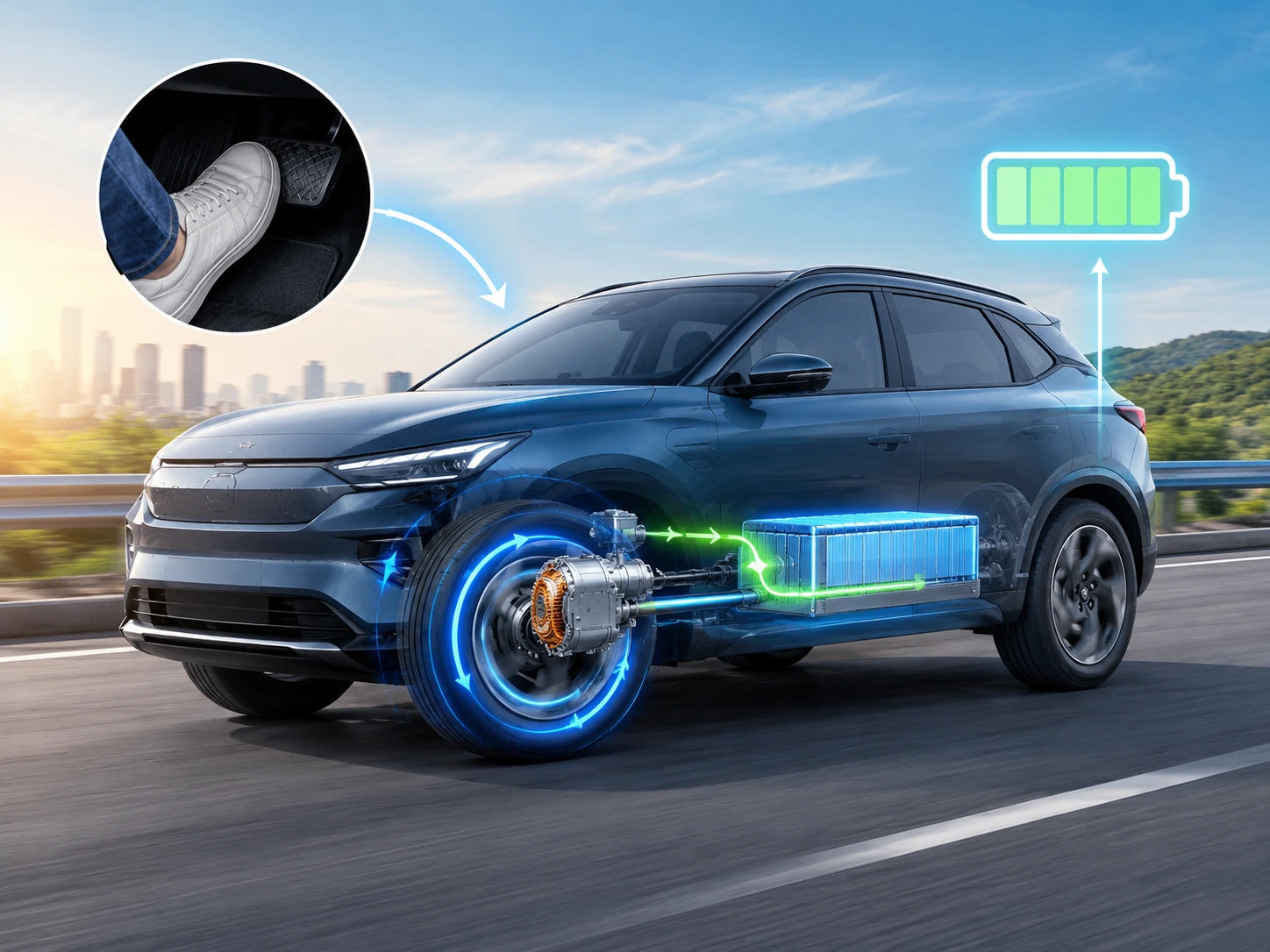
In addition to using electricity to create motion, an electric motor can also function as a generator, transforming mechanical energy into electrical energy. To make things easier for you to grasp, let's briefly go over the complete procedure:
A car is in motion when the battery powers the motor, which rotates the wheels and advances the vehicle. The car gradually slows down when you apply the brakes or remove your foot from the accelerator, and the regenerative braking system signals you to slow down.
The motor, which functions as a generator and transforms some of the vehicle's kinetic energy into electrical energy, is powered by the rotating wheels. The recovered energy is regulated by the vehicle's power electronics before the battery accepts it. The motor can then be powered by the stored electricity, lowering the quantity of energy the vehicle must require from the battery.
This is, however, just a very simplified way of explaining how regenerative braking works, and the actual process is far more complex. The motor controller, battery management system and braking system continuously work together to manage energy recovery safely. It's important to remember that not all the energy can be recovered. Some is lost through electrical and mechanical inefficiencies, while aerodynamic drag, tyre resistance and other forces also dissipate energy as the car moves.
Does Regenerative Braking Charge The Battery?
Yes, the EV's high-voltage battery receives some of the recovered energy from regenerative braking. Nevertheless, the battery is not charged in the same manner as when the vehicle is connected to an AC or DC charger.
Instead of creating new energy, you may think of it as recovering some of the energy the car already possesses. Although the system can increase efficiency, it cannot eliminate the requirement for external charging or offer an infinite range.
Additionally, when the battery is almost fully charged or too hot or cold to absorb energy at the necessary rate, regeneration may be restricted. The amount of energy that can be recovered in these circumstances is managed by the vehicle's battery management system.
How To Use Regen To Increase EV Range
When utilised to increase an electric car's range, regenerative braking can be quite helpful, especially in urban areas where there are many opportunities to slow down due to traffic lights, congestion, and frequent speed changes.The secret is to prevent losing energy in the first place rather than just choosing the strongest regeneration level and leaving it there.
To get the most out of regenerative braking, consider the following best practices:
1. Prepare for traffic and gradually slow down
Instead of accelerating until the very last second and braking hard, release the pedal early if you see a red traffic signal or a line of cars ahead. It helps you keep a smoother driving rhythm while allowing the regenerative braking system to recover some energy.
2. Select the Appropriate Regen Setting
Many EVs have regenerative braking that can be adjusted, giving drivers control over how much the vehicle slows down when the accelerator is released.
| Regen setting | When it can be useful |
|---|---|
| Low regeneration | Open roads where you want the car to coast more freely |
| Medium regeneration | Everyday driving and mixed traffic |
| High regeneration | Congested roads with frequent slowdowns |
| Automatic regeneration | Wherever supported, where traffic and road conditions change frequently |
| One-pedal driving | Slow-moving traffic, where the system allows acceleration and deceleration to be managed mainly through the accelerator pedal |
The names and operation of these settings vary between manufacturers. Refer to your car's owner's manual to understand the available options.
3. Avoid Hard Acceleration Followed By Hard Braking
Regenerative braking only recovers a portion of the energy used to accelerate the car. Repeatedly accelerating aggressively and then braking wastes energy even when regeneration is available. Smooth acceleration, sensible speeds and anticipating traffic are generally better for efficiency.
4. Make Use Of Downhill Sections
When driving downhill, gravity can help keep the vehicle moving. Regenerative braking can recover some of that energy while helping control the car's speed.
5. Don’t Expect Maximum Regeneration With A Full Battery
If the battery is fully charged, the vehicle may reduce regenerative braking because there is limited capacity to accept additional energy. You may notice weaker deceleration when lifting off the accelerator. Always leave enough room to slow down safely, especially after a full charge or on a long descent.
6. Maintain A Steady Speed On Highways
On highways, there are generally fewer opportunities to recover braking energy because the car spends more time travelling at a relatively constant speed. Maintaining a steady, legal speed and avoiding unnecessary acceleration and braking can therefore be more useful than repeatedly slowing down to regenerate electricity.
Benefits Of Regenerative Braking
Regenerative braking offers several benefits beyond recovering energy that are as follows:
- Improved efficiency: It recovers a portion of the vehicle's kinetic energy that would otherwise be lost during deceleration.
- Potentially better range: The recovered energy can reduce the amount of electricity drawn from the battery over a journey.
- Reduced brake wear: Since the friction brakes may be used less frequently, brake pads and discs can last longer, depending on driving conditions.
- Convenient driving: Adjustable regeneration and one-pedal driving can reduce the need to move repeatedly between the accelerator and brake pedals.
- Useful on downhill roads: The system can recover some energy while helping control the vehicle's speed.
That said, the benefits vary depending on the EV, its regeneration system, the route and the driver's habits. Regeneration is not a guarantee of a particular increase in range.
Also Read: EV vs PHEV — Who Should Buy What?
Is Regenerative Braking Bad For The Battery?
No, regenerative braking is a normal part of an EV's operation and is designed to work within the battery's operating limits. The battery management system regulates incoming energy based on factors such as temperature and state of charge. If the battery cannot accept energy at the required rate, the vehicle may limit regeneration.
Like any charging process, energy recovery involves battery cycling. However, regenerative braking should not be confused with an uncontrolled charging method or a battery-repair procedure. If you notice a sudden or persistent change in regenerative braking behaviour, check the vehicle's warning messages and owner's manual, and contact an authorised service centre if necessary.
What Is The Difference Between Battery Regeneration And Battery Reconditioning?
While both these two terms can sound similar, they describe different processes. Here’s how different the two really are:
| Parameter | Regenerative braking | Battery reconditioning |
|---|---|---|
| Purpose | Recovers some energy while a vehicle slows down | Attempts to improve the condition or performance of a deteriorated battery |
| Where it is used | Electric vehicles and many hybrids | Certain conventional batteries and specialised battery-service applications |
| How it works | Uses an electric motor as a generator | Depends on battery chemistry and the reconditioning method |
| Does it charge the battery? | Returns the recovered energy to the battery | May involve charging, testing or other procedures |
| Can it restore a worn-out battery completely? | Not applicable | No guarantee; results depend on the battery’s condition and chemistry |
Battery reconditioning is not a universal fix for degraded batteries. In particular, the methods used for lead-acid batteries must not be assumed to work for lithium-ion EV traction batteries.
The Bottom Line
Regenerative braking is one of the features that makes an electric car more efficient. It recovers some of the energy that would otherwise be lost during deceleration, can help improve driving range and may reduce wear on conventional brakes.
The best results come from combining suitable regeneration settings with smooth acceleration, early deceleration and steady driving. It is not a substitute for external charging, and it cannot reverse battery degradation.
Frequently Asked Questions
Expand all