EV Subsidy in Odisha 2026: Policy Extended, Road Tax & How to Apply
- 1E-scooters get ₹5,000 per kWh up to ₹20,000; e-cars get up to ₹1.5 lakh
- 2Every EV registered in Odisha pays no road tax or registration fee
- 3The policy runs till 31 December 2026, and you can claim online after registration
- Odisha EV Policy 2021 at a glance
- EV subsidy amounts in Odisha by vehicle type
- Road tax and registration fee exemption in Odisha
- Other benefits
- Popular EVs and how much you save in Odisha
- Who is eligible for EV subsidy in Odisha
- How to apply for EV subsidy in Odisha
- Recent changes to the Odisha EV policy
- What the draft Odisha EV Policy 2025 proposes
- EV subsidy in other states
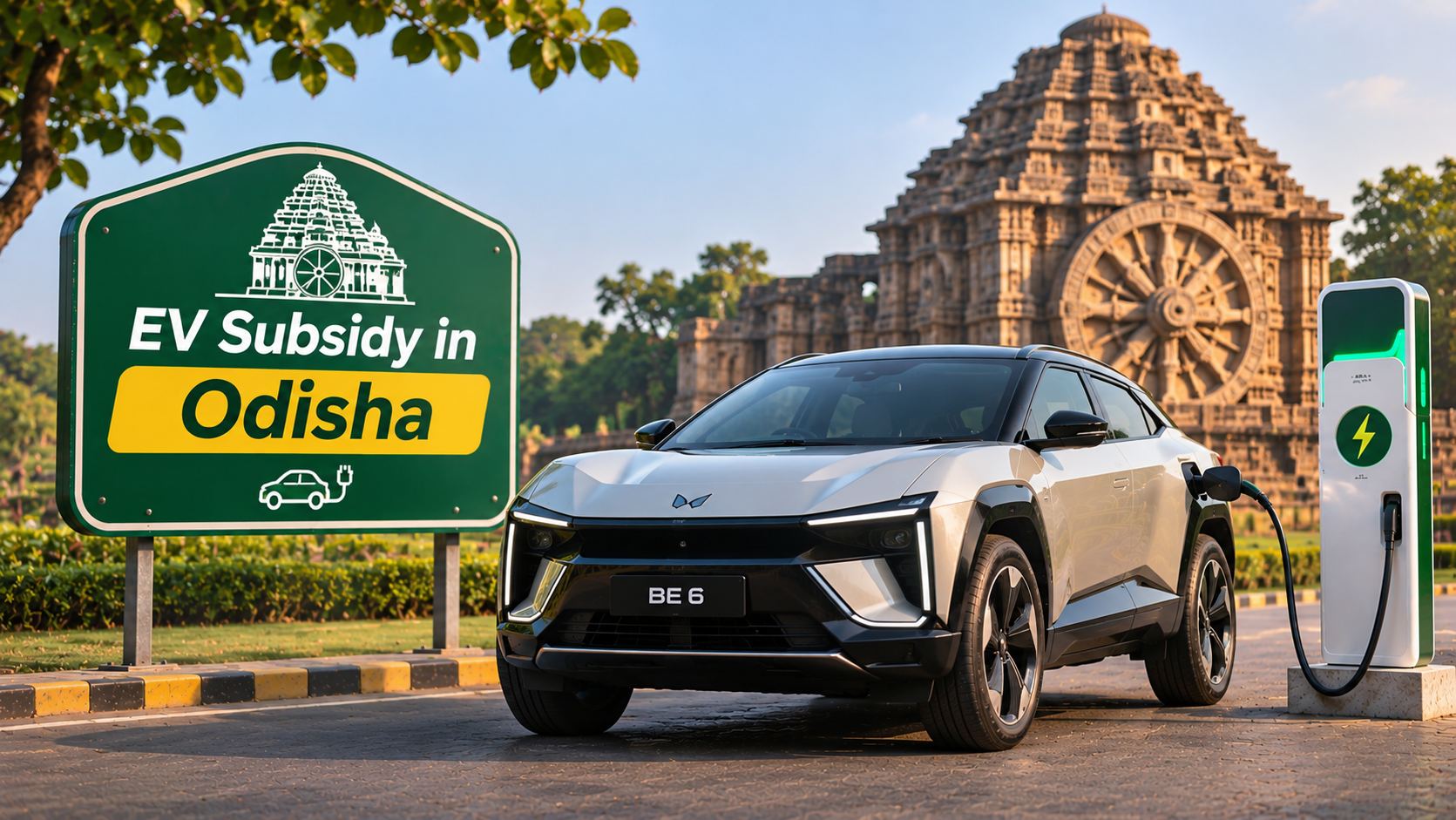
Odisha's EV policy pays a subsidy on almost every vehicle type and waives road tax on all of them, and the state has kept it running through a series of short extensions. The Odisha Electric Vehicle Policy 2021 came into force on 1 September 2021 and was originally due to end on 31 December 2025. Since then, the state has extended it a quarter at a time, and an October 2026 notification moved the end date to 31 December 2026.
The benefits cover almost every vehicle type. Electric two-wheelers get ₹5,000 per kWh of battery capacity, up to ₹20,000. Electric three-wheelers get a flat ₹30,000. Electric cars get ₹10,000 per kWh, up to ₹1.5 lakh, which puts Odisha level with Maharashtra for the largest car subsidy among the states in this series. On top of that, every EV is fully exempt from road tax and registration fees, and EV loans carry a 5 per cent interest subvention.
You claim the subsidy yourself, online, after the vehicle is registered, and the money is paid into your bank account. Two-wheeler buyers also get the central PM E-DRIVE incentive at the dealership. The scheme is meant for permanent residents of Odisha, and the state has tightened address checks after finding buyers from neighbouring states using it. By December 2025, more than 2.19 lakh EVs were on Odisha's roads and over ₹340 crore had been paid out across categories.
A replacement policy has been in draft since September 2025 but is not yet approved. This guide covers what applies now, what you save on popular EVs, who qualifies and how to apply. For a comparison with other states, see our guide to state-wise EV subsidies in India.
Odisha EV Policy 2021 at a glance
| Item | Details |
| Policy | Odisha Electric Vehicle Policy 2021, amended in April 2023 |
| In force since | 1 September 2021 |
| Current validity | Extended to 31 December 2026 |
| Nodal department | Commerce and Transport Department, Government of Odisha |
| Subsidy claim | Online, through the state transport department's online services |
| Payment | Direct Benefit Transfer (DBT) to the owner's bank account |
EV subsidy amounts in Odisha by vehicle type
The April 2023 amendment linked the two-wheeler and car subsidies to battery capacity, replacing the earlier flat caps.
| Vehicle type | Subsidy | Maximum per vehicle |
| Electric two-wheeler | ₹5,000 per kWh | ₹20,000 |
| Electric three-wheeler | Flat amount | ₹30,000 |
| Electric car | ₹10,000 per kWh | ₹1.5 lakh |
| Electric goods carrier | Flat amount, for the first 5,000 registered in Odisha | ₹30,000 |
| Electric bus | 10% of cost, cap depends on type | ₹2 lakh to ₹4 lakh |
Since most electric cars on sale have batteries well above 15 kWh, nearly every model reaches the ₹1.5 lakh cap.
Road tax and registration fee exemption in Odisha
Every battery electric vehicle registered in Odisha during the policy period is fully exempt from motor vehicle tax and registration fees. The exemption is applied at registration, so there is nothing to claim.
The saving is substantial because Odisha's standard one-time road tax is relatively high. Private cars and two-wheelers pay 6 per cent up to ₹5 lakh, 8 per cent between ₹5 lakh and ₹10 lakh, and 10 per cent above ₹10 lakh. An EV pays none of it.
Other benefits
- Interest subvention. EV loans for personal vehicles, buses and goods carriers carry a 5 per cent interest subvention. Ask your lender and the RTO how it is applied to your loan.
- Government employees. State government employees can get interest-free loans to buy an EV.
Scrappage support for goods carriers. Owners who scrap an old petrol or diesel goods carrier and buy an electric one get additional support.
Popular EVs and how much you save in Odisha
These are rough estimates for popular variants. Road tax savings use Odisha's rates above, applied to approximate ex-showroom bands; vehicle prices themselves are left out because they change too often to stay accurate.
Electric two-wheelers
| Model (variant, battery) | Central PM E-DRIVE | Odisha subsidy | Road tax saving (approx.) | Total saving (approx.) |
| Ola S1 X (4 kWh) | ₹5,000 | ₹20,000 | ₹6,000 to ₹6,500 | ₹31,000 to ₹31,500 |
| TVS iQube (3.5 kWh) | ₹5,000 | ₹17,500 | ₹8,000 to ₹9,000 | ₹30,500 to ₹31,500 |
| Bajaj Chetak C3502 (3.5 kWh) | ₹5,000 | ₹17,500 | ₹7,000 to ₹8,500 | ₹29,500 to ₹31,000 |
| Hero Vida VX2 Plus (3.4 kWh) | ₹5,000 | ₹17,000 | About ₹8,000 | About ₹30,000 |
| Ather Rizta S (2.9 kWh) | ₹5,000 | ₹14,500 | ₹7,000 to ₹8,000 | ₹26,500 to ₹27,500 |
Because Odisha pays by battery size, a larger battery earns a larger subsidy, up to the ₹20,000 cap at 4 kWh.
Electric cars
| Model (variant, battery) | Central PM E-DRIVE | Odisha subsidy | Road tax saving (approx.) | Total saving (approx.) |
| Tata Punch EV (40 kWh) | None | ₹1.5 lakh | ₹1.1 lakh to ₹1.3 lakh | ₹2.6 lakh to ₹2.8 lakh |
| Tata Nexon EV (45 kWh) | None | ₹1.5 lakh | ₹1.4 lakh to ₹1.5 lakh | ₹2.9 lakh to ₹3.0 lakh |
| MG Windsor EV (52.9 kWh) | None | ₹1.5 lakh | ₹1.8 lakh to ₹1.9 lakh | ₹3.3 lakh to ₹3.4 lakh |
| Mahindra XEV 9e (59 kWh) | None | ₹1.5 lakh | ₹2.2 lakh to ₹2.3 lakh | ₹3.7 lakh to ₹3.8 lakh |
These totals exclude the interest subvention on a loan, which adds to the savings if you finance the car.
Who is eligible for EV subsidy in Odisha
Buyer conditions
- Permanent residents. The subsidy is meant for permanent residents of Odisha. Since August 2025, the state has been verifying permanent addresses, after finding misuse by buyers from neighbouring states.
- Registration in Odisha. The vehicle must be registered with an Odisha RTO.
- Matching names. The name on the bank account must match the name on the registration certificate exactly. Any mismatch leads to automatic rejection.
Valid bank details. The account type and branch details must be correct, since the account is verified before payment.
Vehicle conditions
- Purchase date. The vehicle must be bought on or after 1 September 2021 and registered while the policy is valid, currently up to 31 December 2026.
- Two-wheeler standards. Electric two-wheelers must have a top speed of at least 40 km/h, an acceleration of at least 0.65 m/s², consumption of no more than 7 kWh per 100 km and a warranty of at least three years, including the battery. Low-speed scooters do not qualify.
Advanced batteries. The vehicle must use an advanced battery, not a lead-acid one, and the model must be registered with the Transport Department.
How to apply for EV subsidy in Odisha
Yes, the Odisha subsidy claim can be completed fully online. You apply after the vehicle is registered, and most of the vehicle details are filled in automatically. The purchase and registration still go through the dealer.
- Complete the PM E-DRIVE e-voucher. For a two-wheeler, finish the Aadhaar face authentication at the dealership. The central ₹5,000 is deducted from the price.
- Register the vehicle in Odisha. Check that the road tax and registration fee show as zero.
- Open the transport department's online services. On odishatransport.gov.in, choose the option to apply for the electric vehicle subsidy.
- Enter your registration number. The vehicle's details are pulled from the national Vahan registration database.
- Enter your bank details. Use an account in the same name as the RC. The account is verified before payment.
- Receive the payment. The RTO where the vehicle is registered releases the subsidy, which reaches your account by DBT. You get an SMS when it is paid.
Apply soon after registration. The policy's validity has been extended only a few months at a time, so leaving the claim late adds risk.
Recent changes to the Odisha EV policy
| When | What changed |
| October 2026 | Policy extended to 31 December 2026 |
| June 2026 | Policy extended to 30 September 2026 |
| March 2026 | Policy extended to 30 June 2026 |
| December 2025 | Policy extended to 31 March 2026, past its original end date of 31 December 2025 |
| September 2025 | Draft Odisha EV Policy 2025 released for public comments |
| August 2025 | Permanent address checks ordered for subsidy claims |
| April 2023 | Two-wheeler and car subsidies linked to battery capacity, with caps of ₹20,000 and ₹1.5 lakh |
| December 2022 | Upgraded claim portal with automatic disbursal launched |
| September 2021 | Odisha EV Policy 2021 came into force |
What the draft Odisha EV Policy 2025 proposes
The draft replacement, released in September 2025, would run until 31 December 2030 and target a 50 per cent EV share of new registrations. It proposes ₹10,000 per kWh, up to ₹1.5 lakh, for private cars, a flat ₹2 lakh for cars in commercial use, ₹20,000 for e-rickshaws and ₹30,000 for larger three-wheelers. It would also restrict benefits to permanent residents, bar ownership transfer for five years and allow one claim per vehicle segment. The draft has not been approved, so these terms may change.
EV subsidy in other states
Odisha's two-wheeler subsidy is generous, but Delhi pays more, up to ₹30,000 in the first year of its new policy, as our guide to EV subsidy in Delhi explains. For other states:
You can also compare EV subsidies across states in one place.
Frequently Asked Questions
Expand all