Decoding the Mahindra Scorpio Classic Safety Rating: Crash Tests, Platform, and Features Explained
- 1Relies on an older body-on-frame chassis that scored 0-stars in crash tests
- 2Misses out entirely on critical active safety tech like Electronic Stability Control
- 3Offers standard dual airbags but falls short of modern 6-airbag mandates
The Mahindra Scorpio Classic is like an automotive institution in India. It is the undisputed king of the rural roads, a symbol of authority, and a true icon of unapologetic, raw road presence. But as a buyer, here is the uncomfortable, unfiltered truth we need to address: does an imposing stance and heavy sheet metal actually translate to modern crash safety for your family? In today's Indian market, consumers often confuse ruggedness with passenger safety during a crash.
Judging the safety of the Scorpio Classic is an incredibly important decision category precisely because of this psychological bias. While shiny star ratings give a good starting point for modern vehicles, the Classic requires us to dig much deeper into its architectural roots. What happens to a heavy ladder-frame chassis during an offset collision? How does the lack of modern electronic aids affect its stability? We are bypassing the marketing gloss to offer a complete, brutally honest breakdown of its structural integrity, so you know exactly what this SUV means for your family’s daily commute and highway safety.
Mahindra Scorpio Classic Crash Test Scores at a Glance
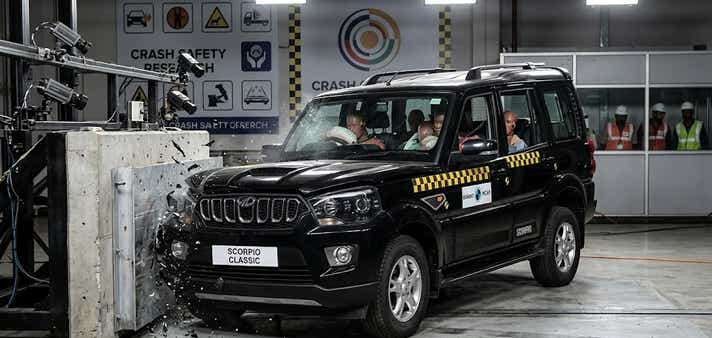
The Mahindra Scorpio Classic in its current BS6 phase-II avatar has not been independently crash-tested by BNCAP or the new GNCAP protocols. The data below references the structural test of its direct pre-facelift predecessor under the older Global NCAP regime
| Testing Body | Overall Rating | Adult Protection (AOP) | Child Protection (COP) | Bodyshell Integrity |
| Global NCAP (2016 Protocol) | 0 Stars (Non-Airbag Model) | 0.00 / 17.00 | 16.73 / 49.00 | Unstable |
If you are looking for heavily certified, modern alternatives, we highly recommend checking out the safest cars in India according to GNCAP.
How is the Mahindra Scorpio Classic Tested?
When independent bodies like Global NCAP conduct a crash test, they simulate high-severity, life-threatening scenarios. The primary evaluation is a 64 km/h front offset deformable barrier crash. Imagine driving at highway speeds and suddenly swerving to avoid an oncoming truck, but you still clip its front corner. All the kinetic energy of your heavy SUV is focused onto just 40% of the vehicle’s front width.
For the Scorpio's underlying structure, this presents a massive physical challenge. During the historical testing of this platform, sensors inside the adult crash dummies recorded the exact G-forces transferred to the head, chest, and knees to see if the metal absorbs the shock or simply passes it onto the human body.
Decoding the Scorpio Classic Crash Test Rating
While the current Scorpio Classic now features standard dual airbags, understanding its structural legacy is vital.
- Adult Occupant Protection (AOP): In the foundational tests of this chassis, the lack of effective crumple zones meant that the impact energy bypassed the frame and invaded the passenger cabin. The steering wheel exhibited significant rearward movement, and the dummies recorded severe, life-threatening forces to the chest and head. While modern airbags in the Classic will cushion the initial blow, they cannot fix structural intrusion.
- Child Occupant Protection (COP): The older platform scored poorly here due to excessive forward excursion of the child dummies during impact. The current Scorpio Classic does offer ISOFIX anchors, but a high-riding, stiffly sprung vehicle naturally generates higher rotational forces during a crash, making child restraint systems work overtime.
Bodyshell Integrity: Global NCAP rated the bodyshell as "Unstable." This is the most crucial takeaway. An unstable bodyshell means the passenger compartment is unable to withstand further loadings. If the A-pillars buckle and the roof caves in, airbags become entirely secondary.
The Foundation: Analysing the Mahindra Scorpio Classic's Platform
To truly understand the Scorpio Classic build quality, we have to talk about its bones. It is built on a traditional ladder-on-frame (or body-on-frame) chassis. Think of it like a heavy steel ladder upon which the engine, suspension, and the main cabin are bolted.
This platform is phenomenal for low-speed abuse. If you are t driving through deep ruts or carrying heavy loads, this chassis takes a beating like an absolute champion. It is the reason the Scorpio lasts for decades in harsh rural environments. However, in a high-speed crash, a ladder frame is fundamentally disadvantaged compared to a modern monocoque.
Intra-Brand Comparison: The Generational Leap
This is where Mahindra’s own evolution highlights the Classic’s shortcomings. If you walk into a Mahindra showroom, you will see the Scorpio N sitting right next to the Classic. The Scorpio N uses a completely re-engineered, third-generation ladder-frame architecture (the Z101 platform) utilising advanced high-strength steel that is specifically tailored to absorb offset crash loads. The difference is night and day, culminating in a 5-star GNCAP rating. For a deep dive into that transformation, read our breakdown of the Mahindra Scorpio N Safety Rating.
Segment Comparison: Ladder-Frame vs. Monocoque
When you compare the Scorpio Classic bodyshell integrity to monocoque rivals priced similarly, like the Hyundai Creta or Kia Seltos, the dynamic shifts. While the Creta might feel less macho on a dirt road, its unibody construction is vastly superior at deflecting crash energy around the occupants rather than through them.
Which Variant Was Tested? (And Why It Matters)
When assessing the Scorpio Classic, it is important to know that its underlying chassis remains identical whether you buy the entry-level trim or the fully loaded version.
Tested Model Details (Current Specifications)
| Make & Model | Trim Level | Kerb Weight | Safety Equipment on Board |
| Mahindra Scorpio Classic | S / S11 | ~1,850 kg | Dual Airbags, ABS with EBD, Rear Parking Sensors |
Why does this matter? Because the Scorpio Classic completely misses out on the modern democratisation of safety. Even if you are willing to pay upwards of ₹17 Lakh for the top-end S11 variant, you cannot buy your way into better safety. You are still limited to just two airbags.
Mahindra Scorpio Classic Safety Features: Standard vs. Advanced Features
Here is a harsh reality check on the equipment list. While it has the basics, the Classic base model safety features are barebones by 2026 standards.
The Non-Negotiables (Standard Features)
- Dual Front Airbags: Provides baseline frontal impact cushioning for the driver and passenger.
- ABS with EBD: Anti-lock Braking System ensures the wheels don't lock up under hard braking, while Electronic Brakeforce Distribution optimises stopping power based on load.
- Panic Brake Indication: Flashes the hazard lights during sudden, severe braking to warn trailing drivers.
ISOFIX Child Seat Mounts: Standardised anchors for securing modern child seats safely.
The Glaring Omissions (What Even the Higher Variants Miss)
- No Electronic Stability Control (ESC): This is the most critical missing feature. ESC prevents skidding in sudden manoeuvres. For a tall, heavy, top-heavy SUV like the Scorpio, dodging a stray dog at 80 km/h without ESC carries a massive risk of a rollover.
- No 6 Airbags: With no side or curtain airbags, passengers are highly vulnerable to head trauma in a side-impact collision.
No ADAS: Forget Level 2 autonomy; the Classic lacks basic active safety like autonomous emergency braking or blind-spot monitoring.
Mahindra Scorpio Classic vs. Competitors Safety Rating
| Car Model | Global/Bharat NCAP Score | Bodyshell Rating | Standard Safety Features | Starting Price |
| Mahindra Scorpio Classic | 0 Stars (Old Protocol, Pre-Facelift) | Unstable | 2 Airbags, ABS, ISOFIX | ₹13.00 Lakh |
| Mahindra Scorpio N | 5 Stars (GNCAP) | Stable | 2 to 6 Airbags, ESC, ABS | ₹13.49 Lakh |
| Toyota Fortuner | 5 Stars (ASEAN NCAP) | Stable | 7 Airbags, VSC, ABS | ₹33.43 Lakh |
The Verdict: If we are purely evaluating the safety battle, the Scorpio Classic loses heavily, even to its own sibling. The Scorpio N is priced almost identically at the base level but offers a vastly superior, modern, and crash-tested platform.
Final Verdict: Should You Trust the Mahindra Scorpio Classic with Your Family?
Is the Mahindra Scorpio safe for highway driving? The answer requires pragmatic honesty. If you need a robust, abuse-friendly workhorse for low-speed rural roads, farm duties, or mountainous terrains where top speeds rarely exceed 40 km/h, the Scorpio Classic is practically indestructible. Its ladder-frame chassis will outlast most modern crossovers.
However, if you are an urban buyer looking for a family SUV to cruise at 100 km/h on expressways, the Scorpio Classic should give you pause. The lack of a stable crumple zone, the absence of side airbags, and critically, the missing Electronic Stability Control make it a liability in high-speed emergency situations. For highway family duties, you are infinitely better off choosing the technologically superior Scorpio N.
Frequently Asked Questions
Expand all