How to Pass Your RTO Driving Test in India: Driving Licence Test Tips Nobody Actually Tells
- 1Master the 8-figure, hill start, and parking test with real tips
- 2Know the exact rollback limit before an automatic hill test fail
- 3Choose the right car and avoid the mistakes that fail most learners
- RTO Driving Test Day Cheat Sheet: Everything at a Glance
- What Actually Happens at the RTO on Test Day
- RTO Driving Test Tips: The Vehicle You Bring Changes Your Odds More Than You Think
- RTO Driving Test Tips for Automated Track
- Manual Examiner Test: What Is Actually Being Observed
- Why People Actually Fail the Driving Licence Test: Most Common Questions Answered
- Pre-Test Preparation: What to Do and When
- What to Bring: The Complete Document List
- What If you Fail the Driving Licence Test?
Everyone who has sat in a car outside an RTO compound, heart beating a little too fast, knows what this moment feels like. You have practised. You more or less know the controls. And yet something about doing it in front of a system that judges your every move turns straightforward driving into something that feels high-stakes, impossibly.
The hard truth is that most people who fail their RTO driving test do not fail because they cannot drive. They fail because they have never seen the actual track layout, because they practised the wrong manoeuvres in the wrong way, or because they showed up in the wrong vehicle for the test.
This guide is built to close that gap. This RTO driving test guide will give you an explanation of every automated track manoeuvre, the real dimensions to practise against, and a practical method for simulating the test track in any empty parking lot.
RTO Driving Test Day Cheat Sheet: Everything at a Glance
| Factor | What to Know |
| Test Type | Automated track (most metros) or Manual examiner, check your RTO before test day |
| Duration on Track | 10 to 15 minutes for all manoeuvres combined |
| Hardest Section | Hill Start / Gradient, the highest single-point failure rate on automated tracks |
| Rollback Allowed | 30 cm maximum on the slope, beyond this is an automatic fail |
| Attempts Allowed | Unlimited within a 180-day LL validity window (7-day wait between attempts) |
| Best Vehicle to Bring | A compact hatchback: Alto, Swift, WagonR. Avoid SUVs and sedans for the 8-figure and parallel parking sections |
| Result Timing | Immediate on automated tracks. Manual test results may take a few hours on the portal |
What Actually Happens at the RTO on Test Day
Knowing the sequence of events before you arrive removes at least some of the anxiety on your driving licence test day.
Document Verification Before Anything Else
You will not see the track until an officer has physically checked your documents. Carry your original Learner’s Licence, your application acknowledgement (printed or clearly on screen), and one original photo ID. If you are appearing for a transport or heavy vehicle DL, you will also need your training completion certificate and Class 8 pass certificate. A missing document means being turned away; there is no flexibility here.
Batch Assignment and the Waiting Game
Driving tests run in batches, not as individual appointments. You will receive a queue number and wait to be called. At busy RTOs in cities like Delhi, Mumbai, or Bengaluru, that wait can stretch past an hour even if you arrived on time. Build this into your schedule. Bring water. Do not leave the compound to “quickly grab something”, batches move faster than expected and missing your call means rescheduling.
Automated or Manual: How to Know Which Test You Will Take
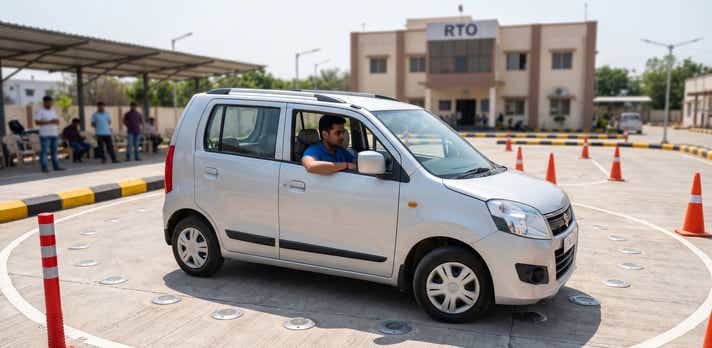
A growing number of RTOs across Delhi, Karnataka, Maharashtra, Tamil Nadu, Telangana, and Gujarat have switched to automated driving test tracks. On these tracks, embedded sensors do the evaluation, not a person. Results are immediate, and there is no subjectivity involved. If you are unsure whether your RTO uses an automated track, call the office directly or search the RTO name alongside “automated driving test track” to confirm before test day.
Manual examiner tests are still common in smaller towns and states that have not yet installed automated infrastructure. The evaluation process differs, and the tips for each are covered separately below.
RTO Driving Test Tips: The Vehicle You Bring Changes Your Odds More Than You Think
This is the RTO Driving Test tip that most driving school instructors will not tell you directly, but it matters enormously for the automated track: the size and turning radius of your car have a direct effect on how easily you can complete the 8-figure and parallel parking sections.
Why a Compact Hatchback Is the Correct Choice
The 8-figure loop diameter at most Indian RTOs ranges from 9 to 11 metres. The parallel parking bay is tight by design. A Maruti Alto, Swift, WagonR, or i10 has a short wheelbase, a small turning radius, and a narrow body that gives you genuine clearance inside these sections. You can complete the 8-figure in one clean sweep without having to inch forward and back to correct your line.
An Innova, Creta, or a mid-size sedan like the City or Verna does not offer the same freedom. The longer wheelbase means your rear wheels cut a larger arc than the front, the wider body reduces your margin from the sensor markers, and the overall size makes the 8-figure section feel like threading a needle.
If you own an SUV and have no access to a smaller car, borrow one from a friend or family member for test day. The inconvenience is significantly smaller than the cost and delay of a retest.
RTO Driving Test Tips for Automated Track
The automated driving test is the section people are least prepared for because information about the actual experience is scarce online. Here is what each section involves, with practical technique and the exact failure triggers sensors are programmed to catch.
Mastering the Straight Drive Without Triggering Sensor Penalties
The opening section is a straight drive within clearly marked lane boundaries for a set distance,typically 30 to 50 metres, depending on the RTO layout. It sounds like a formality. Candidates still lose marks here.
The issues are almost always the same: drifting sideways because the driver is looking at the bonnet rather than far ahead, accelerating too quickly and then braking abruptly at the end zone (which registers as poor vehicle control), or skipping the mirror check before pulling away. Check your mirrors before starting, look toward the far end of the lane, hold 9-and-3 or 10-and-2 on the wheel, and maintain 20 to 25 km/h.
The Hill Start: How Much Rollback Is Allowed Before You Fail?
This is the question people search for most, and the answer is specific: the maximum permitted rollback on the gradient section of an automated driving test is 30 centimetres. Beyond that, the sensor embedded in the slope detects the reversal and marks the section as failed. On most tracks, a single rollback failure ends the test.
In a manual car, the technique that eliminates rollback entirely is the controlled handbrake release. Engage the handbrake fully before you stop. Bring the clutch up to the biting point; you will feel the engine’s note drop and the car resist slightly , then apply gentle throttle while releasing the handbrake. Done correctly, the car does not move backwards by a centimetre. Practice this on a slope, not a flat car park, at least a dozen times before your test.
In an automatic, the hill start is considerably simpler: keep your foot on the brake, shift to Drive, then ease off the brake while simultaneously applying throttle. Most modern automatics also have a hill-hold function that prevents rollback for about two seconds.
Reverse Parking: Getting the Entry Angle Right the First Time
In the reverse parking section, you are required to reverse the vehicle into a marked bay precisely enough that it sits within the sensor boundary without crossing any edge. The sensors check both lateral and longitudinal accuracy, meaning you cannot park diagonally and count on being inside the outer lines.
The entry position is the part most candidates get wrong. Position your car parallel to the bay, roughly one metre away from the outer edge of the bay opening. Drive forward past the bay until your B-pillar (the column between the front and rear door) aligns with the far inner corner of the space. Then steer sharply into the bay. As the rear swings in, counter-steer to straighten before the front of the car clears the entry.
Parallel Parking: The Section Where Vehicle Choice Shows
The parallel parking manoeuvre requires you to slot the car between two boundary markers, parallel to a simulated kerb, within a bay typically 1.5 to 1.8 times the length of your vehicle. Sensors detect whether you cross into the oncoming lane zone, whether you touch the kerb markers, and how many back-and-forth corrections you make.
This is where the compact hatchback advantage is most obvious. The technique itself is the standard three-point parallel park: pull alongside the front marker, reverse at an angle until the rear is near the kerb boundary, counter-steer to straighten, and correct forward if needed. Practice this on a flat road against physical markers at least 15 times before the test.
How to Pass the 8-Figure Driving Test: Layout, Dimensions, and Technique
The 8-figure, also called the figure-of-eight, is the manoeuvre that generates the most searches before test day, because it is uniquely difficult to simulate without the actual track. Here are the approximate dimensions and the rules your technique must follow:
- Lane width: Approximately 3 to 3.5 metres, tight enough that a wide SUV has very little margin on either side
- Loop diameter: Roughly 9 to 11 metres per loop; varies by state RTO, but consistently unforgiving for long wheelbases
- Speed limit: 5 to 10 km/h throughout; most automated systems trigger a sensor penalty above 15 km/h in this zone
- Common fail trigger: The nose of the car crosses the outer boundary on the second loop while the driver is still focused on completing the first
- Rule of thumb: Look at the exit of each loop while you are still entering it, not at the cones beside you
The most effective mindset for the 8-figure is to stop thinking of it as two separate circles and start treating it as one continuous flowing line. Your steering input should never fully stop between loops. As you exit the first curve, you are already feeding in the counter-steering for the second. Low speed is the single most important variable here. Candidates who attempt the 8-figure at even 15 km/h find that the car’s momentum works against them in the tight arcs. Set your speed and maintain it.
The S-Curve: Counter-Steer Earlier Than Feels Natural
The S-curve requires navigating a tight S-shaped lane without crossing the boundary sensors on either side. Enter at 5 to 8 km/h and do not accelerate until you are fully out of the exit boundary. Begin counter-steering for the second curve before you have finished the first; the car’s rear needs time to follow.
A common fail trigger is braking sharply mid-curve, which causes the rear to swing wide and trip the boundary sensor.
Which RTOs Have Automated Tracks?
Delhi NCR, Bengaluru, Pune, Chennai, Hyderabad, Ahmedabad, and most district RTOs in Maharashtra, Karnataka, and Telangana now operate automated tracks. The most reliable method is to call your specific RTO directly and confirm before your test date.
Manual Examiner Test: What Is Actually Being Observed
At RTOs without automated infrastructure, a licensed examiner either accompanies you in the vehicle or observes from an external point while you complete a defined route. The evaluation is more holistic and more subjective than the sensor-based test, but the standards are consistent.
Smooth Throttle and Clutch Coordination from Metre One
Stalling the engine on pull-away, grinding gears during changes, or riding the clutch down a straight are all marked down immediately. The examiner is watching to see whether you can operate the vehicle smoothly without thinking about the mechanics.
Mirror Checks That Are Visible, Not Just Mental
Examiners watch your eyes and head movement. You need to make a deliberate, visible head movement toward each mirror before pulling away, turning, or changing lanes.
Signalling Every Single Time Without Exception
Indicate before turning, before changing lanes, before pulling in to park, and before pulling out again. There is no such thing as an “obvious” turn that does not require a signal in a driving test.
Correct Speed for the Context, Not Just the Limit
Driving too fast for the test route is flagged. Driving so slowly and tentatively that the examiner notes a lack of confidence is also flagged.
Lane Positioning and Junction Behaviour
Stay in the correct lane throughout the route. Position the car correctly for turns. At unmarked junctions, demonstrate that you are looking in both directions before proceeding, even if you have the right of way.
Why People Actually Fail the Driving Licence Test: Most Common Questions Answered
What Happens If You Touch a Cone or Sensor Marker?
On automated tracks, physical contact with a marker triggers an immediate section failure in most state systems. The test continues but that manoeuvre is scored as failed. At some RTOs, a single contact also ends the entire test session. Do not assume you can gently brush a marker and continue; slow the car down further rather than risk contact.
Can Stalling the Engine Fail You?
A single stall mid-manoeuvre on an automated track generally does not automatically fail the test, but it creates a secondary problem: if the stall occurs on the slope, the car immediately becomes a rollback risk. On manual examiner tests, stalling once is noted but typically not a standalone fail reason. Stalling twice or more, or stalling and then struggling to restart smoothly, creates a pattern that the examiner cannot overlook.
Is Not Checking Mirrors Really a Fail?
On manual tests, yes. Not checking mirrors before starting is one of the most consistently noted manual test fail reasons across Indian RTOs. Examiners treat it as evidence of incomplete training. On automated tracks, the mirror check is self-managed, but the habit still matters for the manoeuvres where your positioning relative to other markers depends on what you can see behind you.
What If You Drive Too Slowly?
Hesitant, excessively slow driving on a manual test reads as a lack of vehicle confidence and competence. The examiner wants to see that you can make a decision and execute it. On automated tracks, going below the minimum required speed in certain sections can also trigger a penalty, depending on the RTO’s system calibration.
Wrong Gear at the Wrong Moment
This is primarily a manual test concern. Pulling away in second, changing down from fourth to second at speed, or staying in first gear down a long straight are all noticed immediately. Know your gear ratios and practice changing smoothly at appropriate speeds before your test date.
Pre-Test Preparation: What to Do and When
One Week Before the Test
- Complete at least three full sessions that run all the automated track manoeuvres in sequence, not just the ones you find difficult
- Practise the hill start specifically on an actual slope, not a flat surface
- If you have access to the actual test track or a similar facility, use it
- Review basic road signs in case you are asked during a manual test
Two Days Before
- Organise all documents into a single folder or envelope: LL original, acknowledgement, photo ID
- Confirm your test slot time, the RTO address, and which gate to enter
- Verify whether the RTO provides a test vehicle or whether you must bring your own
- If bringing your own vehicle, check RC, insurance, and PUC certificate validity
The Evening Before
- Do not do an intensive driving session. Your muscle memory is already set. Additional practice at this stage adds fatigue, not improvement
- Set an alarm giving you at least 30 minutes of buffer beyond what you think you need to arrive on time
- Lay out your documents and keys so there is nothing to scramble for in the morning
On the Morning of the Test
- Eat a proper breakfast. Low blood sugar is a direct contributor to test anxiety and slow reaction time
- Arrive at the RTO 20 to 30 minutes before your slot. Not cutting it close
- Before you get into the test vehicle, take one slow breath and remind yourself that you have done this before in practice
What to Bring: The Complete Document List
Mandatory for all applicants:
- Original Learner's Licence card
- Application acknowledgement printout (or clearly visible on phone)
- One original photo ID (Aadhaar, Voter ID, or Passport)
If bringing your own test vehicle:
- Vehicle Registration Certificate (RC)
- Valid vehicle insurance
- Valid PUC (Pollution Under Control) certificate
- A passenger with a valid driving licence (since this is mandated by law if you hold a learner licence)
For transport/HMV DL applicants:
- Training completion certificate
- Form 1A medical certificate signed by a registered doctor
- Educational qualification certificate (Class 8 pass)
Optional but useful:
- A pen for any forms to fill at the counter
- Water bottle , waiting can take over an hour at busy RTOs
What If you Fail the Driving Licence Test?
You are eligible to rebook after seven days from the failure date. Log in to parivahan.gov.in, navigate to DL Services, and schedule the test as you did the first time. A retest fee of approximately ₹50 to ₹150 applies depending on your state. There is no cap on the number of attempts, provided your Learner’s Licence remains valid within its 180-day window.
If your LL expires before you pass, you will need to apply for a fresh Learner’s Licence and restart the waiting period entirely. This is the strongest reason to treat each attempt seriously and to practice deliberately rather than repeatedly.
Moreover, many learners focus only on passing the test, but understanding how to check e-challan status later as a regular driver is just as important for avoiding penalties and keeping your record clear.
Frequently Asked Questions
Expand all